BuzzSumo Review 2026
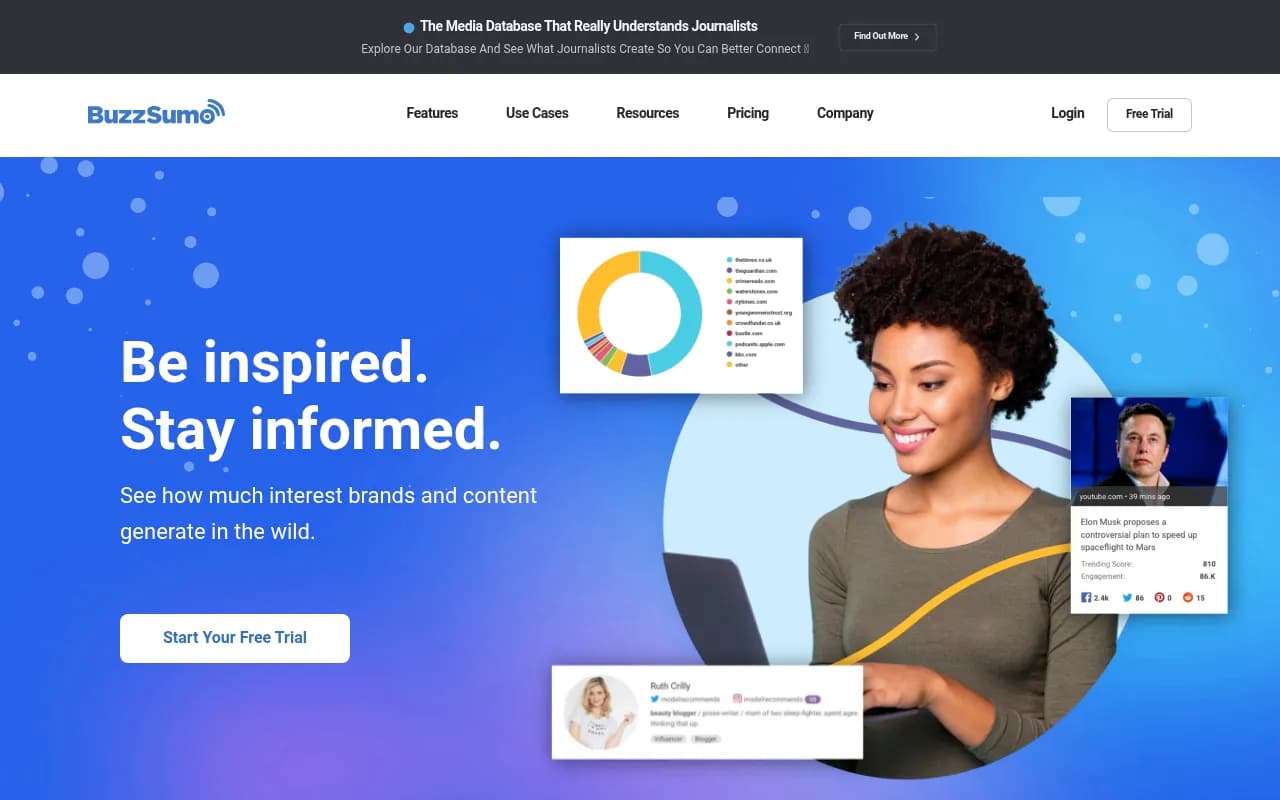
Content intelligence tool for finding trending topics, analyzing competitor content performance, and identifying key influencers for outreach campaigns.
Key Takeaways:
• Best for: Content marketers, PR teams, and agencies needing data-driven content research and journalist outreach in one platform • Standout features: 700K journalist database with monthly updates, 8 billion article archive, real-time trending content feeds, and social engagement data across multiple platforms • Limitations: Pricing starts at $199/month (no free tier), search limits on lower plans, and some users report occasional data lag on very recent content • Bottom line: The most comprehensive content intelligence tool for teams that need both content research and PR outreach capabilities, though smaller creators may find it expensive
BuzzSumo has been a staple in content marketers' toolkits since its launch, evolving from a simple content discovery tool into a full-fledged content intelligence and PR platform. Built by a UK-based team, it's now used by major brands like Expedia, BuzzFeed, Ogilvy, and The Telegraph to inform content strategy, track brand mentions, and execute PR campaigns. The platform sits at the intersection of content marketing, SEO, and digital PR -- making it particularly valuable for agencies and in-house teams that need to justify content decisions with hard data.
The core value proposition is simple: see what content is actually performing in your niche, understand why it's working, and use that intelligence to create better content or secure better media coverage. Unlike basic social listening tools that just count mentions, BuzzSumo provides deep engagement analytics and connects you directly with the journalists and influencers who can amplify your message.
Content Analyzer is the heart of the platform -- a searchable database of 8 billion articles with engagement metrics from Facebook, Twitter, Reddit, Pinterest, and YouTube. You can search by topic, domain, or specific URL to see what content has generated the most shares, links, and engagement over the past five years (or as recent as 15 minutes ago). The filters are extensive: content type (articles, videos, infographics), date range, domain authority, word count, language, and country. This isn't just vanity metrics -- you can see exactly which headlines, formats, and angles are resonating with real audiences. For example, search "remote work" and instantly see the top 100 articles by total engagement, who published them, when, and how many backlinks they earned. This makes competitive content analysis incredibly fast -- you can audit a competitor's entire content strategy in 20 minutes.
Trending Feeds surfaces viral content published in the last 24 hours, categorized by industry (marketing, tech, health, finance, etc.) or custom topics you define. This is gold for reactive content teams and social media managers who need to jump on trending conversations quickly. You can follow curated feeds or create custom feeds based on keywords, and get alerts when something starts taking off. The trending algorithm considers velocity of engagement, not just total shares, so you catch stories early before they peak.
Question Analyzer scrapes millions of questions from Reddit, Quora, Amazon reviews, and Q&A sites to show you exactly what your audience is asking. Search a topic and get a list of real questions people are posting, sorted by engagement. This is invaluable for content ideation -- you're not guessing what people want to know, you're seeing their actual questions. Many users build entire content calendars from Question Analyzer results, creating articles and videos that directly answer high-engagement questions.
Media Database & Outreach (available on PR & Comms plan and above) is where BuzzSumo differentiates itself from pure content research tools. It's a database of 700,000 journalists with 330,000 profiles updated monthly -- not stale data from years ago. You can search by topic, publication, location (down to state level on Enterprise), and see what each journalist has written recently, their social engagement, and contact information. The platform tracks which journalists are actively writing about your industry right now, not who covered it last year. You can build media lists, track outreach, and even use the built-in AI pitching tool to draft personalized pitches based on a journalist's recent work. Coverage Reports show all your media mentions with engagement data, placement (headline, first paragraph, or body), and excerpts -- making monthly reporting to clients or stakeholders much faster.
Influencer Discovery lets you find and vet influencers on Facebook, Twitter (X), YouTube, and TikTok. Search by topic or keyword and get a list of profiles ranked by authority, engagement, and reach. You can see their average engagement rate, follower growth, posting frequency, and top content. The Advanced Chrome Extension (Suite plan and above) adds even more data when you're browsing profiles directly -- engagement ratios, related profiles, audience demographics. This helps you quickly separate genuine influencers from those with inflated follower counts but low engagement.
Monitoring & Alerts tracks mentions of your brand, competitors, keywords, or specific domains across the web and social media. You can create alerts that notify you via email or Slack when new content is published or when a tracked term starts trending. The link monitoring feature shows you new backlinks as they appear -- often faster than traditional SEO tools. One case study user (Connective3) specifically praised BuzzSumo for picking up new links "a lot quicker than other link index tools," which is crucial for time-sensitive PR campaigns.
YouTube Analyzer (Suite plan and above) provides engagement data on YouTube videos -- views, likes, comments, social shares, video length. You can research what video content is performing in your niche, analyze competitor channels, and identify trending video topics. This is particularly useful for brands investing in video content who need to understand what formats and topics are actually working.
Chrome Extension brings BuzzSumo data into your browser, so you can analyze content engagement while browsing Google search results, competitor websites, or social media. Hover over a link and instantly see its share counts and engagement metrics. This saves enormous amounts of time when doing competitive research or evaluating content ideas on the fly.
API Access (available on all paid plans) lets you integrate BuzzSumo data into your own tools, dashboards, or reporting systems. Agencies use this to build custom client dashboards, and enterprise teams use it to automate content performance tracking and feed data into internal analytics platforms.
Who Is It For:
BuzzSumo is built for content marketers, PR professionals, and agencies who need data to back up their content and outreach strategies. The ideal user is someone managing content for a brand or multiple clients, who needs to answer questions like: What topics should we write about? What content is our competitor publishing that's working? Which journalists should we pitch? Who are the key influencers in our space?
Specific personas who get the most value:
• Content marketing teams at mid-size to enterprise brands (50-500+ employees) who publish regularly and need to justify content investments with performance data. If you're publishing 10+ pieces of content per month and want to know what will actually perform before you invest in creation, BuzzSumo pays for itself quickly.
• Digital PR agencies managing outreach for multiple clients. The Media Database and Coverage Reports are specifically built for this use case -- you can research journalists, track coverage, and report results all in one place. Agencies like Rise at Seven and Connective3 use it as their primary PR intelligence tool.
• SEO agencies and consultants who need content and link building intelligence. The combination of content research, backlink tracking, and journalist outreach makes it a powerful tool for earning high-quality editorial links.
• Social media managers who need to stay on top of trending topics and find shareable content quickly. Trending Feeds and the Chrome Extension make reactive content much easier.
• Freelance content strategists and consultants who need to deliver data-backed recommendations to clients. The ability to quickly audit competitor content and identify content gaps is a huge time-saver.
Who should NOT use BuzzSumo:
Small businesses, solopreneurs, and bloggers with limited budgets will likely find it expensive for what they need. At $199/month minimum, it's a significant investment if you're not publishing content regularly or running active PR campaigns. If you're just looking for basic social listening or occasional content ideas, there are cheaper alternatives. The platform also has a learning curve -- it's powerful but not immediately intuitive, so expect to spend time learning the features.
Integrations & Ecosystem:
BuzzSumo integrates with Slack (for alert notifications), Zapier and IFTTT (via RSS feeds on Enterprise plan), and Google Chrome (via extension). The API is well-documented and used by many agencies to build custom integrations with their own tools. You can export data to CSV for further analysis in Excel or Google Sheets. The platform also offers Article Uploads (Suite plan and above) where you can batch upload URLs to track their performance over time -- useful for regular client reporting.
There's no native integration with content management systems like WordPress or HubSpot, so you'll need to manually implement insights rather than having them pushed directly into your publishing workflow. The Chrome Extension partially bridges this gap by bringing data into your browser wherever you're working.
Pricing & Value:
BuzzSumo has four pricing tiers, all billed annually with a 20% discount compared to monthly billing:
• Content Creation: $199/month (1 user, unlimited searches, 2 alerts) -- includes Content Analyzer, Trending Feeds, Question Analyzer, Chrome Extension, and API access. Good for individual content marketers or small teams focused purely on content research.
• PR & Comms: $299/month (5 users, unlimited searches, 5 alerts) -- adds Media Database & Outreach, Coverage Reports, and Slack integration. This is the entry point for PR teams and agencies doing journalist outreach.
• Suite: $499/month (10 users, unlimited searches, 10 alerts) -- adds YouTube Analyzer, Advanced Chrome Extension, and Article Uploads. The most popular plan for full marketing teams that need both content and PR capabilities.
• Enterprise: $999/month (30 users, unlimited searches, 50 alerts) -- adds RSS feed sync, granular location search, and early access to beta features. For large agencies and enterprise brands with extensive needs.
All plans include a free trial (no credit card required), which is generous and lets you properly evaluate the platform before committing. The main limitation on lower tiers is user count and alert limits, not search volume -- all plans have unlimited searches, which is a significant advantage over competitors that cap searches.
Value assessment: At $199/month, BuzzSumo is expensive compared to basic content research tools, but competitive with other enterprise content intelligence platforms. If you're a content team publishing regularly or a PR agency doing outreach, the time savings alone justify the cost -- you can research content ideas, audit competitors, and build media lists in a fraction of the time it would take manually. The 8 billion article database and 700K journalist profiles are genuinely hard to replicate with free tools. However, if you're a small business publishing sporadically, the ROI is harder to justify -- you might be better off with a cheaper tool or manual research.
One cost consideration: the jump from Content Creation ($199) to PR & Comms ($299) is only $100/month but adds 4 more users and the entire Media Database -- that's excellent value if you need PR capabilities. The jump to Suite ($499) is steeper but adds YouTube analysis and advanced features that agencies typically need.
Strengths:
• Massive content database -- 8 billion articles with engagement data going back five years is unmatched. You can research virtually any topic and get meaningful data.
• Journalist database quality -- 330K monthly profile updates means you're not pitching journalists who left their beat two years ago. The social engagement data helps you identify high-impact journalists, not just anyone with an email address.
• Speed of link detection -- Multiple users report that BuzzSumo picks up new backlinks faster than traditional SEO tools, which is crucial for time-sensitive PR tracking.
• All-in-one platform -- Having content research, influencer discovery, media outreach, and monitoring in one tool eliminates the need for multiple subscriptions and makes workflows more efficient.
• Question Analyzer -- Scraping real questions from Reddit, Quora, and Amazon is incredibly valuable for content ideation and understanding audience pain points.
Limitations:
• No free tier -- At $199/month minimum, it's a significant commitment. The free trial helps, but there's no ongoing free option for casual users or small businesses.
• Data lag on very recent content -- Some users report that very recent content (last few hours) doesn't always show up immediately. The platform is better for analyzing content from a day or more ago.
• Learning curve -- The interface is powerful but not immediately intuitive. New users need to invest time learning the features and filters to get full value.
• Limited CMS integrations -- No native WordPress, HubSpot, or other CMS integrations means you're manually implementing insights rather than having them flow directly into your publishing workflow.
Bottom Line:
BuzzSumo is the best all-in-one content intelligence and PR platform for teams that need both content research and journalist outreach capabilities. If you're a content marketing team at a mid-size or larger brand, a digital PR agency, or an SEO consultant who needs to back up recommendations with hard data, BuzzSumo delivers exceptional value. The combination of an 8 billion article database, 700K journalist profiles with monthly updates, and real-time trending feeds makes it the most comprehensive tool in this category.
The pricing is steep for small businesses and individual creators, but for teams publishing regularly or agencies managing multiple clients, the time savings and data quality justify the investment. The ability to research content ideas, audit competitors, build media lists, and track coverage all in one platform eliminates the need for multiple tools and makes workflows significantly more efficient.
Best use case in one sentence: Content marketing teams and PR agencies at brands or agencies that publish regularly and need data-driven insights to inform content strategy and secure media coverage.
Tags:
Similar and alternative tools to BuzzSumo