Key Takeaways
- Semrush leads with the most comprehensive feature set including keyword research, competitor analysis, content optimization, and AI search tracking—ideal for agencies and enterprises managing multiple clients
- Ahrefs offers the largest backlink database (880M+ citations) and most accurate keyword difficulty scores, making it the gold standard for serious SEO professionals
- Mangools (KWFinder) provides the easiest interface and best value for beginners and small businesses, with plans starting at just $29/month
- LowFruits specializes in finding genuinely easy-to-rank keywords by analyzing SERP weaknesses—perfect for new sites and content creators who need quick wins
- Traditional keyword research is no longer enough: tools that track AI search visibility (ChatGPT, Perplexity, Claude) are becoming essential as AI-generated answers replace traditional search results
Why Keyword Research Still Matters in 2026
Keyword research remains the foundation of every successful SEO strategy, but the landscape has fundamentally changed. Google processes over 8.5 billion searches daily, yet increasingly those searches result in AI-generated answers rather than clicks to websites. According to Research and Markets, the global SEO services market is projected to reach $146.96 billion by 2027, growing at 18.4% CAGR—driven largely by the shift toward AI search optimization.
The difference between websites that dominate search results and those that remain invisible comes down to strategic keyword research. But in 2026, that means understanding not just what people search for, but how AI models interpret and cite your content when generating answers.
Discovery drives everything: Without ranking for the keywords your customers use, your content remains invisible no matter how valuable it is. Someone searching "best project management software" is ready to buy, while "what is project management" is just learning. The right keywords bring qualified traffic that converts.
Competition varies wildly: Some keywords have thousands of competing websites; others have just dozens. Strategic research reveals opportunities where you can actually rank and get traffic. A well-researched article targeting the right keyword can bring thousands of visitors monthly for years. A poorly researched one might get 10 visitors total.
Algorithm updates favor relevance: Google's E-E-A-T framework (Experience, Expertise, Authority, Trust) means content created by people with firsthand experience ranks higher. Keyword research helps you identify topics where you can demonstrate genuine expertise.
The 2026 Keyword Research Landscape
Before diving into specific tools, understand what's changed:
AI-powered search engines like Google's Search Generative Experience (SGE), ChatGPT, Perplexity, and Claude now synthesize information from multiple sources instead of showing ten blue links. Your content needs to be structured, authoritative, and easily parseable by AI systems.
Generative Engine Optimization (GEO) has emerged as a new discipline focused on getting your brand, products, and content cited within AI-generated responses. Traditional SEO focused on ranking in organic results; GEO focuses on being the source AI models reference.
Search intent has become more nuanced: Users expect immediate, comprehensive answers. Long-form content that thoroughly covers a topic outperforms thin pages targeting exact-match keywords.
Local and voice search continue growing: Mobile-first indexing and voice assistants mean conversational, question-based keywords matter more than ever.
Semrush: The All-in-One SEO Powerhouse
Semrush has evolved from a keyword research tool into a complete digital marketing platform. With over 25 billion keywords in its database and data for 130+ countries, it's the go-to choice for agencies and enterprises managing multiple clients.
Core Keyword Research Features
Keyword Magic Tool: Enter a seed keyword and Semrush returns thousands of related keywords with search volume, keyword difficulty, CPC, and competitive density. The interface groups keywords by topic clusters, making it easy to build comprehensive content strategies.
Keyword Gap Analysis: Compare your domain against up to five competitors simultaneously to find keywords they rank for but you don't. This reveals content opportunities and competitive weaknesses you can exploit.
Keyword Difficulty Score: Semrush's KD metric (0-100) estimates how hard it will be to rank in the top 10 for any keyword. It analyzes the authority of currently ranking pages, making it more accurate than simple competition counts.
Search Intent Classification: Every keyword is tagged as informational, navigational, commercial, or transactional—helping you align content with user intent and conversion goals.
Beyond Traditional Keyword Research
What sets Semrush apart is the ecosystem built around keyword data:
Content Marketing Platform: The SEO Writing Assistant analyzes your content in real-time, suggesting keywords to include, optimal content length, and readability improvements. The Topic Research tool generates content ideas based on what's currently ranking.
Position Tracking: Monitor your rankings for unlimited keywords across any location, with daily updates and competitor comparison. Track featured snippets, local packs, and AI Overviews separately.
Site Audit: Automatically crawl your website to identify technical SEO issues that prevent pages from ranking—broken links, duplicate content, slow load times, mobile usability problems.
Backlink Analysis: With 43 trillion backlinks in its index, Semrush shows exactly which sites link to your competitors and identifies link-building opportunities.
AI Search Tracking: Semrush now monitors brand mentions in Google AI Overviews, though it uses fixed prompts rather than customizable queries. For comprehensive AI search visibility across ChatGPT, Perplexity, Claude, and other models, dedicated platforms like Promptwatch offer deeper insights.
Pricing and Plans
- Pro: $139.95/month (5 projects, 500 keywords to track, 10,000 results per report)
- Guru: $249.95/month (15 projects, 1,500 keywords, Content Marketing Platform)
- Business: $499.95/month (40 projects, 5,000 keywords, API access, white-label reports)
All plans include a 7-day free trial. Annual billing saves 17%.
Who Should Choose Semrush
Best for: Digital marketing agencies, in-house marketing teams, and SEO professionals managing multiple clients or large websites. If you need an all-in-one platform that handles keyword research, content optimization, rank tracking, technical audits, and competitor analysis, Semrush delivers the most complete solution.
Not ideal for: Beginners overwhelmed by the interface complexity, or solopreneurs on tight budgets who only need basic keyword research.
Ahrefs: The Gold Standard for Serious SEO
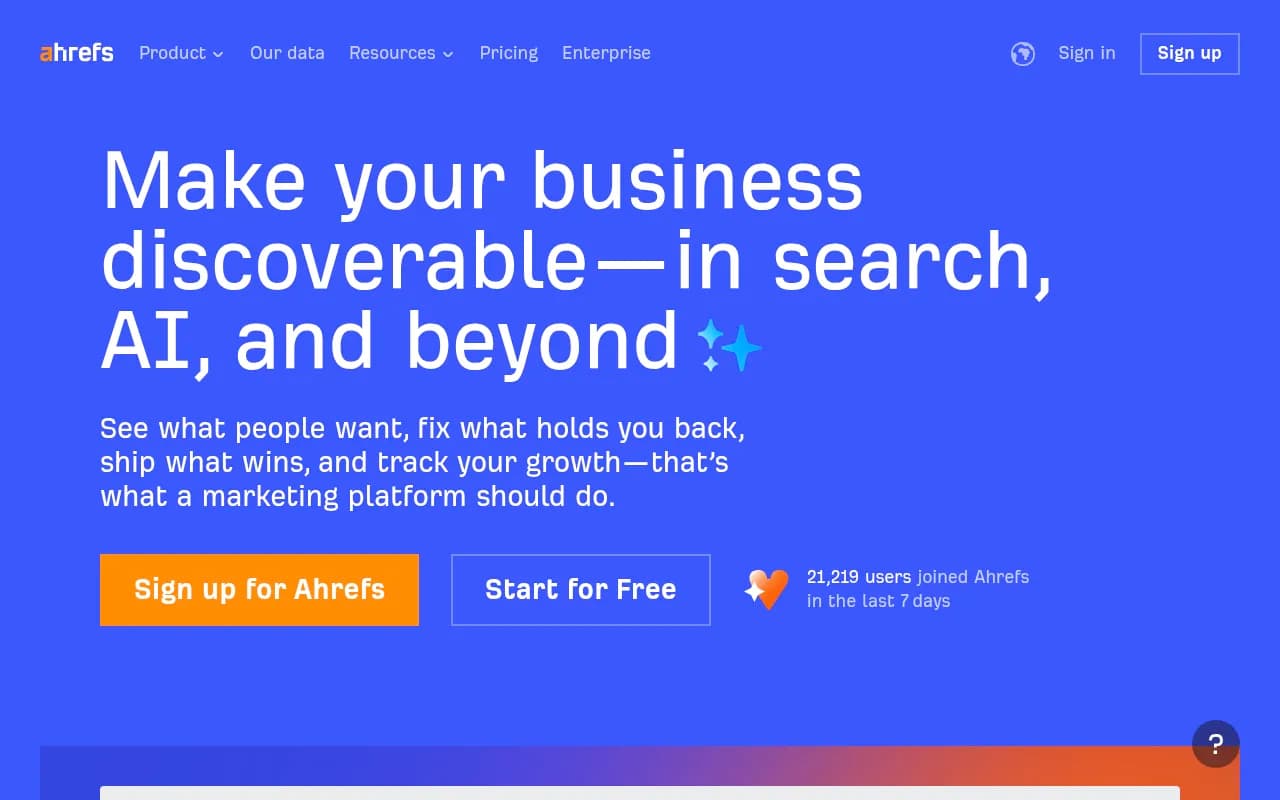
Ahrefs built its reputation on having the largest and most accurate backlink index on the web—43 trillion links across 880 million domains. But its keyword research tools are equally impressive, with 10 billion keywords across 171 countries and the most reliable keyword difficulty scores in the industry.
Keyword Explorer Excellence
Keyword Difficulty (KD): Unlike competitors that estimate difficulty based on domain authority, Ahrefs calculates KD by analyzing how many backlinks you'd need to rank in the top 10. This makes it the most actionable difficulty metric available—you know exactly what it takes to compete.
Traffic Potential: Ahrefs shows not just search volume for a single keyword, but the total traffic the top-ranking page receives from all keywords it ranks for. This reveals high-opportunity topics where one piece of content can capture traffic from dozens of related searches.
Parent Topic: Identifies the broader topic a keyword belongs to, helping you avoid creating multiple pages that compete with each other (keyword cannibalization).
Clicks Data: Shows how many searchers actually click through to websites versus zero-click searches (featured snippets, knowledge panels, etc.). This reveals which keywords drive real traffic versus just impressions.
SERP Overview: Detailed analysis of the top 10 results including domain rating, URL rating, backlinks, traffic, and word count—giving you a clear picture of what it takes to rank.
Content Research and Gap Analysis
Content Explorer: Search Ahrefs' index of 880 million pages to find the most shared and linked-to content on any topic. Filter by domain rating, traffic, publication date, and language to discover what's working in your niche.
Content Gap: Enter your domain and up to 10 competitors, and Ahrefs shows keywords they all rank for but you don't. This is the fastest way to identify missing content opportunities.
Site Explorer: Analyze any website's organic traffic, top pages, and keyword rankings. See which pages drive the most traffic and reverse-engineer their success.
Rank Tracking and Monitoring
Rank Tracker: Monitor your positions for unlimited keywords across any location, with daily updates. Track desktop and mobile separately, and see your visibility in featured snippets.
Site Audit: Crawl your website to identify 140+ technical SEO issues, with prioritized recommendations for what to fix first. Monitor site health over time and track improvements.
Pricing and Plans
- Lite: $129/month (5 projects, 750 keywords to track, 500 pages crawled per project)
- Standard: $249/month (20 projects, 2,000 keywords, Content Explorer access)
- Advanced: $449/month (50 projects, 5,000 keywords, advanced features)
- Enterprise: $14,990/month (custom limits, API access, dedicated support)
All plans include a 7-day trial for $7. Annual billing saves 20%.
Who Should Choose Ahrefs
Best for: Serious SEO professionals, content marketers, and agencies who need the most accurate keyword difficulty data and comprehensive backlink analysis. If you're building links as part of your SEO strategy, Ahrefs is essential.
Not ideal for: Beginners who find the interface overwhelming, or businesses focused purely on keyword research without link building needs.
Mangools (KWFinder): Best Value for Beginners
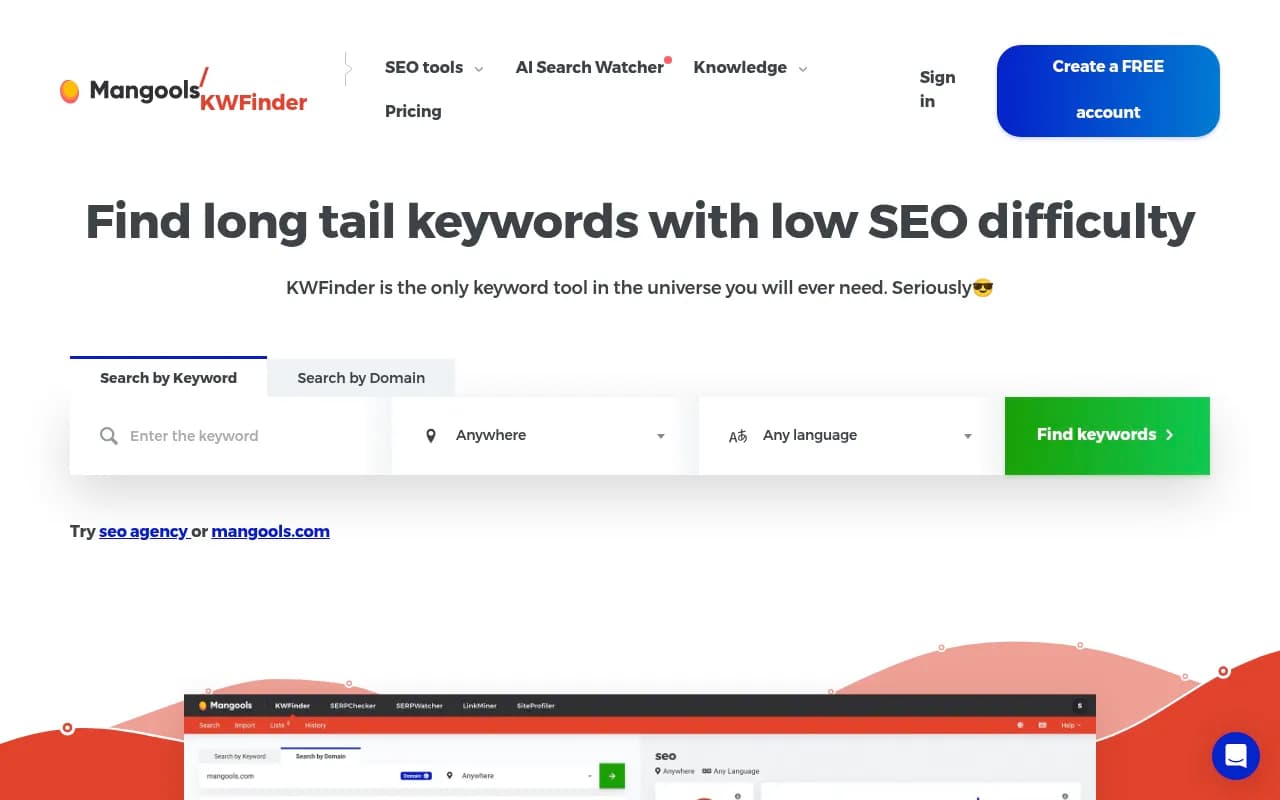
Mangools offers a suite of five SEO tools—KWFinder (keyword research), SERPChecker (SERP analysis), SERPWatcher (rank tracking), LinkMiner (backlink analysis), and SiteProfiler (website analysis)—at a fraction of the cost of Ahrefs or Semrush. The interface is beautifully designed and genuinely easy to use, making it perfect for beginners and small businesses.
KWFinder: Keyword Research Simplified
Intuitive Interface: Enter a seed keyword and KWFinder returns hundreds of related keywords with search volume, keyword difficulty, and trend data. The clean, visual layout makes it easy to spot opportunities at a glance.
Accurate Keyword Difficulty: KWFinder's KD score (0-100) analyzes the authority of currently ranking pages using Moz's Domain Authority and Page Authority metrics. While not as precise as Ahrefs' backlink-based calculation, it's reliable for most use cases.
Location-Specific Data: Search volume and difficulty for 50,000+ locations worldwide, including cities and regions—essential for local SEO.
Autocomplete Suggestions: Pull keyword ideas from Google Autocomplete, showing exactly what people are searching for in real-time.
Question Keywords: Filter results to show only question-based keywords (who, what, when, where, why, how)—perfect for creating FAQ content and targeting voice search.
Supporting Tools
SERPChecker: Analyze the top 50 results for any keyword, with detailed metrics on domain authority, page authority, backlinks, social shares, and estimated traffic. Spot weak competitors you can outrank.
SERPWatcher: Track your rankings for unlimited keywords with daily updates. The interface is simpler than Semrush or Ahrefs, focusing on the metrics that matter most.
LinkMiner: Analyze backlinks for any website or URL, with metrics on link strength and context. Find link-building opportunities by seeing who links to your competitors.
SiteProfiler: Get a quick overview of any website's SEO metrics, top content, and backlink profile—useful for competitive research.
Pricing and Plans
- Mangools Basic: $29/month (100 keyword lookups/day, 200 keywords to track, 25 site lookups/day)
- Mangools Premium: $49/month (500 lookups/day, 700 keywords to track, 70 site lookups/day)
- Mangools Agency: $89/month (1,200 lookups/day, 1,500 keywords to track, 150 site lookups/day)
All plans include a 10-day money-back guarantee. Annual billing saves 40%.
Who Should Choose Mangools
Best for: Beginners, bloggers, small businesses, and freelancers who need powerful keyword research tools without the complexity or cost of enterprise platforms. The interface is so intuitive you can start finding keywords within minutes of signing up.
Not ideal for: Large agencies managing dozens of clients, or advanced users who need comprehensive backlink analysis and technical SEO audits.
LowFruits: Find Easy-to-Rank Keywords Fast
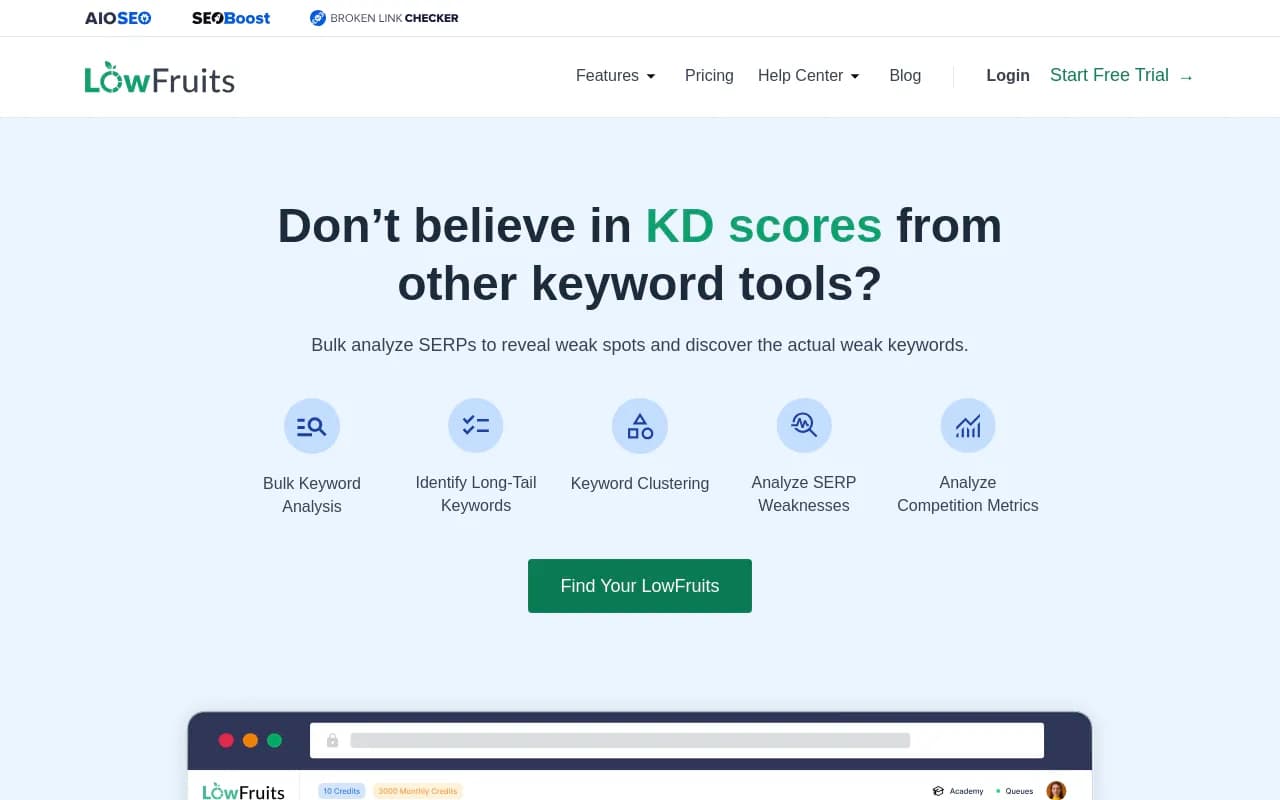
LowFruits takes a completely different approach to keyword research. Instead of showing you search volume and difficulty scores, it analyzes SERP weaknesses to find keywords where weak competitors are ranking—meaning you can rank too, even with a new or low-authority website.
The LowFruits Methodology
SERP Weakness Analysis: LowFruits crawls Google results and identifies "weak spots"—keywords where low-authority domains, forum threads, or outdated content are ranking in the top 10. These are opportunities where better content can easily take their place.
Domain Authority Filtering: Filter results to show only keywords where sites with low domain authority are ranking. If a site with DA 10 is ranking on page one, you can probably rank there too.
Wildcard Search: Use wildcards (*) to find long-tail variations of your seed keyword. For example, "how to * without *" generates hundreds of question-based keywords.
Question Extraction: Automatically extract question keywords from Google's "People Also Ask" boxes and forum discussions—perfect for creating FAQ content that ranks.
Reddit and Forum Analysis: Find keywords where Reddit threads, Quora answers, or forum posts are ranking—indicating low competition and high opportunity.
Unique Features
Keyword Clustering: Automatically group related keywords into topic clusters, making it easy to plan comprehensive content that covers a subject thoroughly.
SERP Screenshot Preview: See actual screenshots of the top 10 results for each keyword, so you can quickly assess competition without opening multiple tabs.
Rank Tracking: Monitor your positions for unlimited keywords with weekly updates. The focus is on tracking progress for the low-competition keywords you've targeted.
Chrome Extension: Analyze any Google search results page directly in your browser, identifying weak competitors and opportunities on the fly.
Pricing and Plans
- Starter: $29/month (unlimited keyword searches, 30 SERP analyses/day, 100 keywords to track)
- Pro: $49/month (unlimited searches, 100 SERP analyses/day, 300 keywords to track)
- Agency: $99/month (unlimited searches, 300 SERP analyses/day, 1,000 keywords to track)
All plans include a 7-day free trial.
Who Should Choose LowFruits
Best for: New websites, bloggers, and content creators who need quick wins and can't compete for high-difficulty keywords yet. If you're starting from zero authority, LowFruits helps you find genuinely rankable keywords that will bring traffic while you build domain authority.
Not ideal for: Established websites with high domain authority, or businesses targeting highly competitive commercial keywords where SERP weakness analysis is less relevant.
Head-to-Head Comparison
Database Size and Coverage
Winner: Ahrefs
- Ahrefs: 10 billion keywords across 171 countries
- Semrush: 25 billion keywords across 130 countries
- Mangools: 2.5 billion keywords across 50,000+ locations
- LowFruits: Uses Google data directly (no proprietary database)
While Semrush has the largest raw keyword count, Ahrefs' data is widely considered more accurate for English-language searches. LowFruits' approach of analyzing live Google results means it always shows current competition.
Keyword Difficulty Accuracy
Winner: Ahrefs
Ahrefs calculates difficulty based on how many backlinks you'd need to rank, making it the most actionable metric. Semrush and Mangools use domain authority-based calculations that are less precise but still useful. LowFruits doesn't provide difficulty scores—instead showing you actual weak competitors.
Ease of Use
Winner: Mangools
Mangools wins on interface design and learning curve. You can start finding keywords within minutes. Semrush and Ahrefs require more time to master but offer far more depth. LowFruits is simple but requires understanding its unique methodology.
Value for Money
Winner: Mangools
At $29/month for the Basic plan, Mangools delivers 80% of what most users need at 20% of the cost. LowFruits at $29/month offers incredible value for its specific use case. Semrush and Ahrefs justify their higher prices with comprehensive feature sets.
Best for Finding Quick Wins
Winner: LowFruits
No other tool specializes in finding genuinely easy-to-rank keywords. If you need traffic fast and can't compete for high-difficulty terms, LowFruits is unmatched.
Best All-in-One Platform
Winner: Semrush
Semrush offers the most complete ecosystem—keyword research, content optimization, rank tracking, technical audits, backlink analysis, and even basic AI search monitoring. For agencies managing multiple clients, it's the most efficient single platform.
Best for Link Building
Winner: Ahrefs
Ahrefs' backlink database is the largest and most accurate, making it essential for link-building campaigns. The Link Intersect tool and broken link finder are unmatched.
Choosing the Right Tool for Your Needs
For Beginners and Small Businesses
Recommendation: Mangools ($29-49/month)
Start with Mangools Basic or Premium. The interface is intuitive, the data is reliable, and the price is affordable. Once you've mastered keyword research basics and need more advanced features, consider upgrading to Semrush or Ahrefs.
Alternative: LowFruits ($29/month) if you're starting a new website and need quick wins from low-competition keywords.
For Bloggers and Content Creators
Recommendation: LowFruits ($29-49/month) + Mangools ($29/month)
Use LowFruits to find easy-to-rank keywords and Mangools for broader keyword research and rank tracking. This combination costs $58-78/month and covers everything most bloggers need.
Alternative: Semrush Pro ($139.95/month) if you want an all-in-one platform with content optimization tools.
For Ecommerce Businesses
Recommendation: Semrush Guru ($249.95/month)
Ecommerce needs comprehensive keyword research for product pages, category pages, and blog content. Semrush's Content Marketing Platform helps create optimized product descriptions and buying guides. The Position Tracking tool monitors rankings for thousands of product-related keywords.
Alternative: Ahrefs Standard ($249/month) if link building is a major part of your strategy.
For SEO Agencies
Recommendation: Semrush Business ($499.95/month) or Ahrefs Advanced ($449/month)
Agencies need white-label reports, API access, and the ability to manage dozens of client projects. Semrush offers better reporting and client management features. Ahrefs provides superior backlink analysis if that's a core service you offer.
Supplement with: LowFruits Agency ($99/month) for finding quick wins for new client websites.
For Enterprise SEO Teams
Recommendation: Semrush Business + Ahrefs Advanced
Large teams benefit from using both platforms—Semrush for content strategy and project management, Ahrefs for technical SEO and link building. The combined cost ($949/month) is justified by the comprehensive capabilities.
Add: Dedicated AI search visibility tracking with platforms like Promptwatch to monitor brand mentions in ChatGPT, Perplexity, Claude, and other AI models that increasingly influence purchase decisions.
Beyond Traditional Keyword Research: AI Search Optimization
Traditional keyword research tools focus on ranking in Google's organic results. But in 2026, that's only half the battle. AI-powered search engines like ChatGPT, Perplexity, Claude, and Google's AI Overviews are fundamentally changing how people find information.
When someone asks ChatGPT "what's the best project management software for small teams," the AI generates a comprehensive answer synthesizing information from multiple sources. If your brand isn't cited in that answer, you're invisible—even if you rank #1 in traditional Google results.
Generative Engine Optimization (GEO) has emerged as a new discipline focused on getting your content cited by AI models. This requires:
- Structured, authoritative content that AI models can easily parse and reference
- Entity-based optimization that establishes your brand as an authority on specific topics
- Answer-focused content that directly addresses user questions
- Citation-worthy sources that AI models trust and reference
Tools like Promptwatch help you understand and optimize for AI search visibility. They track which prompts mention your brand across ChatGPT, Perplexity, Claude, and other models, identify content gaps where competitors are cited but you're not, and provide actionable recommendations for improving AI visibility.
While Semrush and Ahrefs have added basic AI search monitoring, dedicated GEO platforms offer deeper insights and optimization capabilities. As AI search continues growing, tracking your visibility in AI-generated answers will become as essential as tracking traditional rankings.
Practical Keyword Research Workflow
Regardless of which tools you choose, follow this proven workflow:
Step 1: Brainstorm Seed Keywords
Start with 5-10 broad topics related to your business. For a project management software company, that might be "project management," "team collaboration," "task tracking," "productivity tools," and "agile methodology."
Step 2: Expand with Keyword Tools
Enter each seed keyword into your chosen tool (Semrush, Ahrefs, Mangools, or LowFruits) and generate hundreds of related keywords. Look for:
- Long-tail variations (3+ words) with lower competition
- Question keywords that match user intent
- Commercial intent keywords that indicate buying readiness
- Topic clusters that can be covered in comprehensive guides
Step 3: Analyze Competition
For each promising keyword, analyze the top 10 results:
- What's the domain authority of ranking sites?
- How many backlinks do top pages have?
- What's the content length and quality?
- Are there weak competitors you can outrank?
Step 4: Prioritize by Opportunity
Create a spreadsheet ranking keywords by:
- Search volume (traffic potential)
- Keyword difficulty (competition level)
- Business value (how likely to convert)
- Content gap (do you have content covering this?)
Focus on keywords with decent search volume, manageable difficulty, and high business value.
Step 5: Create Optimized Content
For each target keyword:
- Research the top 10 results to understand what's working
- Create content that's more comprehensive and valuable
- Structure with clear headings, lists, and examples
- Include related keywords naturally throughout
- Add images, screenshots, and visual elements
- Optimize title tags, meta descriptions, and URLs
Step 6: Track and Iterate
Monitor your rankings weekly or monthly. If you're not ranking after 3-6 months:
- Analyze what's missing compared to top results
- Add more depth and examples
- Build backlinks to the page
- Update with fresh information
- Consider targeting an easier keyword variation
Common Keyword Research Mistakes to Avoid
Focusing only on search volume: High-volume keywords are often too competitive. Better to rank #1 for a 500-volume keyword than #50 for a 10,000-volume keyword.
Ignoring search intent: Ranking for "project management" when you sell software won't convert if searchers want the definition, not a product.
Keyword stuffing: Using your target keyword 50 times in a 1,000-word article hurts more than helps. Write naturally and include related terms.
Neglecting long-tail keywords: Specific phrases like "best project management software for remote teams under $50/month" convert better than broad terms.
Not analyzing competitors: Understanding why current top results rank reveals what you need to do to outrank them.
Creating thin content: A 300-word article won't rank for competitive keywords. Comprehensive, valuable content wins.
Forgetting about AI search: Optimizing only for traditional Google results means missing the growing share of searches answered by AI models.
The Future of Keyword Research
Keyword research is evolving rapidly. Here's what to expect:
AI-generated search results will dominate: By 2027, analysts predict 50%+ of searches will be answered by AI without users clicking through to websites. Optimizing for AI citations becomes as important as traditional rankings.
Voice search continues growing: Conversational, question-based keywords will matter more as voice assistants improve.
Entity-based search replaces keywords: Google increasingly understands entities (people, places, things, concepts) rather than just matching keywords. Building topical authority matters more than targeting individual keywords.
Personalization increases: Search results vary more based on user history, location, and context. Tracking average positions becomes less meaningful than understanding the range of positions different users see.
Video and visual search expand: Keywords for YouTube, TikTok, and image search become as important as text-based search.
The tools that adapt to these changes—combining traditional keyword research with AI search optimization, entity tracking, and multi-platform visibility—will be the ones that matter in 2027 and beyond.
Final Recommendations
For most users, the best approach is combining tools:
Budget-conscious beginners: Start with Mangools Basic ($29/month) for keyword research and rank tracking. Add LowFruits ($29/month) when you need quick wins.
Serious content creators: Invest in Semrush Pro ($139.95/month) for comprehensive keyword research, content optimization, and rank tracking. The Content Marketing Platform alone justifies the cost.
SEO professionals: Choose Ahrefs Standard ($249/month) if link building is central to your strategy, or Semrush Guru ($249.95/month) if you need broader digital marketing capabilities.
Agencies and enterprises: Use both Semrush Business and Ahrefs Advanced for complete coverage. Supplement with dedicated AI search visibility tracking as AI-generated answers increasingly influence customer decisions.
Whichever tools you choose, remember that keyword research is just the beginning. The real work is creating content that's more valuable, comprehensive, and authoritative than what currently ranks—content that both Google's algorithms and AI models recognize as the best answer to user questions.