LowFruits Review 2026
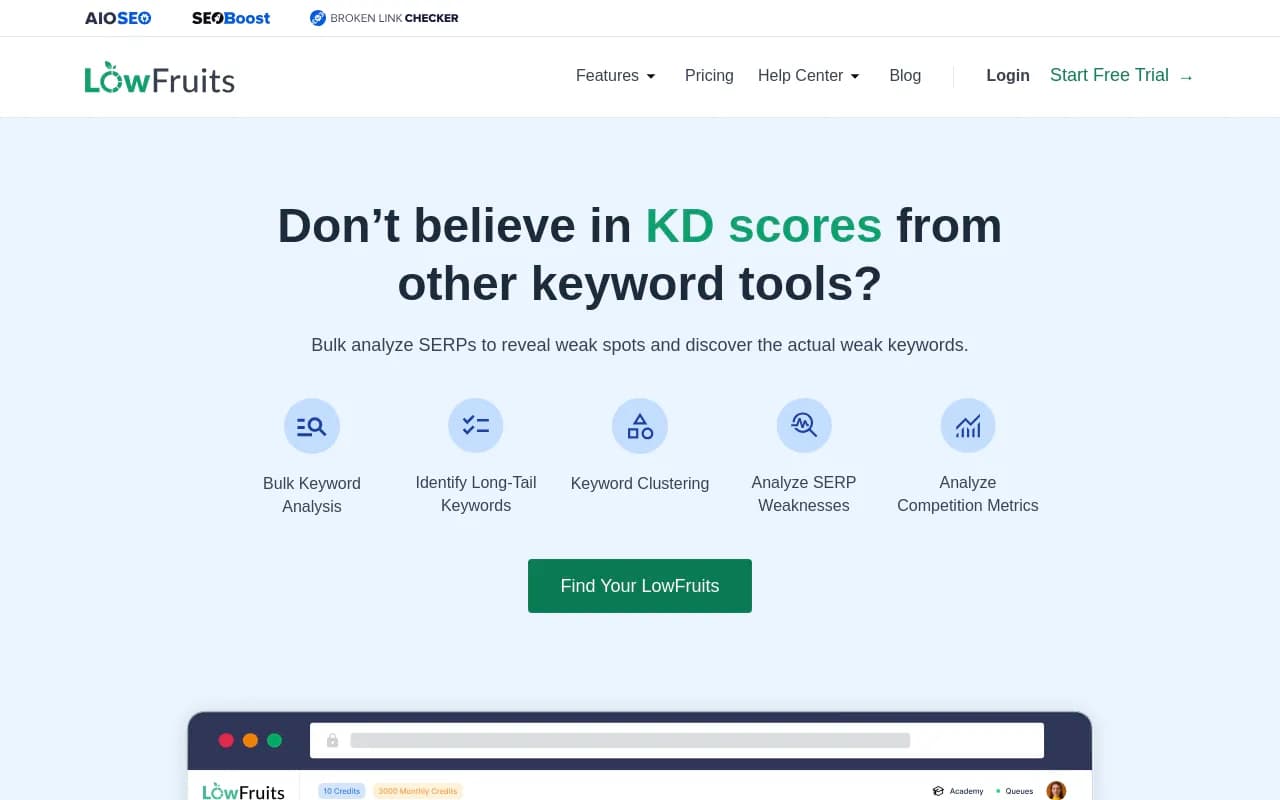
LowFruits is a keyword research and SERP analysis tool that helps SEOs and content creators identify low-competition keywords by bulk analyzing search results for weak spots like low-authority sites. Unlike traditional tools that rely on keyword difficulty scores, it reveals actual ranking opportuni
Key Takeaways:
• LowFruits specializes in finding "low-hanging fruit" keywords by analyzing actual SERP weaknesses rather than relying on generic difficulty scores • Best for niche site owners, affiliate marketers, and SEO agencies who manually analyze SERPs and need to scale that process • Standout features include wildcard keyword discovery, automatic clustering, and detailed weak-spot highlighting in search results • Pricing starts at pay-as-you-go credits or subscription plans from around $29-49/month with unlimited searches • Limitations: smaller keyword database than Ahrefs/SEMrush, focused specifically on finding easy wins rather than comprehensive keyword research
LowFruits is a specialized keyword research tool built for one specific job: helping you find keywords you can actually rank for without a massive backlink profile or high domain authority. Created for SEOs who got tired of chasing competitive keywords based on misleading difficulty scores, it takes a fundamentally different approach by analyzing the actual search results to reveal weak spots where lower-authority sites are ranking.
The tool launched as a solution to a common problem in the SEO world. Traditional keyword tools like Ahrefs and SEMrush assign keyword difficulty (KD) scores, but these scores often don't tell the full story. A keyword might have a KD of 40, but if you manually check the SERP and see that half the top 10 results are low-authority forum posts or outdated content, that's actually an easy target. LowFruits automates this manual SERP analysis process, letting you analyze hundreds or thousands of keywords in bulk to find these hidden opportunities.
Keyword Discovery with Wildcard Searches
The Keyword Finder pulls long-tail keyword suggestions directly from Google Autocomplete, which means you're getting real search queries people are typing. The standout feature here is wildcard searching using the asterisk (*) symbol. You can search for patterns like "how to * without *" or "best * for beginners" to uncover specific keyword combinations that most competitors won't find in standard tools. This is particularly powerful for finding question-based keywords and comparison queries.
The tool also includes intent filtering so you can focus on informational, commercial, or transactional keywords depending on your content strategy. International support means you can research keywords in any language and country, pulling data specific to that market rather than defaulting to US English results.
Bulk SERP Analysis and Weak Spot Detection
This is where LowFruits really differentiates itself. You can import your own keyword list (from any source) or use the keywords generated by the tool, then analyze all of them in bulk. For each keyword, LowFruits extracts the top 10-20 search results and analyzes multiple metrics:
• Domain Authority (DA) of ranking sites • Content word count for each result • Title tag relevance and optimization • Website types (forums, social media, low-quality sites) • Presence of exact match domains • Number of weak spots in the top 10
The tool highlights keywords where multiple low-DA sites are ranking, where forum threads or Reddit posts appear in top positions, or where content is thin and outdated. These are your "low fruits" -- keywords where you have a realistic shot at ranking even with a newer or lower-authority site. The visual interface color-codes results so you can quickly scan for opportunities without clicking into each SERP manually.
Automatic Keyword Clustering
LowFruits automatically groups keywords that share similar search intent into clusters. Instead of creating separate articles for "best running shoes for beginners," "beginner running shoes," and "running shoes for new runners," the clustering feature identifies these as targeting the same intent and groups them together. This helps you plan content more efficiently and avoid keyword cannibalization. Each cluster shows the primary keyword, related variations, and combined search metrics.
Advanced Filtering and Prioritization
Once you have your analyzed keyword list, the filtering system lets you narrow down to the most promising opportunities. You can filter by:
• Number of weak spots in top 10 (e.g., show only keywords with 3+ low-DA sites ranking) • Maximum DA of ranking sites • Search volume ranges • Word count of competing content • Presence of specific website types • Title relevance scores
This makes it easy to create a shortlist of winnable keywords that match your site's current authority level and content capabilities. You can export filtered lists to CSV for content planning or sharing with writers.
Subscription-Only Features
The tool offers both pay-as-you-go credits and monthly subscriptions. Subscription plans unlock several additional features:
• Boosted Keyword Finder: Enhanced keyword discovery with more suggestions and deeper analysis • Rank Tracker: Monitor 100-500 keywords (depending on plan tier) to track your progress on target keywords • Domain Explorer: Database of 150,000+ weak authority websites, useful for finding guest post opportunities or understanding your competition • Competitor Keyword Extraction: Pull the keywords a competitor is ranking for and analyze them for weak spots • Sitemap Extraction: Quickly extract all URLs from a competitor's sitemap for content gap analysis • Unlimited Report Downloads: Export as many reports as needed without additional charges
Who Is LowFruits For
This tool is purpose-built for specific types of SEO practitioners:
Niche site owners and affiliate marketers building content sites from scratch are the core audience. If you're starting a new site in a competitive niche and need to find keywords you can rank for in months rather than years, LowFruits helps you identify those early wins. Many users in the niche site community (testimonials from Hassan, Siry, Russ Egan) specifically mention using it to find keywords they can rank for "by the next morning."
SEO agencies managing multiple client sites benefit from the bulk analysis capabilities. Instead of manually checking SERPs for every keyword across 10-20 client projects, you can batch analyze thousands of keywords and quickly identify opportunities for each client. The pay-as-you-go credit system works well for agencies with variable workloads.
Content creators and bloggers who are tired of writing content that never ranks find value in the tool's focus on realistic opportunities. Rather than targeting high-volume competitive terms, you can build topical authority by ranking for dozens of related long-tail keywords first.
Who should NOT use this tool: If you're working with established, high-authority sites (DA 60+) that can compete for any keyword, you probably don't need LowFruits' weak-spot analysis -- you're not looking for weak SERPs. Similarly, if you need comprehensive keyword research with detailed search volume data, competitor analysis, and backlink metrics, you'll still need Ahrefs or SEMrush as your primary tool. LowFruits is a specialist tool that complements broader SEO platforms rather than replacing them.
Integrations and Workflow
LowFruits is primarily a standalone web application. You can import keyword lists from CSV files (from any source like Ahrefs, SEMrush, Google Keyword Planner, or your own brainstorming). Export options include CSV downloads of your analyzed keywords with all metrics included.
The tool doesn't have a public API or direct integrations with other platforms, so it fits into workflows as a research step rather than an automated system. Most users follow this pattern: generate or import keywords → analyze in LowFruits → export winners → create content → track rankings (either in LowFruits' built-in tracker or your main SEO tool).
Pricing and Value
LowFruits offers two pricing models:
Pay-As-You-Go Credits: Purchase credit packs that don't expire for 1 year. You get 3 free keyword searches every 7 days, then 1 credit per additional search. For SERP analysis, 1 keyword analyzed = 1 credit consumed. This works well if you do keyword research in batches or have irregular needs. Credit packs start around $29 for smaller amounts.
Monthly Subscriptions: Two tiers available (Standard and Premium), typically priced around $29-49/month for Standard and $79-99/month for Premium based on similar tools in this space. Subscriptions include unlimited keyword searches and a monthly credit allowance for SERP analysis (credits reset each month and don't roll over). Standard includes 100 tracked keywords, Premium includes 500. Subscriptions also unlock the exclusive features mentioned earlier (Domain Explorer, Competitor Extraction, Boosted Finder, etc.) and provide a 10% discount on any additional pay-as-you-go credits you purchase.
Compared to Ahrefs ($99-999/month) or SEMrush ($119-449/month), LowFruits is significantly cheaper, but it's also much more focused. You're paying for one specific capability -- finding easy-to-rank keywords through SERP analysis -- rather than a full SEO suite. For niche site builders and smaller agencies, this focused approach at a lower price point makes sense. For enterprise SEO teams, LowFruits would be a supplementary tool alongside a primary platform.
Strengths
Solves a real pain point: Manually analyzing SERPs is time-consuming but necessary for finding real opportunities. LowFruits automates this exact workflow, saving hours of manual work.
Wildcard keyword discovery: The ability to use asterisks in searches uncovers keyword combinations that don't appear in standard keyword tools' databases. This is genuinely unique and valuable for finding untapped opportunities.
Honest approach to keyword difficulty: By showing you the actual sites ranking rather than a single difficulty score, you can make informed decisions based on your site's specific authority level and capabilities.
Affordable for solopreneurs and small teams: The pricing is accessible for individual site owners and small agencies who can't justify $100+/month for enterprise SEO tools.
Active community and testimonials: Strong word-of-mouth in the niche site and affiliate marketing communities, with users like Jared Bauman and Pete McPherson publicly recommending it.
Limitations
Smaller keyword database: LowFruits pulls from Google Autocomplete rather than maintaining a massive keyword database like Ahrefs or SEMrush. This means you might miss some keyword opportunities that don't appear in autocomplete suggestions.
Limited competitive intelligence: While you can analyze competitor keywords with a subscription, the tool doesn't provide backlink analysis, traffic estimates, or the depth of competitive research available in full SEO platforms.
Credit system can be confusing: The distinction between searches and SERP analyses, plus the difference between pay-as-you-go and subscription credits, creates some complexity in understanding costs.
No API or automation: Everything is manual through the web interface. If you want to integrate keyword research into automated workflows or custom dashboards, you'll need to work with CSV exports.
Bottom Line
LowFruits is the right tool if you're building sites in competitive niches and need to find keywords you can actually rank for without a massive backlink budget. It's particularly valuable for niche site owners, affiliate marketers, and SEO agencies working with newer or lower-authority domains. The wildcard search and bulk SERP analysis features genuinely save time and uncover opportunities that traditional keyword tools miss.
Best use case in one sentence: Finding and validating low-competition long-tail keywords by analyzing actual SERP weaknesses at scale, specifically for sites that can't compete head-to-head with high-authority domains.
Tags:
Similar and alternative tools to LowFruits