Key takeaways
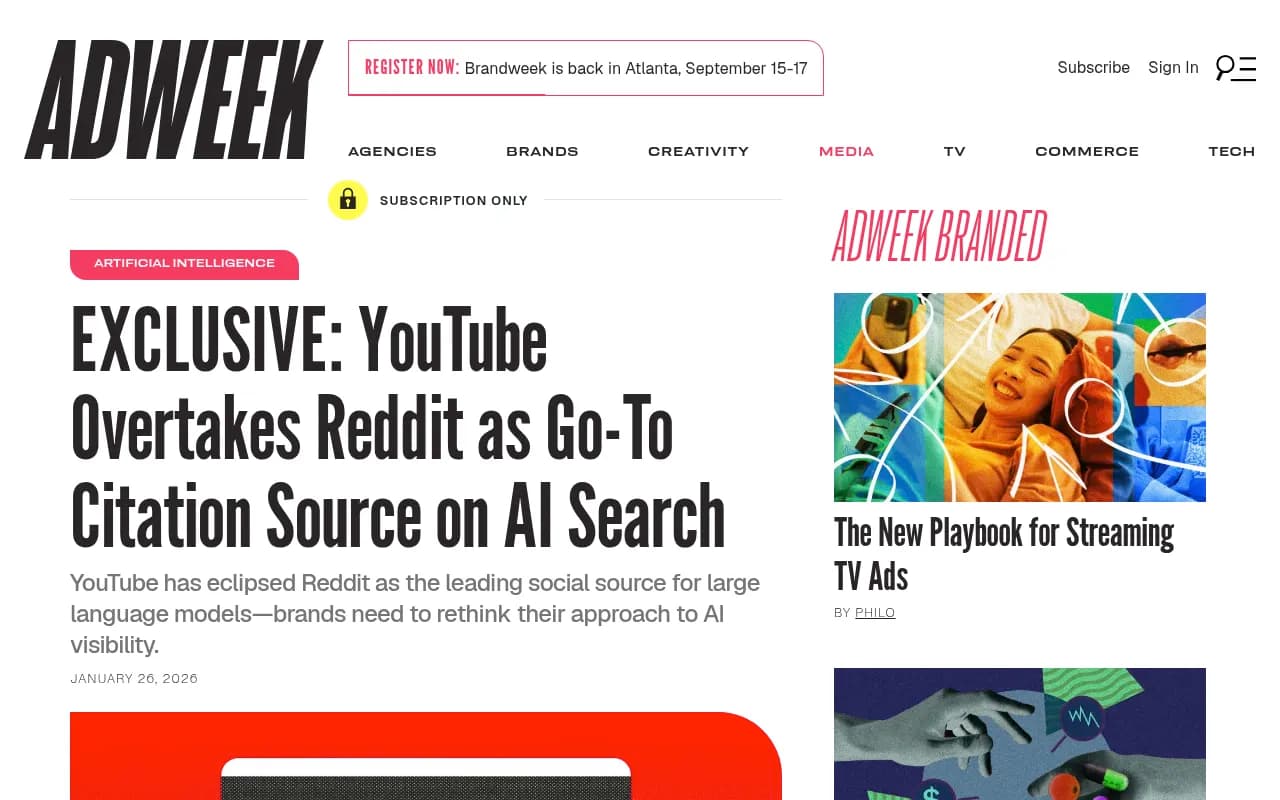
- YouTube has overtaken Reddit as the most cited social platform in AI-generated responses, appearing in roughly 16% of LLM answers vs Reddit's 10%, according to data from Bluefish and Adweek.
- LLMs weight third-party, community-driven signals more heavily than brand-owned content -- which is why Reddit, YouTube, and LinkedIn matter so much for AI citations.
- Each platform serves a different citation function: YouTube for how-to and explainer content, Reddit for authentic community discussions, LinkedIn for B2B authority signals.
- Coordination across all three platforms multiplies your citation surface area -- the same topic covered on YouTube (with a transcript), Reddit (with a community thread), and LinkedIn (with a thought leadership post) gives AI models multiple angles to cite.
- Tools like Promptwatch can show you exactly which prompts your competitors are being cited for but you're not -- so you can target your social content where it actually moves the needle.
There's a shift happening in how brands get discovered, and most marketing teams are still treating it like a traditional SEO problem. They're optimizing title tags and building backlinks while AI models are quietly pulling answers from YouTube transcripts, Reddit threads, and LinkedIn posts -- and citing those sources directly to millions of users.
A study of 30 million LLM citations found that Reddit and YouTube together drive a substantial share of AI search visibility. Then newer data from Bluefish, reported by Adweek, showed YouTube has actually overtaken Reddit as the single most cited social platform in AI responses. YouTube appears in roughly 16% of LLM answers; Reddit sits around 10%.
The reason YouTube caught up is interesting. LLMs struggled with video for a long time -- they can't watch a clip. But transcripts, video descriptions, chapter markers, and the text surrounding YouTube content gave AI models something they could actually read and index. Once that text layer became accessible, YouTube's massive content library became a citation goldmine.
This guide is about how to build a coordinated strategy across Reddit, YouTube, and LinkedIn that systematically increases your brand's citation surface area in AI search. Not just "post more content" -- but a specific playbook for each platform and how to make them work together.
Why social platforms punch above their weight in LLM citations
Before getting into tactics, it's worth understanding why this is happening. LLMs are trained to trust independent, third-party signals over brand-owned content. A company's own website saying "we're the best solution for X" carries less weight than a Reddit thread where real users are discussing the same thing, or a YouTube video where a practitioner walks through a real use case.
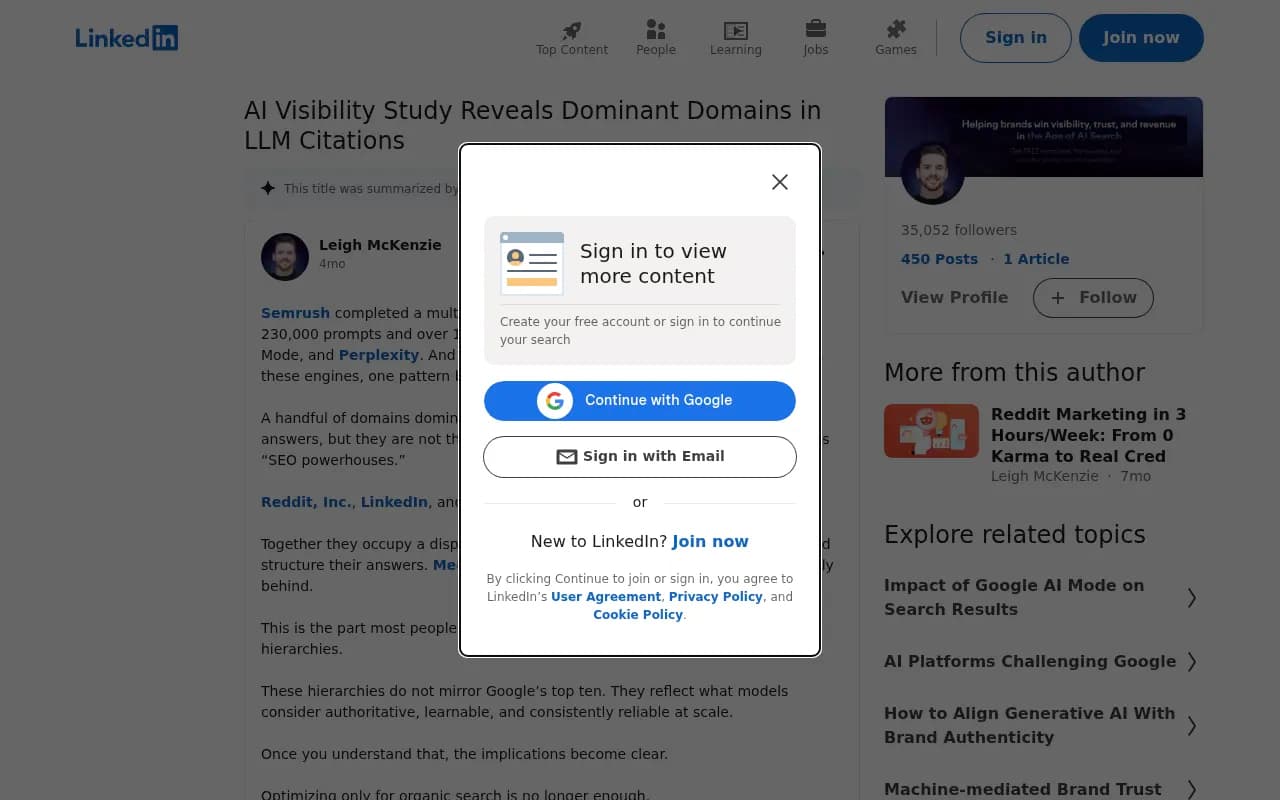
Semrush's multi-platform AI visibility study, which analyzed over 230,000 prompts and 100 million citations across ChatGPT and other models, found that community-driven sites consistently outperform brand-owned domains in citation rates. The logic makes sense: AI models are trying to give users trustworthy, unbiased answers. Third-party sources feel more trustworthy.
This creates a real opportunity. Most brands are not actively managing their presence on these platforms with AI citations in mind. They're posting on Reddit sporadically, uploading YouTube videos without transcripts, and treating LinkedIn as a job board. Meanwhile, their competitors who do this well are getting cited by ChatGPT and Perplexity every time someone asks a relevant question.
Platform by platform: what actually drives citations
YouTube: transcripts are the real asset
YouTube's rise to the top of the LLM citation chart came down to one thing: readable text. AI models can't watch videos, but they can read transcripts, descriptions, pinned comments, and chapter titles.
If you're creating YouTube content without optimizing the text layer, you're leaving citations on the table. Here's what matters:
Transcripts and captions. Auto-generated captions are a start, but they're often inaccurate. Upload a clean, manually edited transcript. This is the primary text AI models will read. Make sure it includes the specific terminology, questions, and answers that your target audience would search for.
Video descriptions. Write descriptions like mini-articles, not afterthoughts. A 300-500 word description that summarizes the video's key points, includes relevant terminology, and answers the core question the video addresses gives AI models a clean, structured text source to cite.
Chapter markers with descriptive titles. "Part 1" is useless. "How to identify keyword gaps in AI search" is a citation-worthy phrase. Chapter titles appear in search results and are readable by crawlers.
The content itself. YouTube rewards videos that directly answer specific questions. "How does [tool category] work?" and "What's the difference between X and Y?" formats perform well for AI citations because they match the question-and-answer format LLMs prefer.
For video creation and optimization at scale, tools like Pictory and InVideo can help you repurpose existing content into YouTube-ready formats.
Reddit: authentic discussion beats polished content
Reddit's citation power comes from something you can't fake: real people having real conversations. LLMs weight Reddit highly because it represents genuine community opinion, not marketing copy.
The challenge is that Reddit has strict norms around self-promotion, and communities can smell a brand account from miles away. The brands that win on Reddit for AI citations are the ones that actually participate in communities rather than just dropping links.
Participate before you promote. Spend time in subreddits relevant to your industry. Answer questions. Share opinions. Build a history. When you eventually post something that references your brand or content, it lands differently when you're a recognized community member.
Answer questions thoroughly. The Reddit posts most likely to get cited by LLMs are detailed, specific answers to questions -- not promotional posts. A 500-word answer to "what's the best approach to [specific problem]?" that happens to mention your product in context is far more valuable than a post that's obviously an ad.
Create threads that invite discussion. "I tested 5 different approaches to [problem] -- here's what I found" generates the kind of discussion that AI models love to cite. The original post plus the replies create a rich, multi-perspective source.
Target the right subreddits. Not all subreddits are equal for citation purposes. Communities with high engagement, clear topical focus, and a history of being cited in search results are your priority. For most B2B brands, subreddits like r/marketing, r/SEO, r/entrepreneur, and industry-specific communities are the starting point.
LinkedIn: authority signals for B2B AI queries
LinkedIn's role in AI citations is different from Reddit and YouTube. It's less about volume and more about authority signals. When someone asks an AI model a B2B question -- "what's the best approach to enterprise content strategy?" or "how do companies handle AI search visibility?" -- LinkedIn content from credible professionals often surfaces as a citation.
The key insight from the research: text posts get the most engagement on LinkedIn by a wide margin. Not carousels, not videos, not link posts. Plain text posts that share a specific insight, opinion, or data point.
Write posts that take a position. "Here's what I've learned after running 50 AI visibility audits" or "The conventional wisdom about [topic] is wrong -- here's why" generates engagement and, more importantly, creates a citable text source.
Use specific data and examples. LLMs cite LinkedIn posts that contain specific, verifiable claims. "We saw a 40% increase in AI citations after adding transcripts to our YouTube videos" is more citable than "video content is important."
Build a consistent topical presence. Posting about AI search visibility once a month won't build the topical authority that gets you cited. Consistent posting on a specific topic over time signals to both LinkedIn's algorithm and AI models that you're a credible source on that subject.
Company pages vs. personal profiles. Personal profiles consistently outperform company pages for LinkedIn citations. AI models seem to weight individual expert voices more heavily than brand accounts. Encourage your team's subject matter experts to post, not just the company page.
The coordination strategy: making platforms work together
Here's where most brands miss the opportunity. They treat Reddit, YouTube, and LinkedIn as separate channels with separate content calendars. The real leverage comes from coordinating them around the same topics.
Think of it as a citation cluster. When an AI model is asked about a specific topic, it searches across multiple sources. If your brand appears on YouTube (with a detailed transcript), Reddit (with a community discussion), and LinkedIn (with expert commentary) -- all covering the same topic from different angles -- your citation probability multiplies.
The topic-first approach
Start with the questions your target audience is asking AI models. Not just keyword research -- actual prompts. "What's the best [product category] for [use case]?" or "How do I solve [specific problem]?" These are the prompts you want your brand to appear in.
For each target prompt, build a content cluster across platforms:
- YouTube video that directly answers the question, with a clean transcript and detailed description
- Reddit thread that discusses the topic authentically, ideally with community participation
- LinkedIn post from a subject matter expert sharing a specific insight or data point on the topic
This isn't about posting the same content three times. Each platform needs content that fits its norms. The YouTube video is a detailed walkthrough. The Reddit thread is a genuine discussion. The LinkedIn post is a sharp, opinionated take. But they all reinforce the same topical authority.
Timing and sequencing
The order matters. A common approach:
- Publish the YouTube video first (it takes longest to get indexed and cited)
- Post the LinkedIn content in the same week to build topical momentum
- Seed the Reddit discussion after both are live, so you have assets to reference if relevant
Measuring what's working
This is where most teams get stuck. Traditional social media metrics (likes, shares, views) don't tell you whether your content is being cited by AI models. You need to track AI visibility directly.
Promptwatch is built specifically for this. It tracks which prompts your brand appears in across ChatGPT, Perplexity, Claude, Gemini, and other AI models, and shows you which pages and sources are being cited. Critically, it also shows you the prompts your competitors are being cited for that you're not -- which is exactly the intelligence you need to prioritize your social content strategy.

For broader AI visibility monitoring, a few other tools worth knowing:
Otterly.AI

Profound

Platform comparison: what each channel delivers for AI citations
| Platform | Citation frequency | Content type that works | Citation mechanism | Brand control |
|---|---|---|---|---|
| YouTube | ~16% of LLM answers | How-to videos, explainers, tutorials | Transcripts, descriptions, chapter titles | Medium -- you control the content |
| ~10% of LLM answers | Q&A threads, detailed answers, discussions | Thread content and replies | Low -- community norms apply | |
| Growing, especially B2B | Text posts, expert opinions, data points | Post text, profile authority | High -- you control the content | |
| Brand website | High baseline | Articles, guides, comparison pages | Page content, structured data | Full control |
The table makes something clear: your brand website still matters enormously. Social platforms supplement it, they don't replace it. The best strategy combines strong on-site content with coordinated social presence.
Common mistakes that kill your citation potential
Posting without transcripts. If you're uploading YouTube videos without clean transcripts, AI models can't read your content. This is the single biggest missed opportunity for most brands on YouTube.
Treating Reddit as a distribution channel. Reddit communities will downvote and ban promotional content. The brands that get cited are the ones that genuinely contribute. If your Reddit strategy is "post links to our blog," it won't work.
Inconsistent topical focus. AI models build topical associations. A LinkedIn profile that posts about AI search one week, company culture the next, and product launches the week after doesn't build the topical authority that drives citations. Pick your topics and stick to them.
Ignoring competitor citations. If ChatGPT is consistently citing your competitors for a specific question, that's a signal about what content you're missing. Tracking competitor citations and building content to compete for those prompts is one of the highest-leverage moves you can make.
No transcript optimization. Having a transcript isn't enough. If your YouTube transcript is a wall of unstructured text with no clear questions and answers, it's harder for AI models to extract citable content. Structure matters.
Building the workflow
A practical weekly cadence for a team of two or three people:
- Monday: Review AI visibility data -- which prompts are you appearing in, which are competitors winning?
- Tuesday-Wednesday: Create the week's YouTube content (script, record, upload with optimized description and transcript)
- Thursday: LinkedIn posts from subject matter experts on the same topic
- Friday: Reddit participation -- answer questions, contribute to discussions, seed threads where relevant
This isn't a massive time commitment. The YouTube video might be 10-15 minutes long. The LinkedIn post is 200-300 words. The Reddit contribution is a thoughtful reply to an existing thread. The cumulative effect over months is a substantial citation footprint across all three platforms.
For social media scheduling and management across platforms, tools like Sprout Social and Buffer can help keep the workflow organized.
For content creation at scale, especially if you're producing YouTube scripts or LinkedIn posts in volume:
What the data tells us about 2026
The direction is clear. YouTube's rise to the top of the social citation chart isn't a fluke -- it reflects AI models getting better at processing video-associated text. Reddit's position at 10% is stable because community-driven discussion is inherently trustworthy to LLMs. LinkedIn's B2B authority signals are increasingly relevant as more professionals use AI models for work-related queries.
The brands that will dominate AI citations in 2026 are the ones building systematic, coordinated presence across all three platforms right now -- not as an afterthought to their SEO strategy, but as a core part of how they create and distribute content.
The starting point is knowing where you stand. Run a prompt audit. Find out which questions your target audience is asking AI models, which ones you're appearing in, and which ones your competitors are winning. That data tells you exactly where to focus your social content effort.
Platforms like Promptwatch make this audit straightforward -- the Answer Gap Analysis shows you the specific prompts where competitors are visible and you're not, which is the clearest possible signal for where to invest your content energy.
The mechanics of getting cited by AI models are learnable. The brands that treat this as a discipline -- with consistent processes, measurement, and iteration -- will build citation advantages that compound over time.