Key takeaways
- Otterly.AI is the easiest sell for small teams with tight budgets -- monitoring starts at $29/month with almost no friction to get started.
- Peec AI is the strongest mid-market option if your CFO wants data depth and analytics without enterprise pricing.
- Brandlight.ai is a niche player with a narrower feature set -- harder to justify unless it fits a very specific use case.
- Promptwatch is the only platform that closes the loop from monitoring to content creation to revenue attribution, which makes it the most defensible spend when you need to show actual business impact.
- The core CFO question isn't "what does it cost?" -- it's "what does it change?" Most monitoring-only tools struggle to answer that.
There's a conversation happening in marketing teams right now that goes something like this: the CMO wants to track AI visibility, the SEO lead has found four tools that all claim to do it, and the CFO wants to know why any of them are worth the budget.
It's a fair question. The GEO and AI visibility space raised over $300M between mid-2025 and spring 2026. Every tool in the category has a slick dashboard and a compelling demo. But "we can see our brand mentions in ChatGPT" is not a business case. A business case requires showing what changes when you spend the money.
This guide compares four platforms -- Brandlight.ai, Promptwatch, Peec AI, and Otterly.AI -- specifically through the lens of CFO justification. What does each tool actually do? What does it cost? And what's the realistic answer when finance asks "so what?"
What CFOs actually want to know
Before getting into the tools, it helps to be clear about what "justifying to your CFO" actually means. Finance teams generally care about three things:
- What problem does this solve, and how big is that problem?
- What's the cost relative to the expected return?
- How will we know if it's working?
The third question is where most AI visibility tools fall apart. Monitoring dashboards show you data. They don't show you causation. If your brand mention rate in Perplexity goes up 12% after you start using a tool, was that the tool? New content you published? A competitor stumbling? Without attribution and action capabilities, you're paying for a number that moves and hoping it means something.
Keep that in mind as we go through each platform.
The four platforms at a glance
| Platform | Starting price | Monitoring | Content generation | Attribution | Best for |
|---|---|---|---|---|---|
| Otterly.AI | $29/month | Yes | No | No | Entry-level monitoring, small teams |
| Peec AI | ~$99/month | Yes | No | Limited | Mid-market analytics |
| Brandlight.ai | Not publicly listed | Yes | Limited | No | Niche brand tracking |
| Promptwatch | $99/month | Yes | Yes | Yes | Full-cycle optimization |
Otterly.AI: the easiest entry point, but limited upside
Otterly.AI is genuinely the most accessible tool in this category. You can start at $29/month, get monitoring across ChatGPT, Perplexity, and Google AI Overviews, and have something running in under an hour. For a small team that just wants to know whether their brand shows up in AI search at all, it works.
The CFO pitch is simple: "It's $29/month and we'll finally know if we exist in AI search." That's a low bar to clear.
The problem is what comes next. Otterly gives you visibility data but no path to acting on it. You can see that a competitor appears in 40% of relevant AI responses and you appear in 8%, but the tool doesn't tell you why or what to do about it. There's no content gap analysis, no crawler logs, no attribution to traffic or revenue. The dashboard shows you a problem. You're on your own to solve it.
For a CFO who asks "what will we do differently because of this data?" -- Otterly doesn't have a great answer. It's a monitoring tool, not an optimization tool. That's fine if you just need to establish a baseline, but it's a harder sell if you're trying to justify ongoing spend.
Otterly.AI

Peec AI: strong analytics, still monitoring-first
Peec AI raised $29M and hit $4M+ ARR in its first ten months -- which tells you the market has responded well to what it's built. The platform has more analytical depth than Otterly, with better prompt tracking, more granular reporting, and a stronger mid-market positioning.
Where Peec AI earns its budget is in the data layer. If your team wants to understand prompt-level performance, track share of voice across AI models, and do competitive benchmarking with real numbers, Peec delivers that more robustly than the entry-level options.
The CFO pitch here is: "We're getting serious analytics on our AI search position, comparable to what we do for traditional SEO." That's a reasonable argument, especially for teams that already have a culture of measurement.
But Peec AI is still fundamentally a monitoring and analytics platform. It doesn't generate content, doesn't have AI crawler logs showing you why you're being cited or not, and doesn't connect visibility to revenue in a meaningful way. The data is good. The "so what" is still on you.
For a CFO who's comfortable with analytics spend and trusts the team to translate data into action, Peec is defensible. For a CFO who wants to see a direct line from tool spend to business outcome, it's harder.

Brandlight.ai: niche positioning, unclear ROI story
Brandlight.ai occupies a narrower slice of the market. It tracks how AI engines discover and recommend your brand, with a focus on brand-level visibility rather than prompt-level or page-level granularity.
The honest assessment: Brandlight is harder to evaluate because its pricing isn't publicly listed and its feature set is less documented than the other three platforms here. In the 2026 GEO platform comparison landscape, it consistently appears in the "niche players" category rather than the leaders quadrant -- which usually means it does something specific reasonably well but lacks the breadth to be a primary platform.
For certain use cases -- brand managers who want a focused view of how their brand entity is perceived across AI models, without needing content optimization or deep analytics -- Brandlight might fit. But the CFO justification is genuinely difficult here. Without transparent pricing, clear attribution capabilities, or a documented path from monitoring to action, it's hard to build a business case that finance will sign off on.
If you're considering Brandlight, the question to ask before buying is: "What specifically will we do with this data that we can't do without it?" If the answer is vague, that's a warning sign.
Promptwatch: the platform with an answer to "so what?"
Promptwatch is the only platform in this comparison that's built around the full optimization cycle rather than just monitoring. That distinction matters enormously when you're trying to justify budget.
The structure is: find gaps, create content, track results. Answer Gap Analysis shows you exactly which prompts competitors are visible for that you're not -- not as an abstract score, but as specific questions AI models are answering without citing you. Content Agents then generate articles, listicles, and briefs grounded in that prompt data, designed to fill those gaps. And page-level tracking shows you when new content gets crawled, cited, and drives actual traffic.
That last part -- AI Crawler Logs -- is something most competitors don't have at all. You can see which AI crawlers hit your site, which pages they read, what errors they encountered, and when a page moved from "crawled" to "cited." That's the kind of evidence that turns a monitoring dashboard into an optimization workflow.
For a CFO conversation, this changes the framing entirely. Instead of "we're spending $249/month to watch a number," it becomes "we're spending $249/month on a system that identifies content gaps, generates the content to fill them, and tracks the revenue impact." That's a capital allocation argument, not a vanity metrics argument.
Promptwatch's pricing runs from $99/month (Essential: 1 site, 50 prompts, 5 articles) to $249/month (Professional: 2 sites, 150 prompts, 15 articles, crawler logs) to $579/month (Business: 5 sites, 350 prompts, 30 articles). There's a free trial, and annual billing brings the cost down further.
The platform covers 10 AI models -- ChatGPT, Perplexity, Google AI Overviews, Google AI Mode, Claude, Gemini, Meta/Llama, DeepSeek, Grok, Mistral, and Copilot -- and includes features like Reddit and YouTube insights, ChatGPT Shopping tracking, competitor heatmaps, and multi-language/multi-region monitoring.

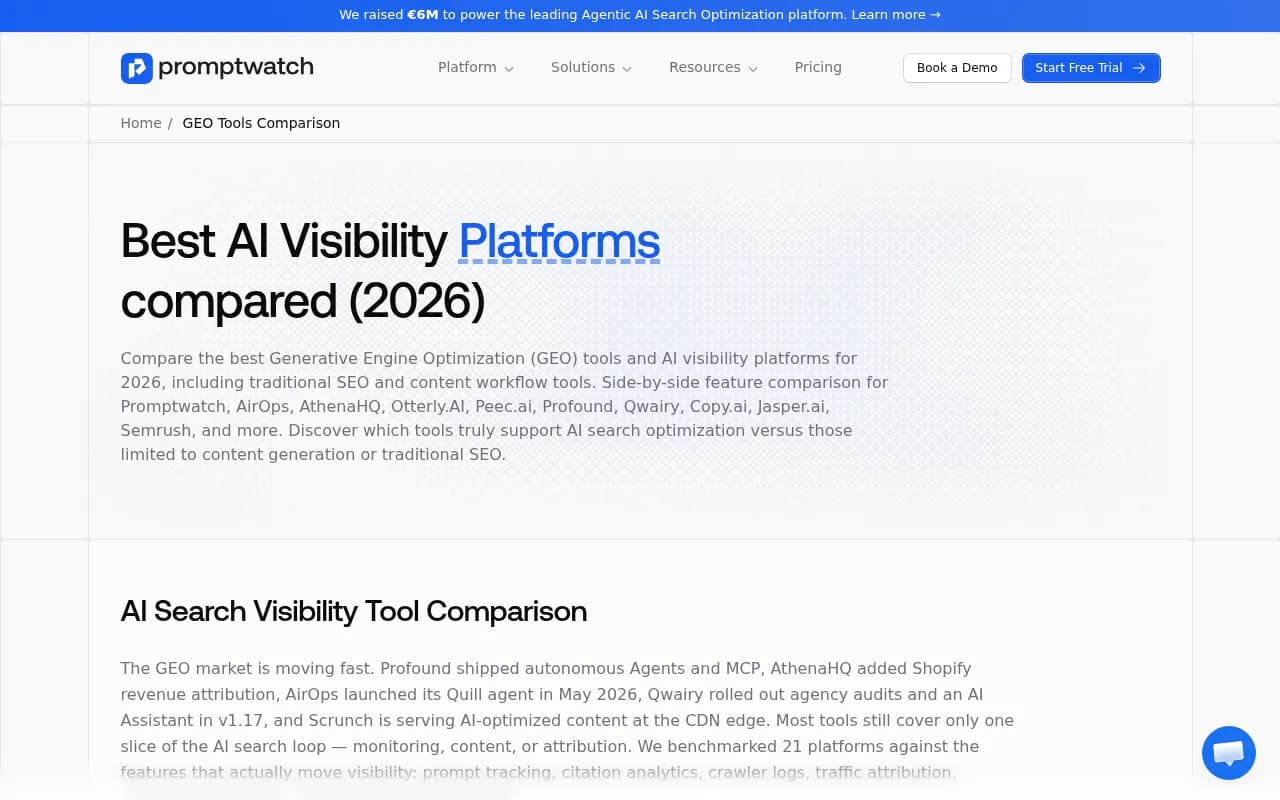
Head-to-head: CFO justification scorecard
| Criteria | Otterly.AI | Peec AI | Brandlight.ai | Promptwatch |
|---|---|---|---|---|
| Transparent pricing | Yes ($29+) | Partial | No | Yes ($99+) |
| Monitoring depth | Basic | Strong | Moderate | Strong |
| Content generation | No | No | No | Yes |
| Crawler logs / indexing data | No | No | No | Yes |
| Revenue attribution | No | Limited | No | Yes |
| Competitive gap analysis | Basic | Moderate | Limited | Strong |
| Reddit / YouTube insights | No | No | No | Yes |
| ChatGPT Shopping tracking | No | No | No | Yes |
| "So what?" answer | Weak | Moderate | Weak | Strong |
| CFO justifiability | Low-medium | Medium | Low | High |
The real question: monitoring vs. optimization
The fundamental split in this market is between tools that show you data and tools that help you act on it. Right now, most platforms -- including Otterly and Peec -- are in the first category. That's not a criticism; monitoring is a legitimate starting point. But it creates a ceiling on ROI justification.
When you're paying for monitoring, the best outcome is "we know more." When you're paying for optimization, the best outcome is "we rank better and we can prove it drove revenue." Those are very different conversations with finance.
Brandlight sits in the monitoring camp with less analytical depth than Peec and less transparency than Otterly. Promptwatch is the only platform here that's genuinely built for the second conversation.
That said, the right tool depends on where your team is. If you've never measured AI visibility and need to establish a baseline before asking for more budget, Otterly at $29/month is a reasonable starting point. If you have a data-driven team that can translate analytics into action independently, Peec gives you the numbers to work with. If you need to show your CFO a closed loop from spend to outcome, Promptwatch is the only platform in this comparison that's built to do that.
Practical advice for the budget conversation
A few things that actually help when you're making this case to finance:
First, frame it as a channel shift, not a new expense. AI search is eating traditional search traffic. If you're not tracking and optimizing for it, you're losing ground that your competitors are taking. The question isn't whether to invest -- it's whether to invest proactively or reactively.
Second, use the free trial before the budget conversation. Promptwatch has one. Otterly has one. Show up to the CFO meeting with actual data about your current AI visibility, not a vendor slide deck.
Third, be honest about what monitoring-only tools can and can't do. If you buy Otterly or Peec, you'll need to budget for the human time to turn that data into content and optimization work. That cost is real even if it doesn't show up on the tool invoice.
Fourth, connect it to existing metrics your CFO already cares about. If you can show that AI-referred traffic converts at a certain rate, or that a competitor's AI visibility correlates with their market share gains, you're speaking finance's language.
The AI visibility category is real, the tools are maturing fast, and the CFO conversation is getting easier as the data gets better. The platforms that will be easiest to justify in 2026 are the ones that don't just show you the problem -- they help you fix it.