Key takeaways
- Peec AI is a solid monitoring tool but stops short of helping you act on what it finds — most teams hit this wall within weeks.
- The best alternatives in 2026 don't just track citations; they help you identify gaps, generate optimized content, and close the loop with traffic attribution.
- Promptwatch is the only platform rated "Leader" across all GEO categories in a 2026 comparison of 12 platforms, largely because it combines monitoring, content generation, and crawler log analysis in one place.
- If you're purely budget-constrained, Otterly.AI and LLMrefs offer solid entry-level monitoring.
- For enterprise teams, Profound and Scrunch AI have strong feature sets but come at a higher price and without some of the optimization capabilities that actually move the needle.
There's a specific kind of frustration that comes from staring at an AI visibility dashboard. You can see that ChatGPT isn't citing your brand. You can see which competitors are showing up instead. And then... the tool shrugs. "Here's your data. Good luck."
That's the core problem with Peec AI and, honestly, with most tools in this space. They're built around monitoring, not optimization. Knowing you're invisible is step one. Knowing what to do about it is the whole game.
AI platforms generated over 1.1 billion referral visits in June 2025, up 357% year-over-year according to Similarweb's 2025 Generative AI Report. Meanwhile, Google AI Overviews now trigger for more than 13% of queries and cause a 34.5% drop in click-through rates for position-one organic results. The brands winning in this environment aren't just tracking their AI citations — they're systematically creating content that gets cited.
This guide covers the six alternatives that actually help you move your score, not just measure it.
Why teams leave Peec AI

Peec AI does a few things well. It tracks how your brand appears across ChatGPT, Perplexity, Claude, and Gemini using UI-level scraping, which gives more realistic results than API-only tools. Prompt suggestions are reasonably smart. The interface is clean.
But the limitations show up fast when you try to act on the data:
- No built-in content creation or optimization tools — you find the gap, then you're on your own
- Niche or low-volume queries can be unreliable
- Competitive sentiment tracking is thin
- No crawler logs, so you can't see how AI bots are actually reading your site
- No traffic attribution, so you can't connect visibility improvements to revenue
For teams that just want a dashboard to report on AI mentions, Peec AI works fine. For teams that want to actually improve their position, it runs out of runway quickly.
The 6 best Peec AI alternatives in 2026
1. Promptwatch — best for end-to-end AI visibility optimization
Promptwatch is the only platform in a 2026 comparison of 12 GEO tools rated as a "Leader" across all categories. The reason is straightforward: it's built around a complete optimization loop, not just a monitoring dashboard.

The core workflow goes like this. Answer Gap Analysis shows you exactly which prompts your competitors are visible for but you're not. You see the specific topics and questions AI models want to answer but can't find on your site. Then the built-in AI writing agent generates articles, listicles, and comparisons grounded in real citation data — not generic SEO filler, but content engineered to get cited by ChatGPT, Claude, Perplexity, and others. Then you track results at the page level as your visibility scores improve.
A few things stand out that competitors simply don't have:
- AI Crawler Logs that show in real time which pages ChatGPT, Claude, and Perplexity are reading, how often, and what errors they're hitting
- Prompt Intelligence with volume estimates, difficulty scores, and query fan-outs showing how one prompt branches into sub-queries
- Reddit and YouTube tracking, which surfaces discussions that directly influence AI recommendations — a channel most tools ignore entirely
- ChatGPT Shopping tracking for brands that appear in product recommendation carousels
- Traffic attribution via code snippet, Google Search Console integration, or server log analysis
It monitors 10 AI models: ChatGPT, Perplexity, Google AI Overviews, Google AI Mode, Claude, Gemini, Meta/Llama, DeepSeek, Grok, Mistral, and Copilot.
Pricing starts at $99/month (Essential: 1 site, 50 prompts, 5 articles), $249/month (Professional: 2 sites, 150 prompts, 15 articles, crawler logs), and $579/month (Business: 5 sites, 350 prompts, 30 articles). A free trial is available.
The honest summary: if you want to stop measuring your invisibility and start fixing it, this is where to start.
2. Profound — best for enterprise AI search insights
Profound

Profound has a strong feature set and is genuinely well-regarded for enterprise-level AI monitoring. It tracks brand mentions across 9+ AI search engines, surfaces competitive intelligence, and has solid prompt tracking capabilities.
Where it falls short relative to Promptwatch: no Reddit or YouTube tracking, no ChatGPT Shopping monitoring, and the content optimization side is thinner. It's primarily a monitoring and insights platform. If your team has a separate content operation and just needs deep data to feed it, Profound is a legitimate choice. If you need the full loop in one tool, it's not quite there.
Pricing is on the higher end, which makes it harder to justify for smaller teams.
3. Otterly.AI — best entry-level monitoring
Otterly.AI

Otterly.AI tracks citations across six AI platforms: ChatGPT, Gemini, Perplexity, Claude, Copilot, and AI Overviews. It's clean, reasonably priced, and gets the basics right.
The limitation is that it's monitoring-only. No content generation, no crawler logs, no gap analysis, no traffic attribution. It's a good starting point if you're just trying to understand the landscape before committing to a more capable platform. But most teams outgrow it within a few months once they realize they need to act on the data, not just collect it.
4. Scrunch AI — best for enterprise-wide AI monitoring
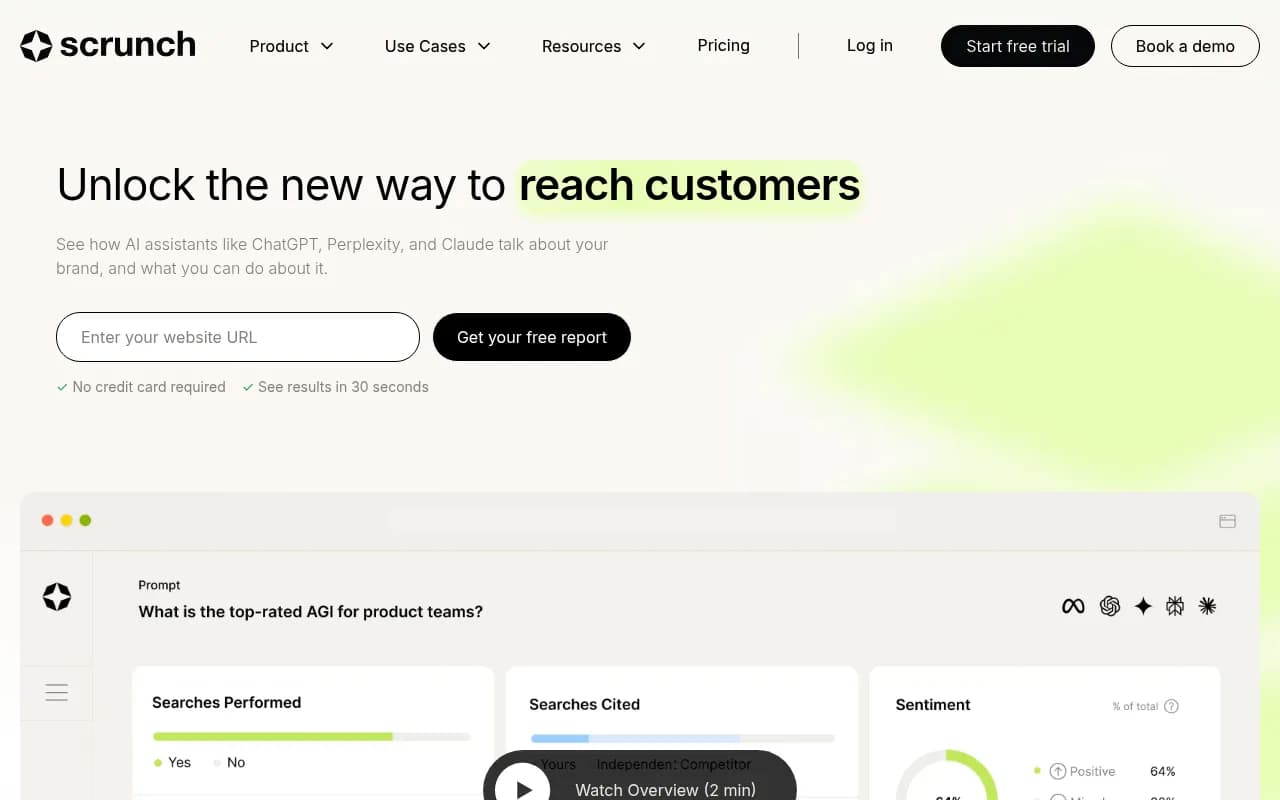
Scrunch AI is positioned for enterprise teams that need broad AI monitoring across a large brand footprint. It handles multi-location and multi-brand scenarios reasonably well and has solid reporting.
Like Profound, it's strong on the monitoring side but lighter on optimization. No built-in content generation, and the gap analysis capabilities are less developed than Promptwatch's Answer Gap Analysis. For large organizations that already have content teams and just need visibility data piped into their workflows, it's worth evaluating.
5. LLMrefs — best for citation and source tracking
LLMrefs
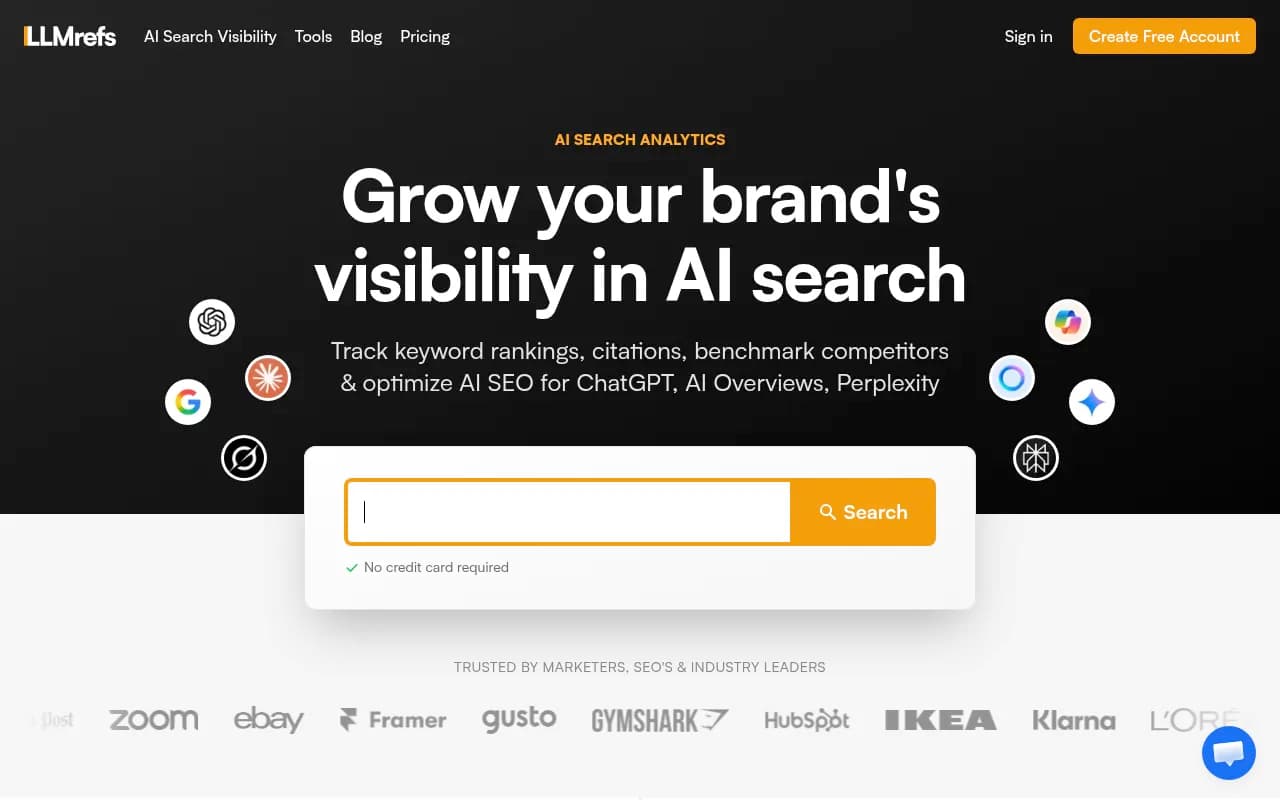
LLMrefs does one thing particularly well: tracking exactly which sources AI models are citing and how often. If you want to understand the citation graph — which pages, Reddit threads, YouTube videos, and domains are being referenced in AI responses — LLMrefs gives you that visibility across ChatGPT, Perplexity, and 9 other AI engines.
It's more of a research and intelligence tool than a full optimization platform. Useful for content strategists who want to know where to publish and what to optimize, but you'll need other tools to actually execute on those insights.
6. AthenaHQ — best for sentiment-led brand control

AthenaHQ focuses on how AI models characterize your brand, not just whether they mention you. If the concern is that ChatGPT is describing your product inaccurately or associating your brand with the wrong attributes, AthenaHQ surfaces that.
It's monitoring-focused, which is a recurring theme in this space. The optimization and content generation capabilities aren't there. But for brand teams where sentiment and framing matter as much as citation frequency, it fills a specific gap.
How they compare
| Tool | Monitoring | Content generation | Crawler logs | Traffic attribution | Reddit/YouTube tracking | Pricing from |
|---|---|---|---|---|---|---|
| Promptwatch | 10 AI models | Yes (built-in AI writer) | Yes | Yes (3 methods) | Yes | $99/mo |
| Profound | 9+ AI models | No | No | Limited | No | Higher |
| Otterly.AI | 6 AI platforms | No | No | No | No | Lower |
| Scrunch AI | Broad coverage | No | No | No | No | Enterprise |
| LLMrefs | 11 AI engines | No | No | No | No | Varies |
| AthenaHQ | Sentiment focus | No | No | No | No | Varies |
| Peec AI | 4+ AI engines | No | No | No | No | €89/mo |
The pattern is hard to miss. Most tools in this space are monitoring dashboards. They show you data and leave you to figure out what to do with it. Promptwatch is the exception — it's built around the full cycle of finding gaps, creating content, and tracking results.
What to actually look for when choosing
Monitoring depth vs. optimization capability
The first question to ask is whether you need a monitoring tool or an optimization platform. Most teams think they need monitoring until they realize that knowing you're invisible doesn't make you visible.
If your team has the bandwidth to take raw citation data and independently run content strategy, gap analysis, and production, a monitoring-only tool might be enough. If you need the whole workflow in one place, you need something with content generation built in.
Crawler log access
This is underrated. AI crawler logs tell you which pages ChatGPT, Claude, and Perplexity are actually reading — and which ones they're skipping or hitting errors on. Without this, you're optimizing blind. You might write the perfect article and have no idea that the AI crawler is encountering a 404 or a JavaScript rendering issue that prevents it from reading the page at all.
Very few tools offer this. It's one of the clearest differentiators between a serious optimization platform and a monitoring dashboard.
Traffic attribution
AI visibility without revenue attribution is a vanity metric. The question isn't just "are we being cited?" — it's "is that citation driving traffic and conversions?" Tools that connect AI visibility to actual business outcomes (via GSC integration, server log analysis, or a tracking snippet) let you close the loop and justify the investment.
Prompt intelligence
Volume estimates and difficulty scores for prompts matter for prioritization. If you're tracking 50 prompts and trying to decide where to focus content creation effort, knowing which prompts have high volume and low competition is the difference between strategic optimization and guessing.
Query fan-outs — where one prompt branches into multiple sub-queries — are even more valuable. They show you the full surface area of a topic so you can build content that covers it comprehensively.
Reddit and YouTube tracking
AI models don't just cite brand websites. They cite Reddit threads, YouTube videos, and third-party publications. If you're not tracking what's being said about your brand in those channels, you're missing a significant part of the picture. Most tools ignore this entirely.
The bottom line
The AI search visibility space in 2026 is full of monitoring tools dressed up as optimization platforms. Most of them will show you a dashboard of citations and mention counts, and then leave you to figure out the rest.
The tools that actually move your AI visibility score are the ones that help you find what's missing, create content that fills those gaps, and track whether it's working. That loop — find, create, track — is what separates optimization from observation.
If you're evaluating alternatives to Peec AI, start by asking what happens after you see the data. If the answer is "you're on your own," keep looking.