Key takeaways
- Peec AI tracks AI visibility well but stops at monitoring — it doesn't help you fix gaps or create content that gets cited.
- The €85 → €205 pricing jump and limited engine coverage (Claude costs extra) are the most common reasons teams look elsewhere.
- A full optimization workflow has three stages: find gaps, create content, track results. Most platforms only do the first.
- Promptwatch is the only platform in this comparison rated as a leader across all three stages.
- Migration takes roughly two to four weeks if you follow the structured handoff process in this guide.
Peec AI raised €21 million in its Series A in late 2025, which tells you something about where the market is heading. AI search visibility is real, it matters, and brands are starting to budget for it seriously. If you're reading this, you've probably already been using Peec AI for a while. Maybe you set up your prompts, watched your visibility scores, and then... waited.
That's the core problem with monitoring-only platforms. They tell you where you stand. They don't tell you what to do about it.
This guide is for teams who want to move from passive tracking to an actual optimization loop — and for anyone who's outgrown Peec AI's pricing tiers, engine coverage, or reporting depth. We'll cover what Peec AI does well, where it falls short, how to evaluate alternatives, and how to migrate without losing your baseline data.
What Peec AI actually does well
Before we get into the migration, it's worth being honest about where Peec AI earns its place.
Setup is genuinely fast. You can go from signup to seeing visibility data in under 30 minutes, which is rare in this category. The interface is clean, the prompt management is straightforward, and the 115+ language support is legitimately useful for international teams.
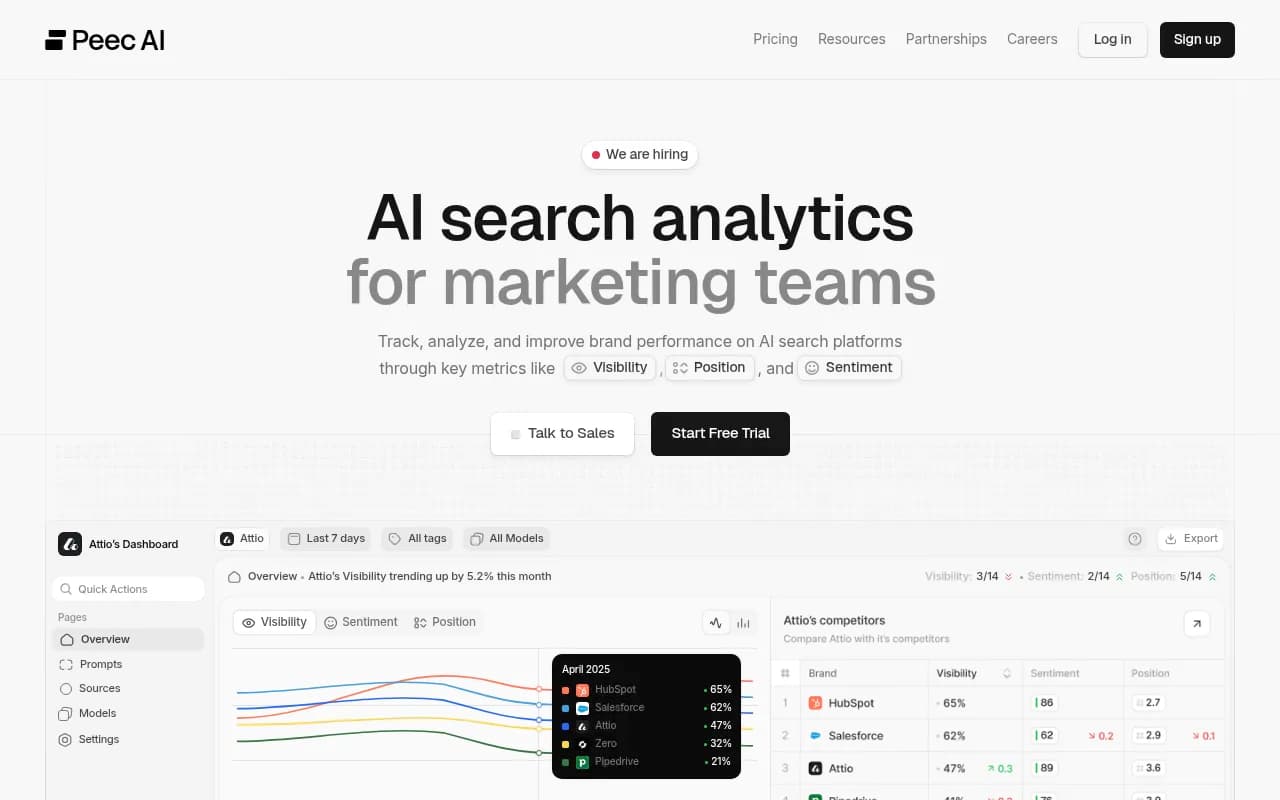
The platform covers ChatGPT, Perplexity, and Google Gemini on its base plan, which handles the three most common AI search engines for most marketing teams. Source-level visibility — seeing which pages AI models are citing — is a real differentiator over some cheaper tools.
For teams that just need to know "are we showing up in AI search?" Peec AI answers that question clearly.
Where teams hit the ceiling
Three friction points come up consistently when teams start looking for alternatives.
The pricing jump. Peec AI Starter is €85/month for 50 prompts. Pro is €205/month for 150 prompts. That's a 2.4x price increase for 3x the prompts. If you're managing multiple brands or running an agency, you hit that ceiling fast and the math stops working.
Claude costs extra. Claude Sonnet is only available on the Scale tier (€425/month) or as a paid add-on ranging from €30 to €140/month depending on your plan. For teams that want to track visibility across all major AI models from day one, that's a meaningful gap.
No optimization layer. This is the big one. Peec AI shows you your visibility scores. It doesn't tell you which content to create, which prompts to target, or how to close the gap between where you are and where competitors are. The reporting is descriptive, not prescriptive. You get the what, but not the how.
The full optimization workflow: what you're actually trying to build
Before evaluating platforms, it helps to define what "full optimization" actually means. There are three stages:
- Find the gaps. Which prompts are competitors ranking for that you're not? Which topics are AI models answering with your competitors' content instead of yours?
- Create content that gets cited. Not generic SEO content — articles, comparisons, and listicles specifically engineered to match what AI models want to cite when answering those prompts.
- Track the results. See which pages are getting cited, by which models, how often, and whether that visibility is driving actual traffic and revenue.
Most platforms in this space do step one reasonably well. Very few do all three. That gap is where the real differentiation lives.
Platform comparison: Peec AI vs the alternatives
Here's how the main platforms stack up across the dimensions that matter for a full optimization workflow.
| Platform | Monitoring | Gap analysis | Content generation | Crawler logs | Pricing (entry) | Claude included |
|---|---|---|---|---|---|---|
| Peec AI | Yes | Limited | No | No | €85/mo | Add-on only |
| Promptwatch | Yes | Yes (Answer Gap) | Yes (AI writing agent) | Yes | $99/mo | Yes |
| Profound | Yes | Partial | No | No | $399/mo | Enterprise only |
| Otterly.AI | Yes | No | No | No | $29/mo | Yes (Lite) |
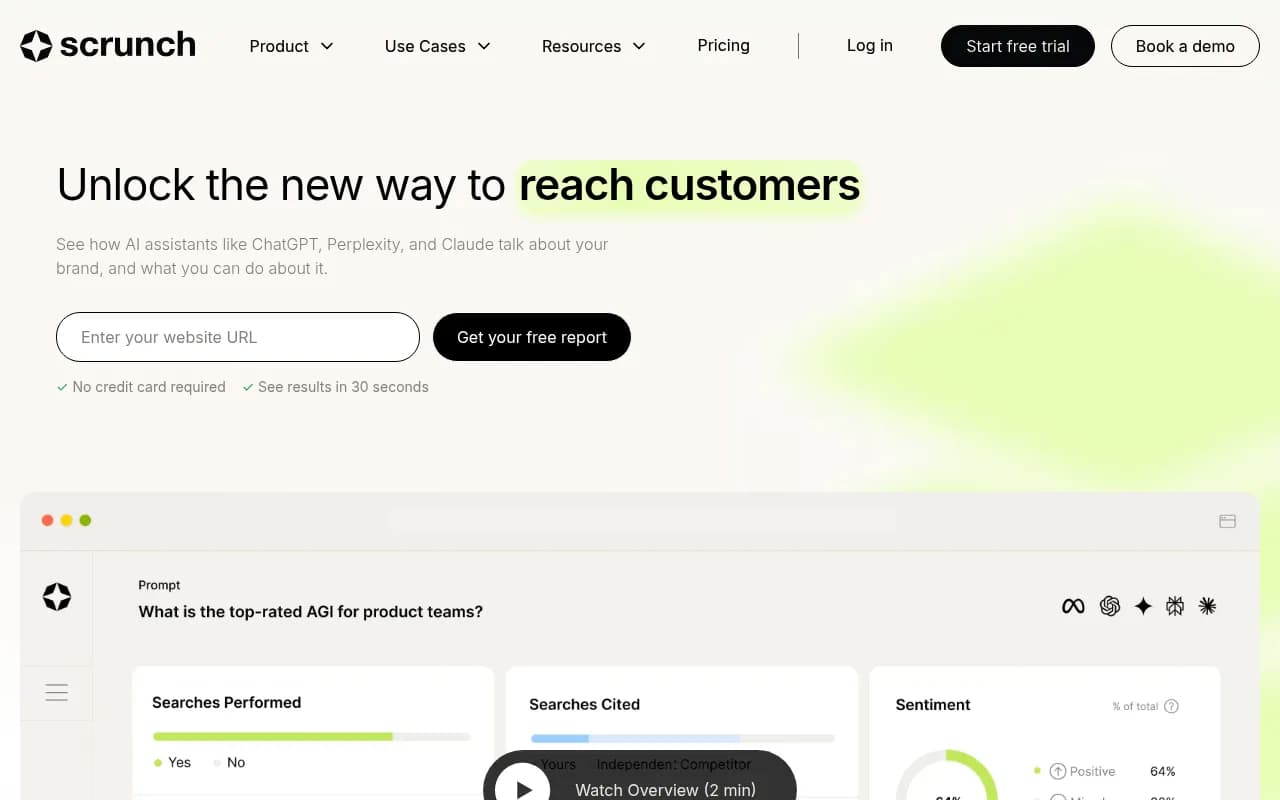
| Scrunch AI | Yes | Partial | No | No | $250/mo | Yes |
| SE Visible | Yes | No | No | No | Bundled with SE Ranking | |
| LLMrefs | Yes | No | No | No | Free tier available |
A few things worth noting from this table. Profound has strong data assets (proprietary prompt volume data, SOC 2 Type II compliance) but starts at $399/month and is genuinely built for Fortune 500 procurement cycles, not marketing teams. Otterly.AI is the cheapest entry point at $29/month but is monitoring-only with no path to optimization. Scrunch AI is solid for agencies that need multi-client reporting but doesn't help you create content.
Profound

Otterly.AI

The platform that covers all three stages of the optimization loop is Promptwatch.
Promptwatch tracks 10 AI models (including Claude, DeepSeek, Grok, Mistral, Meta AI, and Copilot), shows you exactly which prompts competitors are visible for that you're not, and has a built-in AI writing agent that generates content grounded in real citation data. It also logs AI crawler activity in real time — which pages ChatGPT, Claude, and Perplexity are reading, how often, and what errors they're hitting. Most competitors in this space don't have that at all.

How to evaluate which platform is right for your team
Not every team needs the full optimization stack. Here's a quick decision framework.
You should stay on Peec AI (or a similar monitoring tool) if:
- You're in early-stage monitoring and just need to establish a baseline
- Your budget is under €100/month and you only need three engines
- You have a separate content team that doesn't need platform-generated briefs
You should move to a full optimization platform if:
- You've been monitoring for 60+ days and your visibility scores haven't improved
- You're losing prompt share to competitors and don't know why
- Your team is spending hours manually researching what content to create for AI search
- You need to show ROI from AI visibility work, not just report on scores
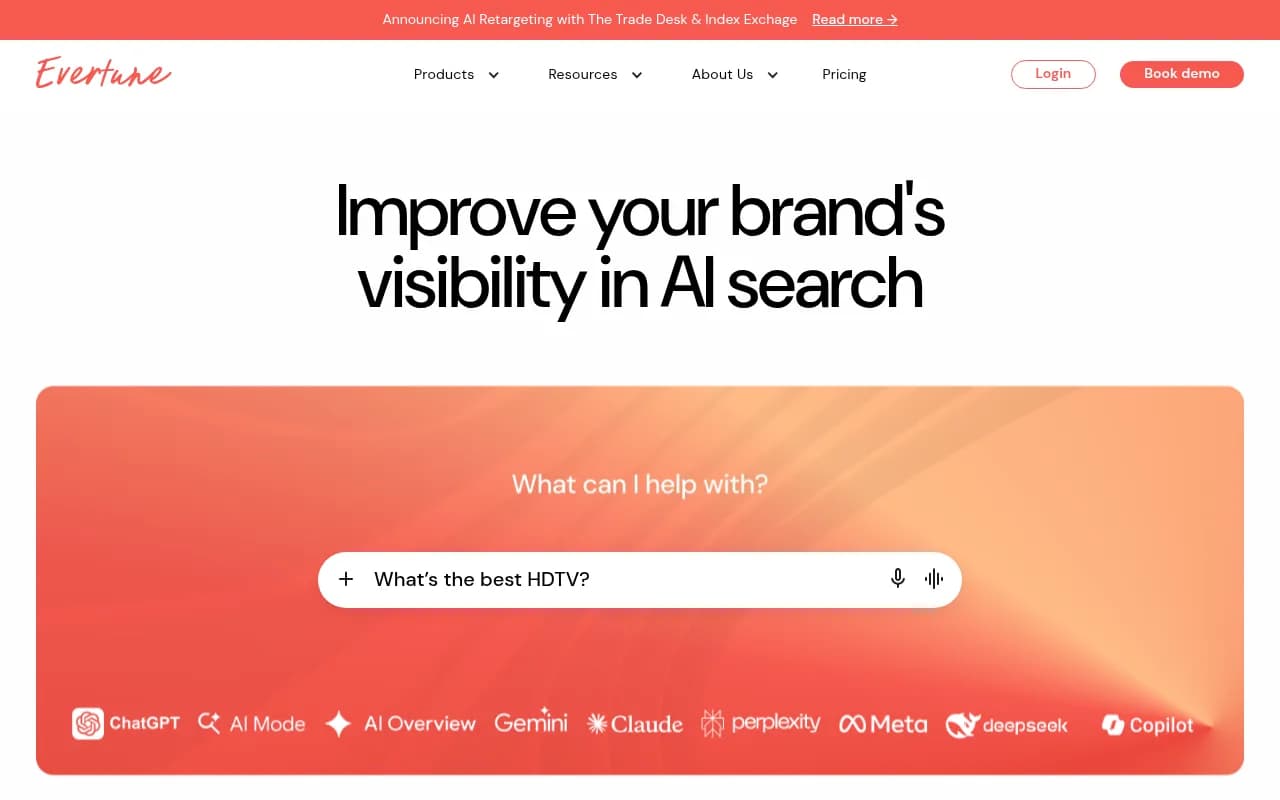
You should consider enterprise options (Profound, Evertune) if:
- You're at a Fortune 500 with SOC 2 compliance requirements
- You need dedicated account management and custom SLAs
- Your budget is $2,000+/month
Migration guide: moving from Peec AI to a full workflow
This is the practical part. Here's how to migrate without losing your baseline data or disrupting ongoing reporting.
Step 1: Export your baseline data (week 1)
Before you cancel or downgrade anything, export everything from Peec AI. You want:
- Your full prompt list (every prompt you're currently tracking)
- Historical visibility scores for each prompt, ideally 90 days back
- Source/citation data showing which pages are currently being cited
- Any competitor tracking data you've set up
Most platforms will let you export this as CSV. Keep it. You'll use it to set up your new platform and to compare progress over time.
Step 2: Set up your new platform in parallel (week 1-2)
Don't cancel Peec AI yet. Run both platforms simultaneously for at least two weeks. This lets you:
- Verify that your new platform is pulling comparable data
- Identify any discrepancies in how different platforms measure visibility
- Build confidence with your team before switching reporting systems
When setting up your new platform, import your existing prompt list first. Then add prompts your competitors are ranking for that you haven't been tracking — this is usually where the gap analysis feature pays for itself immediately.
Step 3: Run your first gap analysis (week 2)
This is the step that Peec AI can't do. Once you're set up on a platform with gap analysis, run it against your top two or three competitors. You're looking for:
- Prompts where competitors appear in AI responses but you don't
- Topics where AI models are citing competitor content instead of yours
- Questions your target audience is asking that your website doesn't answer
The output of this analysis becomes your content roadmap. Prioritize by prompt volume and difficulty — go after high-volume, winnable prompts first.
Step 4: Create and publish content (week 2-4)
For each gap you've identified, you need content that AI models will want to cite. This isn't the same as traditional SEO content. AI models cite sources that:
- Directly answer the question being asked
- Are specific and factual, not generic
- Come from domains that AI crawlers have indexed and trust
If your new platform has a built-in content generation tool, use it — the best ones are grounded in actual citation data, not just keyword research. If you're writing manually, structure each piece around the exact prompt you're targeting, include specific data points, and make sure the page is crawlable by AI bots (check your robots.txt and crawler logs).
Step 5: Downgrade or cancel Peec AI (week 3-4)
Once you've verified your new platform is working, your gap analysis is complete, and you've published your first round of content, you can downgrade or cancel Peec AI. Update your team's SOPs and reporting templates to reflect the new workflow.
Step 6: Track and iterate (ongoing)
Set a monthly review cadence. Look at:
- Which new pages are being cited and by which models
- Whether your visibility scores are improving on the prompts you targeted
- New gaps that have opened up as competitors publish content
The goal is a closed loop: find gaps, create content, track results, repeat.
A note on traffic attribution
One thing most teams overlook when migrating: connecting AI visibility to actual traffic and revenue. Visibility scores are useful, but they're not the end goal.
Look for platforms that offer traffic attribution through a code snippet, Google Search Console integration, or server log analysis. This lets you answer the question "did our improved AI visibility actually bring more visitors?" — which is what stakeholders actually care about.
Common migration mistakes to avoid
Migrating prompts without auditing them. Your Peec AI prompt list was built for monitoring. Before importing it wholesale, review each prompt and ask: is this something a real customer would actually ask? Cut the ones that are too branded or too narrow.
Expecting immediate results. AI models update their training data and citation patterns on their own schedules. After publishing new content, give it four to eight weeks before drawing conclusions about whether it's working.
Ignoring crawler logs. If your new platform has AI crawler logging, check it early. You may find that AI crawlers are hitting error pages, being blocked by your robots.txt, or simply not visiting your most important pages. Fixing these issues is often faster than creating new content.
Switching platforms mid-reporting cycle. If you have monthly or quarterly reports going to leadership, time your migration so you're not switching data sources in the middle of a reporting period. It creates apples-to-oranges comparisons that are hard to explain.
Final recommendation
If you're currently on Peec AI and your visibility scores have plateaued, the platform isn't going to fix that for you. Monitoring tells you where you are. Optimization changes where you end up.
The platforms worth evaluating seriously in 2026 are Promptwatch (for teams that want the full loop from gap analysis to content generation to traffic attribution), Profound (for enterprises with compliance requirements and larger budgets), and Scrunch AI (for agencies that need clean multi-client reporting without the optimization layer).
For most marketing teams, the move from Peec AI to Promptwatch is the most direct path to actually improving AI search visibility rather than just measuring it.
The migration itself is straightforward if you follow the steps above. The harder part is the mindset shift: from "we're tracking our AI visibility" to "we're actively improving it." That's the workflow worth building in 2026.