Key takeaways
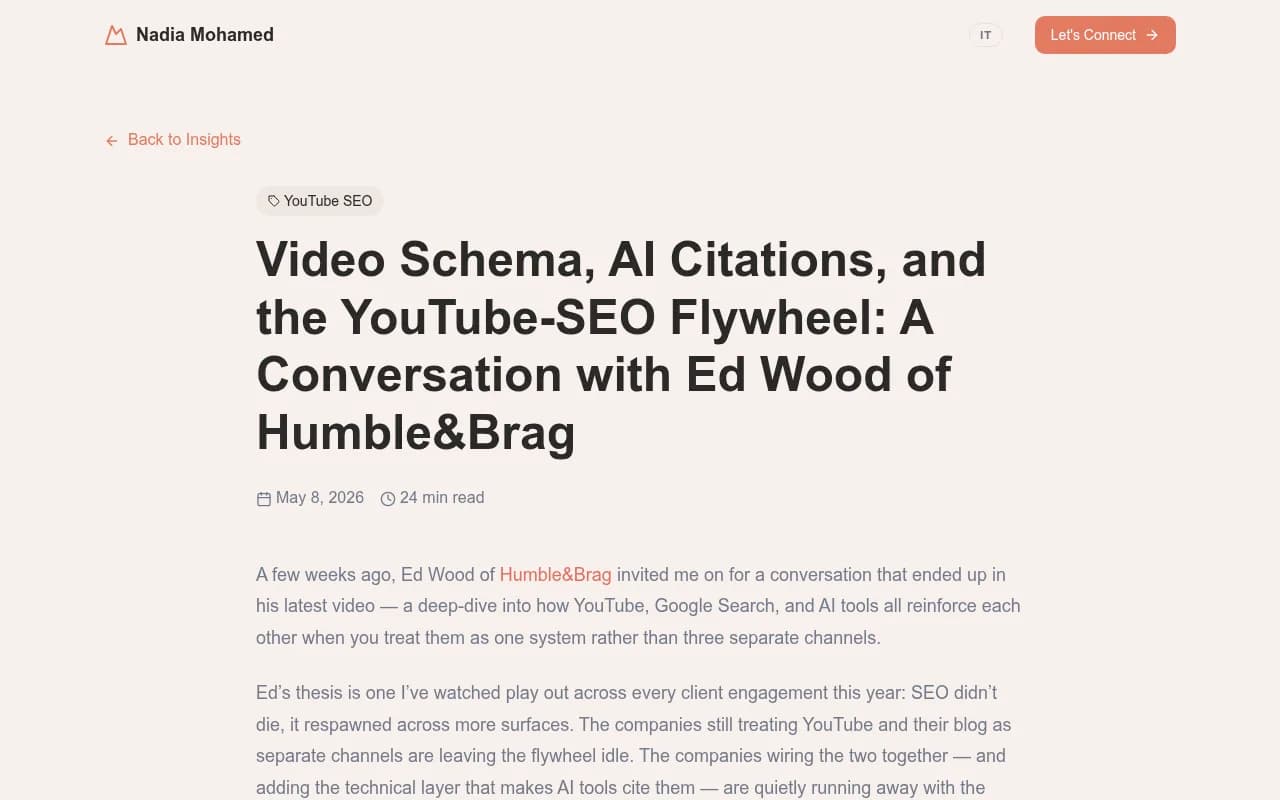
- YouTube holds roughly 20% of all citations across major AI platforms in 2026, making it the single most influential content type for AI visibility
- Ahrefs research across ~75,000 brands found YouTube mentions correlate more strongly with AI visibility than domain rating, backlinks, or brand mentions on other sites
- 94% of YouTube AI citations go to long-form video; views and subscriber count have near-zero correlation with citation frequency
- Only Gemini can actually "watch" a YouTube video. Claude has no direct access at all, which means transcript pages and structured metadata are essential
- Tracking YouTube citations requires dedicated AI visibility tools -- traditional rank trackers don't capture this data
Something interesting happened in 2026: YouTube stopped being just a video platform and became one of the most powerful AI citation sources on the internet. If you're only thinking about YouTube in terms of views and subscribers, you're measuring the wrong thing.
According to data from Six Digital, YouTube holds a 20% average citation share across AI platforms including Google AI Overviews, ChatGPT, and Perplexity. That's not a small number. For context, most individual websites would be thrilled to capture even 1% of citations in their niche. YouTube, as a domain, is eating a fifth of all AI citations.
The question isn't whether YouTube matters for AI search. It clearly does. The question is: which videos get cited, why, and how do you track it?
Why AI models cite YouTube videos at all
Before getting into tracking, it helps to understand the mechanics. AI models don't watch videos. They read text. So when ChatGPT or Perplexity cites a YouTube video, they're almost certainly working from one of three sources:
- The video's title, description, and metadata indexed by search engines
- Auto-generated or uploaded transcripts that appear in search indexes
- Third-party content (articles, forum posts) that reference and summarize the video
Gemini is the exception here. As a Google product with direct YouTube integration, Gemini can actually process video content. Claude, by contrast, has no direct YouTube access at all. This creates an important asymmetry: a video that's well-transcribed and has a rich description page will get cited across all AI models, while a video that relies purely on its visual content will only ever be cited by Gemini.
This is why Georgie Kemp from VEED noticed that approximately 10% of their AI citations were coming from YouTube videos published months or years ago, optimized for traditional search. Those videos had good descriptions, chapters, and in some cases transcript pages. The AI models could read them.
What actually predicts AI citation frequency
Research from OtterlyAI's 2026 study produced some genuinely surprising findings:
- 94% of YouTube AI citations go to long-form video (typically 10+ minutes)
- Views and subscriber count have near-zero correlation with citation frequency
- Description length and chapter structure are the strongest predictors of being cited
That last point is worth sitting with. A channel with 500 subscribers and detailed chapter markers and a 500-word description is more likely to get cited by ChatGPT than a channel with 500,000 subscribers and a two-sentence description.
The Ahrefs research (from Louise Lineham, analyzing ~75,000 brands) reinforces this from a different angle: YouTube mentions outperform every other factor in predicting AI brand visibility, including domain rating and backlink profiles. This held true across ChatGPT, Google AI Mode, and AI Overviews.
So the citation signal isn't about popularity. It's about readability and structure.
The technical layer: what AI crawlers can and can't see
This is where most people get it wrong. The AI crawlers (GPTBot for ChatGPT, ClaudeBot for Claude, PerplexityBot for Perplexity) don't execute JavaScript. If your video content is embedded in a JavaScript-rendered page, those crawlers see nothing.
A few things that matter technically:
Transcripts are the most important asset. If you want Claude or Perplexity to cite your video, you need the transcript to exist somewhere they can read it. That means either a dedicated page on your website with the full transcript, or a companion blog post that covers the video's content in text form.
VideoObject schema helps, but only in the right context. The common mistake is adding VideoObject schema to pages where the video is a secondary element. If the video isn't the primary content of the page, the schema doesn't help much. More importantly, nesting VideoObject inside a BlogPosting schema helps AI readability but does not get the video indexed as a video result in traditional search.
Chapter structure is both a YouTube signal and an AI signal. When you add chapters to a video (using timestamps in the description), YouTube surfaces them in search. But they also give AI models a structured outline of the video's content, which makes it far easier to cite specific sections.
Description length matters more than most people think. A 500-word description that covers the key points of the video gives AI models something to work with. A two-sentence description gives them almost nothing.
How to track which videos are being cited
This is the part most guides skip over, probably because it's genuinely harder than traditional rank tracking.
Traditional SEO tools track keyword rankings in Google. AI citation tracking is different: you're monitoring whether a specific URL (your YouTube video or your transcript page) appears in AI-generated responses to relevant prompts.
There are a few approaches, ranging from manual to fully automated.
Manual spot-checking
The simplest approach: take the key questions your video answers and ask them directly to ChatGPT, Claude, Perplexity, and Gemini. See if your video or channel gets mentioned.
This works fine for occasional checks but doesn't scale. You can't manually test hundreds of prompts across four AI models every week.
Dedicated AI visibility platforms
This is where purpose-built tools come in. Promptwatch tracks your brand and content visibility across 10 AI models (ChatGPT, Perplexity, Claude, Gemini, Grok, DeepSeek, and more), including page-level tracking that shows exactly which URLs are being cited, how often, and by which models.

The YouTube-specific capability here is the Reddit & YouTube Insights feature, which surfaces discussions and video content that AI models are actively citing. This tells you not just whether your videos are being cited, but which competitor videos are getting cited instead of yours -- which is often more actionable.
For teams that want a simpler entry point, a few other tools in the catalog offer AI citation monitoring:
Otterly.AI

Profound


The difference between these tools matters. Most monitoring platforms show you citation data but stop there. Promptwatch's Answer Gap Analysis goes further: it shows you which prompts competitors are visible for that you're not, and the built-in content generation tools help you create the pages and transcript content that would close those gaps.
Setting up prompt tracking for YouTube content
When configuring any AI visibility tool for YouTube tracking, you want to think about prompts in two categories:
Brand prompts: "What are the best YouTube channels for [your topic]?" or "Who should I watch to learn about [your niche]?"
Content prompts: The specific questions your videos answer. If you published a video called "How to set up Google Analytics 4 for ecommerce," your tracking prompt should be something like "How do I set up GA4 for an ecommerce store?"
The second category is where most of the citation opportunity lives. AI models are more likely to cite a specific video that answers a specific question than to recommend your channel in general.
Optimizing existing videos for AI citation
Here's the thing Georgie Kemp discovered at VEED: you probably already have videos that could be getting cited but aren't, because they're missing the text layer that AI models need.
The optimization checklist for existing videos:
1. Audit your descriptions. Go through your top 20 videos and check whether the descriptions actually summarize the content. If they're short, keyword-stuffed, or just promotional, rewrite them. Aim for 300-500 words that cover the key points the video addresses.
2. Add or improve chapters. Every video over 5 minutes should have chapters. Write chapter titles as questions or clear topic labels, not vague headings like "Part 1."
3. Create transcript pages. For your most important videos, publish a companion page on your website with the full transcript. This is the single most effective thing you can do to make your video content accessible to Claude and other AI models that can't access YouTube directly.
4. Check for JavaScript rendering issues. If your website uses a JavaScript framework and your video pages are client-rendered, AI crawlers may not be able to read them. Tools like Screaming Frog can help you audit this.
5. Add VideoObject schema correctly. Only add VideoObject schema to pages where the video is the primary content. Match the schema to the page architecture.
Which AI models cite YouTube most, and how they differ
Understanding the differences between AI models helps you prioritize where to focus.
| AI model | YouTube access | Citation behavior | What helps most |
|---|---|---|---|
| Gemini | Direct (can watch videos) | Cites YouTube heavily, especially recent content | Video quality, channel authority, recency |
| Google AI Overviews | Via search index | Cites videos that rank in Google video search | Traditional YouTube SEO + schema |
| ChatGPT | Text only (via index) | Cites based on description/transcript text | Long descriptions, transcript pages |
| Perplexity | Text only (via crawl) | Cites specific answers to specific questions | Chapter structure, answer-first descriptions |
| Claude | No direct access | Relies entirely on indexed text | Transcript pages on your website |
The practical implication: if you want citations across all five, you need both strong YouTube metadata (for Gemini and Google) and off-YouTube text content (for ChatGPT, Perplexity, and Claude).
Measuring the impact: connecting citations to traffic
Citation tracking tells you whether AI models are mentioning your videos. But the real question is whether those citations are driving traffic.
This is harder to measure than it sounds. AI-referred traffic often shows up in analytics as direct traffic or with referrer strings that don't obviously identify the AI source. A few approaches that work:
UTM parameters on transcript pages. If you link from your YouTube description to a transcript page on your website, use UTM parameters. When AI models cite the transcript page, the traffic will carry those parameters.
GSC integration. Google Search Console shows traffic from Google AI Overviews separately from organic search. If your videos are getting cited in AI Overviews, you'll see it there.
AI-specific traffic attribution. Platforms like Promptwatch offer traffic attribution through a code snippet, GSC integration, or server log analysis, connecting AI visibility to actual sessions and revenue. This closes the loop between "our video got cited" and "that citation drove 200 sessions last month."
The content gap problem: finding what you're missing
Most YouTube creators and SEO teams focus on the videos they've already published. The more valuable question is: what prompts are AI models answering in your niche where no one is citing your content?
This is the answer gap problem. If someone asks Perplexity "what's the best way to structure a SaaS onboarding video," and Perplexity cites three competitor channels but not yours, that's a gap. You either need a video that answers that question, or a transcript/article page that does.
Identifying these gaps manually is tedious. AI visibility platforms with gap analysis features automate this: they show you the prompts where competitors appear and you don't, along with the specific content that would close the gap.
A practical setup for 2026
If you're starting from scratch, here's a reasonable sequence:
-
Set up AI visibility tracking with a tool that monitors page-level citations (not just brand mentions). Configure prompts around the questions your videos answer.
-
Audit your top 20 videos for description quality and chapter structure. Fix the worst offenders first.
-
Create transcript pages for your five most important videos. Publish them on your website with proper VideoObject schema.
-
Check that your video pages aren't JavaScript-rendered in a way that blocks AI crawlers.
-
Monitor citation data for 4-6 weeks to establish a baseline, then use gap analysis to identify which new videos or transcript pages would have the most impact.
The companies that are quietly winning AI search right now aren't necessarily the ones with the biggest YouTube channels. They're the ones who figured out that AI models need text, and built the text layer around their video content before most people realized that was the game.
YouTube's 20% citation share isn't going to shrink. If anything, as AI models get better at processing video, the advantage will shift toward channels that have both the video content and the structured text to support it. Getting the infrastructure right now is the move.