Key takeaways
- Answer gap analysis means finding the prompts where competitors appear in AI answers but you don't — and then doing something about it.
- Promptwatch is the only platform in this comparison that closes the loop: it finds gaps, generates content to fill them, and tracks the results.
- Otterly.AI has strong citation analytics and multi-engine coverage, but stops at monitoring.
- Peec AI is clean and affordable, but capped at 100 prompts and missing Claude, Gemini, and AI Mode on its base plan.
- AthenaHQ is technically capable but monitoring-focused, with no content generation or crawler logs.
Answer gap analysis sounds simple: find the questions AI models answer for your competitors but not for you. In practice, it's where most GEO platforms fall apart. They show you a list of gaps. Then they leave you to figure out what to do with it.
That's the real test. Not which dashboard looks nicest, but which platform actually helps you close the gap between where you are and where you need to be.
In 2026, four platforms come up most often in this conversation: Peec AI, Promptwatch, Otterly.AI, and AthenaHQ. They're all tracking AI visibility. They all claim to help with answer gaps. But they work very differently — and the differences matter a lot depending on what you actually need.
Let's get into it.
What answer gap analysis actually means
Before comparing tools, it's worth being precise about what "answer gap analysis" means, because different platforms define it differently.
At its most basic, it's competitive prompt monitoring: you track a set of prompts, see which AI models cite your competitors, and notice where you're absent. That's table stakes.
A more useful version adds context: which prompts have the highest volume? Which gaps are winnable? What content would need to exist on your site for an AI model to cite you? What's the specific angle or question your site is currently failing to answer?
The best version closes the loop entirely: it identifies the gap, tells you what to create, helps you create it, and then tracks whether the new content gets cited.
Most platforms in this space do the first version. A few attempt the second. Only one does all three.
The four platforms, compared
Peec AI

Peec AI is a clean, focused monitoring tool. It tracks how your brand appears across ChatGPT, Perplexity, Google AI Overviews, and DeepSeek, with unlimited countries and languages at no extra cost — which is a genuine differentiator for international teams.
The gap analysis works by tracking your prompts against competitor responses and flagging where you're missing. The interface is straightforward, and the data is easy to read.
But there are real limitations. The Pro plan (€199/month) caps you at 100 prompts and 9,000 AI answers per month. Claude, Gemini, and Google AI Mode are Enterprise add-ons with custom pricing. There's no content creation tooling, no crawler logs, and no way to act on the gaps the platform surfaces.
For teams that just want a simple visibility monitor and don't need to do much with the data, Peec is fine. For teams that want to actually improve their AI visibility, the ceiling arrives fast.
Otterly.AI
Otterly.AI

Otterly.AI is one of the more mature monitoring platforms in the space. It covers prompt tracking, citation analysis, multi-engine monitoring, and competitor benchmarking — and it does all of these well. The citation analytics are particularly strong, and the platform recently added an MCP server that lets AI-native teams query their brand data without leaving their workflow.
On answer gap analysis specifically, Otterly shows you which prompts competitors are winning and where you're absent. The engine comparison view makes it easy to see whether a gap is specific to one model or consistent across all of them.
What Otterly doesn't do is help you close those gaps. There's no content generation, no content briefs, and no mechanism to go from "we're missing here" to "here's what we should publish." The platform is honest about this — it positions itself as a monitoring and analytics tool, not an optimization platform.
That's a reasonable position. But it means Otterly is only half the answer for teams that want to actually move their visibility scores.
AthenaHQ

AthenaHQ has strong technical credentials and covers prompt tracking, citation analysis, and competitor benchmarking across multiple AI engines. It's particularly focused on enterprise use cases, and AthenaHQ's own data claims a +45% increase in AI answer share for customers in a 30-day test period.
The gap analysis functionality shows you where competitors are visible and you're not, with decent filtering by model and topic area. The platform also has Shopify revenue attribution, which is useful for ecommerce brands.
What's missing: crawler logs, content generation, and any mechanism to act on the gaps identified. AthenaHQ is a monitoring platform with good analytics depth, but it stops there. No content briefs, no AI-generated articles, no way to go from gap to published page within the platform.
Promptwatch

Promptwatch takes a different approach to answer gap analysis. The feature is called Answer Gap Analysis, and it does what the name suggests: it shows you exactly which prompts competitors are visible for but you're not, and it identifies the specific content your website is missing — the topics, angles, and questions AI models want answers to but can't find on your site.
That's the monitoring half. The other half is what makes Promptwatch different from the other three.
Content Agents generate articles, listicles, comparisons, and content briefs grounded in real prompt data, citation data, prompt volumes, persona targeting, and competitor analysis. This isn't generic content generation — it's content built specifically to fill the gaps the platform has already identified. The briefs include brand guidance, search results, news context, screenshots, and uploaded knowledge-base files.
Then there's the tracking layer. Page-level visibility tracking shows exactly which pages are being cited, how often, and by which AI models. Agent Analytics (AI crawler logs) shows the timeline from publish to crawl to citation — so you can see when a new page gets discovered and when it starts appearing in AI answers. Traffic attribution connects visibility to actual revenue.
The result is a loop: find gaps, create content to fill them, track whether it works. Most platforms in this space do step one. Promptwatch does all three.
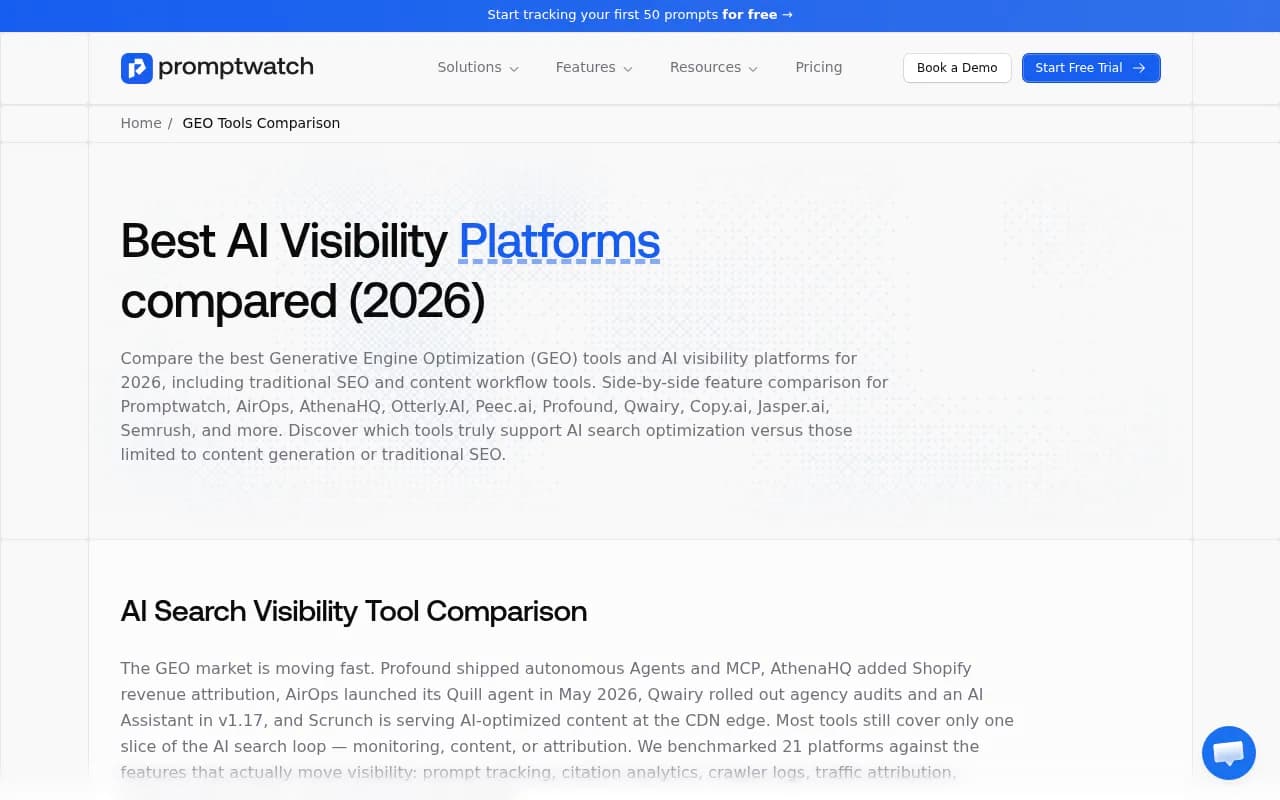
Feature comparison
Here's how the four platforms stack up across the capabilities that matter most for answer gap analysis:
| Feature | Peec AI | Otterly.AI | AthenaHQ | Promptwatch |
|---|---|---|---|---|
| Prompt tracking | Yes | Yes | Yes | Yes |
| Multi-engine coverage | 4 base (Claude/Gemini extra) | Yes | Yes | 10+ models |
| Competitor monitoring | Yes | Yes | Yes | Yes |
| Answer gap analysis | Basic | Yes | Yes | Yes (with content mapping) |
| Prompt volume/difficulty scores | No | No | No | Yes |
| Query fan-outs | No | No | No | Yes |
| Citation tracking | Yes | Yes (strong) | Yes | Yes |
| AI crawler logs | No | Beta | No | Yes (Professional+) |
| Content gap briefs | No | No | No | Yes |
| AI content generation | No | No | No | Yes |
| Page-level visibility tracking | No | No | No | Yes |
| Reddit/YouTube insights | No | No | No | Yes |
| ChatGPT Shopping tracking | No | No | No | Yes |
| Traffic/revenue attribution | No | No | Shopify only | Yes |
| Prompt cap (base plan) | 100 | Varies | Varies | 50 (free) / 150 (Pro) |
| Starting price | €199/mo | Varies | Custom | $99/mo |
Who should use which platform
This isn't a case where one platform is objectively best for everyone. The right choice depends on what you're actually trying to do.
Peec AI makes sense if you need a simple, affordable monitor for a small number of prompts and you're primarily interested in ChatGPT, Perplexity, and Google AI Overviews. The unlimited language/country coverage is useful for international brands. But if you need Claude or Gemini, or if you need to act on the gaps you find, you'll hit the ceiling quickly.
Otterly.AI is a good fit for teams that want deep citation analytics and multi-engine monitoring, and are comfortable doing their content work in a separate tool. The MCP integration is a nice touch for developer-heavy teams. It's not the right choice if you want a single platform that goes from gap identification to published content.
AthenaHQ suits enterprise teams with a technical SEO focus who want solid monitoring and are already running their own content operations. The Shopify attribution is useful for ecommerce. But the lack of content generation and crawler logs means you'll need to pair it with other tools.
Promptwatch is the right choice if you want to actually improve your AI visibility, not just measure it. The answer gap analysis feeds directly into content generation, which feeds directly into tracking — so you can run the full optimization cycle in one place. It's also the most comprehensive in terms of model coverage, with 10+ AI engines tracked including ChatGPT, Claude, Gemini, Perplexity, Google AI Mode, DeepSeek, Grok, Mistral, Meta AI, and Copilot.
The gap between monitoring and optimization
The deeper issue with most GEO platforms is that they're built around the assumption that visibility data is valuable by itself. It is — but only if you can do something with it.
Finding out that a competitor appears in ChatGPT responses to "best project management software for agencies" is useful information. Knowing that your site is missing content that addresses agency-specific workflows, pricing transparency, and onboarding time is more useful. Having a content brief that maps that gap to a specific article structure, with prompt volume data and competitor citation analysis built in, is actually actionable.
That's the difference between a monitoring dashboard and an optimization platform. Most tools in this space are the former.
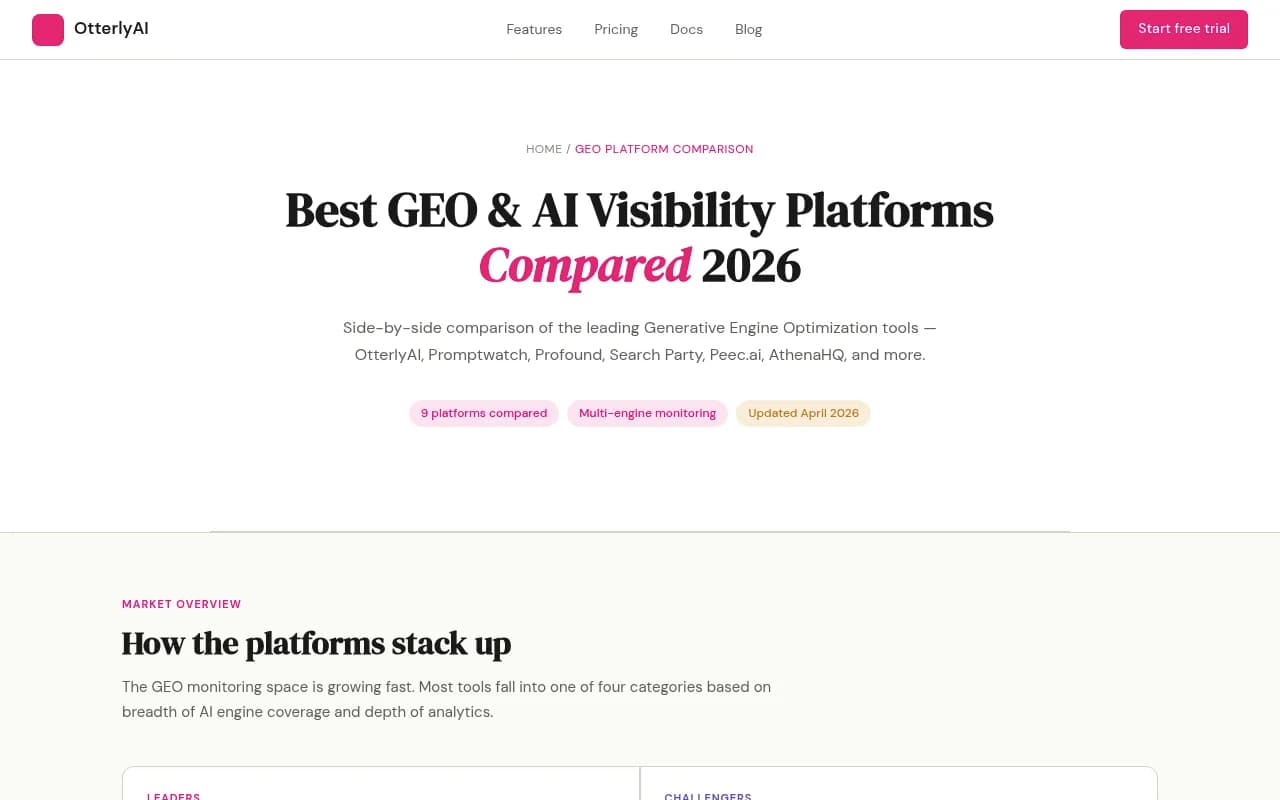
Promptwatch's pricing reflects this broader scope: Essential at $99/month (1 site, 50 prompts, 5 articles), Professional at $249/month (2 sites, 150 prompts, 15 articles, crawler logs), and Business at $579/month (5 sites, 350 prompts, 30 articles). There's a free trial available.
Peec AI's Pro plan at €199/month is competitive for pure monitoring, but the 100-prompt cap and limited model coverage mean it's not a like-for-like comparison.
The verdict
If the question is "which platform has the best answer gap analysis," the honest answer depends on what you mean by "best."
For raw monitoring breadth and citation analytics, Otterly.AI is strong. For clean, simple tracking at a reasonable price, Peec AI works. For enterprise-grade monitoring with technical depth, AthenaHQ is capable.
But if "best answer gap analysis" means the feature that actually helps you close the gaps — not just find them — Promptwatch is in a different category. It's the only platform here that connects gap identification to content creation to citation tracking in a single workflow. The others show you where you're losing. Promptwatch shows you where you're losing and helps you fix it.
For most marketing teams and agencies that care about AI visibility as an outcome rather than a metric, that distinction is what matters.