Key takeaways
- Profound is a strategic intelligence platform built around prompt volume data and opportunity discovery -- strong for prioritization, weak on content execution.
- AirOps is a content production engine with CMS integrations and AI writing workflows -- built to publish at scale, less focused on ongoing tracking.
- Promptwatch is the only platform in this comparison that closes the full loop: find visibility gaps, generate content to fix them, track results, and attribute traffic to revenue.
- Pricing matters: Profound's full functionality starts at $399/mo, AirOps requires contacting sales, and Promptwatch's Professional plan is $249/mo with a free trial.
- If your goal is to actually rank in AI search (not just monitor it), the tool you choose needs to do more than show you a dashboard.
There's a version of this comparison that just lines up features in a table and calls it a day. That's not this one.
Profound, AirOps, and Promptwatch are genuinely different products. They share a category name -- AI visibility -- but they're solving different problems for different teams. Picking the wrong one doesn't just cost you money. It costs you months of effort pointed in the wrong direction.
So let's get into what each one actually does, where each one stops, and which one makes sense depending on what you're trying to accomplish.
What we're actually comparing
Before the breakdown: all three tools exist because AI search is eating traditional search traffic. ChatGPT, Perplexity, Google AI Overviews, Claude -- these systems are answering questions that used to send people to your website. If your brand isn't cited in those answers, you're invisible to a growing chunk of your market.
The tools in this comparison help you understand and improve that visibility. But "help you" means very different things depending on the product.
Profound: the strategic intelligence layer
Profound is the most funded player in this space -- $58.5M from Khosla Ventures, Kleiner Perkins, NVIDIA, and Sequoia. That's a meaningful signal about where the market is heading, but it doesn't automatically translate into the right tool for your team.
Profound

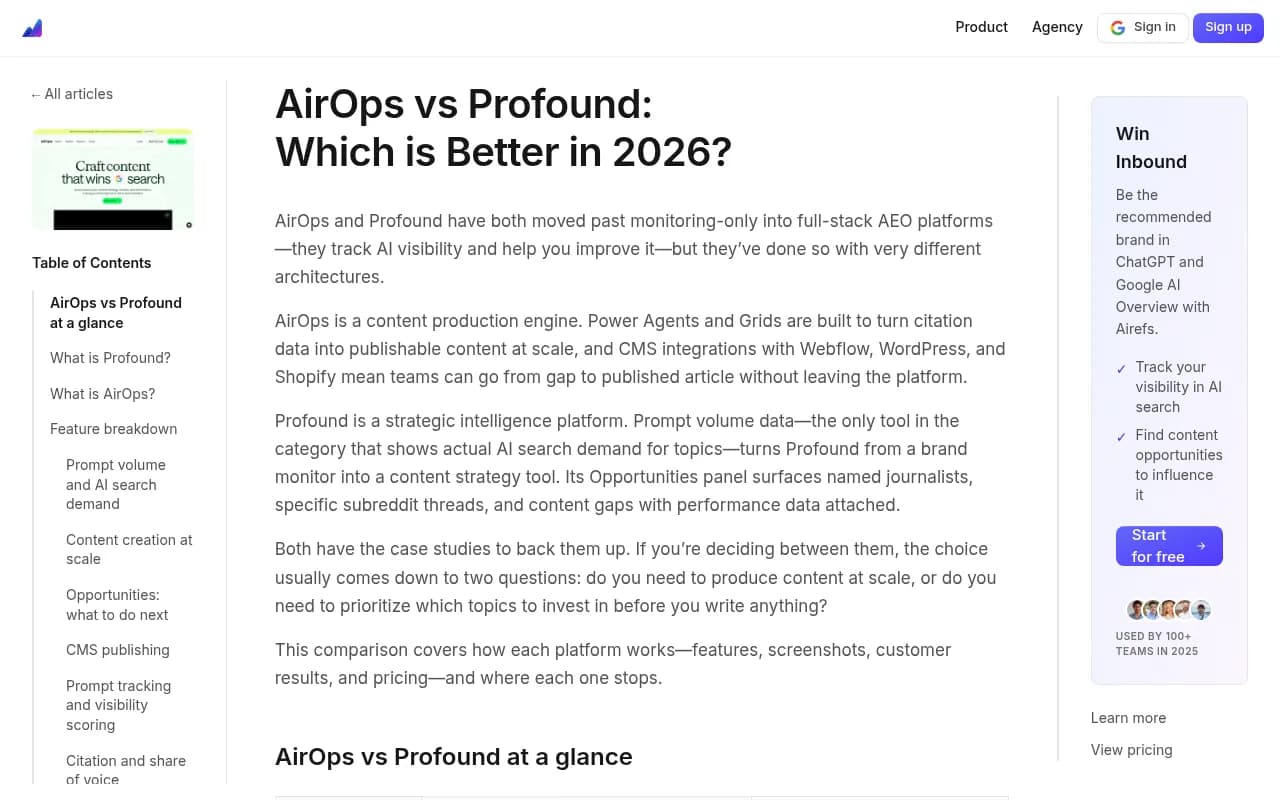
What Profound does well is strategic prioritization. Its standout feature is actual prompt volume data -- the only tool in this category that shows you real AI search demand for specific topics. That's genuinely useful. Instead of guessing which prompts matter, you can see which ones people are actually typing into ChatGPT and Perplexity, then build your content strategy around that signal.
The Opportunities panel is also worth noting. It surfaces named journalists, specific subreddit threads, and content gaps with performance data attached. That's more actionable than a generic "you're missing coverage here" alert.
Where Profound runs into friction: it's expensive to get the full picture. The platform starts at $99/mo, but most of the features that make it worth using -- including broader AI model coverage and deeper analytics -- sit behind the $399/mo tier. One analysis from contentmonk.io put it bluntly: Profound costs 48% more than competitors and only shows you visibility gaps without helping you create the content to fix them.
The other honest limitation: Profound doesn't have CMS publishing, Reddit tracking, or ChatGPT Shopping monitoring. For a platform at that price point, those are real gaps.
Best for: Enterprise teams that need to prioritize content investment before writing anything, and have budget to match.
AirOps: the content production engine
AirOps takes a different angle entirely. It's less focused on monitoring and more focused on production -- turning citation data into published content at scale.
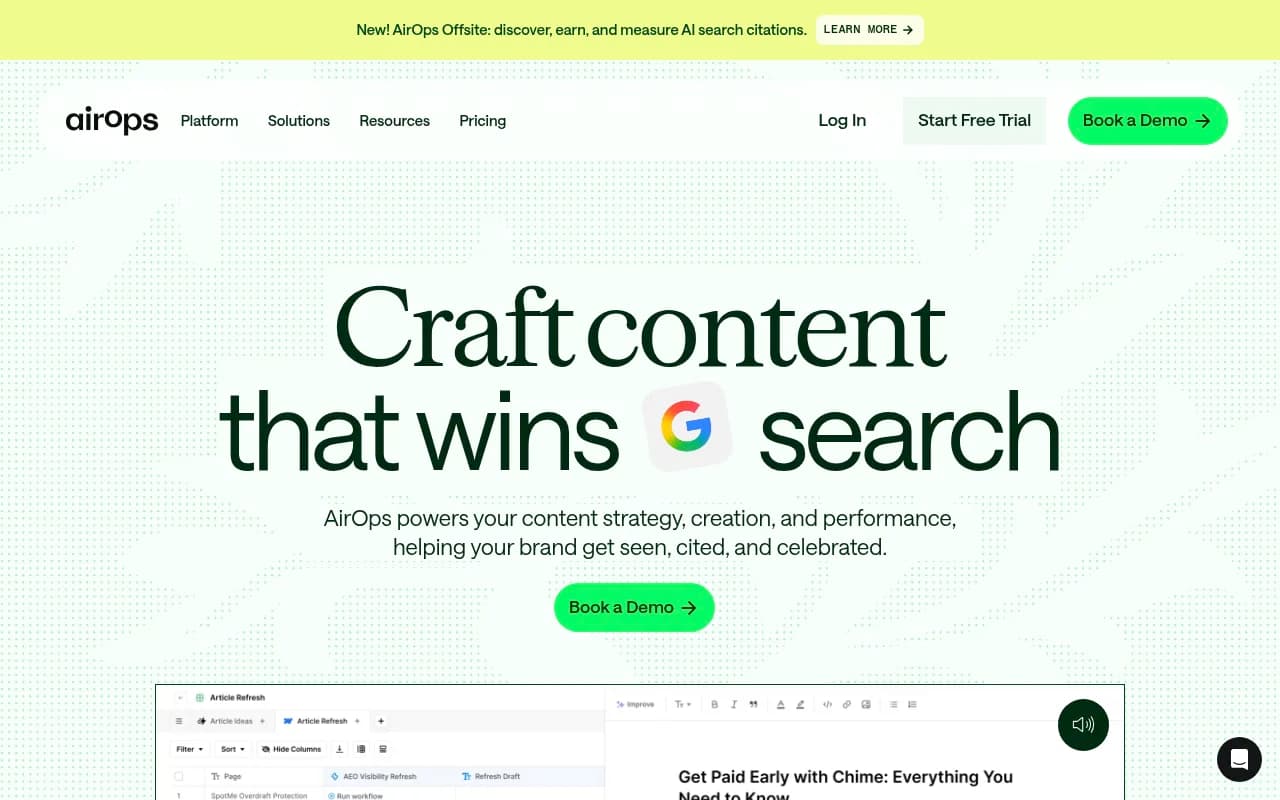
The core of AirOps is its Power Agents and Grids system. You feed it your visibility gaps, and it generates content briefs, drafts, and (through CMS integrations with Webflow, WordPress, and Shopify) can publish directly without leaving the platform. For teams that need to produce a lot of content fast, that pipeline is genuinely useful.
AirOps also has a Page360 analytics layer that unifies AI citation data with Google Analytics, which gives you some sense of how AI visibility connects to actual traffic. That's a step beyond pure monitoring.
The limitations are real though. AirOps tracks fewer AI models at lower tiers (ChatGPT only on the Solo plan; ChatGPT, Google, Perplexity, and AI Studio on Pro+). Pricing isn't transparent -- you need to contact sales for anything beyond the free Insights tier. And while the content production workflow is strong, the monitoring side is thinner than Profound or Promptwatch.
There's also a customer profile question. AirOps counts Webflow, Notion, HubSpot, Ramp, and Carta among its customers -- mostly growth-stage SaaS companies that need to produce content at scale. If that's your situation, AirOps fits well. If you need deep competitive intelligence or multi-region tracking, it's not built for that.
Best for: Content teams at growth-stage SaaS companies that need to publish AI-optimized content quickly and at volume.
Promptwatch: the full-loop platform
Promptwatch is built around a different premise than the other two: monitoring alone doesn't get you ranked. You need to find the gaps, fix them with content, and then verify that the fix worked.

That sounds obvious when you say it out loud. But most tools in this category stop at step one. They show you a dashboard of where you're invisible, and then leave you to figure out what to do about it.
Promptwatch's Answer Gap Analysis shows you exactly which prompts competitors are getting cited for that you're not -- not just that a gap exists, but the specific topics, angles, and questions AI models want answers to but can't find on your site. Then the built-in AI writing agent generates content grounded in real citation data (880M+ citations analyzed), prompt volumes, persona targeting, and competitor analysis. Not generic SEO filler -- content engineered to get cited by ChatGPT, Claude, Perplexity, and others.
After you publish, page-level tracking shows which pages are being cited, how often, and by which models. Traffic attribution (via code snippet, Google Search Console integration, or server log analysis) connects visibility to actual revenue. That's the loop closed.
A few capabilities that stand out in the context of this comparison:
- AI Crawler Logs: Real-time logs of AI crawlers hitting your site -- which pages they read, errors they encounter, how often they return. Profound and AirOps don't have this.
- Reddit and YouTube Insights: Surface discussions that directly influence AI recommendations. Most competitors ignore this channel entirely.
- ChatGPT Shopping Tracking: Monitor when your brand appears in ChatGPT's product recommendations and shopping carousels.
- Multi-language and multi-region: Monitor AI responses in any language, from any country, with customizable personas.
- 10 AI models monitored: ChatGPT, Perplexity, Google AI Overviews, Google AI Mode, Claude, Gemini, Meta/Llama, DeepSeek, Grok, Mistral, Copilot.
Promptwatch is used by 6,700+ brands and agencies including Booking.com, Center Parcs, and Wortell. Pricing starts at $99/mo (Essential), $249/mo (Professional), and $579/mo (Business), with a free trial available.
Best for: Marketing and SEO teams that want to actually improve AI search rankings, not just track them. Agencies managing multiple clients. Any brand that needs to connect AI visibility to traffic and revenue.
Side-by-side comparison
| Profound | AirOps | Promptwatch | |
|---|---|---|---|
| AI models monitored | 3 (Growth) / 10+ (Enterprise) | 1-4 depending on plan | 10 across all plans |
| Prompt volume data | Yes (unique) | Limited | Yes |
| Content generation | Briefs + drafts | Power Agents + Grids | AI writing agent (citation-grounded) |
| CMS publishing | No | Webflow, WordPress, Shopify | No (content exported) |
| AI crawler logs | No | No | Yes |
| Reddit/YouTube tracking | No | No | Yes |
| ChatGPT Shopping | No | No | Yes |
| Traffic attribution | Google Analytics | Page360 (GA integration) | GSC, code snippet, server logs |
| Multi-region/language | Limited | Limited | Yes |
| Answer gap analysis | Yes | Yes | Yes (core feature) |
| Starting price | $99/mo ($399 for full features) | Free / contact sales | $99/mo |
| Free trial | Free AEO report | 14 days + 50K credits | Yes |
| Best for | Strategic prioritization | Content production at scale | Full-loop optimization |
How to choose
The honest answer depends on where your team is stuck.
If you're stuck on prioritization -- you have content capacity but don't know which topics to invest in -- Profound's prompt volume data is genuinely useful. It's the only tool that shows real AI search demand, and the Opportunities panel gives you named sources and specific threads to target. Just be prepared for the price jump when you need the full feature set.
If you're stuck on production -- you know what to write but can't publish fast enough -- AirOps's content pipeline is worth looking at. The CMS integrations and Power Agents workflow reduce the gap between "identified opportunity" and "published article." The monitoring side is thinner, but if production is the bottleneck, that trade-off might make sense.
If you're stuck on results -- you've been monitoring for months but your AI visibility scores aren't moving -- the issue is probably that monitoring-only tools can't fix the problem they're showing you. Promptwatch's action loop (find gaps, generate content, track results) is built specifically for this situation. The AI crawler logs and traffic attribution also help you understand why visibility isn't improving, not just that it isn't.
There's also a budget reality to consider. If you're a smaller team or agency, Profound's full functionality at $399/mo is a significant commitment. Promptwatch's Professional plan at $249/mo covers two sites, 150 prompts, 15 articles per month, crawler logs, and state/city tracking -- more complete coverage at a lower price.
What the research actually shows
A few things worth noting from the broader market research on this category:
One analysis from ZipTie.dev noted that "Profound's brand recognition in the category sometimes outpaces feature delivery relative to competitors at similar price points." That's a polite way of saying the reputation is ahead of the product in some areas.
AirOps's Page360 analytics layer is described by Omnia's research as "the most complete prompt-to-published-content pipeline in this category" -- a fair characterization of the production workflow, though it undersells how thin the monitoring side is.
Promptwatch's data -- over 1.1 billion citations, clicks, and prompts processed -- has been cited in the Wall Street Journal and Axios. That scale of citation data is what makes the content generation actually useful: the AI writing agent isn't guessing what gets cited, it's working from a dataset of what has gotten cited.
The bottom line
Profound, AirOps, and Promptwatch are three legitimate products solving three different versions of the same problem. None of them is obviously wrong for every use case.
But if you're trying to actually move your AI visibility scores -- not just understand them -- the tool you need has to close the loop between finding gaps and fixing them. Profound shows you the gaps. AirOps helps you fill them with content. Promptwatch does both, tracks whether it worked, and connects the results to traffic and revenue.
That's a meaningful difference in 2026, when AI search is already driving real traffic and the brands that figure out the optimization cycle first will be the ones that show up in answers a year from now.