Key takeaways
- Scrunch bills prompt credits per AI engine, so a 125-prompt Core plan tracking four engines is really about 31 four-engine prompts a month, not 125 — the sticker price hides the real unit cost.
- Scrunch's data exports cap at 8 queries per export with no fixed schema and no API below Enterprise, which means rebuilding months of historical trend data before a switch is a manual, multi-session job, not a CSV download.
- Sitecore's acquisition of Scrunch (announced June 3, 2026) is the actual trigger behind most of these migrations — teams not on Sitecore's DXP are increasingly treated as a secondary market.
- Using the standard SaaS switching-cost framework (data migration, integration rebuild, retraining, productivity dip, contract exit), a Scrunch-to-Promptwatch move for a mid-market team typically breaks even inside 2-4 months, well under the usual 3-year hurdle rate.
- Promptwatch starts at $95/month with every AI engine, the API, and MCP included, versus Scrunch's $250-300/month for 4 engines with credit-per-engine consumption and no programmatic export on the Core tier.
Why teams are even asking this question
Nobody switches AI visibility platforms for fun. It's expensive to set up new prompt sets, retrain a team on a new dashboard, and explain to a VP of marketing why last quarter's charts don't match this quarter's. So when I started digging into why so many Scrunch customers are quietly evaluating alternatives right now, I expected the usual complaints: price, feature gaps, support tickets that go nowhere. Those are all in there. But the bigger story is structural.
Sitecore acquired Scrunch on June 3, 2026, folding its AI-visibility monitoring into Sitecore's broader SitecoreAI digital experience platform. If you're already a Sitecore DXP customer, that's probably good news — Scrunch's recommendations are being wired directly into Sitecore's content management and digital asset management tools. If you're not on Sitecore, you're now a standalone customer of a product whose roadmap is increasingly built for somebody else's stack. That's the quiet reason a lot of teams are running the switching-cost math this month.
This piece walks through what that math actually looks like, using the real numbers behind a Scrunch-to-Promptwatch move. Not the vendor pitch version. The actual receipts.
What Scrunch costs versus what it looks like it costs
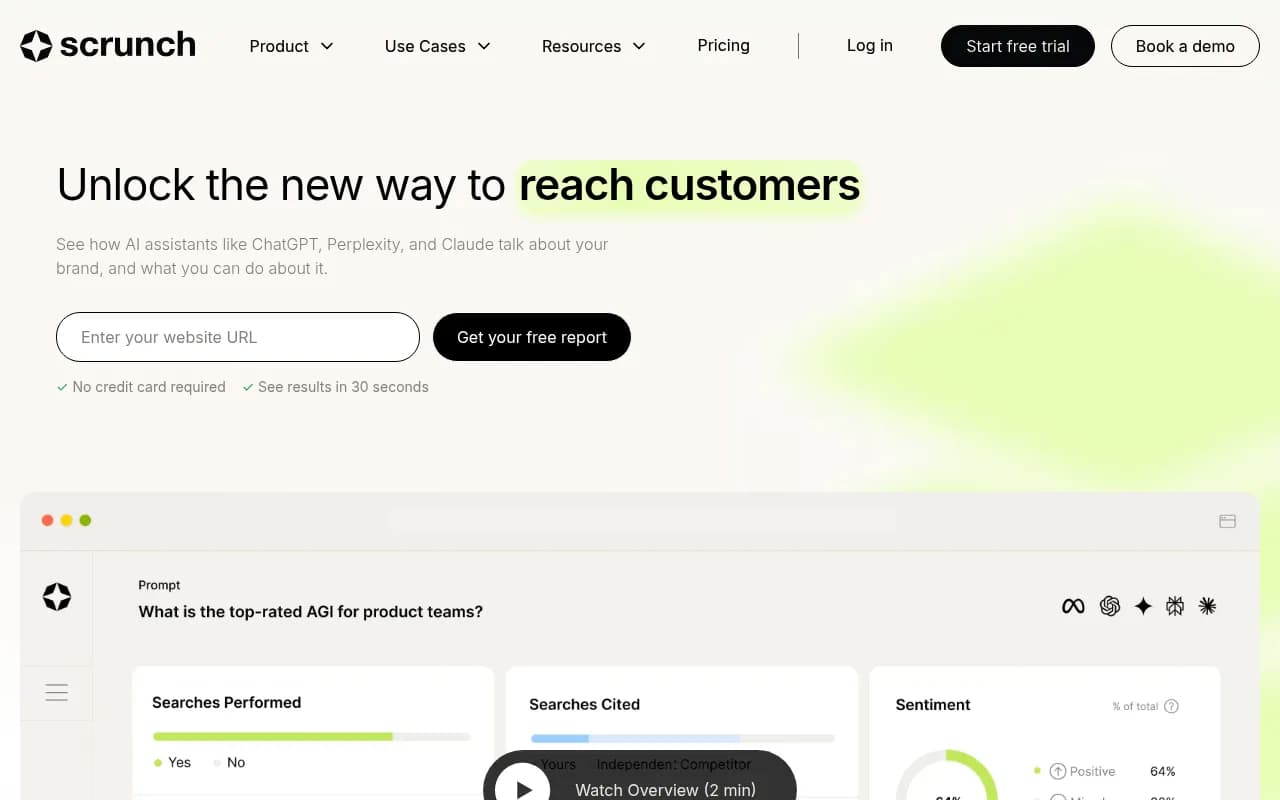
Scrunch's pricing page lists a Core plan at $250/month, but that's the annual-billed rate. Pay month-to-month and it's $300/month, for 125 unique prompts, 5,000 responses, 5 site audits, and 4 tracked LLMs (ChatGPT, Perplexity, Google AI Overviews, Copilot). Enterprise expands to 9 engines and adds API access and SSO, but pricing there is a custom quote with no published floor, so you can't benchmark total contract value without a sales call.
Here's the part that trips people up: Scrunch consumes a separate prompt credit per engine tracked. Track one prompt across four engines and you've spent four credits, not one. A brand running 125 "unique prompts" against the four included engines is realistically burning through the equivalent of about 31 four-engine prompts before hitting the cap. One G2 reviewer summed it up bluntly: "At $300/month with no actionable optimization tools, you are paying a lot just to watch." Another flagged that data refreshes weekly, not daily, which for a channel this volatile is a real handicap.
Compare that to how Promptwatch prices the same job. Promptwatch doesn't charge per engine — a tracked prompt already includes coverage across all 9 supported AI platforms (ChatGPT, Gemini, Claude, Perplexity, Grok, Meta Llama, DeepSeek, Mistral, Copilot, plus Google AI Overviews and AI Mode), generating roughly 120 data points per prompt. Essential starts at $95/month for 50 prompts and 6,000 responses. Professional is $245/month for 150 prompts and 18,000 responses, and adds crawler logs and automated content generation. No engine costs extra at any tier.

| Platform | Entry price/mo | Prompts included | Engines | Credit-per-engine? | API/MCP on entry tier? |
|---|---|---|---|---|---|
| Scrunch AI | $250-300 | 125 (nominal) | 4 | Yes | No (Enterprise only) |
| Promptwatch | $95 | 50 | 9 | No | Yes, included |
| Peec.ai | $95 | 50 | 3 of 6 (extra models $35/mo) | No | Enterprise only |
| Semrush AI Visibility Toolkit | $99 | 25 | 4 | No | Add-on |
| Otterly.AI | $29 | 15 | 4 | No | No below $189 |
On a pure cost-per-response basis, Scrunch lands around $0.017-0.025 depending on which third-party tracker you check, while Promptwatch sits around $0.016. Close on paper. The gap widens once you account for what Scrunch's credit system actually does to your effective prompt count.
The five costs nobody puts in the pricing comparison
The standard SaaS switching-cost framework breaks a migration into five buckets: data migration, integration rebuild, training and change management, the productivity dip while people relearn the tool, and contract exit costs. I want to run each of these against a real Scrunch-to-Promptwatch move, because this is where most switching decisions actually get made or killed.
1. Data migration
This is the ugly one. Scrunch's export tooling is not built for bulk extraction. There's a "Print to PDF" option on the home page that Scrunch's own help docs describe as "not intended for data analysis or manipulation." The actual CSV/Excel export is capped at 8 queries per export, runs asynchronously, and has no fixed schema — the columns you get reflect whatever view you happened to build in the UI. Citation domain and URL breakdowns work the same way. Query API and MCP access, which would let you script a proper pull, are Enterprise-only.
Practically, that means reconstructing several months of prompt-level trend data means dozens of manual export sessions, each limited to 8 queries, stitched back together by hand because there's no consistent schema across pulls. Most teams doing this honestly conclude it isn't worth the hours. The general SaaS guidance here is blunt: most "historical" data has something like a 5% recall rate once it's six months old, meaning the ROI on a full historical migration is usually low anyway. The smarter move is exporting the last 60-90 days as a baseline reference and starting fresh in the new tool rather than trying to port everything.
2. Integration rebuild
If you connected Scrunch to a CMS, Slack, or a BI tool, you'll need to redo those connections. Promptwatch connects crawler logs via Cloudflare, AWS CloudFront, Fastly, Vercel, Netlify, or a custom HTTP endpoint, and publishes content directly to Webflow, Framer, or WordPress. It also ships an MCP server that works with Claude, Cursor, and ChatGPT, and a REST API v2 authenticated with a simple header. Setting up the MCP connection is a single command:
claude mcp add --transport http promptwatch https://server.promptwatch.com/mcp --header "Authorization: Bearer YOUR_API_KEY"
That's a morning of work for most teams, not a sprint.
3. Training and change management
Scrunch users on G2 consistently praise it as "easy to use, intuitive" with a dashboard that makes brand presence easy to scan — that's a real strength and a real cost to give up. Any new tool means new dashboards, new terminology, new habits. Budget a week or two of reduced velocity while the team gets fluent, especially if you're moving from Scrunch's weekly refresh cadence to Promptwatch's daily one, which changes how often people should actually be checking in.
4. Productivity dip
This is the soft cost that rarely makes it into a business case but always shows up in the retro. For roughly two to four weeks, expect slower turnaround on GEO reporting and content decisions as the team re-baselines prompts, re-learns the interface, and figures out which alerts actually matter. It's real, but it's finite, and it's smaller the earlier you start using the new tool's action layer instead of just its dashboards.
5. Contract exit costs
Scrunch's free trial requires a credit card and runs 7 days before auto-converting to a paid plan, so if you're mid-trial this is cheap to walk away from. If you're on an active annual contract, this is where the math can get painful — the standard framework example is a $5,000/month tool with 8 months left on term costing $40,000 to exit before migration even starts. Check your renewal date before you check anything else.
Why the citation-scarcity angle matters more than people think
Here's a detail that changes how urgently you should treat a migration: Promptwatch's own research on average sources per response shows ChatGPT typically cites around 5 sources per web-search answer, while Google AI Overviews and Perplexity cite closer to 10 each. That's a tight number of slots. Microsoft Copilot, by contrast, has swung wildly — from under 2 sources to nearly 17 within a few weeks — evidence that Microsoft is still rebuilding its retrieval system in public (see Promptwatch's data on average sources per response: https://promptwatch.com/data/average-sources-per-response).
The practical implication: if your visibility tracking goes dark or fuzzy for a month during a platform switch, you're not missing a little noise in a high-volume channel. You're missing changes in a five-slot game where being cited or not cited is close to binary. That's the argument for moving fast and cleanly rather than running both tools in parallel indefinitely "just to be safe."
It's also worth noting that log-based crawler tracking, which tells you whether AI bots are actually reading your pages before they cite them, has a much shorter history on most competing platforms than people assume. Promptwatch's own comparison page notes it shipped Fastly log ingestion in July 2025 and full server log analysis that August, while "most of the market didn't turn logs on until 2026, some only this month." If crawler-log history matters to your GEO strategy, check how long a platform has actually had this feature running before assuming the data goes back further than it does.
Running the break-even math
McKinsey's commonly cited SaaS switching guidance sets a rough hurdle: if total switching cost divided by annual savings exceeds three years, the financial case is weak without a non-financial reason to move. Let's run a simple version for a mid-market team moving from Scrunch Core ($300/month, paid monthly) to Promptwatch Professional ($245/month):
- Annual savings: ($300 - $245) x 12 = $660/year on list price alone, before accounting for the fact that Promptwatch Professional includes 150 prompts across 9 engines with no per-engine credit tax, versus Scrunch's 125 nominal prompts across 4 engines with credits consumed per engine (effectively far fewer usable prompt-checks for the money).
- One-time switching cost: figure 15-25 hours of team time (data export attempts, prompt rebuilding, integration setup, training) at a blended rate, plus whatever's left on a Scrunch contract term.
- Even without counting the functional upgrade, most teams land well inside a one-year payback, let alone the three-year hurdle, once you price in the actual usable-prompt gap rather than the sticker price.
The math gets more favorable once you count what the new tool does that the old one didn't. Scrunch's Core and Explorer tiers have no query API, no MCP, and a capped manual export — so there's no action layer to speak of below Enterprise. Promptwatch's entry tier already includes content gap analysis and visitor analytics, and Professional adds crawler logs and automated content generation with direct CMS publishing. That's not a like-for-like swap of monitoring dashboards. It's trading a tool that tells you where you stand for one that also drafts and ships the fix.
What to actually do if you're weighing this move
A few concrete steps, in order:
- Check your Scrunch contract renewal date first. This determines whether you're making a financial decision or a free one.
- Export the last 60-90 days of Scrunch data through the Configure > Exports metadata tool and the citation breakdown exports, accepting the 8-query cap. Don't chase a full historical migration — the recall value on older data is low anyway.
- Rebuild your prompt list in the new tool rather than trying to port it exactly. Scrunch's per-engine credit consumption means your "prompt count" there doesn't map cleanly to a platform that prices per prompt across all engines.
- Set up crawler-log ingestion (via your CDN) and the MCP or API connection in the first week, even before fully retiring the old tool, so you're not flying blind during the transition given how few citation slots exist per AI response.
- Run both tools in parallel for no more than 2-3 weeks, long enough to sanity-check the new baseline, not so long that you're paying for two subscriptions out of caution.
If you're still comparing more than these two platforms, the broader landscape comparison of 22 GEO and AI visibility tools is worth a look, and the GEO software directory at bestgeosoftware.com is a reasonable place to browse alternatives if neither Scrunch nor Promptwatch turns out to be the right fit for your team's size and stack.
Switching platforms is never free. But when a vendor's roadmap visibly shifts toward serving a different customer than you, and the credit structure is quietly taxing you per engine, the real number to watch isn't the monthly invoice. It's how many usable prompt-checks you're actually getting for it, and how long it takes anyone on your team to turn a visibility gap into a published fix.