Key takeaways
- Brandlight is enterprise-only with no public pricing (estimates land between $199/month and $25,000+/month), pairs monitoring with a dedicated activation team, and reports 183M AI answers analyzed daily across up to 13 engines depending on the page you read.
- AthenaHQ starts at $295/month (Starter) or free (Essential), covers 11 models, and just shipped Athena Citation Engine (ACE), a model that scores content on citation probability before you publish it.
- Peec AI is the most accessible of the three at $95/month for Starter, covering 3 models with daily tracking, and its feature set spans discovery, measurement, action, and reporting stages including ChatGPT Shopping SKU tracking.
- None of these three self-published comparisons are neutral. Two of them (AthenaHQ vs. Peec, Brandlight's own "best tools" post) are vendor-authored and rank the publisher first.
- "Deepest data" isn't just about how many engines you track. It's about citation-type granularity, UI-based monitoring versus API-only sampling, and whether the platform tells you why you're invisible, not just that you are.
Why this comparison exists (and why it's messier than it looks)
If you've searched for a comparison of Brandlight, AthenaHQ, and Peec AI, you've probably already found one written by AthenaHQ (comparing itself to Peec) or one written by Brandlight (ranking itself #1 in a "best tools" roundup that also happens to be Brandlight's own blog). That's not a knock on either company. Everyone does this. It just means you need a third-party lens before you commit budget.
I went through the vendor pages, pricing tables, G2 listings, and the handful of independent teardowns that exist, and tried to separate what's verifiable from what's marketing copy dressed as a comparison. Here's where each platform actually stands.
What "monitoring-first" even means here
All three platforms start from the same premise: track how ChatGPT, Gemini, Claude, Perplexity, Google AI Overviews, and others answer prompts about your brand and category, then tell you something useful about it. Where they diverge is how much they do after that measurement step.
- Brandlight frames itself as See, Shape, Act, Transform. It measures, then routes content through a multi-agent workflow (strategist, writer, editor, validator) that produces drafts for human and legal review. It does not auto-publish.
- AthenaHQ measures, then hands you a content optimization agent and prioritized on-page/off-page actions, plus the new ACE scoring layer for pre-publication decisions.
- Peec AI measures across discover, measure, act, and report stages, with gap analysis and a Peec agent that runs pre-built or custom skills, but multiple independent reviewers describe it as "monitoring only, no content generation" at the core.
If your team wants a platform that writes and publishes content on autopilot, none of these three are built for full automation the way a Content Agent-driven platform is. For that comparison point specifically, tools like Promptwatch are worth a look, since its agentic layer plans, writes, and publishes GEO content directly to Webflow, Framer, or WordPress rather than just handing you a recommendation.

Brandlight: the enterprise activation play
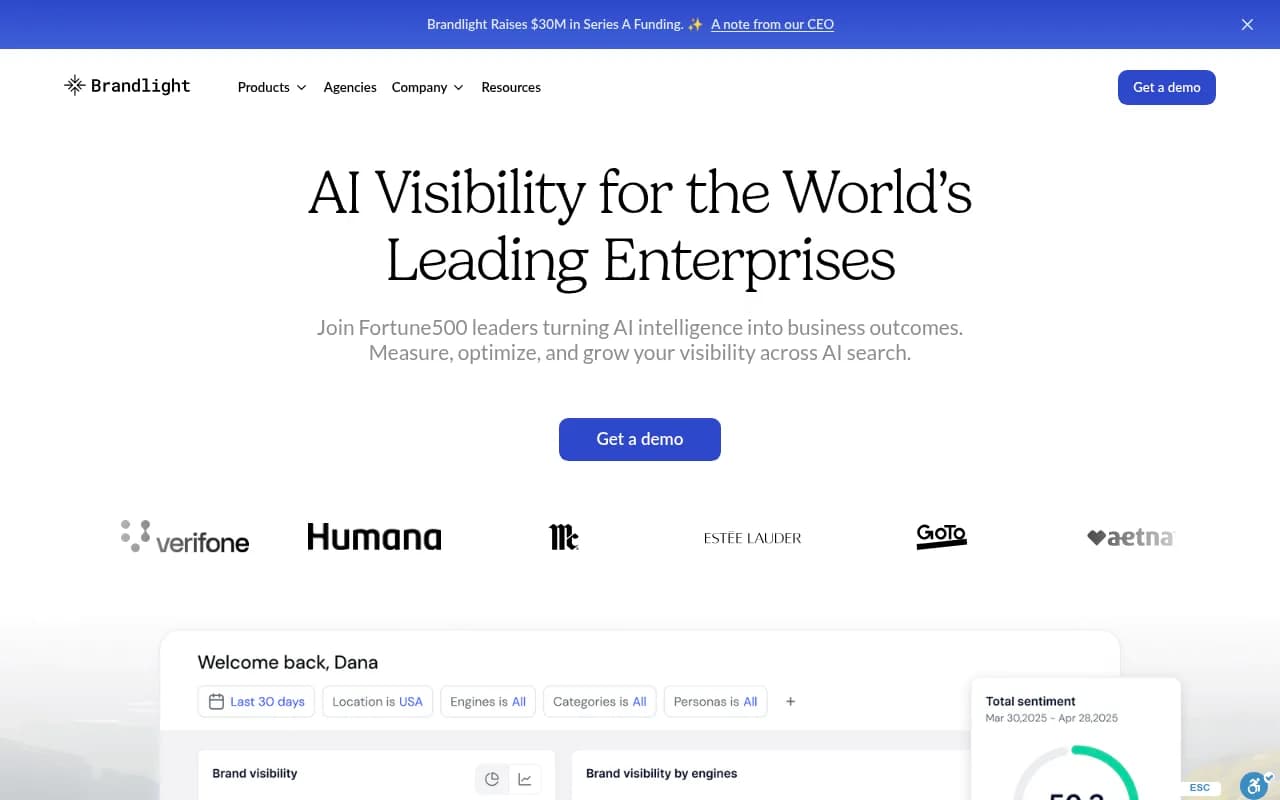
Brandlight positions itself, on its own blog, as the platform for "Fortune 500-class, multi-brand, multi-market organizations that need to change how AI represents them, not just watch a number." That's a real differentiator from a pure tracker, and the Kimberly-Clark case study backs it up: Brandlight reports moving 12 of 12 brands into the top three across all major LLMs for that customer, with 100% paid-pilot-to-annual conversion.
The data claims are where things get murky. Brandlight's research hub (research.brandlight.ai) states 1.8B AI data points analyzed daily and 183M AI answers analyzed, serving 148+ enterprises. But the same company's blog post comparing AI visibility tools cites a different figure, 100M+ answers analyzed and ~98.5M+ sources indexed. Both can be true if the numbers simply update over time and the blog post is older, but it's worth flagging when a vendor's own two pages disagree on the headline metric for "depth of data."
One genuinely useful piece of research Brandlight published: a study asking the same 900 questions via official APIs versus real consumer UIs across ChatGPT, Gemini, and Perplexity, finding only 6-12% brand overlap between the two. That's a real methodology point. If a monitoring platform is pulling data through an API rather than watching what real users actually see in the interface, the numbers can diverge a lot. Promptwatch makes a similar case for its own approach, since its dataset of 26B+ analyzed citations, prompts, and responses is built on real UI monitoring rather than API sampling, which matters if you're trying to answer "what does my customer actually see" rather than "what does the API return."
Engine coverage for Brandlight is inconsistent across its own pages: the comparison blog claims 13 engines tracked, the in-depth post names 7 (ChatGPT, Google AI Overviews, Google AI Mode, Gemini, Perplexity, Microsoft Copilot, Claude) with "coverage adapted per market," and a third-party review says only 4 engines are named on the commerce product page. G2 shows 4.7/5 from 19 verified reviews, with the most commonly cited limitation being lack of transparent pricing. There's no public pricing page; you start with a paid 3-month pilot, and third-party estimates (unverified by Brandlight) suggest anywhere from $199/month to $25,000+/month depending on scope.
AthenaHQ: the automation-first challenger with a citation-probability model
AthenaHQ, founded by former Google Search and DeepMind team members, is more transparent about pricing than Brandlight. Essential is free with $25 of credit, Starter is $295/month for 3,600 credits and coverage of 11 models (ChatGPT, Perplexity, AI Overviews, AI Mode, Gemini, Claude, Copilot, Grok, DeepSeek, Meta AI, Mistral), and Enterprise is custom.
What stands out for the "deepest data" question is Athena Citation Engine (ACE), an Enterprise-tier feature described as a proprietary ML model trained on millions of AI search results. It reads a piece of content and returns a citation-probability score between 0 and 1, letting teams move from reactive tracking to predicting whether a draft is likely to get cited before it ever publishes. That's a meaningfully different kind of depth than "how many engines do you track" — it's depth in predictive modeling on top of the raw citation data.
AthenaHQ's reported customer numbers are aggressive: a 50% increase in demos from AI search, 38% month-over-month lead increase, 40% increase in brand mention rate, and one case citing 1,561% ROI. These come from AthenaHQ's own comparison page against Peec, so treat them as vendor-sourced, but the specificity (percentages, not vague claims) is at least a step up from generic testimonial language. G2 shows a 4.9 rating. One quoted customer switched from a competitor charging nearly $6k/month, citing dashboard density and export friction as the reason they left — a useful, concrete complaint about a rival platform rather than a vague dig.

Peec AI: the transparent, mid-market analytics stack
Peec AI is the clearest on pricing of the three: Starter at $95/month (50 prompts, 3 models, daily tracking, 1 project), Pro at $245/month (150 prompts, 2 projects), Advanced at $495/month (350 prompts, 5 projects, multi-country, Looker Studio integration), and a custom Enterprise tier that tracks up to 13 LLM models.
On raw feature depth, Peec's own pricing page breaks its product into four stages that read like a genuinely comprehensive monitoring stack: Discover (prompt suggestions, intent classification, personas, bulk import), Measure (visibility, position, sentiment, share-of-voice, an Ads library, AI Shopping SKU-level tracking, source analytics with domain/URL-level citation share, brand perception and objection tracking, fact-checking against brand-set facts), Act (gap analysis, recommended actions, a Peec agent with pre-built and custom skills), and Report (visibility lift prediction, a crawlability audit across 40+ bots, AI referrals, and API/MCP/CSV exports).
That SKU-level AI Shopping tracking and the 40+ bot crawlability audit are genuinely deep features for the price point. Peec has raised $29M and reportedly hit $4M+ ARR in ten months, with named customers including Chanel, ElevenLabs, Wix, and Attio. Independent reviewers consistently describe it as clean and trustworthy for agency reporting but note it's "monitoring only, no content generation" at its core — the Peec agent runs skills and recommendations, but it isn't writing and publishing full articles for you.

Side-by-side comparison
| Platform | Entry pricing | Models tracked | Depth signal | Action layer | G2 rating |
|---|---|---|---|---|---|
| Brandlight | No public pricing; paid 3-month pilot, third-party estimates from ~$199/mo to $25k+/mo | Up to 13 engines claimed, 7 named with per-market adaptation | 183M AI answers analyzed daily (per research hub); UI vs API overlap study (6-12%) | Multi-agent draft generation, routed to CMS for human/legal review, no auto-publish | 4.7/5 (19 reviews) |
| AthenaHQ | Free (Essential) or $295/mo (Starter) | 11 models on Starter | Athena Citation Engine (ACE): predictive citation-probability scoring | Content optimization agent, prioritized on-page/off-page actions | 4.9/5 |
| Peec AI | $95/mo (Starter) | 3 models on Starter, up to 13 on Enterprise | SKU-level AI Shopping tracking, 40+ bot crawlability audit, domain/URL citation share | Gap analysis, recommended actions, Peec agent skills | High 4-to-5 range across sources; exact aggregate unconfirmed |
The methodology problem none of them fully solve
Here's the thing that bugged me writing this. Citation mixes shift week to week, not month to month. Promptwatch's own tracking of ChatGPT citation content types in August 2026 shows product pages falling from roughly 30% to 25% of citations within a single month, social post citations collapsing from 4.4% to under 1% the same day Reddit's ChatGPT citation share cratered (August 14), and how-to content more than doubling from 4.3% to 9.1% over those same weeks. If your monitoring platform reports citation type breakdowns monthly or quarterly, you're looking at a blurred average of a landscape that moved several times underneath it. None of Brandlight, AthenaHQ, or Peec AI publish daily citation-type breakdowns at that granularity in their own marketing, which makes it hard to verify how current their "deepest data" claims really are.
It's also worth remembering the average-sources-per-response baseline: ChatGPT typically cites around 5 sources per web-search answer, while AI Overviews and Perplexity sit closer to 10, and Copilot swings wildly, sometimes under 2 and sometimes near 17 within weeks. A platform claiming deep citation data needs to account for that volatility per engine, not just report one aggregate number.
Which one should you actually pick
If you're a global, multi-brand enterprise that needs governance, legal review workflows, and a dedicated strategy team standing between your brand and AI-generated misrepresentation, Brandlight's positioning fits, but go in expecting a sales-led process and a real budget conversation, not a self-serve signup.
If you want predictive scoring on content before you publish it and transparent self-serve pricing with a free tier to start, AthenaHQ's ACE feature and $295/month Starter plan make it the more automation-forward pick among these three.
If you're mid-market, want a clean dashboard for client reporting, and need granular source-level and shopping-level data without paying enterprise rates, Peec AI at $95-$245/month covers the most ground per dollar, with the caveat that you'll need to pair it with a separate content team since it doesn't generate or publish content itself.
Worth noting: all three of these are monitoring-first by design, meaning the heaviest lifting, actually writing and shipping the content that improves your citation rate, still happens somewhere else in your stack. If you want to see how a platform that combines crawler-log analysis, citation tracking, and automated CMS publishing compares against this trio, the GEO software directory at bestgeosoftware.com is a reasonable place to keep browsing options side by side.