Key takeaways
- Brandlight is a sales-led, quote-only platform for Fortune 500 brands, with third-party estimates putting real contracts between $4,000 and $15,000/month; it starts with a paid pilot, not a free trial.
- Otterly.AI publishes its pricing openly: $29/mo for 15 prompts, scaling to $189/mo and $489/mo, with a 14-day free trial and no credit card required.
- Both tools track a similar core of engines (ChatGPT, Google AI Overviews, Perplexity, Copilot), but Brandlight adds server-log crawler analysis and a strategy team that executes content and partnership work for you.
- Neither tool replaces the actual work of turning visibility data into published content; that gap is where platforms with content generation and CMS publishing, like Promptwatch, start to matter.
- If you're choosing based on budget alone, Otterly wins outright. If you're choosing based on organizational support and multi-brand governance, Brandlight is built for that job and priced accordingly.
Two products built for two different buyers
I want to get one thing out of the way first: this isn't really an apples-to-apples comparison, even though both tools get lumped into "AI visibility platforms" in every roundup post this year. Brandlight is built for a CMO at a company like Kimberly-Clark who needs to govern how a dozen brands show up across every AI engine in every market. Otterly.AI is built for a solo marketer or a five-person team that wants to know, cheaply and fast, whether ChatGPT is mentioning them at all.
Putting them head to head only makes sense if you're actually stuck deciding between the two, which happens more than you'd think. Mid-market companies outgrow the $29/mo tier fast, and Brandlight's sales team is happy to have that conversation with anyone who calls, regardless of size. So let's look at what you actually get for the money.
What Brandlight gets you
Brandlight raised a $30M Series A in February 2026, led by Pelion Venture Partners, bringing total funding to $36M since its October 2024 founding in Israel. That capital shows up in the product: a full "See, Shape, Act, Transform" loop that goes beyond dashboards into technical health audits, AI-native content generation, publisher partnership analysis, and even agentic-commerce and AI ad monitoring.
The standout technical feature is server-log analysis, reading raw crawler logs to show which AI bots actually reached the site and which were blocked. Most tools in this category never touch server logs at all; Brandlight shares this capability mainly with Profound. That matters because a dashboard telling you "you're not cited" is a lot less useful than a log telling you ChatGPTBot hit your page and choked on a 403.
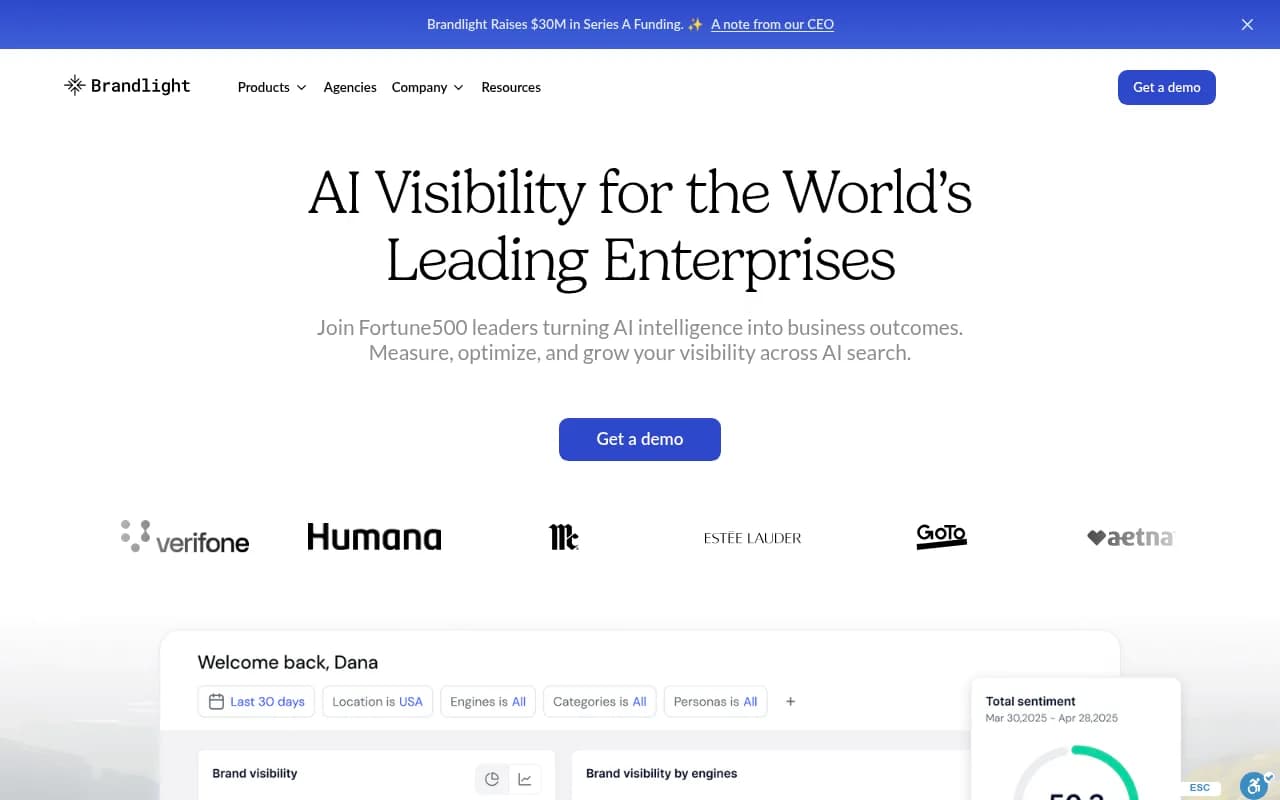
Brandlight tracks seven core engines by its own account, ChatGPT, Google AI Overviews, Google AI Mode, Gemini, Perplexity, Copilot, and Claude, with per-market substitutions where Copilot is paywalled. Its own research hub separately claims 13 engines and over 100 million AI answers analyzed. I'll flag the discrepancy rather than pretend it isn't there; different pages on the same site cite different numbers, which is a small but real credibility wrinkle.
The cost is the obvious trade-off. Brandlight does not publish pricing anywhere, and GrowthManager.ai's independent estimate puts real contracts at $4,000 to $15,000 a month. There's no free trial, engagements start with a paid three-month pilot, and average implementation time runs around two months per G2 user data. This is a procurement purchase. You will not sign up for it on a Tuesday afternoon.
On G2, Brandlight holds a 4.9/5 rating from 236 reviews, 97% of them five stars, which is a strong number for a product only two years old. Reviewers like the cross-platform clarity but flag a steep learning curve given how much data the platform surfaces at once.
What Otterly.AI gets you
Otterly.AI takes the opposite approach on almost every axis: transparent, self-serve, cheap to start. The Lite plan is $29/mo for 15 search prompts across four core engines (ChatGPT, Google AI Overviews, Perplexity, Copilot), with Gemini and Google AI Mode available as add-ons. Standard jumps to $189/mo for 100 prompts and adds API/MCP access and Agent Analytics. Premium sits at $489/mo for 400 prompts. There's a genuine 14-day free trial, no credit card needed.
Otterly.AI

The catch that a lot of comparison posts gloss over: adding Claude and Gemini to a Standard plan pushes the effective price to roughly $357/mo, which narrows the gap with Brandlight's lower estimated tier more than the headline $29 number suggests. Otterly's Enterprise plan, once you add SSO and custom terms, reportedly starts around $1,000/month, which puts its own top tier in the same rough neighborhood as Brandlight's entry point.
Otterly is rated 4.9/5 on G2 from over 40 reviews and was named a G2 "AEO Leader" for Q1 2026. Reviewers like the intuitive dashboards and the newer Agent Analytics feature, which helps teams figure out who their real AI-search competitors are. The recurring critique, echoed across Reddit threads on r/DigitalMarketing and r/SEO_tools_reviews, is that Otterly and tools like it "track the source but give zero actionable strategy on how to restructure content to get cited." It tells you the score. It doesn't fix it.
Side-by-side comparison
| Factor | Brandlight | Otterly.AI |
|---|---|---|
| Pricing model | Custom quote, no public pricing | Published tiers from $29/mo |
| Typical real cost | $4,000-$15,000/mo (third-party estimate) | $29-$489/mo, Enterprise ~$1,000/mo+ |
| Free trial | None; paid 3-month pilot | 14-day free trial, no card |
| Engines tracked | 7 core (claims up to 13) | 4 core + paid add-ons |
| Crawler log analysis | Yes, server-log based | No |
| Content generation | Multi-agent, CMS-routed, human review required | Not a core feature |
| Strategy/service layer | Dedicated AI strategists, forward-deployed engineers | Self-serve |
| G2 rating | 4.9/5 (236 reviews) | 4.9/5 (40+ reviews) |
| Best fit | Fortune 500, multi-brand, multi-market | Solo operators, small teams, agencies testing the channel |
The context that changes the math
Here's something worth sitting with before you sign anything: AI answers cite a small number of sources per response. According to Promptwatch's data on average sources per response, ChatGPT typically cites around five sources per web-search-triggered answer, the smallest citation inventory of any major engine, while Google AI Overviews and Perplexity sit closer to ten. Copilot is the wild card, swinging from under two to nearly seventeen sources in a matter of weeks as Microsoft keeps rearchitecting its retrieval system.
What that means practically: the pool of citation slots per query is tiny. Whether you're paying $29 or $15,000 a month, you're fighting for one of five to ten spots, and no amount of dashboard sophistication changes that math. It does mean, though, that Otterly's lower prompt caps (15 on Lite) aren't as crippling as they sound, because tracking even a handful of high-intent prompts against a five-slot citation pool still gives you a meaningful signal.
The other useful data point: Promptwatch's analysis of ChatGPT citation share by domain rank found that mid-authority domains (DR 46-75) earned nearly half of all ChatGPT citations in August 2026, while the very biggest sites (DR 91-100) fell to around 3% by month's end. Neither Brandlight's enterprise clients nor Otterly's small-business users need Fortune 500-level domain authority to get cited. That's genuinely reassuring if you're a mid-market brand wondering whether either of these tools is even worth it.
Where both tools fall short
Both Brandlight and Otterly get the same structural criticism from independent reviewers: visibility data only matters once it turns into published content and site changes, and neither tool fully closes that loop on its own. Brandlight comes closer, with its multi-agent content workflow that routes drafts to your CMS for human and legal review, but it still requires your team (or Brandlight's strategists) to execute. Otterly stops even earlier, at the recommendation stage.
This is the gap that platforms built around agentic content execution are trying to close. Promptwatch, for instance, pairs the monitoring side (crawler logs, citation trends, Reddit and YouTube tracking, prompt volume and difficulty scoring) with Content Agents that plan, write, and publish GEO-optimized articles directly to Webflow, Framer, or WordPress on a schedule, plus a Unified Actions to-do list that prioritizes what to fix first. If your actual bottleneck is "we know we're invisible but nobody has time to write the content," that's a different problem than either Brandlight or Otterly is solely built to solve.

So which one wins
It depends entirely on what you're optimizing for, and I'd rather be honest about that than force a winner where none exists.
If your budget tops out at a few hundred dollars a month and you want to start tracking AI visibility this week without a sales call, Otterly wins, no contest. The pricing is transparent, the trial is real, and the core feature set covers the four engines that matter most for most brands.
If you're managing a dozen brands across a dozen markets and need a procurement-approved vendor with a dedicated strategist, server-log crawler diagnostics, and SOC 2 Type 2 compliance, Brandlight earns its price. You're not just buying software; you're buying a team that will sit in your quarterly reviews.
For everyone in between, and that's most companies, it's worth widening the search before committing. The GEO software directory at bestgeosoftware.com lists a broader set of platforms across price points, and several mid-tier options (Profound, AthenaHQ, LLM Pulse) sit closer to what a growing mid-market team actually needs than either end of this particular comparison. Pick the tool that matches your actual buying process, not the one with the biggest funding round or the lowest sticker price.