Key takeaways
- Brandlight has no public pricing page. The /pricing URL returns a 404, and every buyer is routed to a sales call or a paid 3-month pilot.
- Third-party trackers and a Brandlight careers listing converge on a similar range: entry around $199/month, an "activation" tier around $750/month, and enterprise contracts between $4,000 and $15,000+ per month, sometimes per brand.
- Enterprise pricing scales on dashboards, markets, lines of business, and service level, not seats. You're buying a managed contract, not a self-serve SaaS plan.
- The price includes a dedicated account executive and "AI Optimization Experts," plus SOC 2 Type 2 compliance, which matters to the healthcare and finance accounts (Humana, Aetna) in its customer list.
- Brandlight's modules identify content gaps and publisher opportunities but don't draft, publish, or post content, so budget for a content team or agency on top of the platform fee.
Why nobody can tell you what Brandlight costs
I spent a chunk of time trying to find a straight answer to "how much is Brandlight," and the honest answer is: nobody outside Brandlight's sales team fully knows. The company's own pricing and plans URLs return 404 errors. Every path leads to "Get a demo" or "Contact sales." That's a deliberate choice, not an oversight, and it tells you something about who they're selling to.
Brandlight was founded in 2024 by Imri Marcus, Uri Gafni, and Didi Dvash out of Tel Aviv, and it raised a $30M Series A led by Pelion Venture Partners (with Cardumen Capital and G20 Ventures), bringing total funding to roughly $35.75M. That's a serious amount of capital for a company that won't tell you its prices on its own website. The customer list backs up the enterprise-only strategy: Kimberly-Clark, LG, The Hartford, Estée Lauder, Volkswagen Group, Humana, Aetna, Caesars Entertainment, Charter Communications. These aren't companies negotiating $99/month self-serve plans. They're running RFPs with procurement teams attached.
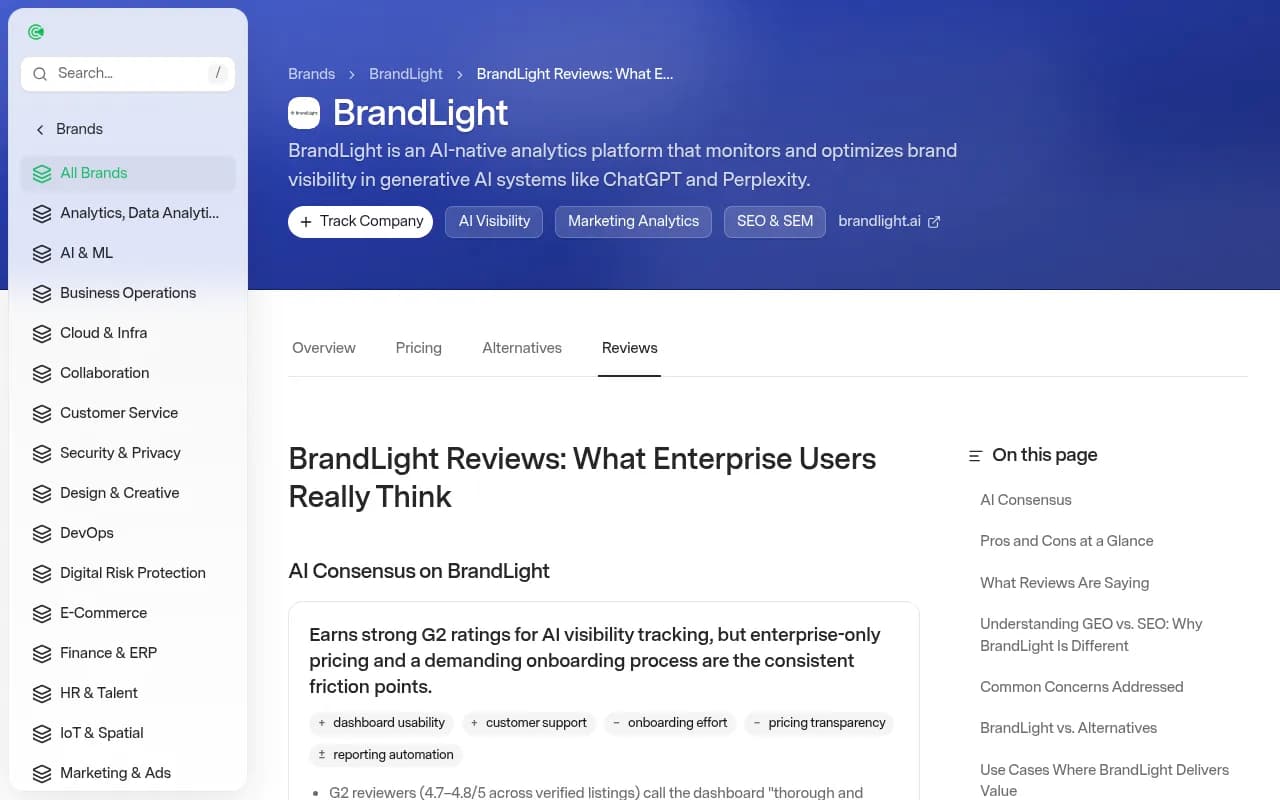
That opacity is also the single most common complaint in reviews. G2's AI-generated review summary for Brandlight flags "a lack of transparent pricing as a common limitation," and if you've ever tried to build a competitive comparison spreadsheet for a CMO, you know exactly how much friction that adds. You can't put "contact sales" in a column next to five other vendors with published numbers and expect anyone to take the comparison seriously.
The numbers that keep showing up
Since Brandlight won't publish figures, I looked at what independent sources have pieced together. A few numbers appear again and again across unrelated outlets, which suggests they're at least roughly accurate, even if none of them is a confirmed primary source.
| Tier | Estimated price | Source reliability | What it's for |
|---|---|---|---|
| Entry / Starter | ~$199/month | Unverified, third-party (alleged Brandlight subdomain) | Single-brand, limited scope |
| Activation | ~$750/month | Unverified, third-party | Mid-tier usage, more prompts/markets |
| Enterprise | $4,000-$15,000/month (up to $25,000+ in some estimates) | Semi-corroborated by a Brandlight careers listing | Multi-brand, multi-market, dedicated support |
The closest thing to a primary source here is a job listing on Simplify.jobs, seemingly pulled from Brandlight's own careers content, which states pricing "ranges from $4,000 to $15,000 per month, with an agency partner program." That's still not a pricing page, but it's a company-originated document rather than a blogger's guess, so it carries more weight than the rest.
One more wrinkle worth flagging: at least one comparison source frames the enterprise range as "$4,000-$15,000 per brand, per month." If that's accurate, a conglomerate running five or six brands through Brandlight could be looking at a multiple of that headline number, not a flat enterprise fee. If you're evaluating this for a multi-brand portfolio, ask that question explicitly on the sales call, because it changes the math dramatically.
No free trial, but there's a paid pilot
Brandlight doesn't offer a free trial. Multiple independent 2026 sources describe the same entry mechanic: a paid three-month pilot instead of a self-serve test drive. That's consistent with the enterprise sales motion, but it's worth knowing going in. You're not going to spin up an account on a credit card and cancel if it doesn't work. You're signing a contract, even for the "trial."
Compare that to how Profound, Peec AI, or Mentionova operate, where you can start on a self-serve plan for under $100/month and walk away with no commitment if it's not a fit.
| Tool | Entry price | Top tier | Free trial |
|---|---|---|---|
| Brandlight | ~$199/mo (unverified) | $4,000-$25,000+/mo, custom | No, paid 3-month pilot |
| Profound | $82.50-$99/mo (50 prompts, ChatGPT only) | Custom, up to 10 engines | Yes |
| Peec AI | ~$95/mo | ~$495/mo plus add-ons | Yes |
| Mentionova | $99/mo (25 prompts, 3 engines) | $799-$999/mo | 14-day trial |
| Evertune | $800/mo (Pro) | Custom | Not stated |
If you want to poke around at similar tools with published pricing before you get on a Brandlight call, the GEO software directory at bestgeosoftware.com is a decent place to browse comparable platforms side by side.
What you actually get for that money
The pricing scope isn't per-seat. It's based on the number of dashboards, markets or regions, lines of business or brands, and service level. That's closer to a managed enterprise contract than a SaaS subscription, and it shows up in what's bundled at the top tier:
- Multi-brand, multi-region, multi-language tracking in one platform
- Coverage across 5-11 AI engines depending on the source, with ChatGPT, Gemini, Claude, Perplexity, Copilot, Grok, and Google AI Overviews mentioned most consistently
- A dedicated account executive plus "AI Optimization Experts" who work directly with your team on implementation
- SOC 2 Type 2 compliance, which Brandlight explicitly positions as the reason regulated accounts like Humana and Aetna buy in
- No requirement to integrate internal systems or share PII, pitched as low-friction onboarding alongside your existing stack
- Five product modules: Visibility & Insights (competitive benchmarking, sentiment, campaign tracking), Content, Partnerships (publisher and media influence analysis), Technical (AI crawler and indexability diagnostics), and Agentic Commerce (AI shopping and shelf optimization)
- An AI-native ads module that measures brand presence in emerging AI ad surfaces, which is a fairly unusual add versus competitors
- Automated weekly reports on sentiment shifts, visibility scores, and competitor mentions
That's a genuinely broad feature set, and for a global CMO managing a dozen sub-brands across regions, the multi-brand rollup and the compliance story are probably worth the premium on their own.
The gap almost every reviewer mentions
Here's the catch, and it's a big one if you're budgeting for outcomes, not just dashboards: Brandlight's modules are analysis and recommendation surfaces. They tell you where you're missing citations and which publishers matter. They don't draft, publish, or post content. No blog posts, no Reddit replies, no YouTube scripts, nothing that closes the loop from insight to a live page. That's the single most consistent criticism across independent comparison sites, and it means your $4,000-$15,000/month contract still needs a content team or agency sitting behind it to actually act on the recommendations.
This matters for the ROI conversation. If you're an enterprise that already has a content org that can execute fast, Brandlight's insight layer is genuinely useful. If you're hoping the platform itself will produce and publish optimized pages, you'll be disappointed and still paying for a second vendor or team to do that work.
This is where the distinction between monitoring platforms and full-stack GEO platforms actually matters in dollar terms. Promptwatch takes a different approach: alongside prompt tracking, citation analytics, and AI crawler logs, it includes Content Agents that plan, write, and publish GEO-optimized articles directly to Webflow, Framer, or WordPress on a schedule, plus Unified Actions, a prioritized to-do list generated from your own visibility data. It's used by 1,840+ brands and agencies, including Duolingo, Yelp, Typeform, and agency networks like Monks and WPP, and sits at 4.7/5 on G2. Pricing is published too: Essential starts at $95/month, Professional (the most popular tier) is $245/month with 15 AEO articles included, and Business runs $579/month for larger teams, all a fraction of Brandlight's enterprise range, with a 7-day free trial on paid plans.

How to think about this if you're evaluating Brandlight
A few questions worth asking on the sales call, based on everything above:
- Is the enterprise quote per brand, or a flat fee covering all brands in the portfolio? The per-brand framing some sources describe could multiply your cost fast.
- Who executes on the content and publisher recommendations Brandlight surfaces? If the answer is "you will," price that labor into your total cost of ownership.
- What's actually included in the three-month paid pilot, and is any portion of that fee creditable toward a full contract if you sign?
- How many of the 5-11 claimed AI engines are tracked at your tier specifically? Enterprise feature lists often gate the full engine set behind the top contract level.
- Ask for the SOC 2 Type 2 report directly if compliance is the deciding factor, rather than taking the marketing claim at face value.
Is Brandlight worth it at that price
For a Fortune 500 with a multi-brand portfolio, dedicated budget for AI visibility as its own line item, and an existing content execution team, Brandlight's white-glove service and compliance posture could justify the spend. The company's own framing backs this up: it's positioned less as software and more as a partner relationship, complete with a named account executive and board-ready reporting.
For anyone else, the math is harder to justify. Mid-market and SMB teams can get comparable monitoring starting at $20 to $99/month from tools like Rankscale, Otterly.AI, or Mentionova, and if content execution is the actual goal rather than just a dashboard, a platform built around publishing, not just diagnosis, is likely to deliver more return per dollar spent. Before signing anything with a five-figure monthly line item, it's worth running a side-by-side trial on a tool with transparent pricing first. If you want a broader sense of what else is out there before that sales call, the AI visibility tool rankings at aisearchtoolrank.com are a useful starting point.
According to Promptwatch's citation data, ChatGPT typically pulls from only about five sources per web-search response, which means the competition for those citation slots is intense no matter which platform you use to track them (see Promptwatch's average sources per response data at https://promptwatch.com/data/average-sources-per-response). That scarcity is exactly why the execution gap in Brandlight's offering matters so much: identifying the five slots you're missing is only half the job.