Key takeaways
- Bluefish AI, once a straightforward AI visibility tracker, has repositioned as an "agentic marketing platform" with four metrics (Visibility, Favorability, Safety, Accuracy) and an enterprise-only, contact-sales pricing model — a pattern worth recognizing in any vendor.
- The clearest sign of vendor drift is a shrinking gap between what the dashboard shows and what you can independently verify: raw responses, query sets, and citation counts you can check against your own logs.
- Citation behavior itself is volatile — ChatGPT's average citations per response dropped about 27% after the GPT-5.3 rollout in March 2026 — so a vendor needs to explain platform-wide shifts, not just report your score moving.
- Ask about data portability before you sign, not after you want to leave. The honest answer is "you get the query set, raw responses, and full history"; the evasive answer is "it lives in our dashboard."
- Roughly 47 GEO tools exist right now, and most run on the same commodity mechanic (scheduled prompts, stored responses, a chart). Bluefish's shift toward agentic commerce and brand governance is one way a vendor tries to escape that commodity trap — but it can also mean less focus on the thing you actually hired them for.
Why this matters right now
I've watched a handful of GEO vendors change shape over the past year, and Bluefish AI is the most visible case study because it's done it loudly, with funding announcements to match. It raised a $20M Series A in August 2025 as a brand visibility tracker, then a $43M Series B in April 2026 repositioned around "agentic marketing for the Fortune 500," and by May 2026 it had launched "AI Accuracy" — a feature that has almost nothing to do with citation share and everything to do with regulatory compliance in pharma, finance, and insurance.
None of that makes Bluefish a bad company. Ann Bordetsky from NEA called it built for "the agent-driven commerce era," and the company says it now serves over 100 enterprise accounts including Adidas, Hearst, and Ulta Beauty. But if you hired a vendor in 2025 to tell you whether ChatGPT was citing your product pages, and eighteen months later your quarterly business review is mostly about "Brand Vault" and hallucination governance, something has shifted under you. Maybe that shift is good for your business. Maybe it isn't. The point of this guide is to help you notice it happening, whichever vendor you're using.
The Bluefish pattern, step by step
Here's the sequence, pieced together from Bluefish's own announcements and independent vendor profiles:
- 2024-2025: Founded by Alex Sherman (PromoteIQ, acquired by Microsoft), Andrei Dunca (LiveRail, acquired by Meta), and Jing Feng. Early pitch is AI visibility monitoring — is your brand showing up in ChatGPT, Perplexity, Claude?
- August 2025: Series A framing already leans into "agentic marketing platform for the agentic era." Revenue reportedly grew 10x in six months pre-round.
- April 2026: $43M Series B, co-led by Threshold Ventures and NEA. The language moves fully to "agent-driven commerce" and Fortune 500 engagement — 10% of the Fortune 500, per the announcement.
- May 2026: "AI Accuracy" launches, built on a new "Brand Vault" that ingests first-party brand content as a "verified source of truth" shared with LLMs as training material. The stats behind the launch cite industry estimates of 5-20% hallucination rates in AI responses, and a March 2026 Rithum survey where 58% of shoppers said their trust drops when AI gives wrong product info.
That's four core metrics now: AI Visibility, AI Favorability, AI Safety, and AI Accuracy. Each addition is defensible on its own. Stacked together, they turn a citation tracker into something closer to a brand governance suite, priced accordingly, with no public price list — Bluefish's own Terms of Service specify fees invoiced annually in advance, which tells you this isn't a self-serve, month-to-month product anymore.
Independent reviewers have noticed gaps that come with this broader framing. Evertune's competitive teardown, published in November 2025, claimed Bluefish at the time didn't support AI Mode, AI Overviews, Claude, or Copilot — a real blind spot if your buyers lean on Claude for B2B research. A separate GEO Compass profile, last updated in June 2026, notes Bluefish tracks six engines publicly and offers no published pricing. Take vendor-versus-vendor claims with a grain of salt since they're marketing content too, but the pattern across independent sources is consistent: as the platform's ambitions widened, the depth of pure citation tracking became a comparison point competitors were happy to exploit.
The general warning signs (not just Bluefish)
Gradient Flow's Ben Lorica wrote a piece in March 2026 that's stuck with me, comparing AI vendor relationships to the early internet's platform consolidation. His framing: when a vendor becomes your roadmap, you inherit their risk profile.
Five things he flags, and they apply well beyond AI infrastructure vendors into GEO specifically:
- Narrowing access to core capability over time. Six months in, you can't export the raw data anymore, can't audit what changed in the methodology, can't run your own version of the analysis.
- Silent behavior shifts behind a stable product name. A vendor's "AI Visibility Score" today might be calculated differently than it was in January, with no changelog.
- Policy volatility that breaks your workflows. The dashboard format changes, the export schema changes, and your downstream reporting pipeline breaks with no code change on your end.
- Asymmetric data flow. Your proprietary content or query history might train the vendor's own models unless you've explicitly opted out — usually opt-out by default on enterprise tiers, opt-in on cheaper ones.
- Switching-cost traps. If a year of query history, prompt sets, and citation trends only exist inside their platform, moving vendors means starting your visibility history from zero.
His recommended fix: treat multi-provider support and data portability like an insurance premium, not a nice-to-have. Ask about it before you're locked in, because switching costs get measured in months once you wait too long.
A concrete checklist to run against your current vendor
Canlah AI published a GEO Vendor Evidence Checklist with 12 procurement questions and a scoring system. It's worth running your incumbent vendor through it, even mid-contract. A few questions that actually separate serious measurement from narration:
| Question | What a strong answer sounds like | What a weak answer sounds like |
|---|---|---|
| How many times do you run each query per cycle? | 5+ runs per engine, contractually specified | "We check periodically" |
| Do you report frequency or a binary yes/no? | "Cited in 4 of 5 runs" | "Cited: yes" |
| Can I see per-engine breakdowns? | Separate scores for ChatGPT, Perplexity, AI Overviews, etc. | One blended "AI visibility score" |
| Do you measure a pre-work baseline? | Documented baseline before any optimization started | "Trust the trend line" |
| What happens to my data if I leave? | You keep the query set, raw responses, and full history | Data stays in their dashboard |
| Can I re-open archived raw responses? | Full raw text, not cropped screenshots | Screenshots only |
Canlah's own scorecard treats 19-24 points as real measurement practice, 12-18 as immature instrumentation, 6-11 as "a content shop with an AI label," and 0-5 as pure narration. Two explicit red flags worth calling out on their own: any vendor that guarantees AI citations (no vendor controls model output, full stop) and any vendor presenting citations for your own brand-name queries as a "visibility win" — that proves nothing about whether you show up when someone asks a generic question in your category.
A separate 25-question checklist from Discovered Labs adds a useful structural flag: 12-month contracts with no performance guarantees. Long lock-ins without accountability protect the agency or vendor, not you.
Why citation data itself is a moving target
One reason it's hard to tell "my vendor is slipping" from "the AI engines changed how they cite" is that the engines really do change, often overnight. Promptwatch's data on this is useful as a sanity check regardless of which vendor you use.
Around the GPT-5.3 rollout on March 4, 2026, Promptwatch's tracking showed average citations per ChatGPT response drop from roughly 6.4 the week prior to about 4.7-4.9 by late March, a decline of nearly 27%, with no recovery a month later — and it hit GPT-5.3, GPT-5.4, and GPT-5-Mini simultaneously. That's the kind of platform-wide shift a vendor should be able to name and explain. If your score dropped in that window and your vendor blamed your content instead of the model update, that's worth a follow-up conversation. See Promptwatch's ChatGPT citation drop data for the detail.
Social and community content has also swung hard. Reddit's share of ChatGPT Search citations collapsed from roughly 4% to 0.5% on a single day, August 14, 2026, according to Promptwatch's Reddit citation tracking. If a vendor is still pitching "get active on Reddit to win ChatGPT citations" as a core 2026 strategy without acknowledging that drop, their methodology is either stale or not grounded in live observation.

And this kind of volatility isn't limited to ChatGPT. Average sources per response varies wildly by engine — ChatGPT typically cites around 5 sources per response, the tightest inventory of the major engines, while Google AI Overviews and Perplexity each cite close to 10. Microsoft Copilot is the real wildcard: its average swung from under 2 to nearly 17 sources per response within a few weeks before settling low again, which is evidence Microsoft is still re-architecting how Copilot attributes sources. A vendor claiming precise, stable Copilot benchmarks during that window should raise an eyebrow. Full detail in Promptwatch's average sources per response report.
Why 80% of GEO vendors might not survive this
Tim Soulo's analysis of the GEO market counted 47 tools currently competing, and his estimate is that roughly 80% will be gone within three to five years. His core argument: the basic mechanic behind most of these products, scheduled prompts, stored AI responses, a dashboard, can be built by a single developer in a few weeks. That's a brutal commodity trap, and it explains a lot of the vendor behavior you're seeing across the market, Bluefish included.
There are two rational responses to that trap. One is to go deeper on measurement rigor, real methodology, real data, transparent limitations. The other is to expand the product surface into adjacent categories, brand governance, agentic commerce, content generation, so the comparison stops being apples-to-apples on citation tracking alone. Bluefish has clearly picked the second path, and it's not a crazy bet given the funding it's attracted. But if what you actually need is rigorous, per-engine citation measurement you can audit, a vendor optimizing for breadth over depth may not be the right long-term partner for that specific job, even if it's a fine partner for something else.
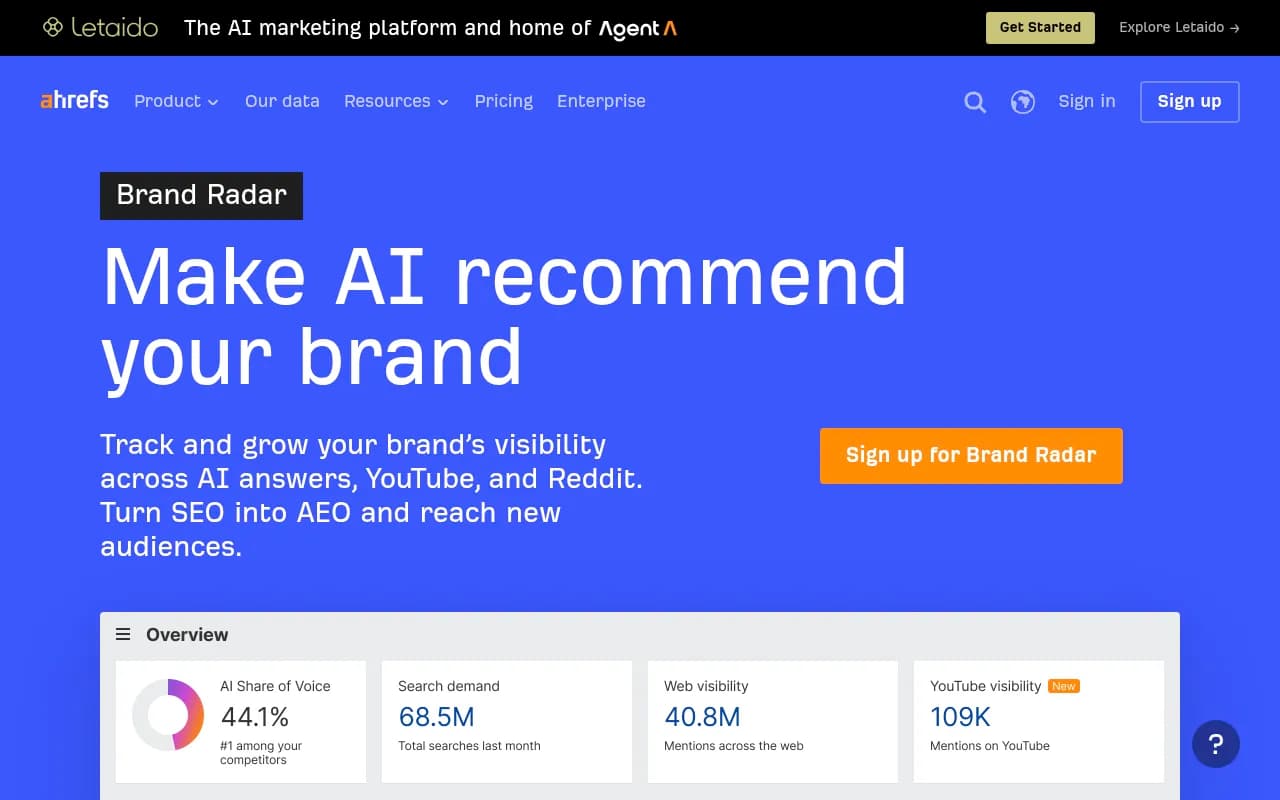
Soulo's other point worth sitting with: no GEO tool has access to real user prompts from ChatGPT, Perplexity, or Gemini. Every vendor works with a proxy for what people actually ask, of varying quality. Ahrefs Brand Radar is cited as one of the better proxies, deriving prompts from real "People Also Ask" search volume data rather than fabricating them from scratch. Worth asking your own vendor directly: where do your prompts come from, and can you show me the methodology?
What to compare before you switch
If this checklist is making you nervous about your current setup, here's a rough sense of where the market sits in terms of depth versus scope, based on public pricing and positioning as of mid-to-late 2026.
| Vendor | Positioning | Pricing signal | Where it's strong |
|---|---|---|---|
| Bluefish AI | Agentic marketing platform (Visibility, Favorability, Safety, Accuracy) | Contact sales, annual invoicing | Agentic commerce surfaces (Amazon, Alexa for Shopping), enterprise governance |
| Profound | Enterprise AI visibility, ~$1B valuation | $99-$399/mo self-serve, custom enterprise | Broad multi-engine tracking, Fortune 500 traction |
| Evertune | Direct foundation-model API access | Reported anywhere from $800 to $3,000+/mo, sales-led | Isolating base-model knowledge from search-augmented answers |
| Otterly.AI | Straightforward prompt tracker | $29-$489/mo | Simplicity, fast setup, Gartner Cool Vendor 2025 |
| Promptwatch | End-to-end visibility plus agentic content execution | $95-$579/mo, free Explore tier | Crawler logs, content agents with CMS publishing, Reddit/YouTube citation tracking, Unified Actions |
A lot of vendor comparison pages disagree with each other on exact prices for the same companies, which is itself a small data point. Treat any single number you read, including the ones above, as a starting point to verify on the vendor's own site before you sign anything.
The distinction that matters most, in my experience, is whether a tool stops at "here's your score" or goes further into "here's why, and here's what to do about it." Promptwatch's crawler logs, for instance, show exactly when ChatGPTBot, ClaudeBot, or PerplexityBot visit your pages and whether they hit errors, which explains the why behind a visibility number instead of just reporting the number itself. Its Content Agents then plan, write, and publish GEO-optimized content directly to your CMS on a schedule, closing the loop from diagnosis to fix rather than leaving you to interpret a dashboard alone. Most of the monitoring-only tools in the market, Otterly, Peec, AthenaHQ, LLM Pulse among them, stop well short of that.
If you're evaluating a broader set of options, the directory at bestgeosoftware.com tracks the wider GEO software category, and agenticseotools.com is a useful starting point specifically for tools that go beyond monitoring into automated execution.
Questions to ask at your next vendor check-in
Bring these to your next quarterly review, regardless of vendor:
- Show me the raw response for a citation you're reporting, not a screenshot or a summary.
- Walk me through exactly why my score moved this month. Was it something on our end, or a platform-wide change?
- If I left tomorrow, what data would I walk away with?
- Has your prompt query set changed in the last six months, and why?
- What percentage of your reported "citations" are for queries that include our brand name?
A vendor with nothing to hide answers these in a sentence or two each. A vendor that's drifted toward narration over measurement will get vague, or redirect you to a feature they launched last quarter that has nothing to do with the question you asked. That redirect, more than any funding announcement or rebrand, is the real tell.