Enginy Review 2026
AI-powered lead generation platform that identifies, qualifies, and engages prospects automatically. Aimed at sales teams looking to build pipeline faster in 2026.
Key takeaways
- Enginy is a full-funnel B2B sales automation platform covering prospect discovery, data enrichment, multi-channel outreach, and inbox management in one tool
- The AI Finder lets you describe your ideal customer in plain language and get a qualified list back in seconds -- no filter-clicking required
- Waterfall enrichment across 30+ data sources means you're not relying on a single provider for emails and phone numbers
- Intent signal tracking (job changes, hiring activity, tech stack updates) helps reps reach out at the right moment rather than cold
- Pricing is not publicly listed on the site, so you'll need to book a demo to get numbers -- a friction point for buyers doing early-stage research
- Competes with tools like Apollo.io, Clay, and Instantly, but positions itself as a more unified, AI-first alternative that doesn't require stitching together multiple tools
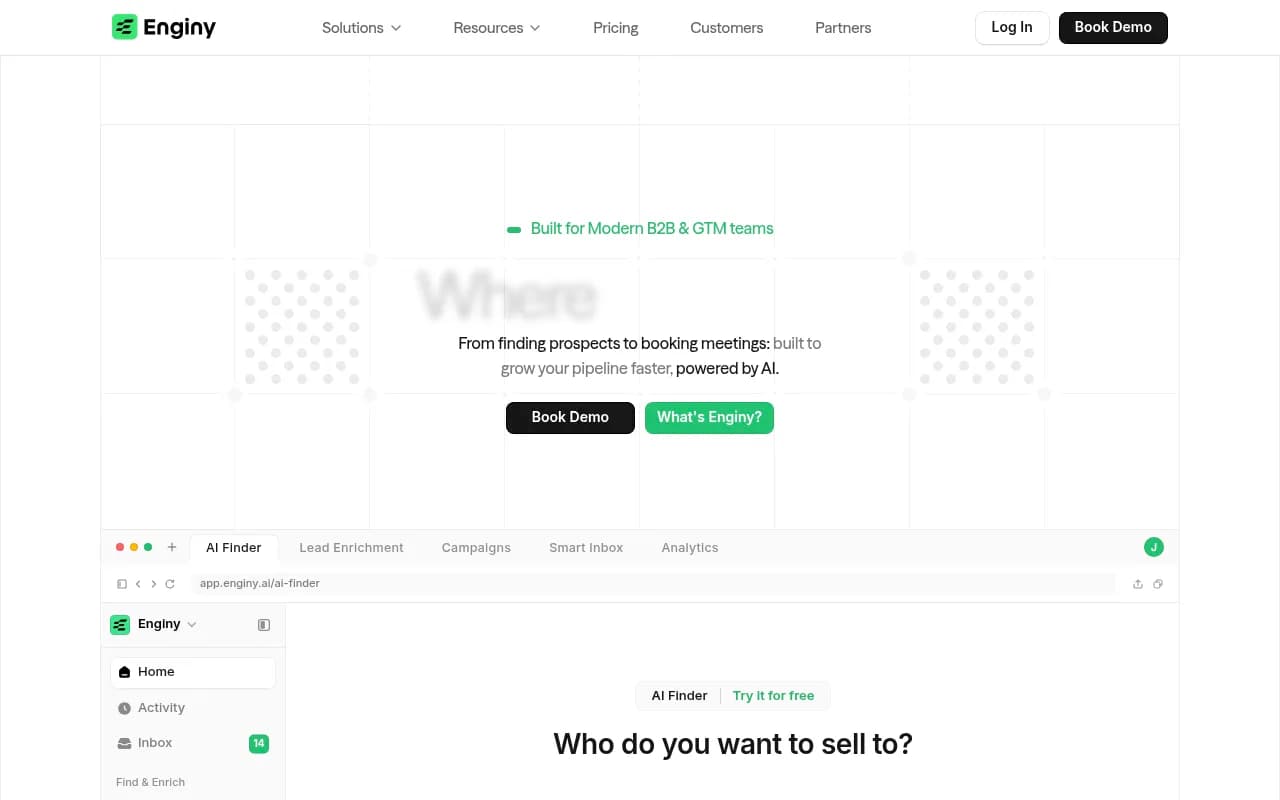
Enginy, formerly known as Genesy, is an AI-native sales platform built for B2B and go-to-market teams. The rebrand is recent enough that the app still shows app.genesy.ai in some places, which tells you this is a company in active transition. The core pitch is straightforward: instead of bouncing between a data provider, a sequencing tool, and an inbox manager, Enginy tries to handle all of it in one place -- from finding the right prospects to booking the meeting.
The target audience is sales teams that do outbound. Specifically, SDRs and sales managers at B2B companies who spend too much time on manual prospecting and not enough time actually talking to buyers. The platform is built around the idea that AI can handle the research, the list-building, the personalization, and the inbox triage -- leaving reps to focus on conversations that actually move deals forward.
The company has real customers. Factorial's CEO Jordi Romero is quoted prominently, and there's a published case study showing conversion rates doubling (from 4% to 8%) on deals touched by Enginy campaigns, with reply rates jumping from 10% to 45%. Sequra and Venair also appear as named customers. These aren't household names globally, but they're credible B2B companies, and the specificity of the metrics suggests these aren't made-up numbers.
Key features
AI Finder (natural language prospect search) This is the feature Enginy leads with, and it's genuinely interesting. Instead of clicking through dropdown filters to build a list, you type a description of who you want to reach -- "Sales leaders managing teams of 10+ at companies growing 20%+ YoY" or "RevOps leaders at companies using HubSpot and Salesforce with 11-50 employees" -- and the AI translates that into a structured search. The examples on the homepage include some creative ones: "Companies founded by ex-Stripe or Revolut employees in the last year" or "Companies founded after 2021, based in NYC, hiring engineers." Whether the underlying data actually supports those kinds of nuanced queries is the real question, but the interface concept is sound. For reps who struggle with traditional filter-based tools, this is a meaningful UX improvement.
Lead enrichment via waterfall across 30+ sources Enginy pulls verified emails and phone numbers by running queries across more than 30 data providers in sequence -- a "waterfall" approach that maximizes coverage by trying multiple sources before giving up. This is the same approach Clay popularized, and it's a meaningful advantage over tools that rely on a single database. The platform also assigns an "ideal customer score" to each contact based on criteria you define, so reps aren't manually sorting through lists to figure out who to prioritize.
Intent signal tracking The platform monitors signals like job changes, leadership hires, and tech stack updates to surface prospects who are likely in a buying window. A company that just hired a new VP of Sales, or that recently added Salesforce to their stack, is a different conversation than a cold contact. Enginy surfaces these signals and lets you act on them with timing that feels relevant rather than random.
AI deep research Beyond basic contact data, Enginy runs AI-powered research on individual profiles and companies -- pulling together context about what someone does, what they've worked on, and what their company is focused on. This feeds directly into personalized outreach. The platform shows pre-generated email intros for each contact in the list view, which gives reps a starting point rather than a blank page.
Multi-channel campaign sequences Enginy supports outreach across email and LinkedIn (social channels). Campaigns can include connection requests, post likes, direct messages, and email steps -- with conditional logic built in (e.g., "if they accepted the connection request, wait 2 days then send a message"). The sequence builder appears visual and drag-and-drop based on the UI screenshots. Email deliverability is handled through built-in domain warm-up, which is a practical feature that many standalone sequencing tools charge extra for.
Smart Inbox with AI triage All replies from campaigns land in a unified inbox. The AI automatically tags conversations by intent -- "Interested," "Meeting Booked," "Referred," "Bad Timing," "Not Interested" -- so reps don't have to read every message to know what to do next. The platform also drafts replies automatically, which reps can review and send. Slack notifications fire when a positive reply comes in, so no one misses a hot lead because they weren't watching the inbox.
AI Playbook configuration There's a configuration layer called "AI Playbook" that lets teams define their outreach logic, personas, and messaging guidelines. This is what allows the AI to generate personalized messages that sound like a specific rep rather than generic automation. The quality of this configuration probably determines how good the output actually is.
CRM sync Enginy syncs with CRM tools to keep contact and activity data current without manual updates. The integrations page mentions 12+ native integrations, though specific CRM names (HubSpot, Salesforce) are visible in the filter examples on the site. Real-time sync means the CRM reflects what's happening in Enginy without someone having to export and import CSVs.
Who is it for
The clearest fit is B2B SaaS companies with dedicated SDR teams -- say, 5 to 50 salespeople -- who are running outbound at scale and currently using a patchwork of tools. If your team is using Apollo or ZoomInfo for data, Outreach or Salesloft for sequences, and then manually managing replies in Gmail, Enginy is pitching itself as the replacement for all three. The consolidation argument is real: fewer tools means less data fragmentation, less context-switching, and lower total cost.
GTM teams at growth-stage companies (Series A to Series C) are probably the sweet spot. These companies have enough budget to invest in sales tooling but aren't so large that they need enterprise-grade customization and compliance features. The Factorial and Sequra case studies suggest Enginy has traction in the European market, particularly Spain, which makes sense given the company's origins as Genesy.
Enginy is probably not the right fit for solo founders or very early-stage teams doing their first 10 outbound emails a day. The platform is built for volume and automation, and the ROI math only works when you're running enough campaigns to justify the setup time. Similarly, enterprise sales teams with complex approval workflows, strict data residency requirements, or deeply customized CRM setups may find the platform too opinionated.
Integrations and ecosystem
The site references 12+ native integrations, with CRM sync being a core feature. Based on the filter examples and UI screenshots, HubSpot and Salesforce are clearly supported. LinkedIn integration is implied by the social outreach features (connection requests, post likes, direct messages), though the exact mechanism -- whether it uses LinkedIn's API or a browser-based approach -- isn't spelled out publicly.
Slack integration is confirmed: the Smart Inbox sends Slack alerts when positive replies come in. There's no mention of a public API or Zapier integration on the homepage, though the integrations page likely has more detail. The platform appears to be a closed ecosystem rather than an open platform, which is a tradeoff -- you get tighter integration between features, but less flexibility to connect to niche tools.
Pricing and value
Enginy doesn't publish pricing on its homepage. The pricing page exists (enginy.ai/pricing) but the scraped content doesn't include specific numbers. You need to book a demo to get a quote, which is a common approach for sales tools in this category but frustrating for buyers who want to self-serve their evaluation.
For context, the blog on Enginy's own site covers Clay's pricing (starting at $149/month for the Starter plan), which gives some sense of the competitive landscape they're positioning against. Tools like Apollo.io start around $49/month per user for basic plans, while more full-featured platforms like Outreach or Salesloft are typically $100-$150+ per user per month. Enginy likely sits somewhere in that range, but without confirmed numbers, it's hard to say whether it's priced competitively or at a premium.
The ROI calculator on the site claims "we save you 4x what we cost," and the Factorial case study cites 3-4 hours saved per SDR per day. If those numbers hold up in practice, the math is compelling -- an SDR's time is expensive, and 3-4 hours of recovered productivity per day is significant.
Strengths and limitations
What Enginy does well:
- The natural language prospect search is a genuine UX improvement over filter-heavy tools. Describing your ICP in plain English and getting a list back is faster and more intuitive for most reps.
- Waterfall enrichment across 30+ sources means better data coverage than single-source tools. Verified emails and phones are the foundation of any outbound motion, and Enginy takes this seriously.
- The unified inbox with AI triage is well-designed. Auto-tagging by intent and AI-drafted replies reduce the cognitive load on reps significantly.
- The end-to-end workflow -- find, enrich, sequence, manage replies -- in one platform reduces tool sprawl and the data sync headaches that come with it.
- Intent signal tracking (job changes, hiring, tech stack) adds a layer of timing intelligence that pure data tools don't offer.
Honest limitations:
- Pricing opacity is a real friction point. Not publishing prices forces every interested buyer into a demo call, which slows down evaluation and signals the platform may be priced for mid-market and above.
- The rebrand from Genesy to Enginy is recent, and the transition isn't fully complete (the app still runs on
app.genesy.ai). This creates minor trust issues for buyers doing due diligence. - LinkedIn automation is a gray area. Tools that automate LinkedIn connection requests and messages operate in tension with LinkedIn's terms of service. Enginy doesn't address this publicly, which is a risk buyers should evaluate.
- There's no mention of a free trial or freemium tier. For a platform competing with tools like Apollo (which has a free plan), the lack of a self-serve entry point limits how many teams can evaluate it without committing to a sales conversation.
Bottom line
Enginy is a well-designed, genuinely integrated B2B sales platform that makes a credible case for replacing the Apollo + Outreach + manual inbox management stack. The AI Finder and Smart Inbox are the standout features, and the customer results from Factorial are specific enough to take seriously.
The best fit is a B2B SaaS company with 5-30 SDRs running outbound at scale, particularly if the team is currently stitching together multiple tools and losing time to data sync and context-switching. Book the demo, push for a trial period, and benchmark the data quality against your current provider before committing.
Frequently asked questions
What is Enginy and what was it previously called?
Who is Enginy best suited for?
How much does Enginy cost?
What makes Enginy different from Apollo or Clay?
Does Enginy support LinkedIn outreach?
Is there a free trial or free plan?
Similar and alternative tools to Enginy