FullEnrich Review 2026
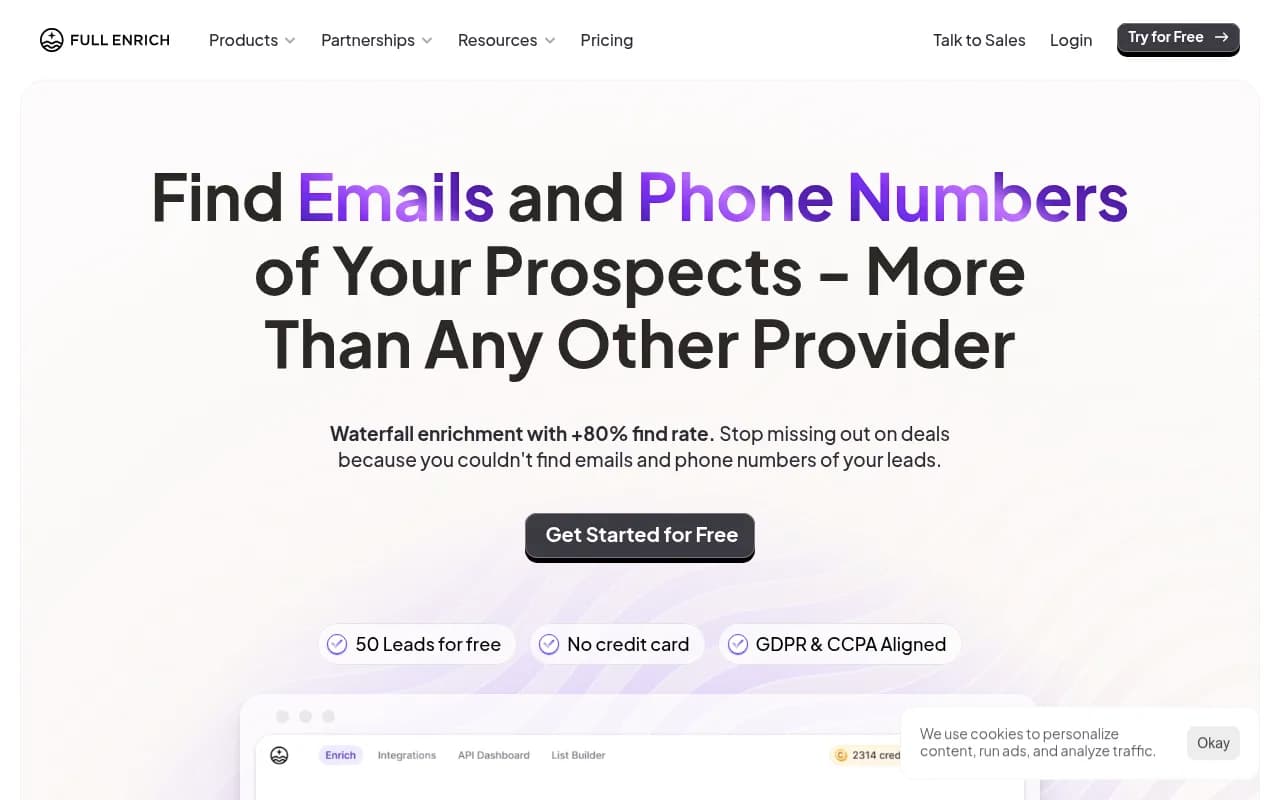
Provides contact-level data enrichment to help sales teams find accurate email addresses and phone numbers for B2B prospecting.
Key Takeaways:
• Best-in-class find rates: FullEnrich claims 80%+ email find rates and 86% phone find rates (US/Canada) by aggregating 20+ data providers in a waterfall approach—significantly higher than single-vendor tools • Triple verification: Uses 3 email verifiers to achieve sub-1% bounce rates and validates up to 80% of catch-all emails that competitors mark as risky • Mobile-first phone data: Only charges for mobile numbers; landlines are free. Advanced validation matches phone ownership to lead names (US/Canada only) • Limitations: Pricing can add up quickly for high-volume users. Phone validation features are US/Canada-centric. Some users report occasional data quality inconsistencies across different regions • Best for: Sales teams and agencies running high-volume outbound campaigns who need maximum contact coverage and can't afford to miss prospects due to missing data
FullEnrich positions itself as the contact enrichment tool for teams who have already tried Apollo, ZoomInfo, Cognism, or Lusha and found their find rates lacking. The core premise is simple but powerful: instead of subscribing to one data provider and accepting a 40-50% find rate, FullEnrich queries 20+ premium vendors simultaneously in a waterfall sequence until it finds verified contact data. The result, according to the company and numerous user testimonials, is an 80%+ find rate for emails and phones—roughly double what most single-vendor tools deliver.
Founded by a team of French entrepreneurs who previously built outbound agencies, FullEnrich launched to solve their own pain point: too many high-value prospects slipping through the cracks because no single data provider had complete coverage. The platform has since been adopted by fast-growing B2B companies, outbound agencies, and sales development teams who treat contact data as the lifeblood of their pipeline.
How Waterfall Enrichment Actually Works
The waterfall model is FullEnrich's defining feature. When you submit a lead for enrichment (via CSV upload, Chrome extension, API, or integration), FullEnrich doesn't just check one database. It queries its network of 20+ data vendors in a prioritized sequence based on the lead's geography, industry, and seniority. The moment a vendor returns a verified email or phone number, FullEnrich stops the waterfall and returns the result. If the first vendor comes up empty, it moves to the second, then the third, and so on.
This approach has two major advantages. First, it dramatically increases find rates because different vendors have different coverage strengths—Apollo might excel at US tech companies while Lusha dominates European mid-market, and Cognism has strong UK data. Second, it's cost-efficient: you pay FullEnrich's per-credit pricing instead of subscribing to 5-10 separate tools at $99-299/month each. The company claims users save an average of $641/month compared to buying multiple vendor subscriptions directly.
The waterfall logic is geography-aware. FullEnrich automatically selects the best-performing vendors for each region: US/Canada leads get routed through vendors with strong North American coverage, EMEA leads hit European-focused databases first, and so on. This regional optimization is why FullEnrich's find rates vary by geography—86% phone / 89% email in US/Canada, 71% phone / 84% email in EMEA, and slightly lower in LATAM and APAC.
Triple Email Verification and Catch-All Handling
Finding an email is only half the battle—if it bounces, your sender reputation tanks and your entire outbound program suffers. FullEnrich addresses this with triple email verification: every email found is run through three separate verification services (not named publicly, but likely includes providers like Zerobounce, NeverBounce, or similar). An email must pass at least two of the three verifiers to be marked as "high confidence." This redundancy is designed to catch false positives that a single verifier might miss.
The result is a claimed bounce rate under 1%, which is exceptional in the contact data industry where 5-10% bounce rates are common. Users in testimonials specifically call out FullEnrich's email accuracy as a standout feature—one agency COO mentioned sending 100k+ emails monthly with minimal deliverability issues.
Catch-all email handling is another differentiator. Catch-all domains (where the mail server accepts all addresses, making verification impossible) are typically flagged as "risky" by most tools. FullEnrich claims to verify up to 80% of catch-all emails using proprietary methods—likely a combination of pattern matching, historical send data, and cross-referencing with other verified contacts at the same domain. This unlocks a segment of prospects that competitors simply skip.
Mobile-First Phone Number Enrichment
FullEnrich's phone enrichment is explicitly mobile-focused. You only pay credits for mobile phone numbers; if the tool finds a landline, it's returned for free. This is a smart positioning for outbound sales teams who know that landlines are nearly useless for cold calling in 2026—they go to receptionists, voicemail systems, or are simply ignored.
For US and Canada leads, FullEnrich offers advanced phone validation that matches the phone line's registered owner against the lead's name. This prevents the common problem of getting a valid phone number that belongs to the wrong person (e.g., a former employee or a spouse). This feature is currently limited to +1 country codes, which is a notable limitation for teams targeting global markets.
Phone find rates are strong in North America (86%) but drop off in other regions—71% in EMEA, 67% in LATAM, 66% in APAC. This reflects the reality that mobile phone data is harder to source outside the US, where privacy regulations are stricter and data vendors have less coverage.
Integrations and Workflow Automation
FullEnrich integrates with 1,000+ apps via Zapier, Make, and native connections. Key integrations include:
• CRMs: HubSpot, Salesforce, Pipedrive—enrich leads directly in your CRM without exporting/importing CSVs • Outbound tools: Lemlist, Instantly, Smartlead, Apollo—enrich prospect lists and push directly to email sequences • Spreadsheets: Google Sheets, Airtable—enrich lists in real-time as you build them • LinkedIn tools: Phantombuster, Waalaxy—scrape LinkedIn Sales Navigator, enrich with FullEnrich, export to outbound tool • Clay: FullEnrich is a popular data provider inside Clay's waterfall enrichment tables, often used as the final fallback after other providers
The Chrome extension allows you to enrich LinkedIn profiles on the fly—click a contact, get their email and phone in seconds. This is useful for account-based prospecting where you're manually researching high-value targets.
The API is robust and well-documented, designed for developers who want to embed enrichment into their own products or automate high-volume workflows. Pricing for API usage is credit-based, same as the web app.
Data Sources and Vendor Network
FullEnrich aggregates data from 20+ vendors, though the full list isn't publicly disclosed (likely due to vendor agreements). Confirmed partners based on logos and user reports include:
• Apollo • Lusha • Cognism • Wiza • Kaspr • Hunter.io • Snov.io • RocketReach • ContactOut • Likely others in the ZoomInfo, Seamless.ai, LeadIQ tier
The platform doesn't let you choose which vendors to query—the waterfall sequence is automated and optimized by FullEnrich's algorithms. This is both a strength (you don't need to know which vendor is best for each use case) and a limitation (you can't exclude vendors you distrust or prefer specific sources).
Who Should Use FullEnrich
FullEnrich is built for teams where contact data is a bottleneck to revenue. Ideal users include:
• Outbound agencies: Running campaigns for 5-20 clients, need maximum find rates to justify their fees. One agency in testimonials mentioned doubling their enrichment rate after switching from Cognism. • Sales development teams: SDRs at B2B SaaS companies, especially those targeting mid-market and enterprise accounts where a single missed contact could mean a lost $50k+ deal. • Recruiters: Headhunters and talent acquisition teams who need direct mobile numbers for passive candidates who don't respond to LinkedIn InMails. • Growth teams: Startups and scale-ups doing founder-led sales or growth hacking, where every lead counts and budget is tight (FullEnrich is cheaper than stacking multiple tools).
Team size: Works for solo founders up to 50+ person sales orgs. The pricing scales reasonably well, though very high-volume users (10k+ enrichments/month) will need custom enterprise pricing.
Industries: Strongest in B2B tech, SaaS, agencies, consulting, and recruiting. Less useful for B2C, local businesses, or industries where decision-makers aren't on LinkedIn.
Who Should NOT Use FullEnrich
This tool is overkill (and expensive) if you:
• Only need basic email finding for low-volume outreach (under 100 leads/month)—a single tool like Apollo or Hunter.io is cheaper • Target consumer audiences or small local businesses—FullEnrich is built for B2B professionals • Require deep firmographic data, technographics, or intent signals—FullEnrich is contact-only, not a full sales intelligence platform like ZoomInfo or 6sense • Are highly privacy-sensitive or operate in jurisdictions with strict data laws—while FullEnrich claims GDPR/CCPA compliance, aggregating data from 20 vendors raises questions about data sourcing transparency
Pricing and Value
FullEnrich uses a credit-based model:
• Start Plan: $29/month for 500 credits (500 enrichments) • Pro Plan: $55/month for 1,000 credits • Scale Plan: Custom pricing, starts around $99-199/month for higher volumes • Free Trial: 50 credits, no credit card required
One credit = one enrichment attempt (email + phone lookup). If FullEnrich finds an email but no phone, you still use one credit. Landline phone numbers don't consume extra credits.
Compared to competitors:
• Apollo: $49-79/month for unlimited emails but lower find rates • Lusha: $39-99/month for 480-1,200 credits • Cognism: Custom pricing, typically $500-1,000+/month for teams • ZoomInfo: $15k-30k+/year, enterprise-only
FullEnrich is competitively priced for the find rate you get. The value proposition is strongest for teams who have already tried single-vendor tools and found them lacking. If you're currently paying for Apollo + Lusha + Cognism ($150+/month combined), FullEnrich at $55-99/month is a no-brainer.
The main pricing complaint from users is that credits can burn quickly if you're enriching large lists (1,000 credits = 1,000 leads, which a busy SDR team could blow through in a week). High-volume users will need to budget $200-500+/month.
Compliance and Data Privacy
FullEnrich claims SOC 2 Type II compliance, GDPR alignment, and CCPA adherence. The SOC 2 report is available on request via their trust portal (trust.delve.co/fullenrich).
However, the waterfall model raises questions about data sourcing. FullEnrich doesn't own the underlying data—it's aggregating from 20+ vendors, each with their own data collection practices. If one of those vendors scrapes LinkedIn in violation of LinkedIn's ToS, or sources data from questionable brokers, that risk flows through to FullEnrich users. The company doesn't publicly disclose how it vets vendor data sources or ensures compliance across its network.
For EU-based companies or those targeting EU prospects, this is worth scrutinizing. GDPR requires that you have a lawful basis for processing personal data, and "legitimate interest" (the usual justification for B2B sales prospecting) has limits. FullEnrich's terms likely shift liability to the user, so do your own compliance review.
Strengths
• Unmatched find rates: 80%+ email and phone coverage is genuinely industry-leading, backed by dozens of user testimonials comparing it favorably to ZoomInfo, Cognism, Lusha, and Apollo • Triple email verification: Sub-1% bounce rate is a huge deliverability advantage • Cost efficiency: Replaces 5-10 separate tool subscriptions with one affordable plan • Mobile-first phone data: Only paying for mobile numbers is smart and user-friendly • Strong integrations: Works seamlessly with HubSpot, Clay, Instantly, and other modern sales tools • Responsive support: Multiple testimonials praise the founders' hands-on customer service
Limitations
• Regional variance: Phone find rates drop significantly outside North America (66-71% vs 86%) • No firmographic data: FullEnrich only does contact enrichment—no company size, revenue, tech stack, or intent data • Credit consumption: High-volume users can burn through credits quickly, making it expensive at scale • Limited phone validation outside US/Canada: Advanced phone ownership matching only works for +1 numbers • Data sourcing transparency: Doesn't disclose which vendors are queried for each lead or how vendor data is sourced, which may concern compliance-focused teams
Bottom Line
FullEnrich is the best contact enrichment tool for B2B sales teams who need maximum coverage and can't afford to miss prospects due to incomplete data. If you've tried Apollo, Lusha, or Cognism and found their 40-50% find rates frustrating, FullEnrich's waterfall approach will likely double your reachable market. The triple email verification and mobile-first phone enrichment are standout features that directly impact outbound performance. Pricing is fair for the value, especially compared to stacking multiple vendor subscriptions. The main trade-offs are regional performance outside North America and lack of firmographic data beyond contact details. Best use case in one sentence: Outbound-focused sales teams and agencies running high-volume campaigns who need the highest possible contact find rates and verified data quality.
Tags:
Similar and alternative tools to FullEnrich