Key takeaways
- Peec AI is a solid AI visibility monitoring tool — it tells you where your brand appears across LLMs, but stops there. No content gap analysis, no content generation, no traffic attribution.
- AirOps is built for content operations teams that want to produce AI-optimized content at scale, but it has limited native monitoring (tracks up to 4 AI models) and no real GEO feedback loop.
- Promptwatch is the only platform of the three that closes the full cycle: track visibility gaps, generate content to fill them, then measure the results — all in one place.
- If you're choosing a GEO platform in 2026, the key question isn't "which tool has the prettiest dashboard?" It's "which tool actually helps me improve my AI visibility, not just observe it?"
The GEO software market has gotten crowded fast. In 2024, you could count the serious AI visibility tools on one hand. By mid-2026, there are over 150 platforms claiming to help brands "win in AI search." Most of them do one thing reasonably well and market it as a complete solution.
Three tools that come up constantly in this space are Peec AI, AirOps, and Promptwatch. They're often compared because they all touch the AI visibility problem — but they approach it from completely different angles. Peec AI is a monitoring dashboard. AirOps is a content production engine. Promptwatch is trying to be the full cycle.
This guide breaks down what each tool actually does, where each one falls short, and which type of team should use which platform.
What problem are we actually solving?
Before comparing tools, it's worth being clear about what "AI visibility" actually requires.
When a buyer asks ChatGPT "what's the best project management software for remote teams?" and your product isn't mentioned, you have a visibility problem. Solving it requires three things:
- Knowing you have the problem (monitoring)
- Understanding why — which topics, questions, and angles your content doesn't cover (gap analysis)
- Creating content that fills those gaps in a way AI models will actually cite (content generation + optimization)
- Confirming it worked (tracking + attribution)
Most tools in this space do step one. A few do steps one and two. Very few do all four.
Peec AI: the monitoring-first platform
Peec AI is a clean, well-designed AI visibility tracker. It monitors how your brand appears across up to 10 LLMs — including ChatGPT, Perplexity, Gemini, Claude, and others — and reports on metrics like mention rate, share of voice, sentiment, and citation frequency.
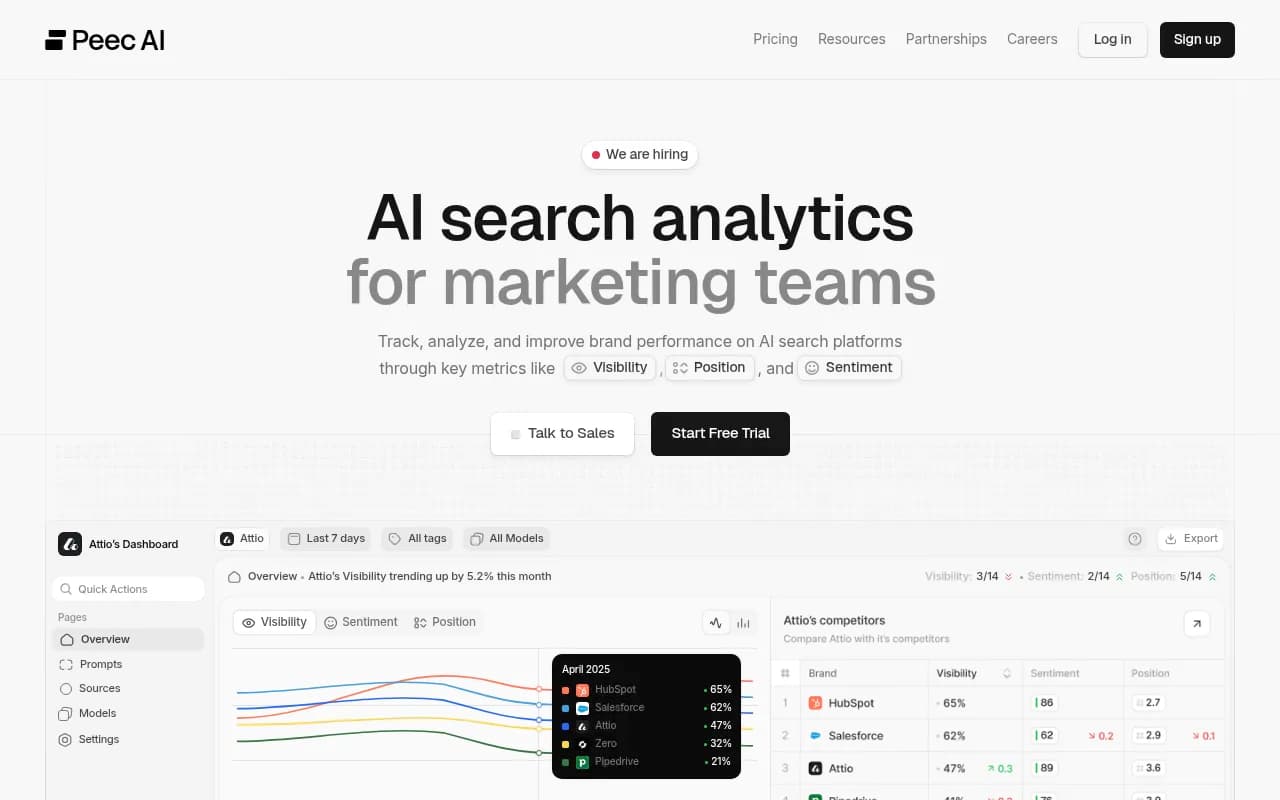
The interface is genuinely good. You can set up prompt tracking quickly, compare your brand against competitors, and get a clear picture of where you stand across different AI models. For teams that have never had any visibility into their AI search presence, Peec AI is a real step forward.
Starting at around €85/month, it's also competitively priced for what it offers.
Where Peec AI falls short
The consistent criticism across user reviews is that Peec AI is primarily a monitoring tool. It shows you the data. It doesn't help you act on it.
There's no content gap analysis that tells you which specific topics or questions you're missing. There's no built-in content generation. There's no traffic attribution to connect your AI visibility scores to actual website visits or revenue. You can see that competitors are getting cited more than you — but Peec AI won't tell you why, or what to write to change it.
For a team that just wants a visibility dashboard and plans to handle strategy and content production separately, that's fine. But for most marketing teams, "we need to improve our AI visibility" and "we need to create content to improve our AI visibility" are the same problem.
AirOps: the content operations platform
AirOps comes at this from the opposite direction. It's built for content teams that want to produce high volumes of AI-optimized content — articles, landing pages, product descriptions — using structured AI workflows.
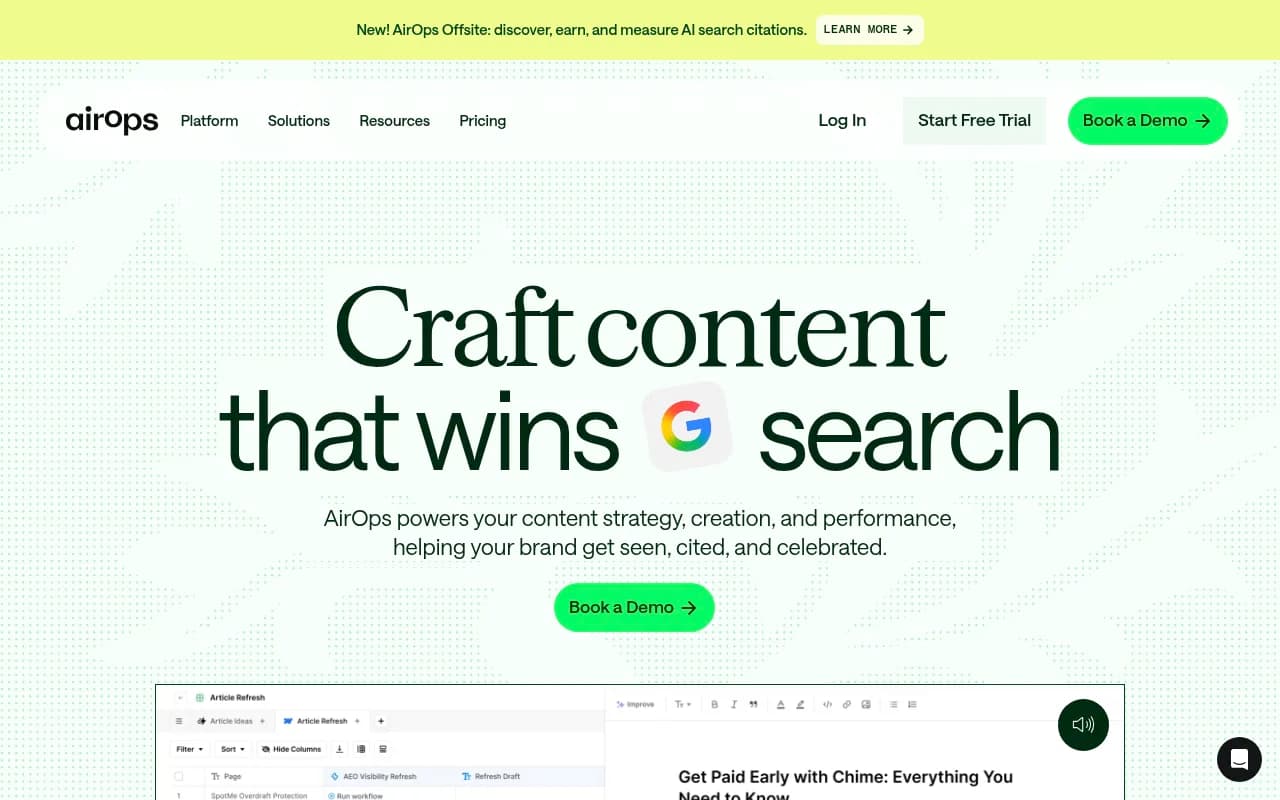
AirOps has a free tier and scales up from there. It's genuinely powerful for content operations: you can build custom AI workflows, connect data sources, and produce content at a scale that would be impossible manually. Teams at larger companies use it to generate hundreds of pages targeting specific AI search queries.
The platform does track some AI visibility — up to 4 models according to current documentation — but this is clearly secondary to its content production capabilities.
Where AirOps falls short
AirOps doesn't have a native feedback loop between visibility data and content creation. You can produce a lot of content with it, but you're largely guessing at what to produce. There's no answer gap analysis showing which prompts your competitors rank for and you don't. There's no citation analysis showing which sources AI models actually pull from. There's no crawler log showing whether AI bots are even reading your new pages.
The result is that AirOps is excellent at the "create" step but weak on the "find gaps" and "track results" steps. You can end up producing a lot of content without a clear signal that it's improving your AI visibility.
Promptwatch: the full-cycle GEO platform
Promptwatch is built around a different premise: monitoring alone isn't useful unless it leads to action, and content creation alone is wasteful unless it's grounded in real visibility data.

The platform monitors 10 AI models (ChatGPT, Perplexity, Claude, Gemini, Google AI Overviews, Google AI Mode, Grok, DeepSeek, Meta/Llama, Copilot, Mistral) and tracks brand visibility at the prompt level. But what distinguishes it from Peec AI isn't the number of models — it's what happens after you see the data.
The action loop
Promptwatch's core workflow goes like this:
Answer Gap Analysis shows you the exact prompts where competitors are visible and you're not. Not vague topic clusters — specific questions and queries, with volume estimates and difficulty scores, that AI models are answering without citing your content.
From there, the built-in AI writing agent generates content grounded in real citation data. Promptwatch has processed over 880 million citations, so when it generates an article or comparison page, it's working from data on what AI models actually cite — not generic SEO best practices.
Then page-level tracking shows you which of your pages are being cited, by which models, and how often. The traffic attribution layer (via code snippet, Google Search Console integration, or server log analysis) connects those citations to actual website visits.
That cycle — find gaps, create content, track results — is what makes Promptwatch a GEO optimization platform rather than a monitoring dashboard.
Additional capabilities
A few Promptwatch features that neither Peec AI nor AirOps offer:
AI crawler logs: Real-time logs of when ChatGPT, Claude, Perplexity, and other AI crawlers visit your site — which pages they read, errors they hit, how often they return. This is how you find out whether AI models can even access your content, which is a prerequisite for being cited.
Reddit and YouTube insights: AI models frequently cite Reddit threads and YouTube videos. Promptwatch surfaces which discussions are influencing AI recommendations in your category — a channel most monitoring tools ignore.
ChatGPT Shopping tracking: For e-commerce brands, Promptwatch monitors when products appear in ChatGPT's shopping carousels and product recommendations.
Competitor heatmaps: Visual comparison of your AI visibility vs competitors across different LLMs and prompt categories.
Multi-language and multi-region: Monitor AI responses in any language, from any country, with customizable personas.
Pricing runs from $99/month (Essential: 1 site, 50 prompts, 5 articles) to $249/month (Professional: 2 sites, 150 prompts, 15 articles, crawler logs) to $579/month (Business: 5 sites, 350 prompts, 30 articles). A free trial is available.
Side-by-side comparison
| Feature | Peec AI | AirOps | Promptwatch |
|---|---|---|---|
| AI models tracked | Up to 10 | Up to 4 | 10 |
| Brand mention monitoring | Yes | Limited | Yes |
| Share of voice / sentiment | Yes | No | Yes |
| Answer gap analysis | No | No | Yes |
| Prompt volume + difficulty scores | No | No | Yes |
| Built-in content generation | No | Yes (core feature) | Yes |
| Citation-grounded content | No | Partial | Yes (880M+ citations) |
| AI crawler logs | No | No | Yes |
| Page-level citation tracking | No | No | Yes |
| Traffic attribution | No | No | Yes |
| Reddit + YouTube insights | No | No | Yes |
| ChatGPT Shopping tracking | No | No | Yes |
| Competitor heatmaps | Basic | No | Yes |
| Multi-language / multi-region | Yes | Limited | Yes |
| Starting price | €85/mo | Free tier | $99/mo |
Which platform is right for which team?
Choose Peec AI if...
You need a clean, affordable monitoring dashboard and your team handles strategy and content production through other tools. Peec AI is a good fit for brands that want to track AI visibility without committing to a full GEO platform — maybe you're just getting started, or you're running a small operation where the monitoring data is enough to inform decisions made elsewhere.
It's also worth considering if you want flexible model selection and a lower price point than the full-featured platforms.
Choose AirOps if...
You have a content operations team that needs to produce AI-optimized content at scale, and you already have visibility data from another source (or you're willing to operate without a tight feedback loop). AirOps is genuinely powerful for content production workflows, and the free tier makes it accessible for teams experimenting with AI content at scale.
It's less suited for teams that need to know what to create before they start creating it.
Choose Promptwatch if...
You want to actually improve your AI visibility, not just observe it. If your goal is to go from "we don't know if we appear in ChatGPT" to "we have a systematic process for finding gaps, filling them, and measuring the results," Promptwatch is the only platform of the three that supports that full workflow natively.
It's also the better choice for agencies managing multiple brands, teams that need traffic attribution to justify GEO investment, and anyone who wants to understand why they're not being cited (crawler logs, citation analysis, Reddit insights) rather than just that they're not being cited.
The real question in 2026
The GEO market is splitting into two camps: monitoring dashboards and optimization platforms. Peec AI is clearly in the first camp. AirOps is in a third category — content production — that overlaps with GEO but isn't quite the same thing. Promptwatch is trying to own the second camp.
For most marketing teams, the monitoring-only approach has a fundamental problem: data without action doesn't improve visibility. Knowing your share of voice is 12% while a competitor's is 34% is useful context, but it doesn't tell you what to do Monday morning.
The platforms that will matter most in 2026 are the ones that close the loop between insight and action. That's the real differentiator — not which tool has the most models tracked or the cleanest UI.
If you're evaluating GEO platforms right now, the most useful question to ask any vendor is: "After I see my visibility data, what does your platform help me do about it?" The answer tells you everything about whether you're looking at a monitoring tool or an optimization platform.