Key takeaways
- Reddit, YouTube, and LinkedIn together account for a significant share of all LLM citations -- in some studies, over 22% of AI answers pull from Reddit and LinkedIn alone
- YouTube overtook Reddit as the top social citation source between August and December 2025, with its share of social citations doubling from 18.9% to 39.2%
- 62% of brands are completely absent from AI-generated answers -- often because they have no presence on the platforms LLMs actually trust
- A social signal audit helps you find where you're missing, what content formats AI models prefer, and which channels to prioritize
- Fixing your AI visibility isn't just about your website -- it requires a deliberate presence on the platforms LLMs use as sources
Why your website isn't enough anymore
Here's something that stings a little: AI models like ChatGPT, Perplexity, and Claude often trust Reddit more than your own website.
That's not a knock on your content team. It's just how LLMs work. They're trained on and retrieve from sources that signal credibility through community engagement, discussion depth, and cross-platform presence. A well-upvoted Reddit thread with 200 comments and genuine back-and-forth often looks more authoritative to an LLM than a polished product page with perfect on-page SEO.
The data backs this up. A study analyzing 30 million LLM citations found that social platforms -- Reddit, YouTube, and LinkedIn -- are consistently among the top cited sources across major AI models. According to Semrush data cited in 2026, Reddit and LinkedIn together account for over 22% of all domains cited by LLMs. That's more than Wikipedia in some analyses.
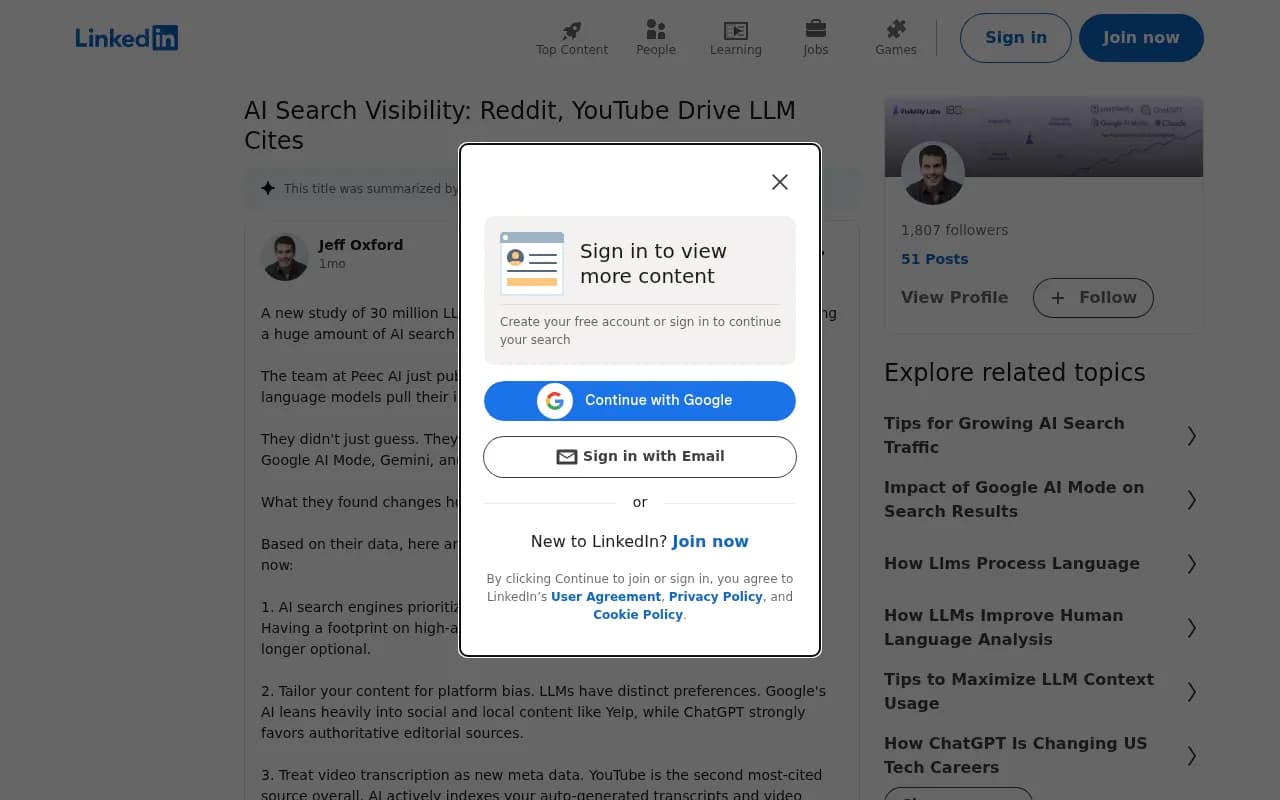
And then there's YouTube. Between August and December 2025, YouTube's share of social citations in LLM responses doubled -- from 18.9% to 39.2% -- while Reddit's share fell from 44.2% to 20.3%. YouTube has overtaken Reddit as the number one social citation source.
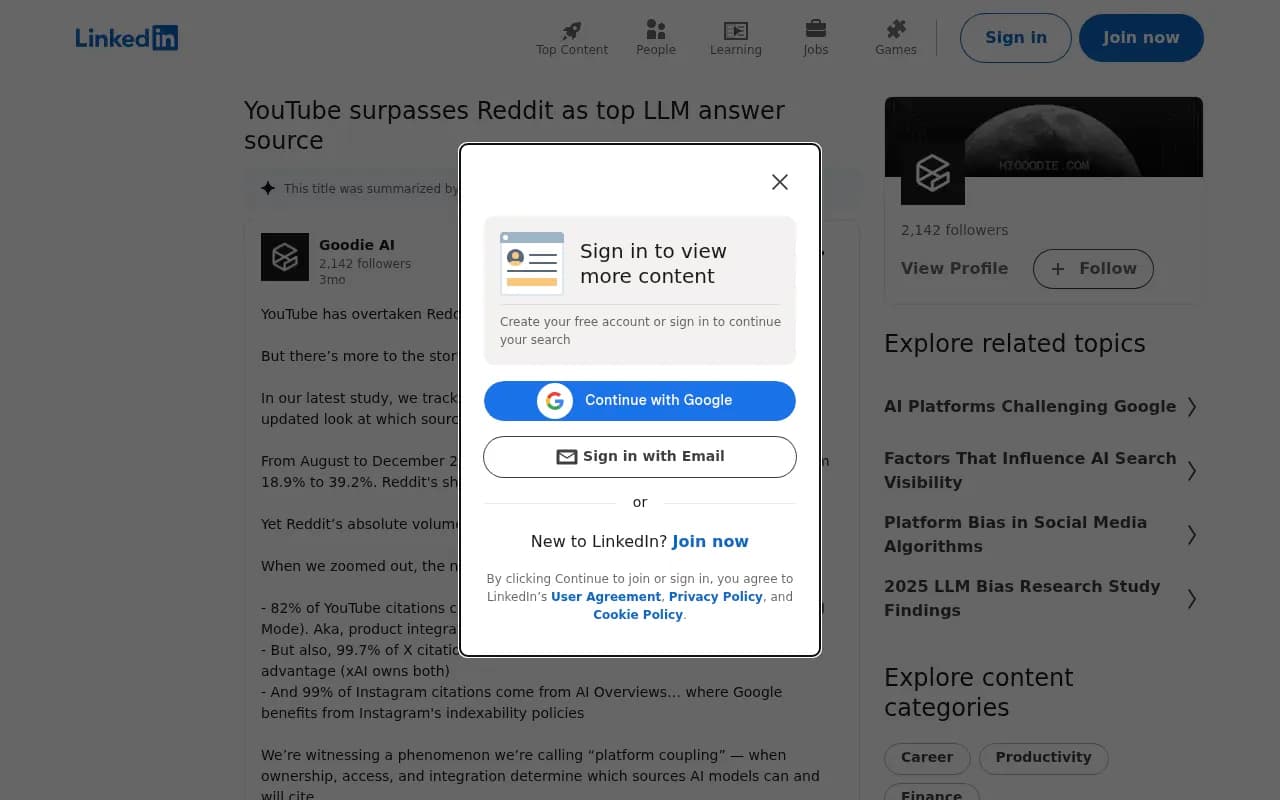
For B2B brands specifically, the picture is even more interesting. When LLMs answer B2B queries, Reddit, LinkedIn, and YouTube are the top three sources being pulled. Not industry publications. Not your blog. Those three platforms.
So what does this mean practically? It means your AI visibility strategy needs a social signal audit -- a structured review of where you appear (or don't appear) on the platforms LLMs actually cite.
What a social signal audit actually is
A social signal audit for AI search is different from a traditional social media audit. You're not measuring follower counts, engagement rates, or reach. You're asking a different set of questions:
- Which platforms are LLMs citing when they answer questions in my category?
- Does my brand appear in those citations?
- What content formats on those platforms get cited most often?
- What topics are being discussed on Reddit, YouTube, and LinkedIn that I'm not part of?
- Are my competitors showing up in these citations while I'm not?
The goal is to map the gap between where LLMs go for answers and where your brand currently exists. Then close that gap.
Platform by platform: what LLMs actually pull
Reddit remains a dominant source for LLM citations, particularly for informational and comparison queries. When someone asks ChatGPT "what's the best project management tool for a 10-person team," there's a good chance the answer is informed by r/projectmanagement threads.
Why? Reddit has authentic, experience-based content. Real users describing real problems and real outcomes. LLMs weight this kind of content because it's specific, opinionated, and hard to fake at scale.
For your audit, you want to know:
- Are there active subreddits in your category?
- Are your brand or products mentioned in those subreddits -- and how?
- Are your competitors being recommended while you're absent?
- Are there threads answering questions you should be answering?
You can start manually by searching Reddit for your category keywords and reading what comes up. But at scale, tools like Promptwatch surface Reddit discussions that directly influence AI recommendations -- which is a much faster way to find the gaps.

YouTube
YouTube's rise to the top citation spot is worth sitting with for a moment. It's not just that people watch more video -- it's that LLMs are increasingly able to process and cite video content, and YouTube's combination of transcripts, metadata, and community signals makes it a rich source.
For AI search purposes, YouTube content that gets cited tends to be:
- Tutorial and how-to content that answers specific questions
- Comparison videos ("X vs Y" formats)
- Review content with genuine opinions
- Content with strong engagement signals (comments, watch time, shares)
Your audit questions here:
- Does your brand have a YouTube presence at all?
- Are there YouTube videos in your category that LLMs cite -- and are any of them yours?
- What questions are people searching on YouTube that you haven't made videos about?
- Are competitor YouTube channels getting cited in AI answers while yours isn't?
LinkedIn's role is more nuanced. It's particularly important for B2B queries, where LLMs pull from thought leadership posts, company pages, and LinkedIn articles. When someone asks an AI model about B2B software categories, pricing benchmarks, or industry practices, LinkedIn content often shows up.
The content that gets cited from LinkedIn tends to be:
- Posts with specific data points or statistics
- Long-form articles that take a clear position
- Content that gets reshared widely within a professional community
- Company pages with complete, regularly updated information
For B2B brands, LinkedIn is arguably the most underutilized citation source. Most companies post on LinkedIn for brand awareness without thinking about whether that content is the kind that LLMs would find useful to cite.
Your audit questions:
- Does your company page have complete, accurate information?
- Are your team members publishing thought leadership that includes specific claims, data, or opinions?
- Are LinkedIn posts in your category getting cited in AI answers?
- What topics are your competitors covering on LinkedIn that you're not?
How to run the audit: a practical process
Step 1: Map the citation landscape
Before you can audit your own presence, you need to understand what LLMs are actually citing in your category. Run a set of representative queries through ChatGPT, Perplexity, Claude, and Gemini. These should be the kinds of questions your target customers ask -- not branded queries, but category and problem-level questions.
For each response, note:
- Which sources are cited?
- Are any of those sources Reddit threads, YouTube videos, or LinkedIn posts?
- Which competitors appear in those citations?
- What topics are being covered in the cited content?
This gives you a baseline. You're not guessing -- you're looking at actual LLM behavior in your category.
Tools like Promptwatch automate this process across 10+ AI models simultaneously, tracking which sources get cited and how often. That's useful when you're running this at scale rather than manually checking a handful of queries.
Step 2: Audit your Reddit footprint
Search Reddit for:
- Your brand name
- Your main product/service category
- The problems your product solves
- Comparison queries that include your brand
Document what you find. Are you mentioned? Is the sentiment positive or negative? Are you absent entirely? Are competitors being actively recommended in threads where you don't appear?
Pay attention to which subreddits are most active in your category. These are the communities that LLMs are likely pulling from.
Step 3: Audit your YouTube footprint
Search YouTube for your main category keywords and comparison queries. Look at which videos rank well and check whether they mention your brand. Then check your own channel (if you have one) -- are you creating content that answers the specific questions people are searching?
One useful signal: look at the comment sections of high-ranking videos in your category. The questions people ask in comments are often exactly the queries that LLMs are trying to answer.
Step 4: Audit your LinkedIn footprint
Check your company page completeness. Then search LinkedIn for posts about your category and see what's getting traction. Look at whether competitors have employees who are active thought leaders publishing content that gets engagement.
For B2B brands, this is often where the biggest gap is. A competitor with three employees who regularly post data-backed opinions on LinkedIn can generate more LLM citations than a brand with a much larger marketing budget that only posts promotional content.
Step 5: Identify the gaps
After running through all three platforms, you should have a clear picture of:
- Where you're absent that competitors aren't
- What content types are getting cited that you're not producing
- Which topics are being discussed that you haven't engaged with
- Which platforms offer the highest opportunity relative to your current effort
What to do with what you find
For Reddit gaps
The instinct is to create Reddit accounts and start posting. Resist this. Reddit communities are good at detecting brand accounts, and getting caught doing promotional posting will actively hurt your reputation.
The better approach:
- Identify the subreddits where your category is discussed
- Participate genuinely -- answer questions, share expertise, engage with existing threads
- If you have employees who are genuine experts, encourage them to participate as individuals
- Create content on your own site that directly answers the questions being asked in Reddit threads -- LLMs often cite the best available answer, and if your site has a better answer than the Reddit thread, it may get cited instead
For YouTube gaps
YouTube requires more investment than the other platforms, but the citation data suggests it's worth it. Focus on:
- Tutorial and how-to content that answers specific questions in your category
- Comparison content (done honestly -- LLMs can tell when it's purely promotional)
- Content that includes specific data, examples, and opinions rather than generic overviews
- Transcripts and descriptions that are thorough and keyword-rich
The goal isn't to go viral. It's to create content that directly answers the questions LLMs are trying to answer.
For LinkedIn gaps
For B2B brands, LinkedIn is often the quickest win. You don't need a production budget -- you need people with genuine expertise willing to share specific opinions and data.
Encourage your subject matter experts to:
- Post about specific problems they've solved, with concrete details
- Share data and research with their own interpretation
- Take positions on industry debates rather than staying neutral
- Write LinkedIn articles that go deeper than a typical post
Company pages matter too. Make sure yours is complete, accurate, and regularly updated with content that would be useful to someone researching your category.
Tracking your progress
Running the audit once isn't enough. Social signal footprints change, and so does LLM citation behavior. YouTube's rise and Reddit's relative decline happened over just five months -- the landscape shifts faster than most marketing teams expect.
Set up a regular cadence (monthly is reasonable for most brands) to:
- Re-run your representative queries across major LLMs
- Check whether your social content is appearing in citations
- Monitor competitor citation patterns
- Track whether the content you've created is getting picked up
For brands that want to track this systematically, Promptwatch includes Reddit and YouTube insights specifically to surface discussions influencing AI recommendations -- one of the few platforms that covers this channel alongside traditional AI visibility tracking.
A note on the 62% problem
The statistic that 62% of brands are completely absent from AI-generated answers is worth returning to. That's not 62% of small businesses -- it's 62% of brands broadly. Most companies have invested heavily in SEO, content marketing, and social media, and still don't appear when AI models answer questions in their category.
The reason is usually a mismatch between where they've invested and where LLMs actually look. A brand with excellent Google rankings but no Reddit presence, no YouTube content, and a LinkedIn page that hasn't been updated in six months is invisible to the citation patterns that matter for AI search.
The social signal audit is how you find out which side of that 62% you're on -- and what to do about it.
Comparison: social platforms for AI citation potential
| Platform | Best for | Content type LLMs cite | Effort to get cited | B2B relevance |
|---|---|---|---|---|
| Informational, comparison queries | Threads with genuine discussion and upvotes | Medium (requires authentic participation) | Medium-High | |
| YouTube | How-to, tutorial, review queries | Videos with strong engagement and clear transcripts | High (production required) | Medium |
| B2B, professional, industry queries | Posts with data, thought leadership articles | Low-Medium (text-based) | Very High | |
| Your website | Branded and direct queries | Well-structured, authoritative content | Medium | High |
Tools worth knowing
For monitoring your brand's AI visibility and tracking which social sources are being cited in your category:
For tracking brand mentions across AI engines more broadly:
For social media monitoring that can feed into your audit process:
For content research to understand what topics are driving discussion on these platforms:
The core insight here is simple: LLMs don't just read your website. They read the internet -- and right now, a significant portion of what they trust comes from Reddit threads, YouTube videos, and LinkedIn posts. If you're not on those platforms in a way that's useful and credible, you're invisible to a growing share of AI-generated recommendations.
The social signal audit is how you find out exactly where the gaps are. The fix is less glamorous than most AI search advice -- it's showing up consistently on the right platforms with content that actually helps people. But that's also why most brands haven't done it yet.