Key takeaways
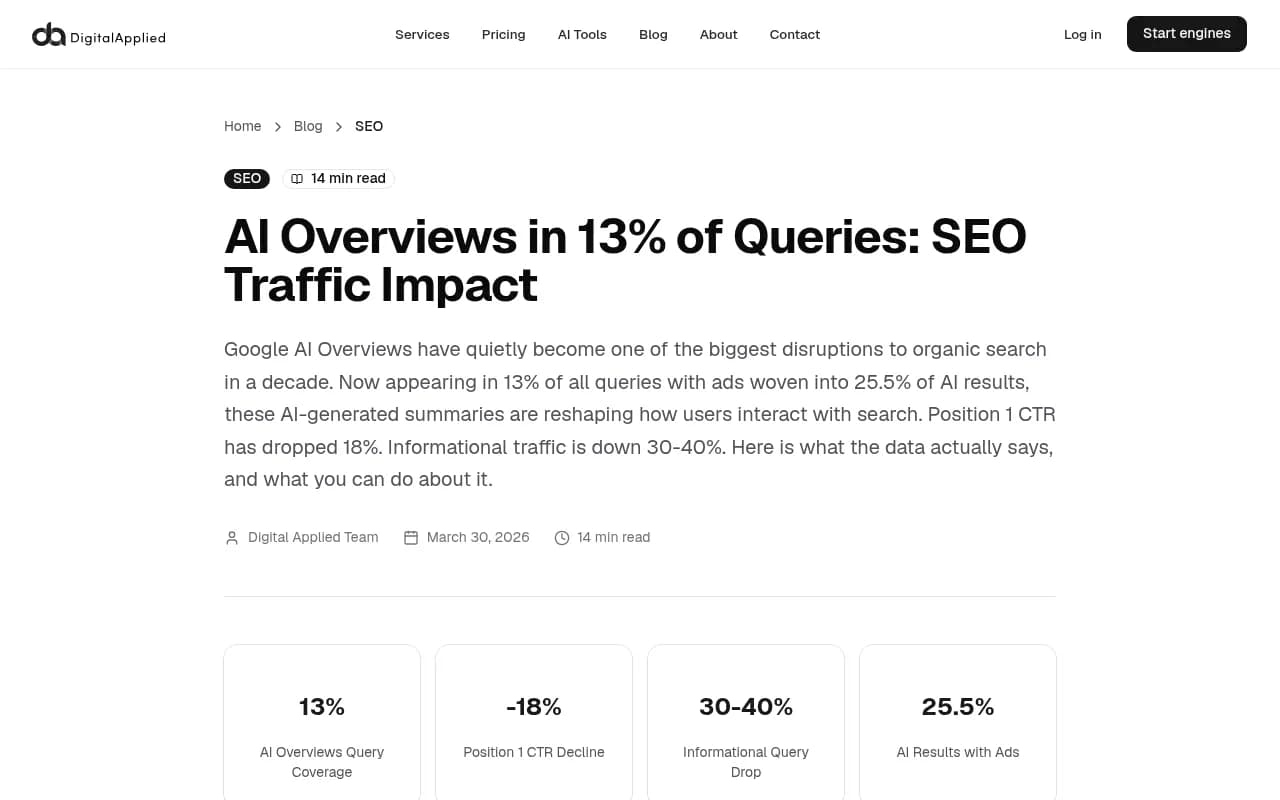
- Ads now appear in an estimated 25.5% of AI Overview results as of Q1 2026, up from 5.17% in early 2025, according to Digital Applied's analysis of over 200,000 keywords.
- Google evaluates both the user's query and the generated AI Overview content for commercial intent, not just the keyword itself. A query with zero commercial phrasing can still pull in Shopping ads if the AI-written answer implies a purchase decision.
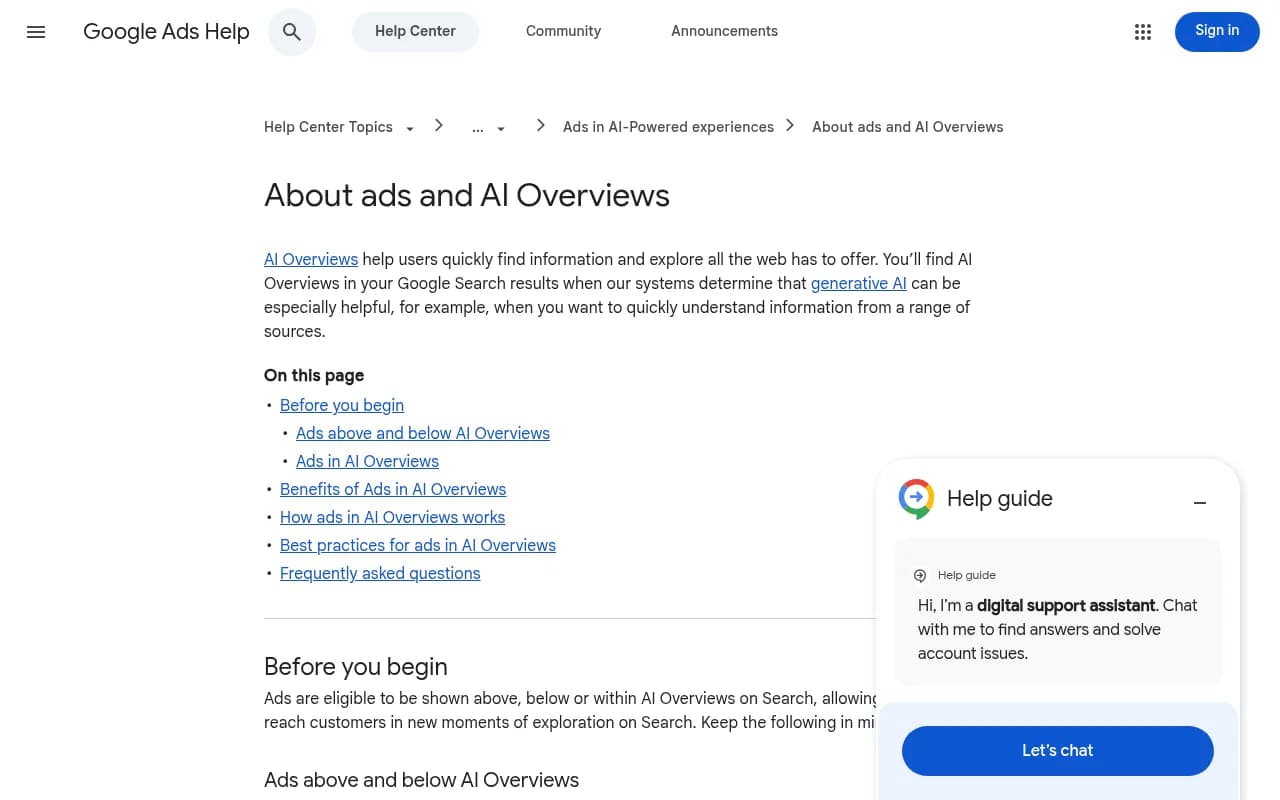
- Ads can appear above, below, or inside the AI Overview. The "inside" placement is still limited to English, on mobile and desktop, in 12 markets including the US, Canada, Australia, and India.
- Query length and intent matter more than exact-match keywords: research-style commercial queries ("best laptops under $1,000") trigger AI Overviews at roughly 45-50%, almost double the rate of purchase-ready transactional queries ("buy Nike shoes") at 20-25%, per Ready2Rank data cited by ziptie.ai.
- There's no dedicated "AI Overview ads" campaign type. Google pulls eligible ads straight from existing Search, Shopping, and Performance Max campaigns, which means you can't directly target this placement, and you can't opt out of it either.
The short version: it's not about bidding on the right keyword
If you're coming from traditional search ads, the instinct is to find the magic keyword list that triggers AI Overview ad placements and bid on it. That's not how this works, and it's worth saying plainly: Google's own documentation states advertisers are "less likely to be targeting" the keywords that trigger AI Overviews in the first place, because AI Overviews surface on complex, answer-seeking queries, not neat little exact-match phrases.
So the real question isn't "which keyword triggers the ad" but "which query shapes and intent combinations cause Google's systems to decide an ad is relevant and helpful enough to insert." That's a mix of query phrasing, commercial signal strength, and what the AI Overview itself ends up saying.
How the trigger actually works, mechanically
According to Google's Ads Help documentation, three things need to line up before an ad shows inside, above, or below an AI Overview:
- An AI Overview has to trigger at all. That happens on "no one right answer" queries, complex questions, or anything where pulling information from multiple sources is genuinely useful.
- Google's systems have to detect commercial intent, and this is evaluated against both the query and the generated AI Overview content, not the query alone.
- Google has to have a quality ad available that's relevant to that combined signal.
That second point is the one most advertisers miss. Google's own example is instructive: someone searches "why is my pool green and how do I clean it." Nothing in that phrasing screams "buy a product." But once the AI Overview generates an answer that discusses pool vacuums and chemicals, Google can decide the overall context is commercial enough to show a pool-vacuum shopping ad. The ad isn't triggered by the search term. It's triggered by what the AI wrote in response to the search term.
This changes the entire mental model for advertisers. You're not targeting a query. You're trying to influence whether an AI-generated paragraph ends up adjacent to commercial subject matter.
Where ads physically show up
There are three distinct placements, and they behave differently depending on query type:
- High-commercial and transactional queries tend to push ads above the AI Overview. Purchase intent is clear enough that Google concentrates competition in the first visible ad slot, the same way it always has on a traditional SERP.
- Informational or mixed-intent queries usually let the AI Overview load first, with ads stacked below it. The summary eats most of the user's attention before they ever scroll to paid listings.
- Embedded placements put a sponsored product card or recommendation directly inside the AI-generated text. A query like "best CRM for ecommerce brands" might generate a comparison list where one sponsored platform sits inside the AI's own answer. This is the placement advertisers have the least control over, since it depends on how Google's model frames the comparison, not on traditional ad rank mechanics.
Query-type breakdown: who gets ads, and how often
Third-party research gives a reasonably consistent picture of which query categories are most likely to both trigger an AI Overview and carry an ad. The numbers below come from Digital Applied's synthesis of Ahrefs, Semrush, Seer Interactive, and SEOClarity data (Sept 2025 - March 2026) plus ziptie.ai's review of Semrush, Ahrefs, and Ready2Rank data through late 2025.
| Query type | AI Overview trigger rate | Ad likelihood | Notes |
|---|---|---|---|
| Definitions / explanations | 40-50% | Low | High AIO coverage, but Google rarely sees commercial intent worth monetizing |
| How-to / tutorials | 35-45% | Low to moderate | Ads show if the tutorial implies a product purchase (e.g. "how to clean a pool") |
| Comparison / "best of" queries | 25-35% | High | Research-style commercial queries trigger AIOs at ~45-50%, the highest of any commercial bucket |
| Purchase-ready transactional ("buy X") | 5-7% overall AIO rate | High when triggered | Lower AIO trigger rate but near-certain ad presence once it fires |
| E-commerce product queries | ~4% | High when triggered | Low overall AIO rate, concentrated commercial ad exposure |
| Local service searches | 6-8% | Moderate | Ads often local-intent Shopping or Performance Max placements |
| Brand navigational queries | 2-3% | Very low | Users already know where they're going; little room for a competing ad |
| Health / science queries | 30-40% | Low (mostly excluded) | Sensitive-category restrictions still apply outside a narrow 2026 US pilot |
A few things jump out from this table. First, the queries most likely to trigger an AI Overview at all (definitions, how-to content, health topics) are the least likely to carry ads, because Google still treats pure informational intent as low-commercial. Second, the inverse group, purchase-ready transactional and e-commerce product queries, triggers AI Overviews far less often, but when it does, an ad is close to guaranteed. Third, comparison and "best of" queries sit in the sweet spot: high AIO trigger rate and high ad likelihood, which makes this the category advertisers should watch most closely in 2026.
There's also a phrasing effect layered on top of intent. Question-phrased queries trigger AI Overviews around 57.9% of the time, long-tail queries of four-plus words trigger at roughly 60.85%, and single-word queries trigger at just 9.5%, per the same ziptie.ai synthesis. Longer, more conversational queries simply give Google's systems more surface area to detect both the "no one right answer" signal and the commercial-intent signal that feeds ad eligibility.
Shopping queries are the fastest-growing ad surface
One trend worth flagging separately: AI Overviews now appear on 14.0% of shopping queries, a 5.6x jump from 2.1% in November 2025, based on Search Engine Land's coverage of a Visibility Labs analysis of nearly 21 million SERPs. That's a much steeper growth curve than AI Overview adoption overall, and it tracks with Google's broader push to monetize shopping-adjacent AI surfaces, including the Direct Offers pilot in AI Mode, which lets retailers like Petco and e.l.f. Cosmetics surface context-aware discounts directly inside AI conversations, not tied to any specific keyword at all.
2026's biggest change: healthcare ads, carefully
For years, AI Overview ads excluded an entire list of sensitive verticals: adult content, alcohol, gambling, finance, healthcare, and politics. That changed in part at Google Marketing Live in May 2026, when Google confirmed a small, US-only test allowing healthcare ads inside AI Mode and AI Overviews for the first time. The catch: eligible campaigns are limited to Performance Max, AI Max with search-term matching, Shopping, and broad match keywords, and the first iteration excludes any creative that uses pinning or text disclaimers, which is a real constraint given how much healthcare advertising relies on pinned regulatory language. Finance and gambling remain excluded for now. It's a narrow test, but it signals where Google is headed: cautiously expanding ad eligibility into categories it previously walled off entirely.
What advertisers should actually do about this
Google's own recommendation, buried in its Ads Help documentation, is blunt: stop trying to exact-match your way into AI Overview ad placements. Instead:
- Use broad match on Search campaigns, or lean on keywordless targeting through AI Max for Search, Performance Max, Shopping campaigns, or Dynamic Search Ads.
- Pair that with Smart Bidding, since the auction signals for AI Overview placements are evaluated differently than a standard SERP auction.
- If you sell physical products, keep your Merchant Center feed current. Pricing, promotions, shipping, and return fields need to be accurate because Google is pulling live data into both the AI Overview content and any adjacent Shopping ad.
- Audit which of your informational keywords are already triggering AI Overviews. These are the queries where you're losing organic clicks (position 1 CTR drops about 18% on average when an AIO appears, and as much as 58% on the worst informational queries), and they're also the queries least likely to carry an ad you can compete for. That combination makes them a traffic risk, not an ad opportunity.
Tracking your exposure to AI Overview ads and citations
Since Google doesn't give advertisers dedicated reporting for AI Overview ad performance (it's still bucketed under "Top Ads" in standard Google Ads reporting, and Google itself calls segmented AIO reporting "early stages"), most of the useful visibility has to come from third-party monitoring. Tools built for AI search visibility, like Promptwatch, track which of your queries trigger AI Overviews, which pages get cited, and increasingly, the broader shift toward commercial content types inside those citations.

For context on how fast commercial content is crowding out purely informational formats inside AI-generated answers, Promptwatch's data on AI Overviews citation types in July 2026 found that product pages overtook listicles as the single most-cited format late in the month, a reversal from January 2026 when product pages made up only about 9% of citations. That shift mirrors the ad-trigger data above: Google's AI surfaces are warming to commercial content across the board, not just in paid placements.
If you're running Google Ads on queries that also trigger AI Overviews, it's also worth separately tracking ad behavior on other AI platforms, since budgets and strategy increasingly need to account for more than one surface. Promptwatch's tracking of ChatGPT's ad rollout, for instance, shows ads appearing in a 7-day average of 32.4% of web-search-enabled ChatGPT responses as of mid-August 2026, up from literally zero before late May. Advertisers managing paid presence across AI Overviews and ChatGPT at the same time are dealing with two separate, fast-moving auction systems, not one unified AI ad market.
For readers who want to compare a broader set of GEO and AI visibility platforms before picking one, the directory at bestgeosoftware.com is a reasonable place to see how the category has filled out in 2026.
The bottom line
There's no keyword list that reliably triggers an AI Overview ad. The trigger is a combination of query complexity, phrasing length, and commercial intent that Google evaluates against both what you searched and what its AI decided to write in response. Comparison and research-style commercial queries are currently the sweet spot where both AI Overview coverage and ad likelihood run high. Pure informational queries get plenty of AI Overview coverage but very few ads. And purchase-ready transactional queries get fewer AI Overviews overall, but when one does appear, an ad is close to a sure thing. Plan your bidding strategy, and your content strategy, around that asymmetry rather than around specific keywords.