Key takeaways
- Consumers expect brands to respond on the platform where the crisis started, not via a press release. 64% say responding on social media itself matters, and 84% say response speed shapes their whole view of the incident (Sprout Social, May 2026).
- The narrative hardens within 2-4 hours. Use a staged timeline like the 15-20-60-90 model: acknowledge at 15 minutes, confirm facts at 20, give a fuller update at 60, keep going at 90 and beyond.
- Build a named crisis team before anything happens. Tier your response (Level 1 complaint vs Level 3 viral/press/boycott) so people aren't debating ownership mid-fire.
- Where you publish the official correction now matters for AI visibility too. Promptwatch's content half-life data shows news-style posts drop out of ChatGPT citations within about five weeks, while an owned FAQ/landing page keeps getting cited for months.
- Don't assume the same crisis will show up the same way everywhere. ChatGPT has largely stopped citing social media (0.46% of citations), but Google AI Overviews still pulls 12.2% of its citations from social platforms, YouTube and Reddit especially.
What actually counts as a crisis in 2026
Not every angry reply is a crisis. A single customer complaint is a Monday. A crisis is when negative attention starts compounding faster than your team can respond to it one message at a time, and it threatens to spread past the people who were originally affected.
The practical signals worth tripwiring for, borrowed from current social listening playbooks: a sudden volume spike (going from 20 daily mentions to 80 in a few hours), a cluster of negative comments on the same specific complaint within an hour, amplification from high-reach accounts rather than just raw mention count, and the same complaint showing up on two or three platforms within a short window. Employee leaks or internal screenshots making it outside the company are their own category and usually move faster than anything else.
Hootsuite's tiering model is still the cleanest way to sort this in practice:
| Level | What it looks like | Who handles it |
|---|---|---|
| Level 1 | Isolated complaint, small reach, no pattern | Social media team responds directly, keeps monitoring |
| Level 2 | Repeated complaints, growing attention, sentiment turning | Alert the wider team, draft messaging, watch it closely |
| Level 3 | Viral spread, press pickup, boycott calls, screenshots circulating off-platform | Full crisis team activates per the documented plan |
The mistake most teams make is treating every Level 2 like a Level 1 until it's obviously a Level 3, by which point you're reacting instead of managing.
Build the team before you need it
Every credible 2026 playbook says the same thing in different words: decide who is in the room and who has authority to approve a public statement before the fire starts, not during it. A cross-functional crisis team typically pulls from social media, communications/PR, legal, customer care, and someone with executive authority to approve language fast. For anything touching product safety, data, or compliance, add that function too.
A few things that separate teams that handle this well from teams that don't:
- One person leads, chosen for ability to make calls under pressure, not seniority or politics.
- Escalation triggers are written down in advance, so nobody has to debate at 2am whether this counts as a Level 2 or Level 3.
- Backups are named for every role. Crises don't wait for someone's vacation to end.
- The team has pre-approved message templates for common scenarios (outage, data incident, employee misconduct, pricing backlash) that just need facts dropped in, not written from scratch under pressure.
The first few hours: a working timeline
The industry-standard timeline that's become the 2026 benchmark is the 15-20-60-90 structure:
- ~15 minutes: Acknowledge publicly. "We're aware of [issue] and looking into it. We'll share an update by [specific time]." This buys time without overcommitting.
- ~20 minutes: Share whatever confirmed facts you actually have, even if incomplete. Don't speculate and don't promise a cause you haven't verified.
- ~60 minutes: A fuller update that explains what's being investigated, what teams are involved, and a realistic timeframe for next steps.
- ~90 minutes and beyond: Keep the cadence going on a fixed, stated schedule ("we'll update every two hours until this is resolved") until the issue is genuinely closed.
The reason speed matters this much: organizations that respond within the first hour are roughly 85% more likely to maintain public trust, and the public narrative tends to solidify within 2-4 hours whether or not the brand has weighed in. If you're not part of shaping that narrative in hour one, someone else will be.
One detail people skip: choose the channel deliberately. For a crisis that started on a specific platform, the first acknowledgment belongs on that same platform, not buried in a press release link. For larger incidents you'll also want a stable source of truth, usually a newsroom page or dedicated statement URL, that social posts can point back to as it develops. The failure mode to avoid is different teams publishing slightly different versions of the story on different channels.
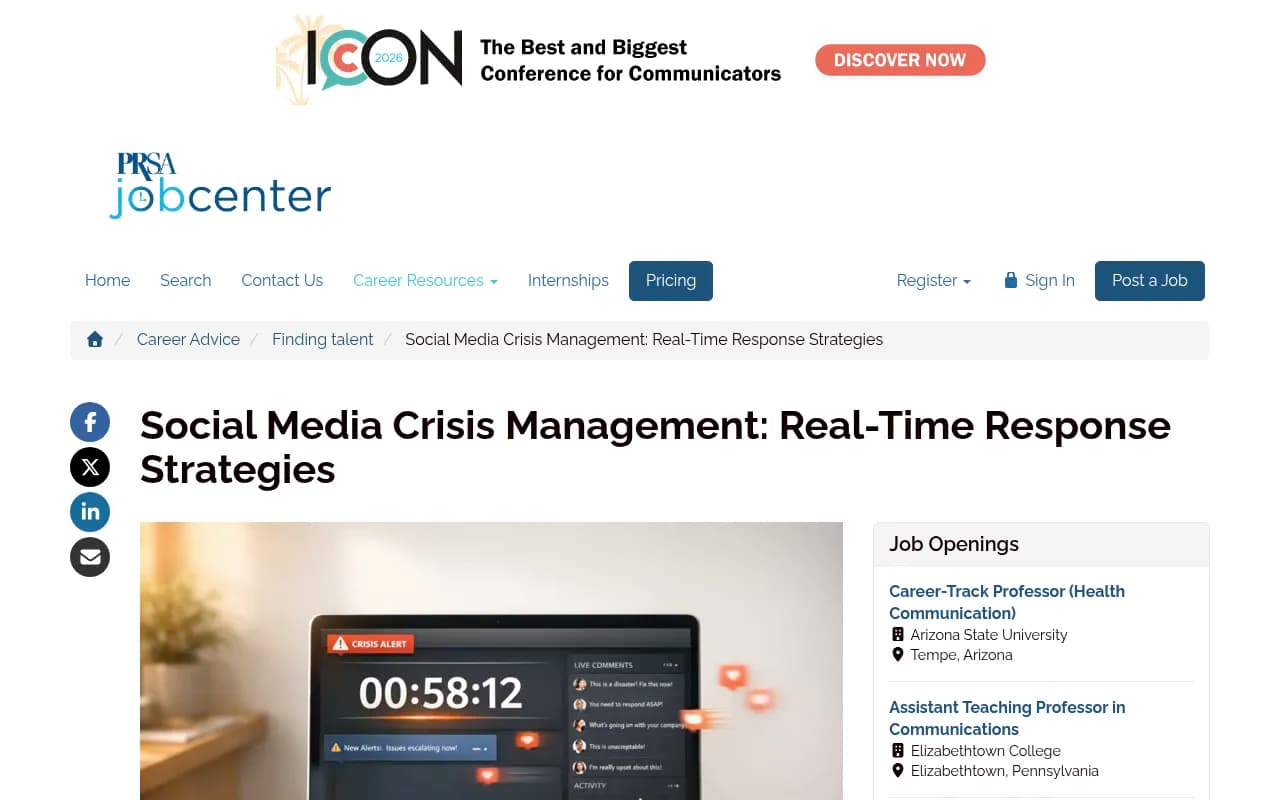
Keeping internal teams aligned (this is where most of these fall apart)
The actual failure point in most botched crisis responses isn't the public statement, it's internal. Social, PR, customer care, legal, regional teams, and spokespeople end up working off different screenshots and assumptions, and the inconsistency leaks out publicly within hours.
The fix is unglamorous: one shared, continuously updated document that states what is actually known, what's still unverified, and what's been communicated so far. Leadership should get a summary, not a raw mention feed, covering what changed, how fast attention is growing, where it's spreading, what the public is saying, and what comes next. If your crisis team is debating basic facts in a Slack thread while the social team is also fielding press calls, you've already lost control of the message.
A concrete framework worth adopting, sometimes called ACE: acknowledge publicly within two hours, communicate updates on a fixed stated cadence on the platform where it started, and execute the actual fix with an explicit close: what happened, what was done, what prevents it happening again. Skipping that last step leaves the story feeling unresolved even after the problem is technically fixed.
The AI search layer nobody's crisis plan accounts for yet
Here's something most crisis playbooks still miss. When someone searches for your brand name plus the controversy six weeks later, the answer they get increasingly comes from ChatGPT, Google AI Overviews, or Perplexity, not a Google results page they scroll through themselves. And those engines don't all pull from the same sources.
ChatGPT has quietly moved away from citing social platforms at all. Promptwatch's data shows social media (Reddit, YouTube, LinkedIn, Facebook, Instagram, TikTok, X combined) now makes up just 0.46% of ChatGPT citations, down from 5.8% a few months earlier, driven largely by Reddit's citation share collapsing from roughly 4% to 0.5% in a single week in August 2026. If your crisis is playing out mostly on Reddit or X, ChatGPT is simply not going to surface that thread anymore.
Google AI Overviews is the opposite story. Social platforms still account for 12.2% of its citations, roughly 26 times ChatGPT's rate, with YouTube and Facebook leading. Perplexity sits in between at around 2.7%. So the same controversy can be effectively invisible in one AI answer engine and still prominently cited in another, months after it happened.

This has a direct, practical implication for where you publish your official response. Promptwatch's content half-life tracking found that news-style posts about a topic get cited heavily at first, then decay fast, half drop out of ChatGPT citations within 36 days, and only 41% remain cited after 60 days. A dedicated statement or FAQ page in a landing-page format behaves completely differently: it keeps roughly 67-78% of its citations after 30 and 60 days. The takeaway is blunt. Treat your official crisis statement as a permanent page on your own site, not a press release that expires, because that's the version AI engines will keep surfacing to anyone who asks about it long after your social posts have scrolled out of view. Teams already using tools like Promptwatch for ongoing brand visibility monitoring can watch which AI engines are still citing crisis-related content and adjust that page's framing accordingly.
After the dust settles
Most of the damage to trust doesn't happen in the first 24 hours, it happens in the weeks after, depending on whether you actually closed the loop. A few things worth doing in the first one to two weeks:
- Hold a formal debrief with everyone who was involved, including social, legal, customer care, and leadership, while details are still fresh. Don't wait a month.
- Track sentiment recovery over time rather than assuming it's over once the mention volume drops. A tool like Brandwatch, Brand24, or Meltwater can show you whether negative sentiment is actually fading or just going quiet.
- Update the documented crisis plan with what you learned. If your escalation thresholds were wrong, fix them now while it's obvious why.
- Set realistic expectations internally about recovery timelines. Roughly half of consumers say they'd consider buying from a brand again within a few months of a properly handled crisis, but that's conditional on actually handling it properly, not just going quiet and hoping.
Picking tools for ongoing monitoring
Most teams underinvest in the detection side and overinvest in the response side. A crisis you catch at 20 mentions is a non-event; the same crisis caught at 2,000 mentions is a Level 3. The right monitoring setup depends heavily on budget and how much of your crisis risk lives in social vs. broader media.
| Tool | Starting price | Strength for crisis use | Watch out for |
|---|---|---|---|
| Sprout Social | ~$249/user/mo | Approval workflows for fast sign-off chains | Per-seat pricing adds up for larger teams |
| Hootsuite (Talkwalker) | ~$99/user/mo | Broad listening at a lower entry price | Less depth than dedicated listening tools |
| Brand24 | ~$249/mo | Solid sentiment tracking, accessible pricing | Smaller scale than enterprise options |
| Agorapulse | ~$99/user/mo | Unified inbox good for triaging during a crisis | Historical/API data often costs extra |
| Meltwater | Custom/sales | Covers broadcast and print alongside social, useful once a crisis crosses into press | Pricing opaque, steeper learning curve |
| Brandwatch | Custom/sales | Enterprise-scale listening and sentiment analysis | Requires a sales call, not self-serve |
For smaller teams, something like Sprout Social or Hootsuite covers detection and response workflows at a reasonable price. If broadcast and print coverage matter because your crisis risk extends beyond social, Meltwater's traditional media monitoring is worth the sales call. Larger organizations or agencies managing crisis response across multiple brands should look at Brandwatch for the depth of its sentiment and volume tracking.
If your crisis response now needs to account for how it plays out in AI search answers months later, that's a separate monitoring job from social listening, and it's worth checking a directory like bestgeosoftware.com for GEO-specific platforms if Promptwatch isn't already part of your stack.
A final note on the deepfake problem
One 2026-specific wrinkle worth planning for: synthetic content is now a meaningful source of crises that have nothing to do with anything your brand actually did. Deepfake volume grew roughly 900% between 2023 and 2025, and influencers have had their likeness used in fake product endorsements that took platforms weeks to remove even after being reported. If a crisis starts with "is this real," verification has to happen before any statement goes out, not after. Build a step into your plan for authenticating screenshots, video, and audio before your crisis team reacts to something that may not have actually happened the way it's being shown.