Brandwatch Review 2026
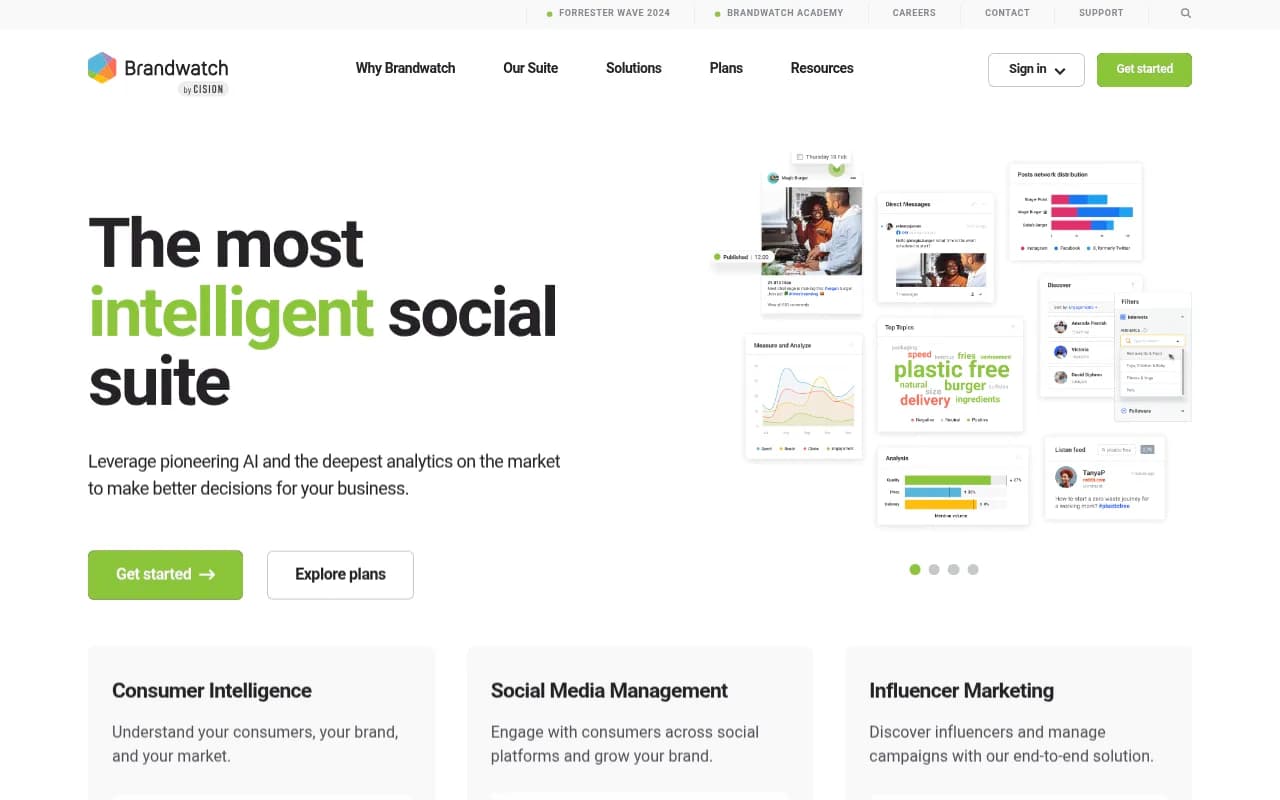
Brandwatch is an enterprise social intelligence and social media management suite used by global brands. It combines consumer research, brand monitoring, social publishing, influencer marketing, and AI-powered analytics in one platform.
Key takeaways
- Brandwatch is one of the most established enterprise social intelligence platforms on the market, with a strong reputation for deep consumer research and brand monitoring across 100M+ sources
- Pricing starts at roughly $1,750/month (based on third-party reporting), making it one of the more expensive options in its category -- not suitable for SMBs or solo marketers
- The platform covers social listening, publishing, engagement, and influencer marketing in a single suite, which reduces the need for multiple tools
- Forrester named it a Leader in its 2024 Social Suites Wave, which carries real weight for enterprise procurement teams
- The suite does not cover AI search visibility (ChatGPT, Perplexity, Google AI Overviews) -- for brands that need to track and optimize their presence in LLM-generated answers, a dedicated platform like Promptwatch is necessary
Brandwatch has been around long enough that most enterprise marketing teams have at least heard of it. Founded in Brighton, UK in 2007, it spent years building what became one of the deepest social listening databases in the industry. The company went through a significant transformation in 2021 when Cision acquired it and merged it with Falcon.io, a social media management platform. That merger is why Brandwatch today is genuinely two things at once: a heavy-duty consumer intelligence tool and a full social media management suite. The Paladin influencer marketing platform was folded in a year later, rounding out the offering.
The target audience is clearly enterprise. We're talking global brands, large agencies, and research-heavy marketing teams that need to process millions of social mentions, run competitive intelligence programs, and coordinate publishing across dozens of accounts. This is not a tool you buy because it's affordable or easy to get started with. You buy it because you need scale, historical data depth, and the kind of analytics that smaller tools simply can't match.
Key features
Consumer Intelligence (social listening at scale)
The core of Brandwatch's original product is its consumer research engine. It monitors over 100 million sources including social networks, forums, blogs, news sites, and review platforms. The historical data archive goes back years, which matters when you're doing trend analysis or benchmarking a campaign against something that happened 18 months ago.
- Boolean query builder lets analysts construct highly specific searches -- useful for filtering out noise in high-volume categories
- Sentiment analysis is AI-powered and has improved significantly over the years, though it still struggles with sarcasm and niche industry language
- Demographic breakdowns (age, gender, location, profession) are inferred from public profile data, which is useful but should be treated as directional rather than precise
- The "Signals" feature surfaces anomalies and trend spikes automatically, so analysts don't have to manually check dashboards
Brand monitoring and crisis detection
Real-time alerts can be configured to fire when mention volume spikes, sentiment shifts, or specific keywords appear. The system monitors across the same 100M+ source pool, so you're not just watching Twitter/X -- you're catching forum discussions, Reddit threads, and news coverage simultaneously.
- Smart alerts use AI to distinguish genuine crises from normal noise fluctuations
- Spike detection compares current volume against historical baselines, not just absolute thresholds
- Competitor monitoring can run in parallel, so you see your brand's share of voice shifting in real time
Social Media Management (formerly Falcon.io)
The publishing and engagement side of the platform handles scheduling, approval workflows, and community management. This is the Falcon.io DNA showing through.
- Unified content calendar with team collaboration, approval chains, and campaign tagging
- Social inbox aggregates mentions, DMs, and comments across platforms into a single queue
- Supports major networks including Instagram, Facebook, X (Twitter), LinkedIn, TikTok, and YouTube
- Content performance analytics feed back into the calendar, so you can see what's working without leaving the tool
Influence (influencer marketing)
The Influence module (formerly Paladin) handles influencer discovery, campaign management, and performance tracking end-to-end.
- Influencer search with filters for audience demographics, engagement rates, and topic affinity
- Campaign briefs, contracts, and payment workflows are managed inside the platform
- Performance reporting tracks reach, engagement, and conversions tied to specific influencer posts
AI-powered analytics
Brandwatch has been integrating generative AI into its analytics layer, with features that summarize large datasets and surface insights without requiring manual analysis.
- "Iris" is Brandwatch's AI assistant, which can answer natural language questions about your data ("What are people saying about our new product launch?")
- Automated report generation reduces the time analysts spend on weekly and monthly reporting
- Trend forecasting uses historical patterns to project where conversations are heading
Search Intelligence (Trajaan integration)
Brandwatch recently announced the acquisition of Trajaan, a search intelligence platform. This is positioned to bridge social and search data, giving marketers a view of both what people are saying on social and what they're searching for. This is still relatively new territory for Brandwatch, and the depth of integration remains to be seen.
Dashboards and reporting
Custom dashboards are one of Brandwatch's stronger selling points. Analysts can build highly specific views combining multiple data sources, and dashboards can be shared with stakeholders who don't have full platform access.
- Drag-and-drop dashboard builder with a wide range of chart types
- Scheduled report delivery via email
- Data export to CSV, Excel, and via API for custom BI integrations
Who is it for
Brandwatch is built for enterprise marketing and insights teams at large companies. Think global consumer goods brands running always-on listening programs, financial services firms monitoring regulatory risk in social conversations, or large agencies managing social intelligence for multiple Fortune 500 clients. The BBC's Principal Social Analyst is a quoted customer -- that's the kind of user who gets real value here. Someone who needs to process millions of mentions, build custom taxonomies, and produce board-level reports.
For agencies, Brandwatch works well when the client roster includes large brands with complex needs. An agency managing 20+ enterprise accounts, each requiring dedicated listening dashboards and monthly insight reports, can justify the cost. Smaller agencies or those focused on SMB clients will find the pricing hard to rationalize.
Industries where Brandwatch particularly shines include consumer packaged goods, retail, financial services, media and entertainment, and technology. These verticals tend to have high social conversation volumes, competitive intelligence needs, and the budget to support enterprise tooling.
Who should not use Brandwatch: startups, small businesses, solo consultants, or any team that primarily needs a simple scheduling and publishing tool. The pricing alone rules out most of these use cases. Tools like Buffer, Hootsuite, or Sprout Social serve those needs at a fraction of the cost. Similarly, if your primary need is tracking how your brand appears in AI-generated answers from ChatGPT or Perplexity, Brandwatch doesn't cover that at all -- that's a different category entirely.
Integrations and ecosystem
Brandwatch connects with a reasonably wide range of external tools, though the depth of integration varies.
- Google Analytics and Adobe Analytics: Connect web performance data to social activity
- Salesforce: CRM integration for tying social engagement to customer records
- Slack: Alert notifications and report sharing
- Tableau and Power BI: Data export for custom visualization
- Zapier: Workflow automation connecting Brandwatch events to other tools
- API access: Available for enterprise customers, enabling custom data pipelines and integrations with internal BI systems
- Social platform native integrations: Direct connections to Meta, X, LinkedIn, TikTok, YouTube, and Pinterest for publishing and analytics
The GitHub presence (github.com/brandwatchltd) suggests some developer tooling exists, though the public repositories are limited. The API is the main path for developers who want to build on top of Brandwatch data.
There's no dedicated mobile app for the full platform, though the social inbox has mobile-friendly access. For a tool at this price point, a more capable mobile experience would be expected.
Pricing and value
Brandwatch does not publish pricing on its website -- you have to request a demo to get a quote. Based on third-party sources including Agorapulse's pricing analysis, the entry point for the Consumer Intelligence product starts around $1,750/month, with annual billing required. That puts the minimum annual commitment at roughly $21,000.
The Social Media Management suite (formerly Falcon.io) has historically had lower entry pricing, but the two products are now sold together as a suite, which affects how pricing is structured. Enterprise deals are custom-quoted based on mention volume, number of users, and which modules are included.
There are three broad plan tiers, but the specifics are not publicly disclosed. What's clear from customer reports is that costs scale significantly with mention volume -- high-volume categories like consumer electronics or fast food can push costs well above the entry price.
Compared to competitors: Sprinklr and Khoros operate at similar or higher price points for enterprise. Meltwater and Talkwalker are closer competitors on the listening side, with similar pricing ranges. For teams that only need social publishing, Sprout Social is considerably cheaper. For teams that only need consumer research, there are more affordable listening tools available.
The value case for Brandwatch is strongest when you're using the full suite -- listening, publishing, and influencer -- because the cost per capability becomes more defensible. Buying just one module at enterprise pricing is harder to justify.
Strengths and limitations
What it does well
- Data depth and historical archive: The breadth of sources and years of historical data is genuinely hard to match. For trend analysis and longitudinal research, this is a real advantage.
- Query flexibility: The Boolean query builder gives analysts precise control over what they're tracking. This matters in noisy categories where simple keyword matching produces garbage results.
- Suite consolidation: Having listening, publishing, engagement, and influencer in one platform reduces the number of vendor relationships and data silos. For large teams, that operational simplicity has real value.
- Enterprise-grade reliability and support: Brandwatch has the infrastructure and support organization that large enterprises expect -- SLAs, dedicated account management, and training resources through Brandwatch Academy.
- Forrester recognition: Being named a Leader in the 2024 Forrester Wave for Social Suites carries weight in enterprise procurement processes where analyst validation matters.
Limitations
- Price: The cost is a genuine barrier. At $1,750+/month as an entry point, it's out of reach for most companies outside the enterprise segment. There's no meaningful free tier or low-cost entry point.
- Complexity: The platform has a steep learning curve. Getting real value out of the Consumer Intelligence product requires analysts who understand Boolean logic and are willing to invest time in query refinement. Casual users will be overwhelmed.
- No AI search visibility: Brandwatch monitors social and web conversations, but it has no capability to track how brands appear in AI-generated search results from ChatGPT, Perplexity, Google AI Overviews, or other LLMs. As AI search becomes a meaningful traffic and discovery channel, this is a gap. Platforms built specifically for that use case, like Promptwatch, cover what Brandwatch cannot.
- Mobile experience: For a platform at this price point, the mobile experience is underwhelming. Teams that need to monitor and respond on the go will feel the limitation.
Bottom line
Brandwatch is a serious tool for serious enterprise teams. If you're running a global brand with high social conversation volume, need deep consumer research capabilities, and want to consolidate social publishing and influencer management under one roof, it's one of the strongest options available. The Forrester recognition and the depth of the listening database are legitimate differentiators.
That said, it's not for everyone -- and the price makes sure of that. For brands that also need to understand and improve their visibility in AI search engines like ChatGPT and Perplexity, Brandwatch won't help. That's a separate problem requiring a dedicated platform like Promptwatch.
Best use case: Large enterprise marketing and insights teams that need deep social listening, competitive intelligence, and integrated social publishing at scale.
Tags:
Frequently asked questions
What is Brandwatch?
How much does Brandwatch cost?
Who is Brandwatch best suited for?
Does Brandwatch track AI search visibility (ChatGPT, Perplexity, etc.)?
What happened to Falcon.io and Paladin?
Is there a free trial for Brandwatch?
Similar and alternative tools to Brandwatch