Amplemarket Review 2026
Sales engagement platform combining B2B contact data, multichannel sequencing, LinkedIn automation, and AI-generated personalization for outbound sales.
Key takeaways
- Amplemarket replaces a stack of tools (ZoomInfo, Outreach, Salesloft, LinkedIn Sales Navigator) with a single platform covering data, sequencing, deliverability, and AI-driven personalization
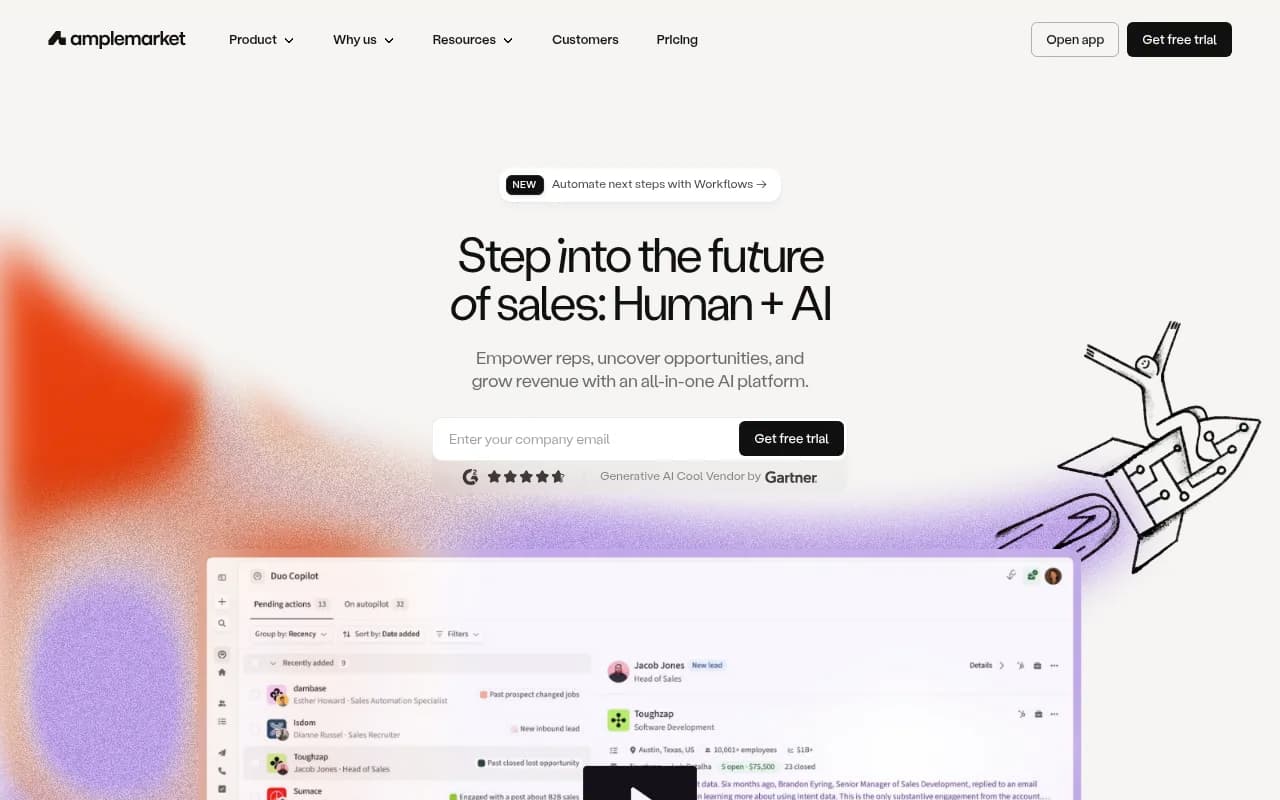
- The Duo AI Copilot is the standout differentiator: it monitors dozens of intent signals daily and auto-generates personalized multichannel sequences, including AI voice notes cloned from your own voice
- Pricing starts at $600/month on an annual contract, which puts it out of reach for solo reps or very small teams
- Deliverability tooling (domain health center, smart warmup, AI scheduling) is more built-out than most competitors in this space
- Not a fit for inbound-heavy teams, marketing automation use cases, or anyone who needs a free or low-cost entry point
Amplemarket is a sales engagement platform built specifically for outbound teams that want to consolidate their tech stack. Where most companies end up stitching together a contact database (ZoomInfo or Apollo), a sequencing tool (Outreach or Salesloft), a LinkedIn automation layer, and some kind of intent data feed, Amplemarket puts all of that under one roof. The pitch is simple: fewer tools, less context-switching, and an AI layer that actually does work rather than just surfacing dashboards.
The company is headquartered in San Francisco with roots in Portugal, and has been building in the sales engagement space since around 2019. Gartner recognized it as a Cool Vendor in Generative AI for Sales, which is a meaningful signal given how crowded this category has become. Customers like Mistral AI, Deel, Vanta, Wasabi, and Hewlett Packard Enterprise appear in their case studies, which suggests the platform scales beyond early-stage startups.
The target audience is outbound-focused B2B sales teams: SDRs, AEs, sales leaders, RevOps, and founders doing their own selling. If your pipeline depends on cold outreach and you're tired of managing five different tools to run a single sequence, Amplemarket is worth a serious look.
Key features
Duo AI Sales Copilot
This is the centerpiece of the platform and the thing that genuinely separates Amplemarket from older-generation sequencing tools. Duo works by ingesting a wide range of intent signals -- competitor G2 reviews, LinkedIn activity, Slack community posts, job changes, website visits, social engagement, funding announcements -- and surfacing the ones most relevant to your ICP each morning. You wake up to a prioritized list of accounts and contacts with a reason to reach out, rather than a cold list you built manually.
From there, Duo drafts a multichannel sequence tailored to that specific signal. If a prospect just left a one-star review on a competitor's G2 page, the outreach references that. If a champion just changed jobs, the sequence acknowledges the transition. The AI learns your company's positioning, competitors, value props, and objection handling from your website and CRM, then writes in your voice. You review and approve before anything sends.
AI voice notes for LinkedIn
This is genuinely unusual. Amplemarket can generate personalized voice notes for LinkedIn outreach using a clone of your own voice. You record a sample, the AI learns your cadence and tone, and then it produces short audio messages that sound like you recorded them yourself. Several users in the testimonials specifically call this out as something they hadn't seen in other tools. It's a differentiator in a world where LinkedIn inboxes are flooded with generic connection requests.
Multichannel sequencing
The sequence builder covers email, phone calls, LinkedIn connection requests, LinkedIn messages, and voice notes. You can set conditional logic (if they open but don't reply, branch to X; if they reply positively, route to Y), run A/B tests on subject lines and message copy, and build multi-threaded sequences that hit multiple stakeholders at the same account simultaneously. The interface is described consistently by users as clean and fast to work with -- building a sequence reportedly takes around 10 minutes once you're familiar with the platform.
B2B contact database and search
Amplemarket maintains its own contact and company database with verified emails and phone numbers. Users specifically praise the mobile phone coverage (one RevOps lead at twinwin reports ~60% mobile number hit rates for their target personas) and the accuracy of email addresses. The search tool supports dozens of filters for company size, industry, technology stack, hiring signals, funding stage, and more. Multiple customers who migrated from ZoomInfo or Apollo report better data quality, particularly for LATAM markets.
Deliverability optimization
This is an area where Amplemarket has invested more than most competitors. The Domain Health Center monitors your sending domains and flags issues before they become inbox problems. There's built-in email warmup, AI-powered send-time scheduling, and deliverability testing. One HPE sales manager reports going from a 5% open rate to nearly 45% after switching. That's an extreme case, but the deliverability tooling is clearly doing real work.
Workflows automation
A recently launched feature (introduced in 2026) that lets teams automate next steps based on triggers and conditions. This moves Amplemarket closer to a full revenue automation platform rather than just a sequencing tool. The specifics of what's configurable are still expanding, but the direction is toward reducing manual handoffs between prospecting, outreach, and CRM updates.
Intent signal library
Beyond the signals Duo surfaces automatically, users can configure custom signal types. The list of built-in signals is extensive: job changes, promotions, competitor engagement, social activity, website visits, Slack community posts, G2 reviews, hiring patterns, funding events, and more. The idea is that any behavioral signal that suggests buying intent can be captured and turned into a trigger for outreach. This is more comprehensive than what you get from basic intent data providers who focus mainly on web traffic and keyword research.
CRM integration and data enrichment
Amplemarket syncs with HubSpot and Salesforce, pulling in existing contact and account data and pushing back engagement activity, sequence status, and reply data. The platform also enriches contacts automatically as new information becomes available. Multiple users mention the HubSpot integration specifically as working well in practice, not just on paper.
Who is it for
The clearest fit is outbound-heavy B2B sales teams at growth-stage companies -- think Series A through Series C SaaS businesses with 5-50 person sales teams where SDRs are running cold outreach at volume. The Startup plan at $600/month covers 2 users, which means the per-seat cost is high enough that it only makes sense if outbound is a core motion, not an experiment.
Founders doing their own selling are another strong use case. Amplemarket explicitly markets to this persona, and the Duo Copilot's ability to surface daily signals and draft sequences means a solo founder can run a reasonably sophisticated outbound operation without hiring a full SDR team. The platform's learning curve is about a week of daily use to get proficient, which is manageable.
Sales leaders and RevOps teams at mid-market companies will find value in the team-level features: shared playbooks, AI trained on company positioning, rep-level analytics, and the ability to ramp new hires faster by giving them an AI copilot that already knows the product and ICP. The claim that new reps can be productive in hours rather than months is ambitious, but the underlying logic is sound -- if the AI handles research and first-draft personalization, reps spend more time on calls and less time on prep.
Who should probably look elsewhere: inbound-focused marketing teams, companies with very small budgets, anyone who needs a free tier to evaluate before committing, and teams whose primary channel is inbound demo requests rather than cold outreach. The platform is also overkill for a single rep doing light prospecting -- the pricing doesn't make sense at that scale.
Integrations and ecosystem
- CRM: HubSpot and Salesforce are the primary integrations, with bidirectional sync for contacts, accounts, and activity data
- LinkedIn: Deep LinkedIn automation including connection requests, messages, and voice notes -- this goes beyond what most sequencing tools offer natively
- Email providers: Connects to Gmail and Outlook/Microsoft 365 for sending
- Slack: Intent signals can include Slack community activity as a data source
- G2: Competitor review monitoring is built into the signal library
- API: Amplemarket has a GitHub presence (github.com/amplemarket) suggesting developer tooling exists, though the depth of the public API isn't fully documented in public-facing materials
- Browser extension: A Chrome extension is available for LinkedIn prospecting and adding contacts to sequences directly from LinkedIn profiles
The ecosystem is more self-contained than tools like Clay, which is designed to pull from dozens of external data sources. Amplemarket's approach is to own more of the stack natively rather than being a data orchestration layer. That's a tradeoff: less flexibility for custom data workflows, but a more coherent out-of-the-box experience.
Pricing and value
Amplemarket uses annual contracts with three published tiers:
- Startup: $600/month (billed annually), 2 users included. Aimed at small teams and founder-led sales.
- Growth: Pricing not publicly listed; designed for scaling sales teams with more users and higher usage limits.
- Elite: Enterprise tier, custom pricing, full feature access.
The $600/month entry point is a meaningful commitment. At 2 users, that's $300 per seat per month on the low end, which is higher than Apollo ($99/user/month) or even Outreach (typically $100-150/user/month). The counterargument -- which Amplemarket makes explicitly -- is that you're replacing multiple tools. If you're currently paying for ZoomInfo ($15,000+/year), Outreach ($150/user/month), and a LinkedIn automation tool, consolidating onto Amplemarket could actually reduce total spend.
There's no free tier. There is a free trial, which several users mention as the point where they got convinced -- one GTM lead at Tidio reports generating 5-6 meetings during the trial alone.
Compared to Apollo.io (which has a free tier and paid plans from $49/user/month), Amplemarket is significantly more expensive but offers more sophisticated AI features, better deliverability tooling, and the Duo Copilot signal layer. Compared to Outreach or Salesloft (which are pure sequencing tools without data), Amplemarket is competitive once you factor in the data costs you'd otherwise pay separately.
Strengths and limitations
What it does well
- The Duo Copilot's signal detection is genuinely broad and actionable. The range of signals -- from Slack community posts to competitor G2 reviews to job changes -- goes well beyond what most intent data providers cover, and the automatic sequence drafting based on those signals saves real time.
- Deliverability tooling is more mature than most competitors. The Domain Health Center, warmup, and AI scheduling combination produces measurably better inbox placement rates based on user reports.
- The all-in-one consolidation story holds up in practice. Multiple customers who migrated from 5-7 tool stacks report running their entire top-of-funnel from Amplemarket alone.
- AI voice cloning for LinkedIn voice notes is a genuinely novel feature that stands out in a crowded market.
- Data quality, particularly for phone numbers and LATAM contacts, gets consistent praise from users who've compared it directly to ZoomInfo and Apollo.
Honest limitations
- The annual contract requirement and $600/month floor make it inaccessible for solo reps, very small teams, or anyone who wants to test before committing financially. There's no monthly billing option at the entry level.
- Reporting and analytics, while functional, aren't as deep as dedicated BI tools or even some competitors. Teams with complex attribution requirements may need to export data to external dashboards.
- The platform is heavily optimized for email and LinkedIn outreach. Teams that rely heavily on phone-first or SMS outreach may find the calling features less developed than dedicated dialers like Salesloft Dialer or Orum.
- Like any AI-generated personalization tool, the quality of Duo's output depends on how well you've configured your company context, ICP, and signal preferences. Out of the box, it needs some setup investment before it produces great results.
Bottom line
Amplemarket makes the most sense for B2B sales teams that are serious about outbound, running at least a few reps, and currently paying for multiple tools that don't talk to each other well. The Duo Copilot's signal-to-sequence workflow is the most compelling version of "AI for sales" I've seen in this category -- it's not just generating copy, it's identifying who to contact, why, and when, then drafting the outreach. That's a meaningful step beyond what Apollo or Outreach offer natively.
The best use case in one sentence: a 5-20 person outbound sales team that wants to replace their ZoomInfo + Outreach + LinkedIn automation stack with a single platform that surfaces daily buying signals and writes the first draft of every sequence.
Tags:
Frequently asked questions
What is Amplemarket?
How much does Amplemarket cost?
What is Duo Copilot?
How does Amplemarket compare to Apollo.io?
Does Amplemarket integrate with HubSpot and Salesforce?
Who should use Amplemarket?
Similar and alternative tools to Amplemarket