LeadIQ Review 2026
Prospecting tool built around LinkedIn workflows, letting sales reps capture and sync contact data directly into their CRM or sequencing tool in real time.
Key takeaways
- LeadIQ is a strong choice for SDR teams that live in LinkedIn and Sales Navigator and need a fast, reliable way to push verified contact data into Salesforce, HubSpot, Outreach, or Salesloft
- The Chrome extension workflow is genuinely one of the smoothest in the category — one-click capture with automatic CRM deduplication is a real time-saver
- Champion Tracking (monitoring when known contacts change jobs) is a standout feature that most pure-play prospecting tools don't offer
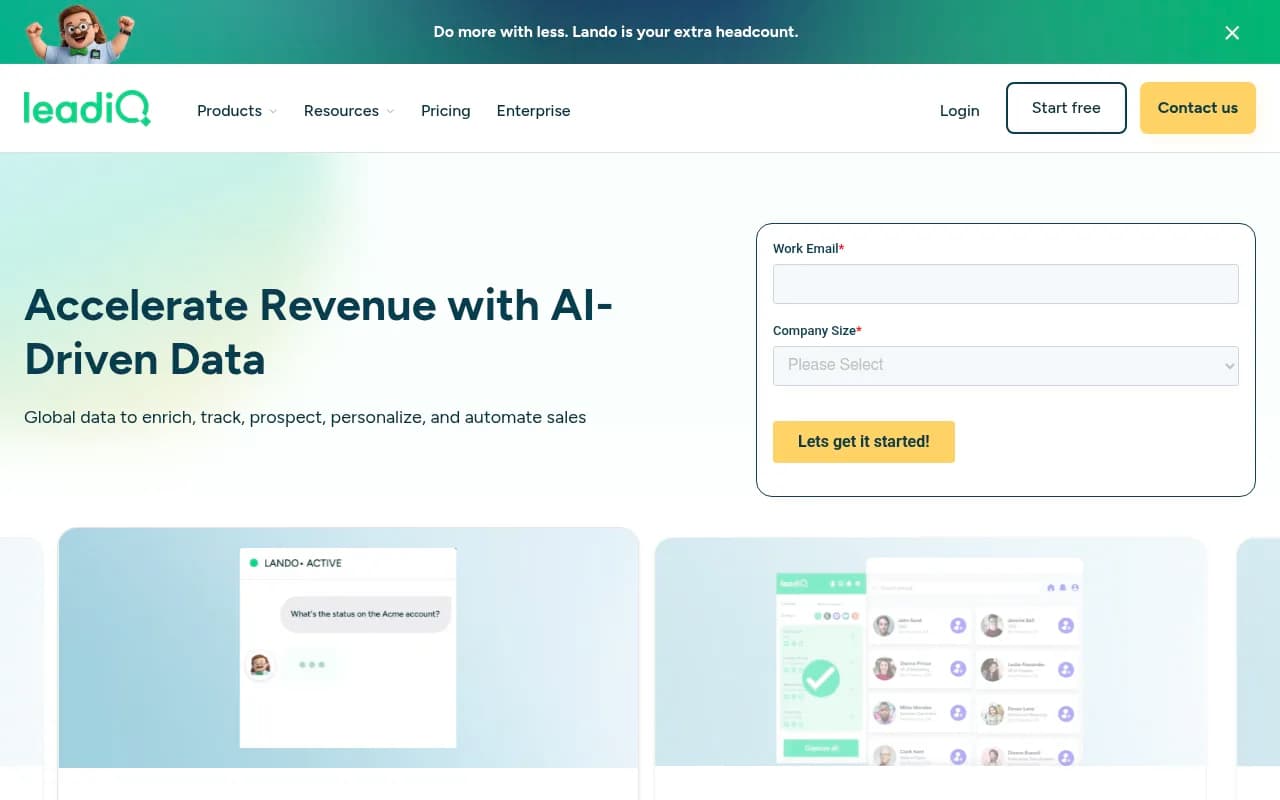
- The new Lando AI agent adds conversational account research directly in the browser, which is a meaningful step beyond basic data capture
- Credit limits on lower tiers can become a friction point for high-volume teams, and the free plan is quite restricted at 50 credits
LeadIQ started as a simple LinkedIn scraper and has grown into something considerably more complete. The company, headquartered in San Francisco, has been building in the B2B prospecting space since around 2015 and has raised funding to expand its data infrastructure and AI capabilities. Today the platform covers contact capture, CRM enrichment, job-change tracking, AI-assisted account research, and personalized outreach generation — all tied together through a Chrome extension that sits on top of LinkedIn and LinkedIn Sales Navigator.
The target audience is outbound sales teams: SDRs, BDRs, and account executives at B2B SaaS and technology companies who run structured prospecting programs. It's not a tool for solo founders doing occasional outreach or for inbound-heavy teams. It's built for people who prospect every single day and need their tools to stay out of the way.
The customer list tells you a lot: WalkMe, Optimizely, Clari, Greenhouse, Gong, MongoDB. These are mid-market and enterprise SaaS companies with dedicated SDR functions. WalkMe's team reportedly saved 1,000 hours per quarter after deploying LeadIQ, and Optimizely attributed $2M in pipeline generated in one year to improved data accuracy and reduced admin work. Those numbers are from LeadIQ's own case studies, so take them with appropriate skepticism, but the pattern is consistent — teams with high prospecting volume get the most out of it.
Key features
Chrome extension and one-click capture
This is the core of the product and where LeadIQ has always been strongest. The extension overlays LinkedIn and LinkedIn Sales Navigator, surfacing verified email addresses and phone numbers for any profile you're viewing. You can capture a single contact or bulk-capture an entire search results page. The real value is what happens next: the extension checks your CRM for duplicates before pushing the record, so you're not creating a mess of duplicate contacts in Salesforce. It also lets you add the contact directly to an Outreach sequence or Salesloft cadence in the same action. For an SDR doing 50-100 prospect touches a day, that workflow compression matters.
Prospector hub
Beyond the extension, LeadIQ has a web-based prospecting interface where you can search and filter contacts by job title, company, industry, location, and other firmographic criteria. It's not as deep as ZoomInfo's database search, but it's solid for building targeted lists without needing to be on LinkedIn. You can build lists, manage them, and export or sync them to your CRM from here.
Champion tracking
This is one of the more genuinely useful features in the platform. You designate contacts as "champions" — typically people who were involved in a past deal, either as buyers or influencers — and LeadIQ monitors their LinkedIn activity for job changes. When a champion moves to a new company, you get an alert. The logic is simple: someone who bought from you before is a warm lead at their next job. Teams that have a meaningful base of past customers or closed-lost deals get real value from this. It's the kind of signal that's easy to miss manually and easy to act on when surfaced automatically.
AI account prospecting
LeadIQ's AI layer tries to surface ICP-fit accounts and identify the right stakeholders within those accounts automatically. You define your ideal customer profile, and the system suggests accounts and contacts that match. This is less about raw data access and more about prioritization — helping reps focus on accounts most likely to convert rather than working through a flat list. The quality of these suggestions depends heavily on how well you've configured your ICP parameters.
Lando AI agent
Lando is LeadIQ's newest addition and the most ambitious. It's a conversational AI agent that runs in your browser and combines your first-party CRM data with LeadIQ's third-party intelligence. You can ask it questions like "which accounts in my territory have had recent leadership changes?" or "what do I know about this prospect's company?" and get synthesized answers without leaving your browser. It's early-stage in terms of maturity, but the direction is right — reducing the context-switching that kills SDR productivity.
Scribe AI personalization
Scribe generates personalized first lines and email snippets based on a prospect's LinkedIn activity, company news, and other signals. Multiple G2 reviewers specifically call out Scribe as a standout feature. The output is more contextually relevant than generic AI email tools because it's pulling from actual prospect data rather than just a name and company. It doesn't write full emails, but it gives reps a strong starting point for personalization at scale.
CRM enrichment
LeadIQ offers native Salesforce enrichment through a Managed Package — meaning it installs directly into your Salesforce org and can enrich existing records automatically. HubSpot enrichment runs through Workato, which adds a dependency but works well for teams already using Workato. There's also a Data API for custom workflows. The enrichment keeps CRM data fresh as contacts change roles or companies, which is a persistent problem for any team with a large database.
Universal credits system
LeadIQ recently moved to a unified credit pool that covers all actions across the platform — contact captures, enrichments, email lookups, phone number reveals. Previously, different actions drew from different buckets, which created confusion. The universal credit system is cleaner, though it also means you need to think more carefully about how you allocate credits across your team.
Who is it for
The clearest fit is an SDR or BDR team at a B2B SaaS company, typically 10-200 employees in the sales function, running structured outbound programs with LinkedIn Sales Navigator as a core tool. If your reps are spending hours each week manually copying contact information from LinkedIn into Salesforce and then into Outreach, LeadIQ pays for itself quickly. The WalkMe case study (1,000 hours saved per quarter across a BDR team) is plausible for teams doing high-volume prospecting.
Sales operations managers and revenue operations teams are also a strong fit, particularly for the CRM enrichment use case. If you have a Salesforce instance with thousands of stale contact records, the Managed Package enrichment can clean that up systematically. The champion tracking feature is especially valuable for companies with long sales cycles and high deal values, where re-engaging past champions at new companies is a meaningful pipeline source.
Who should probably look elsewhere: solo salespeople or very small teams (under 5 reps) where the per-seat cost doesn't make sense. Also, teams that primarily do inbound sales or account management rather than outbound prospecting won't get much value from the core workflow. If you're not living in LinkedIn, the extension-centric design won't feel natural. And if you need a very deep contact database with advanced filtering (think ZoomInfo's 300M+ contact database with technographic and intent data), LeadIQ's database is solid but not in that league.
Integrations and ecosystem
LeadIQ's integration story is one of its genuine strengths. The key connections:
- Salesforce: Native Managed Package for CRM enrichment, plus standard contact/lead sync from the extension
- HubSpot: Sync via Workato; not as seamless as the Salesforce integration but functional
- Outreach: Deep integration — you can add contacts to sequences directly from the extension
- Salesloft: Similar to Outreach; cadence enrollment from the extension
- Gong: Integration for conversation intelligence context
- Groove by Clari: Sales engagement sync
- Zapier: Workflow automation for custom use cases
- Workato: Used for HubSpot enrichment and custom automation
- Clay: Integration for data enrichment workflows
- Chili Piper: Inbound conversion routing
- Nooks and Orum: Parallel dialer integrations for phone-based prospecting
The Data API is available for teams that want to build custom integrations or pull LeadIQ data into proprietary systems. Documentation quality is generally good based on developer feedback.
There's no native mobile app — this is a desktop-first tool, which makes sense given the LinkedIn workflow dependency. The Chrome extension is the primary interface for most users.
Pricing and value
LeadIQ's pricing has three main tiers:
- Free: $0, 1 user, 50 credits per month. Enough to evaluate the product but not for real prospecting volume.
- Pro: $15/month per user (billed annually). Includes more credits and core prospecting features. This seems low based on the website, but third-party sources like Vendr suggest actual per-user pricing typically runs $75-$150+ per user per month at scale, with volume discounts for larger teams.
- Enterprise: Custom pricing, contact sales.
The universal credits system means you're drawing from one pool for all actions, which simplifies budgeting but can create surprises if your team's usage patterns shift. High-volume teams (SDRs doing 100+ captures per day) will need to negotiate credit volumes carefully.
Compared to ZoomInfo, LeadIQ is generally less expensive and more focused on the LinkedIn workflow use case. ZoomInfo has a much larger database and more intent data, but it's also significantly pricier and more complex to deploy. Apollo.io is a closer competitor on price and positioning — it also has a free tier and similar LinkedIn integration, though LeadIQ's CRM sync quality and champion tracking are generally considered stronger. Lusha is another comparable option, particularly for European teams given GDPR considerations.
For a team of 10 SDRs, LeadIQ at mid-tier pricing is a reasonable investment if it saves each rep even 2-3 hours per week on manual data entry. The math works. For a single rep, the free tier is worth trying, but the credit limits will frustrate anyone doing serious prospecting.
Strengths and limitations
What LeadIQ does well:
- The Chrome extension workflow is genuinely fast and reliable. The CRM deduplication before pushing contacts is a detail that saves real headaches.
- Champion tracking is a differentiated feature that creates pipeline from existing relationships — something most prospecting tools ignore entirely.
- The Salesforce Managed Package integration is more robust than most competitors' Salesforce connections. It installs cleanly and enriches records without requiring custom development.
- Scribe's AI personalization generates contextually relevant first lines that are noticeably better than generic AI email tools, according to consistent user feedback on G2.
- The integration breadth (Outreach, Salesloft, Gong, Clay, Zapier, Workato) means it fits into most modern sales tech stacks without friction.
Honest limitations:
- The contact database, while solid, is smaller and less comprehensive than ZoomInfo or Apollo for certain regions and industries. International coverage outside North America and Western Europe can be spotty.
- Credit limits on lower tiers create friction for high-volume teams. Running out of credits mid-month is a real operational problem for SDR managers.
- The Lando AI agent is promising but still early. The conversational interface is useful for account research, but it's not yet at the level where it replaces meaningful manual research for complex enterprise accounts.
- HubSpot enrichment requiring Workato adds cost and complexity for teams not already on Workato. A native HubSpot integration would be cleaner.
Bottom line
LeadIQ is a well-built prospecting tool that earns its place in the stack for outbound-heavy B2B sales teams. The LinkedIn-to-CRM workflow is the best in its class for speed and reliability, champion tracking adds a pipeline source that most teams underutilize, and the Salesforce integration is genuinely enterprise-grade.
Best use case: a 10-50 person SDR team at a B2B SaaS company running structured outbound programs with LinkedIn Sales Navigator, Salesforce, and Outreach or Salesloft.
Tags:
Frequently asked questions
What is LeadIQ?
How much does LeadIQ cost?
Is there a free plan?
How does LeadIQ compare to ZoomInfo?
What CRMs and sales tools does LeadIQ integrate with?
What is champion tracking in LeadIQ?
Similar and alternative tools to LeadIQ