Key takeaways
- AI platforms like ChatGPT recommend local businesses far less often than traditional search engines -- SOCi's 2026 Local Visibility Index found brands appear in AI recommendations only 6.5% of the time, versus 36% in Google's 3-Pack
- ChatGPT recommendations are probabilistic and location-sensitive, meaning the same brand can be visible in one city and invisible in another
- 75% of ChatGPT users still rely on traditional keywords when searching for local services, so keyword-rich, locally-specific content still matters
- Multi-location brands face a harder challenge than local SMBs in AI search -- AI models tend to favor businesses with strong local signals and review data
- Fixing local AI visibility requires a combination of location-specific content, structured data, review management, and active monitoring across AI engines
Something strange happens when you ask ChatGPT to recommend a dentist in Austin versus a dentist in Chicago. You might get completely different brands, different reasoning, and different levels of confidence. One city's response might name three specific practices with context about why they're good. The other might hedge with "I'd recommend checking Google Maps for current options."
That inconsistency isn't a bug. It's how AI search actually works -- and most brands are completely unprepared for it.
Why AI recommendations vary by city
Traditional search engines rank results based on signals that are relatively consistent: backlinks, on-page SEO, Google Business Profile completeness, proximity. The algorithm applies roughly the same logic everywhere.
AI models work differently. When ChatGPT or Perplexity generates a local recommendation, it draws on training data, real-time web retrieval (where available), and probabilistic reasoning. The quality and volume of information available about a business in a specific city directly affects whether that business gets named.
A few factors drive the city-by-city variation:
Training data density. Cities with more digital content -- more local journalism, more review activity, more business listings, more Reddit threads about local services -- produce richer training data. A business in San Francisco has been written about, reviewed, and discussed online far more than an equivalent business in Boise. AI models learn from that density.
Review volume and recency. SOCi's 2026 Local Visibility Index found that ChatGPT recommendations averaged 4.3-star ratings, which suggests AI models are drawing on review signals. Businesses with more reviews, especially recent ones, appear more frequently. A location in a high-review-volume city has a structural advantage.
Local citation consistency. If a business's name, address, and phone number are consistent across directories in one city but inconsistent in another, the AI model has more confidence recommending the first location. Inconsistent citations create ambiguity that AI models resolve by recommending someone else.
Regional content coverage. Local news sites, city-specific blogs, and regional publications create the kind of authoritative, location-specific content that AI models cite. Cities with active local media ecosystems give businesses more opportunities to be referenced in sources AI models trust.
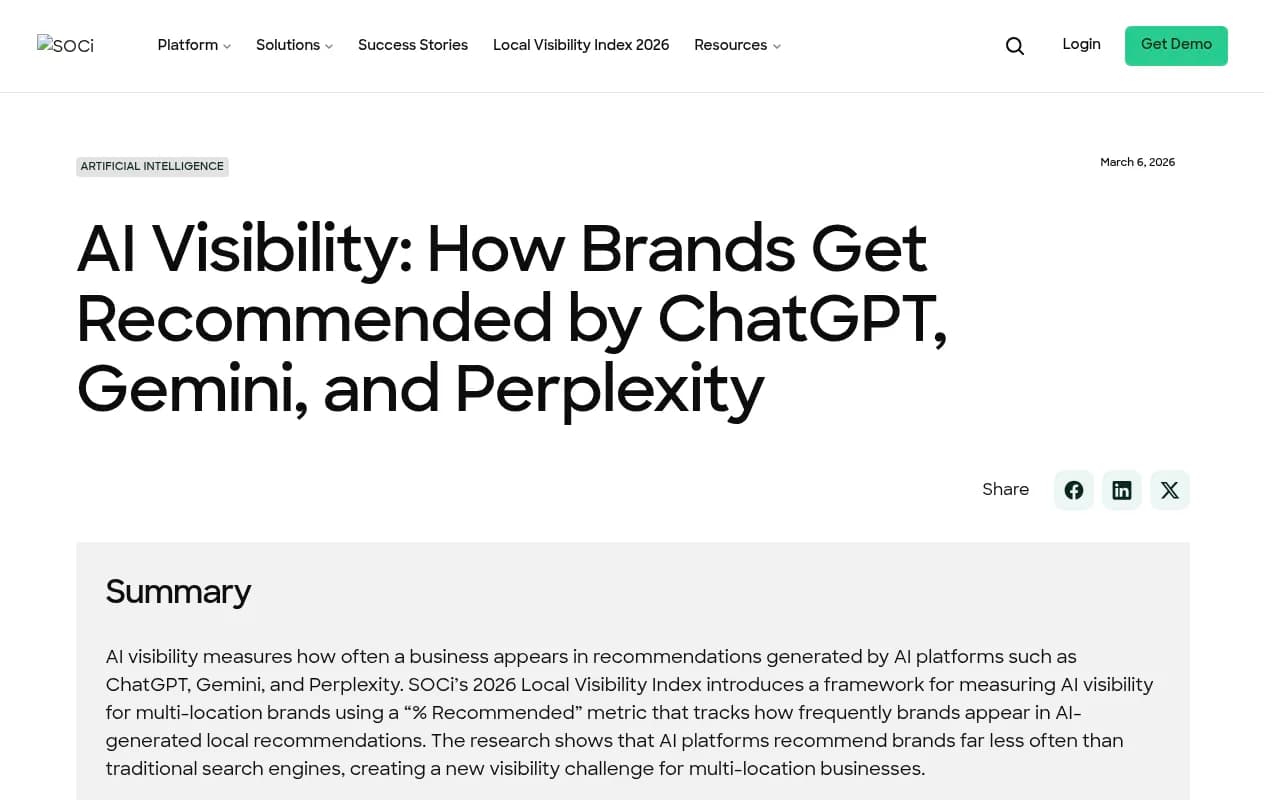
SOCi's 2026 Local Visibility Index found brands appear in AI recommendations just 6.5% of the time -- a stark contrast to traditional search.
The 6.5% problem
SOCi's 2026 Local Visibility Index put a number on something many marketers had been sensing: AI platforms are dramatically more selective than traditional search engines. Brand locations appeared in AI recommendations only 6.5% of the time. Gemini recommended brands 11% of the time. Compare that to the 36% appearance rate in Google's 3-Pack.
That selectivity hits multi-location brands harder than local SMBs. When a national chain operates in 200 cities, its AI visibility isn't uniform -- it's a patchwork. Some locations get recommended regularly. Others are effectively invisible. And the brand usually has no idea which is which.
The underlying reason is that AI models don't have a "brand" concept the way traditional search does. They have information. If the information available about your Chicago location is richer, more consistent, and more frequently cited than your Phoenix location, ChatGPT will recommend Chicago more often -- regardless of how similar the actual businesses are.
How users actually search for local services in AI
Research published in 2026 by ALM Corp found that 75% of ChatGPT users rely on traditional keywords when searching for local services. They're not asking elaborate conversational questions like "What's the best family-owned Italian restaurant in Denver that's good for a first date and has parking?" Most are typing things like "best plumber Chicago" or "dentist near me Austin."
This is actually useful information for brands. It means the keyword fundamentals still matter. Content that clearly signals what you do, where you do it, and why you're good at it -- written in plain language -- remains the foundation of local AI visibility.
What's changed is the destination. That keyword-rich content used to feed Google's index. Now it also feeds the training data and retrieval systems that power ChatGPT, Perplexity, and Gemini. The content requirements overlap significantly, but AI models weight some signals differently, particularly:
- Direct answers to specific questions (not just keyword density)
- Third-party mentions and citations from trusted sources
- Structured data that makes business information unambiguous
- Review content that gives AI models something to synthesize
City-level patterns worth knowing
While every market is different, some patterns emerge when you look at AI visibility data across US cities.
High-density tech markets (San Francisco, Seattle, Austin, New York) tend to have better AI visibility for local businesses, simply because more content exists about businesses in those markets. The downside: competition is fierce. More businesses are also optimizing for AI search, and the AI models have more options to choose from.
Mid-size markets (Nashville, Denver, Portland, Raleigh) often represent a sweet spot. There's enough digital content for AI models to work with, but fewer businesses are actively optimizing for AI visibility. A brand that invests in location-specific content in these markets can establish a strong position relatively quickly.
Smaller markets and rural areas present a different challenge. AI models may have limited information and will often deflect with "I'd recommend checking local directories" rather than naming specific businesses. Brands operating in these markets need to create the content infrastructure that AI models can draw on -- because it often doesn't exist yet.
Cities with strong local media (Chicago, Boston, Philadelphia) give businesses more pathways to AI visibility through press coverage. A mention in the Chicago Tribune or Boston Globe carries more weight in AI training data than a mention in a generic directory.
What multi-location brands are getting wrong
Most multi-location brands approach local AI search the same way they approach traditional local SEO: centralize the strategy, push out templated content, manage listings at scale. That approach worked reasonably well for Google. It's failing for AI.
The core problem is that AI models can detect when content is templated. "Best [service] in [city]" pages that swap out city names but share identical structure and language don't create the kind of distinctive, location-specific information that AI models find useful. They get ignored.
A few specific mistakes come up repeatedly:
Treating all locations equally. Not all markets have the same AI visibility baseline. A brand that invests equally across 200 locations is underinvesting in high-opportunity markets and wasting budget in markets where the fundamentals aren't in place yet.
Ignoring review velocity. AI models appear to weight review recency and volume heavily. A location that hasn't generated new reviews in six months is at a structural disadvantage compared to one with fresh, detailed reviews coming in regularly.
Missing the Reddit signal. AI models, particularly ChatGPT and Perplexity, frequently cite Reddit discussions in local recommendations. A thread on r/Chicago recommending your restaurant carries real weight. Most brands aren't monitoring or participating in these conversations.
No structured data on location pages. Schema markup for local businesses (LocalBusiness, Service, Review) makes it easier for AI models to extract and use information about your locations. Many multi-location brands have this on their main site but not on individual location pages.
What actually works: a city-by-city playbook
Build genuine location pages, not templates
Each location page should answer the questions a local customer would actually ask. What makes this specific location different? Who are the staff? What are the most common services requested in this city? What do local customers say? This isn't about keyword stuffing -- it's about creating information density that AI models can draw on.
A useful test: if you removed the city name from your location page, would it still be clearly about that specific location? If the answer is no, the page isn't doing its job.
Prioritize review generation by market
Identify which of your markets have the lowest review velocity and build specific programs to address them. This might mean post-visit email sequences, in-location prompts, or staff training. The goal isn't gaming the system -- it's making sure your actual customer satisfaction is reflected in the data AI models can access.
Get into local media
A single mention in a credible local publication does more for AI visibility than dozens of directory listings. Identify the key local media outlets in each of your priority markets and build a PR strategy around them. Local business awards, community involvement stories, and expert commentary are all viable pathways.
Monitor Reddit and local forums
Set up monitoring for your brand name and category keywords across relevant subreddits and local forums. When customers mention you positively, that content becomes part of the AI training ecosystem. When they mention problems, you want to know and respond -- negative Reddit threads get cited too.
Implement structured data consistently
Make sure every location page has proper LocalBusiness schema, including accurate NAP data, hours, service areas, and review aggregates. This isn't glamorous work, but it reduces the ambiguity that causes AI models to skip your locations.
Track visibility by city, not just overall
This is where most brands fall down. They might track overall AI visibility, but they don't know which cities are performing and which aren't. You need city-level visibility data to make smart decisions about where to invest.
Tools like Promptwatch let you monitor AI responses across specific locations and personas -- so you can actually see how ChatGPT describes your brand when someone in Dallas asks versus someone in Miami. That city-level granularity is what turns a vague "improve AI visibility" goal into a specific, actionable program.

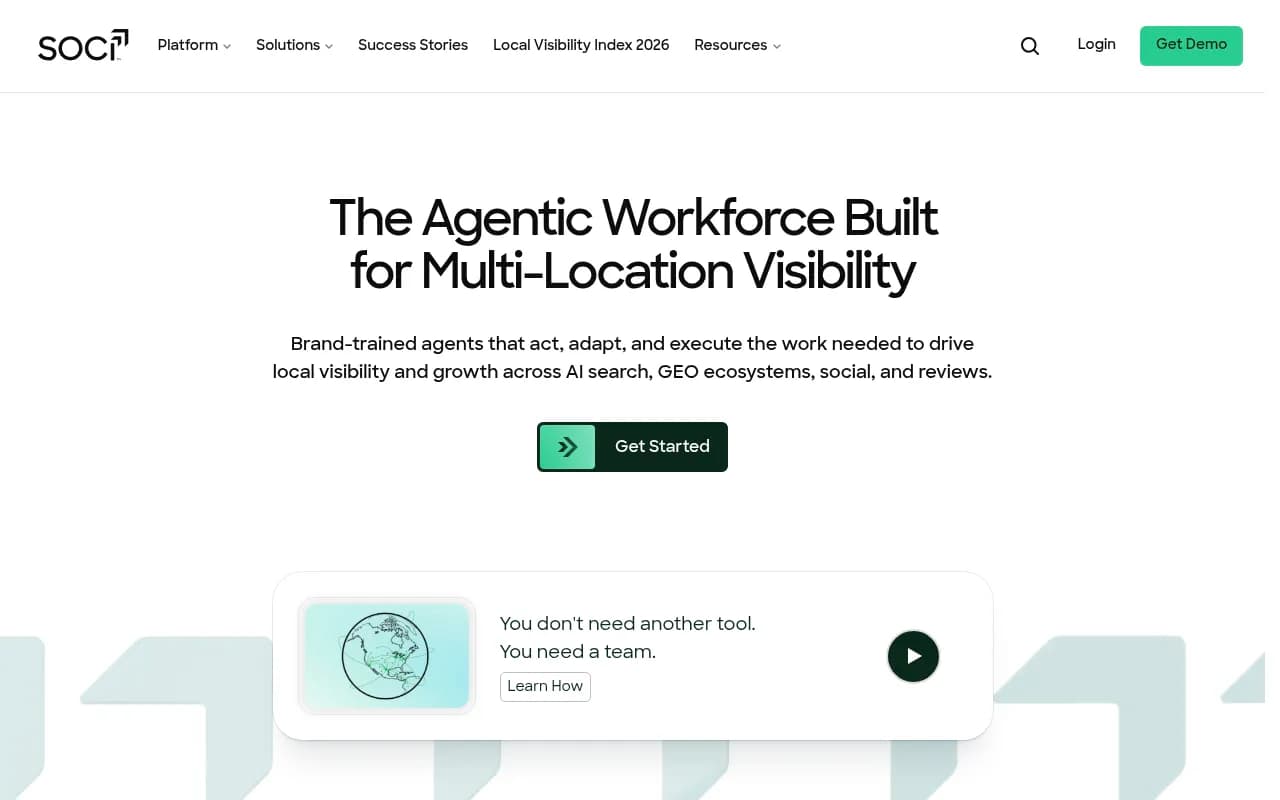
For multi-location brands specifically, platforms like SOCi are built around the local marketing challenge:
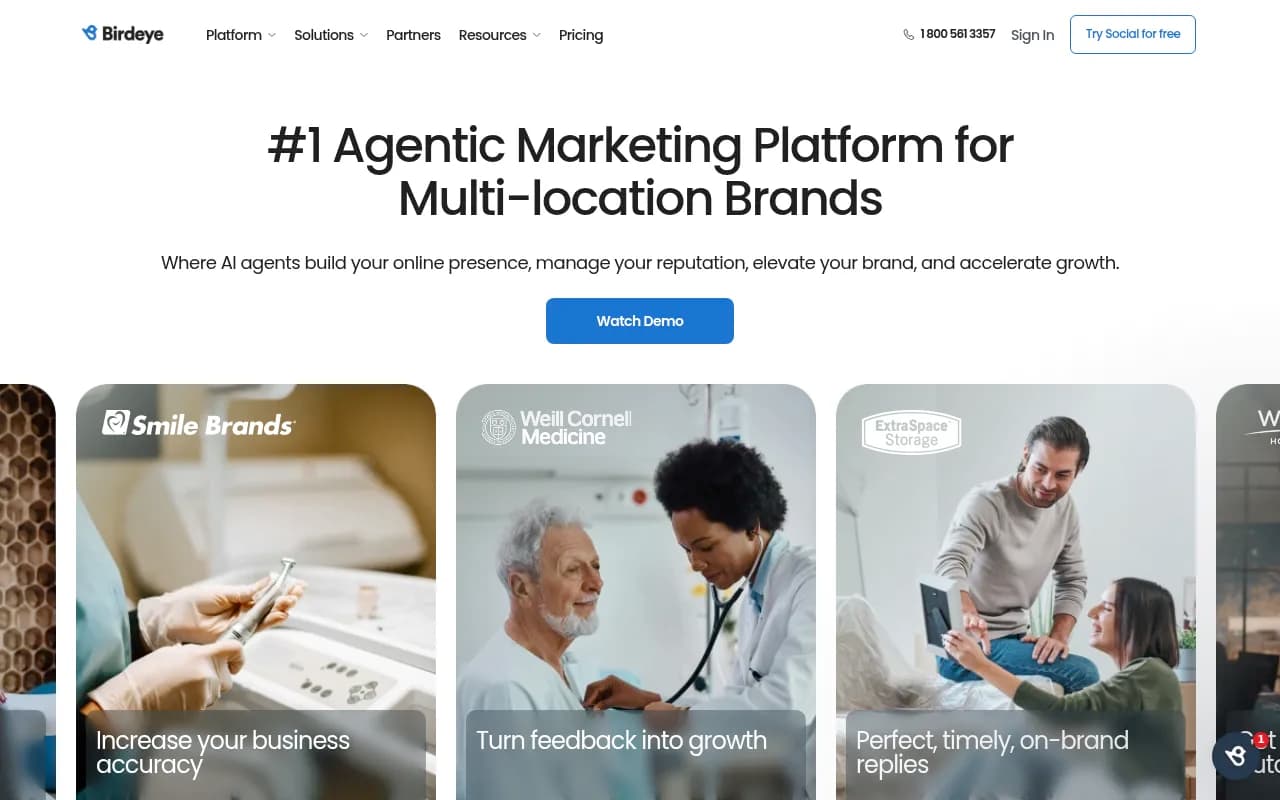
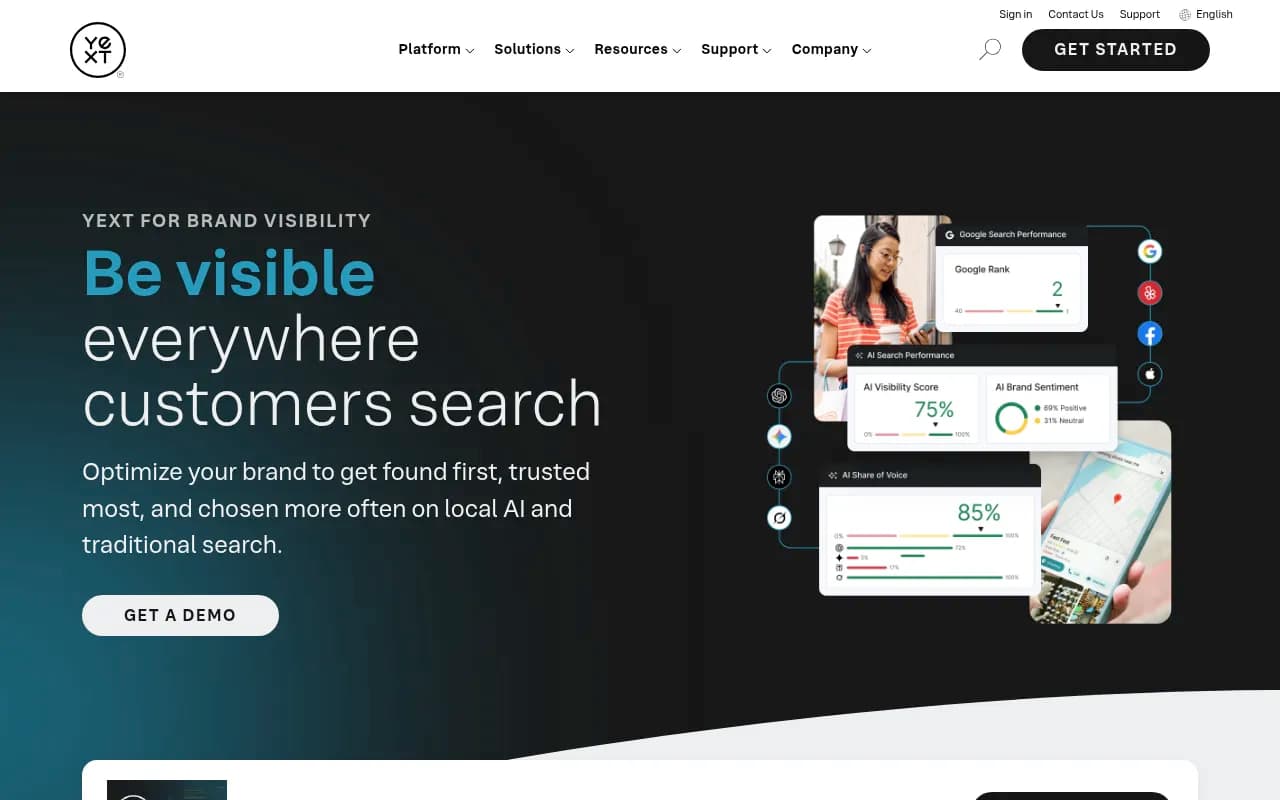
And for tracking how your brand appears across AI engines with location-specific monitoring:
The monitoring gap most brands haven't closed
Here's the uncomfortable reality: most brands don't know what ChatGPT says about them in any specific city, let alone all of them. They might run a few manual searches, see something encouraging, and assume the picture is representative. It's not.
AI recommendations are probabilistic. The same query run ten times in the same city can produce different results. Run it across ten cities and you're looking at enormous variation. Manual spot-checks can't capture this -- you need systematic monitoring at scale.
The brands winning at local AI search in 2026 are the ones that have closed this monitoring gap. They know their visibility scores by market, by AI engine, and by query type. They can see when a city's visibility drops and investigate why. They can identify which content investments are actually moving the needle.
Cities themselves are increasingly AI-native environments -- which means the information ecosystems that AI models draw on are evolving rapidly.
Comparing tools for local AI visibility
| Tool | Local/city tracking | Multi-location support | Review monitoring | Content optimization | AI crawler logs |
|---|---|---|---|---|---|
| Promptwatch | Yes (state/city) | Yes (up to 5+ sites) | No | Yes (built-in AI writing) | Yes |
| SOCi | Yes | Yes (enterprise) | Yes | Limited | No |
| Yext | Yes | Yes | Yes | Limited | No |
| Birdeye | Yes | Yes | Yes | No | No |
| Otterly.AI | Limited | Limited | No | No | No |
The table above isn't exhaustive, but it illustrates the key tradeoff: platforms built for traditional local marketing (SOCi, Yext, Birdeye) have strong review and listing management but limited AI-specific optimization. Platforms built for AI visibility monitoring often lack the local granularity that multi-location brands need. Promptwatch's Professional plan ($249/mo) includes state and city-level tracking, which puts it in a useful middle ground.
Otterly.AI

The content gap is the real opportunity
When you look at why brands are invisible in specific cities, it usually comes down to one thing: there's no content for AI models to draw on. Not bad content -- no content. The location exists in a directory, maybe has a Google Business Profile, but there's nothing that would give an AI model confidence to recommend it over a competitor.
This is actually good news. It means the opportunity is real and actionable. Creating genuine, location-specific content -- pages that answer real questions, blog posts about local topics, press coverage in local outlets -- builds the information infrastructure that AI models need.
The brands that figure this out city by city, market by market, will have a meaningful advantage. AI search is still early enough that the gap between leaders and laggards is widening, not closing. A brand that invests in local AI visibility now is building an asset that compounds over time.
The ones that wait for AI search to "stabilize" before acting will find themselves playing catch-up in a game where the early movers have already established the citation patterns and content authority that AI models rely on.
Start with your top five markets. Audit what AI models actually say about you there. Then build from what's missing.