Key takeaways
- Otterly.AI covers the basics of AI search monitoring but lacks crawler logs, content generation, and traffic attribution that more complete platforms offer.
- The GEO platform market now splits clearly between monitoring-only tools and full optimization platforms that help you act on the data.
- Promptwatch is the only platform in this comparison rated as a "Leader" across all evaluation categories, largely because it closes the loop from gap analysis to content creation to traffic attribution.
- For teams that just want to know where they appear in AI answers, Otterly.AI or Peec.ai may be enough. For teams that want to improve their visibility, you need something that goes further.
- Pricing varies significantly: from ~$49/month for basic trackers to $500+ for enterprise platforms.
Why this comparison matters in 2026
ChatGPT crossed 900 million weekly active users in early 2026. Google AI Overviews now appear on a significant share of high-intent queries. Perplexity has carved out a loyal research audience. Claude and Gemini are embedded in enterprise workflows.
The result: a buyer asking "what's the best project management tool for remote teams" doesn't see your Google ranking. They see whatever the AI tells them. And if you're not in that answer, you're invisible to that buyer.
Traditional SEO tools weren't built for this. Ahrefs tracks Google rankings. Semrush tracks keyword positions. Neither tells you what ChatGPT says about your brand when a prospect asks a purchase-intent question.
That's the gap GEO and AI visibility platforms fill. But not all of them fill it equally. Some show you the problem. Others help you fix it. The difference matters a lot when you're trying to justify budget or move the needle on pipeline.
What Otterly.AI actually does
Otterly.AI is one of the earlier dedicated AI visibility trackers. It monitors brand mentions across ChatGPT, Perplexity, and Google AI Overviews, and shows you how often your brand appears in AI-generated responses for a set of tracked prompts.
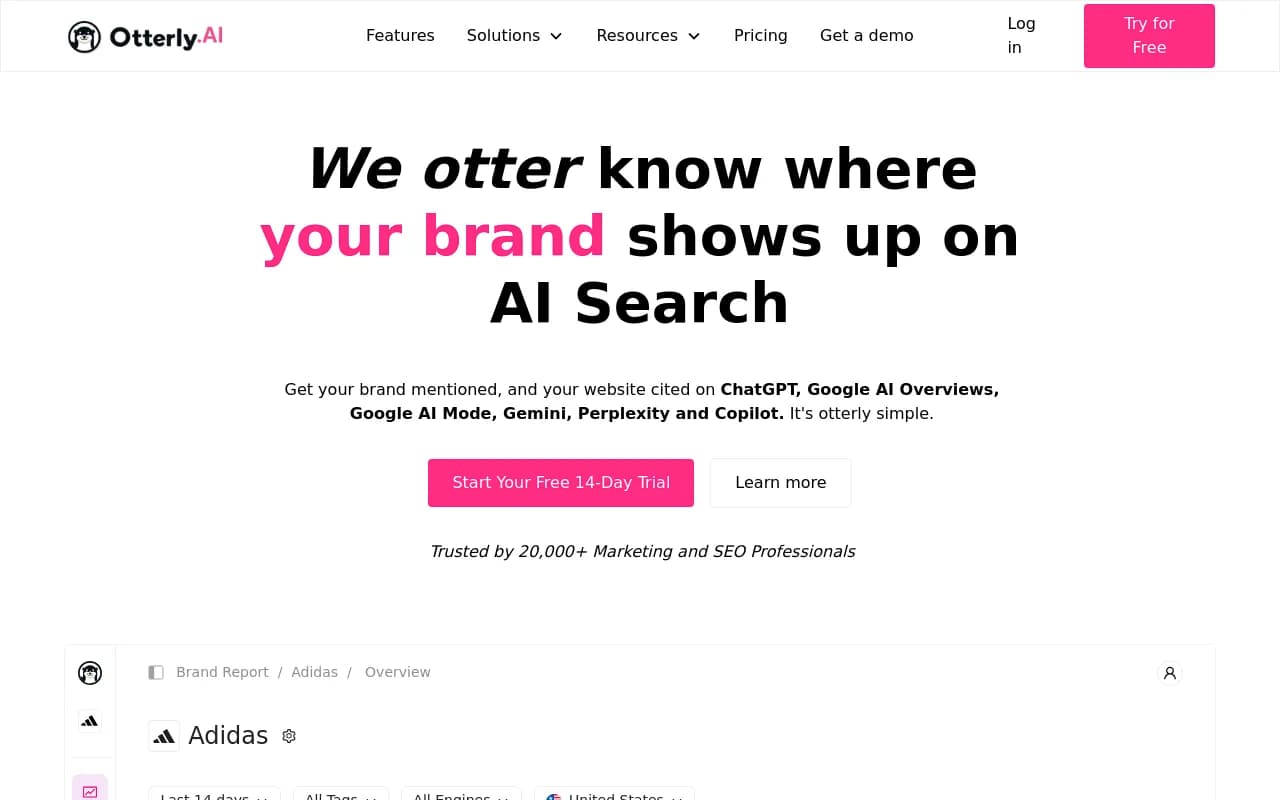
The core use case is straightforward: set up prompts relevant to your category, run them on a schedule, and see whether your brand gets mentioned. You get mention rates, sentiment indicators, and some competitor comparison.
Where Otterly.AI runs into limits:
- AI engine coverage: ChatGPT, Perplexity, and Google AI Overviews are covered. Claude, Gemini, Grok, DeepSeek, Mistral, and Copilot are either add-ons or not available at all, depending on the plan. That's a meaningful blind spot as enterprise buyers increasingly use Claude and Gemini.
- No crawler logs: You can't see which pages AI crawlers are actually visiting on your site, which means you can't diagnose why you're not being cited.
- No content generation: Otterly.AI shows you where you're missing. It doesn't help you create the content that would fix the gap.
- No traffic attribution: There's no way to connect AI visibility to actual website traffic or revenue.
- Limited prompt intelligence: No volume estimates, difficulty scores, or query fan-outs to help you prioritize which prompts to target.
For a small team that just wants a basic dashboard showing whether their brand appears in AI answers, Otterly.AI works fine. For a team that wants to actually improve their AI visibility, it's a starting point, not a complete solution.
The competitive landscape: four types of platforms
Before getting into the head-to-head comparison, it helps to understand how the market is structured. There are roughly four types of tools competing in this space:
Dedicated GEO/AEO platforms: Built specifically for AI search visibility. Range from monitoring-only (Otterly.AI, Peec.ai) to full optimization platforms (Promptwatch, Profound, AthenaHQ).
SEO suites with AI features: Semrush, Ahrefs, and SE Ranking have added AI tracking as bolt-on features. Useful if you're already paying for these platforms, but the AI tracking depth is limited compared to dedicated tools.
Brand monitoring tools: Brand24, Mention, and Brandwatch have added some LLM mention tracking. These are better for PR and social listening than for GEO optimization.
Enterprise-specific platforms: Profound, Scrunch AI, and Evertune target larger organizations with more complex needs and higher price points.
Head-to-head comparison: Otterly.AI vs the top alternatives
Here's how the major platforms stack up across the dimensions that matter most for a GEO workflow.
| Platform | AI engines covered | Crawler logs | Content generation | Traffic attribution | Prompt intelligence | Reddit/YouTube tracking | Pricing (starting) |
|---|---|---|---|---|---|---|---|
| Promptwatch | 10+ (ChatGPT, Claude, Gemini, Perplexity, Grok, DeepSeek, Copilot, Mistral, Meta AI, Google AI Overviews) | Yes | Yes (AI writing agent) | Yes (GSC, snippet, server logs) | Yes (volume, difficulty, fan-outs) | Yes | $99/mo |
| Otterly.AI | 3 core (add-ons for others) | No | No | No | No | No | ~$49/mo |
| Profound | 9+ | No | No | Limited | Limited | No | ~$500/mo+ |
| AthenaHQ | 8+ | No | No | No | Limited | No | ~$300/mo+ |
| Peec.ai | 3 (add-ons) | No | No | No | No | No | ~$49/mo |
| Scrunch AI | 8+ | No | No | No | No | No | ~$400/mo+ |
| Semrush (AI features) | Limited | No | Yes (ContentShake) | Partial | No | No | $139/mo+ |
| Ahrefs (Brand Radar) | Limited | No | No | No | No | No | $129/mo+ |
A few things stand out from this table. Profound and Scrunch AI have strong monitoring capabilities but come at significantly higher price points and don't help you create content. Semrush and Ahrefs have broad SEO capabilities but their AI tracking is shallow and uses fixed prompts. Otterly.AI and Peec.ai are the budget entry points but stop at monitoring.

Promptwatch: the case for a full optimization loop
Most platforms in this space answer one question: "Are we being mentioned?" Promptwatch is built around a different question: "What do we need to do to get mentioned more?"
That shift in framing drives a completely different product. The workflow looks like this:
Step 1 - Find the gaps: Answer Gap Analysis shows you exactly which prompts your competitors are appearing for that you're not. Not just "you're missing," but specifically which topics, questions, and angles AI models want answers to but can't find on your site.
Step 2 - Create content that gets cited: The built-in AI writing agent generates articles, listicles, and comparisons grounded in real citation data. It analyzes which content formats and angles get cited by ChatGPT, Claude, and Perplexity, then writes to those patterns. This isn't generic SEO content -- it's engineered to appear in AI answers.
Step 3 - Track the results: Page-level tracking shows which specific pages are being cited, by which AI models, and how often. Traffic attribution (via GSC integration, a code snippet, or server log analysis) connects AI visibility to actual visits and revenue.
The crawler log feature is worth calling out separately. Promptwatch shows you real-time logs of AI crawlers visiting your site -- which pages ChatGPT, Claude, and Perplexity are reading, how often they return, and any errors they encounter. No other platform in this comparison offers this at the same level. It's the difference between guessing why you're not being cited and actually diagnosing the problem.
With 880M+ citations analyzed and data from 6,700+ brands, the citation intelligence behind the content recommendations is also meaningfully different from platforms that are just running prompts and counting mentions.
Profound: strong monitoring, high price
Profound is a well-built enterprise AI visibility platform. It covers 9+ AI engines, has solid competitive benchmarking, and is used by larger marketing teams that need reliable data at scale.
Profound

The main limitations: it's expensive (typically $500/month and up), it doesn't have content generation, and it doesn't have Reddit or YouTube tracking. If you're a Fortune 500 brand with a dedicated team and budget, Profound is a serious option. If you're a mid-market company or agency, the price-to-capability ratio is harder to justify when Promptwatch covers more ground for less.
AthenaHQ: monitoring-focused, no optimization
AthenaHQ tracks brand visibility across 8+ AI engines and has a clean interface. It's positioned as a monitoring and analytics platform, which it does reasonably well.

The gap: it's monitoring-only. There's no content generation, no crawler logs, no traffic attribution. You can see where you're invisible, but the platform doesn't help you fix it. For teams that want to understand their AI visibility landscape before investing in optimization, AthenaHQ is a reasonable starting point. For teams that want to move the needle, you'll need to pair it with other tools.
Peec.ai: the other entry-level option
Peec.ai and Otterly.AI occupy similar territory. Both are affordable, both cover the core AI engines (with add-ons for others), and both are monitoring-only.

The main difference between them is interface and workflow. Peec.ai has a slightly cleaner dashboard for some users; Otterly.AI has been around longer and has more community familiarity. Neither has a clear functional advantage over the other at the monitoring level.
If you're choosing between Otterly.AI and Peec.ai, the decision probably comes down to pricing and UI preference rather than capability differences.
Scrunch AI: solid but expensive
Scrunch AI is a capable platform with good AI engine coverage and competitive analysis features. It's used by agencies and larger brands.

Like Profound, it's priced for enterprise budgets and doesn't include content generation or traffic attribution. Reddit and YouTube tracking are absent. For agencies managing multiple clients, the per-client pricing can add up quickly.
Semrush and Ahrefs: the SEO incumbents
Both Semrush and Ahrefs have added AI visibility features, and both are worth mentioning because most marketing teams already have subscriptions to one of them.
The honest assessment: these features are shallow compared to dedicated GEO platforms. Semrush uses fixed prompts rather than custom ones, which limits how relevant the data is to your specific category. Ahrefs Brand Radar also uses fixed prompts and has no AI traffic attribution. Neither has crawler logs or content generation built for AI search.
If you're already paying for Semrush or Ahrefs and want a rough sense of your AI visibility, the built-in features are better than nothing. For serious GEO work, you'll want a dedicated platform alongside them.
Other platforms worth knowing about
A few other tools show up frequently in comparisons and are worth a quick mention:
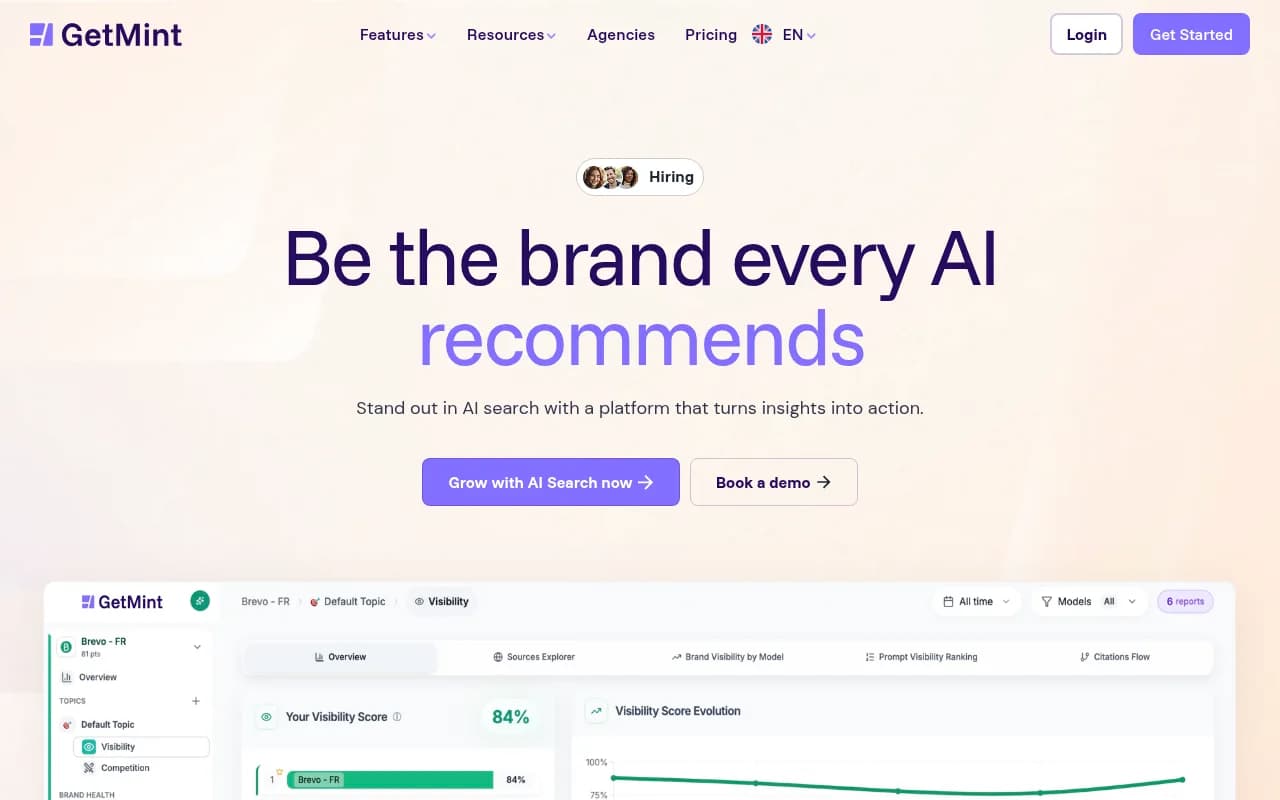
GetMint: Covers 8+ AI engines and has some competitive analysis features. API-only access limits usability for non-technical teams.
Searchable: Has built-in content generation, which puts it in a different category from pure monitoring tools. Coverage is narrower than Promptwatch and some features are add-ons.
Gauge: Solid monitoring platform with good UI. API-only access is a limitation for marketing teams.
LLM Pulse: A lighter-weight option for teams that want basic tracking without the complexity of a full platform.
How to choose the right platform for your situation
The right choice depends on what you're actually trying to accomplish.
If you just want to know whether your brand appears in AI answers: Otterly.AI or Peec.ai will do the job at a low price point. Don't overthink it.
If you want to understand your competitive position across AI engines: AthenaHQ or Profound give you better competitive benchmarking, though at higher price points.
If you want to actually improve your AI visibility: You need a platform that goes beyond monitoring. Promptwatch is the clearest option here -- it's the only platform that combines gap analysis, AI content generation grounded in citation data, crawler logs, and traffic attribution in one place.
If you're an agency managing multiple clients: Promptwatch's agency pricing and multi-site support are worth evaluating. Scrunch AI and Profound also have agency-oriented features, though at higher price points.
If you're already deep in the Semrush or Ahrefs ecosystem: Use their AI features as a starting point, but don't expect them to replace a dedicated GEO platform for serious optimization work.
The monitoring vs. optimization gap
The most important thing to understand about this market is the split between monitoring and optimization. A lot of platforms -- including Otterly.AI -- show you data. They tell you where you appear, where you don't, and how you compare to competitors. That's genuinely useful information.
But knowing you're invisible in ChatGPT for a high-intent prompt doesn't automatically fix the problem. You still need to figure out what content to create, create it, publish it, and then verify that it actually improved your citation rate. Most platforms stop before that work begins.
As one Reddit thread on AI visibility tools put it: "The real split I see in AI visibility tools is monitoring vs execution. A lot of platforms show mentions, citations, and competitor gaps -- but then leave you to figure out what to do next."
That execution gap is where Promptwatch differentiates most clearly. The answer gap analysis tells you exactly what content is missing. The AI writing agent creates it. The page-level tracking and traffic attribution confirm whether it worked. That full loop is what separates an optimization platform from a monitoring dashboard.
For teams that are serious about AI search visibility in 2026, the question isn't whether to invest in GEO tools -- it's whether you want to just watch the data or actually move it.