Key takeaways
- Sprout Social and Hootsuite lead on depth of team-level reporting, but both gate the good stuff (sentiment analysis, team productivity reports) behind their $399/seat Advanced tier
- Agorapulse hits the best balance of price and team reporting, with its team performance report and scheduled report emails available from $119-149/user/month
- Metricool and Iconosquare are the budget picks if you mainly need analytics and client/brand separation, not approval workflows
- Sendible's unlimited-user pricing model is worth a look for agencies, but white-label reporting costs extra and the real bill can balloon fast
- Most "analytics" in these tools still reports vanity metrics without context, so plan to build a warning-signals section into your own reporting process regardless of which tool you pick
Why team analytics matters more than the scheduling itself
Any tool can queue up a post. That part got solved years ago. What separates a real social media management platform from a glorified calendar is whether it can tell you, and your boss, whether any of it worked, and whether your team is actually doing its job well.
That's the lens for this guide. I'm not ranking tools by how pretty their content calendar looks. I'm ranking them by what happens after the post goes live: can you see team reply speed, campaign ROI, tag-level performance, sentiment shifts, and can you get that into a PDF or Slack message without copy-pasting from six dashboards.
A Forrester-commissioned study on social AI tools found teams save around 80% of their time on reporting and 60% on scheduling and publishing when they switch to a platform with built-in automation (https://media.sproutsocial.com/uploads/2025/02/TEI_Sprout-Social_2025-2026.pdf). That's the number that should drive your buying decision, not the number of supported platforms.
Quick comparison
| Tool | Entry tier with real team analytics | Price | Standout reporting feature |
|---|---|---|---|
| Sprout Social | Advanced | $399/seat/mo | Team productivity reports, sentiment analysis, Trellis AI agent |
| Hootsuite | Advanced | $399/user/mo | Team performance/efficiency measurement, 90-day trend forecasting |
| Agorapulse | Professional | $119/user/mo (annual) | Team performance report, ROI reporting, white-label reports |
| Statusbrew | Premium | $229/mo (6 users) | Team & SLA reporting, competitor benchmarking |
| Sendible | Plus | $99/mo (unlimited users) | Assignment/approval workflows, custom branded reports at Premium |
| Metricool | Advanced | $53-67/mo | Looker Studio integration, custom report templates |
| Iconosquare | Scale | $79/mo | Competitor benchmarking, campaign tracking |
The tools, one by one
Sprout Social: deepest reporting, steepest price
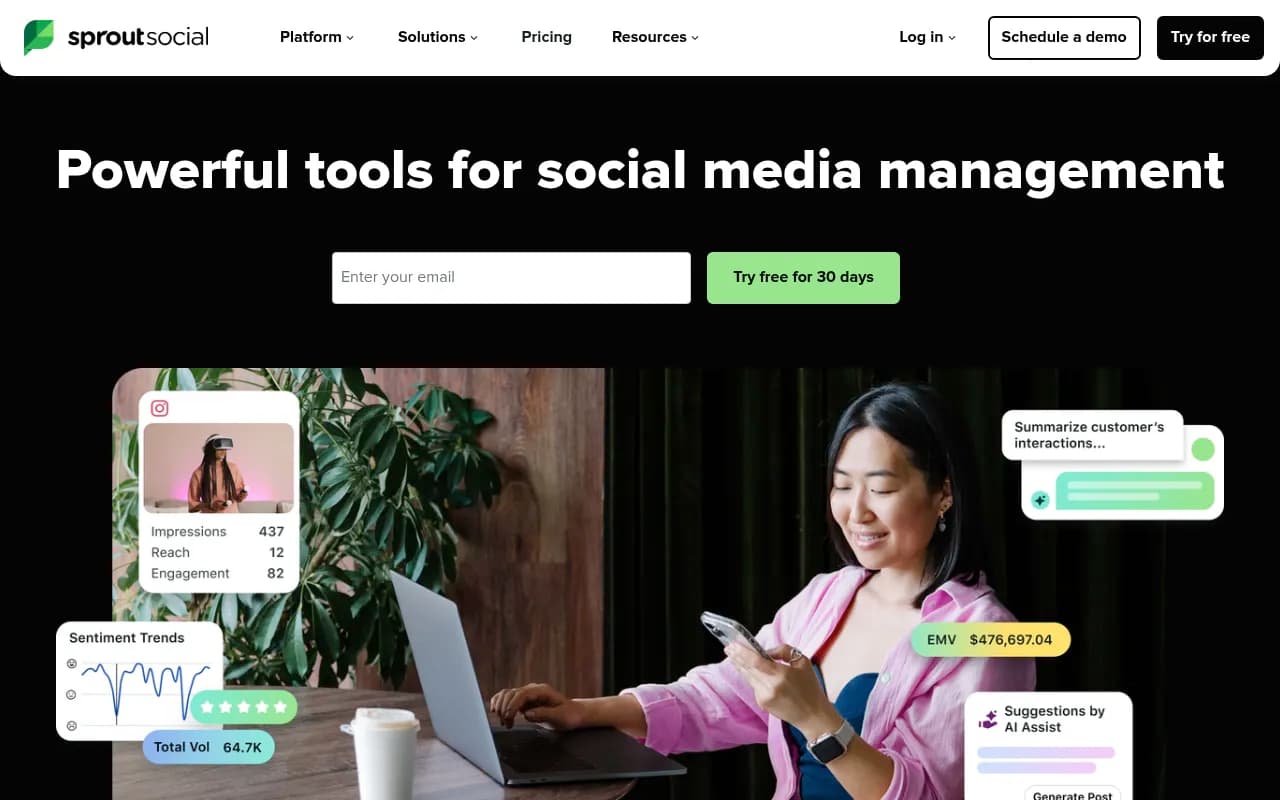
Sprout's reporting is genuinely strong once you're paying for it. The Advanced plan ($399/seat/month) adds team productivity reports and social customer care reports, plus sentiment analysis inside the Smart Inbox. Lower tiers don't get sentiment at all, it's locked to Advanced (https://turrboo.com/blog/sprout-social-pricing).
Sprout also launched Trellis in 2026, an AI agent that lets you ask conversational questions about your social data instead of building a report manually. Sprout frames it as changing "how social teams prove their value" (https://investors.sproutsocial.com/news/news-details/2026/Now-Generally-Available-Sprout-Socials-AI-Agent-Trellis-Is-Helping-Reshape-How-Social-Teams-Prove-Their-Value/default.aspx). It's a real time-saver if your team is constantly asked for ad-hoc numbers by stakeholders who don't want to open a dashboard.
The catch: Premium Analytics and Listening are paid add-ons on top of your plan, even at the Advanced tier. If your finance team balks at $399/seat before add-ons, budget accordingly.
Hootsuite: built for larger teams, same price ceiling
Hootsuite's Advanced plan, also $399/user/month, explicitly promises to help you "measure team performance and efficiency," plus content approval workflows and auto-routing of inbound messages to the right team member. Every Hootsuite plan, even Standard, now runs its AI assistant Wisdom for drafting and basic analysis, which is a nice touch that Sprout doesn't match at the entry tier.
Hootsuite and Sprout essentially tie for feature depth at the top end. The real differentiator is workflow style: Hootsuite leans toward customer-care routing, Sprout leans toward tagging and campaign-level attribution. Pick based on which problem you actually have.

Agorapulse: the best value for mid-sized teams
This is where I'd start if your team is under 20 people and you don't have enterprise budget. Agorapulse's Professional plan ($119/user/month annual) adds a team performance report that tracks reply speed and effectiveness per profile, plus approval workflows. Bump up to Advanced ($149/user/month annual) and you get scheduled report emails, automated ROI reporting, and 24-month data retention.
One real cost to plan for: Agorapulse bundles 10 social profiles into every plan, and extra profiles run $10-15/month each. A 3-person team on Professional managing 15 profiles lands around $407/month, not the sticker price you see on the pricing page (https://checkthat.ai/brands/agorapulse/pricing).

Statusbrew: SLA reporting most tools skip
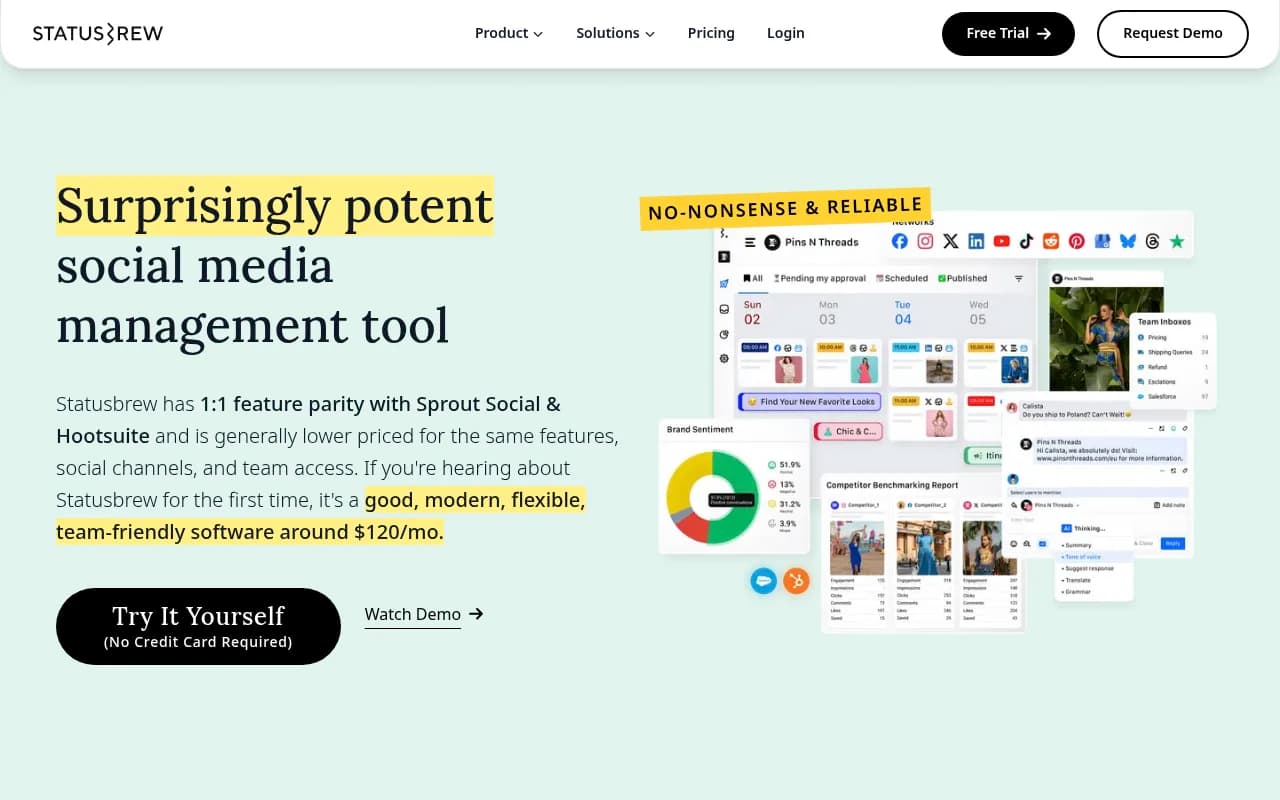
If your team does social customer care and needs to prove response-time compliance, Statusbrew's Premium plan ($229/month for 6 users) is one of the few tools with dedicated SLA reporting alongside team analytics. It also bundles AI sentiment analysis and competitor benchmarking at that tier. Third-party sites quote different numbers than Statusbrew's own pricing page, so check statusbrew.com/pricing directly before budgeting.
Sendible: agencies should run the real numbers first
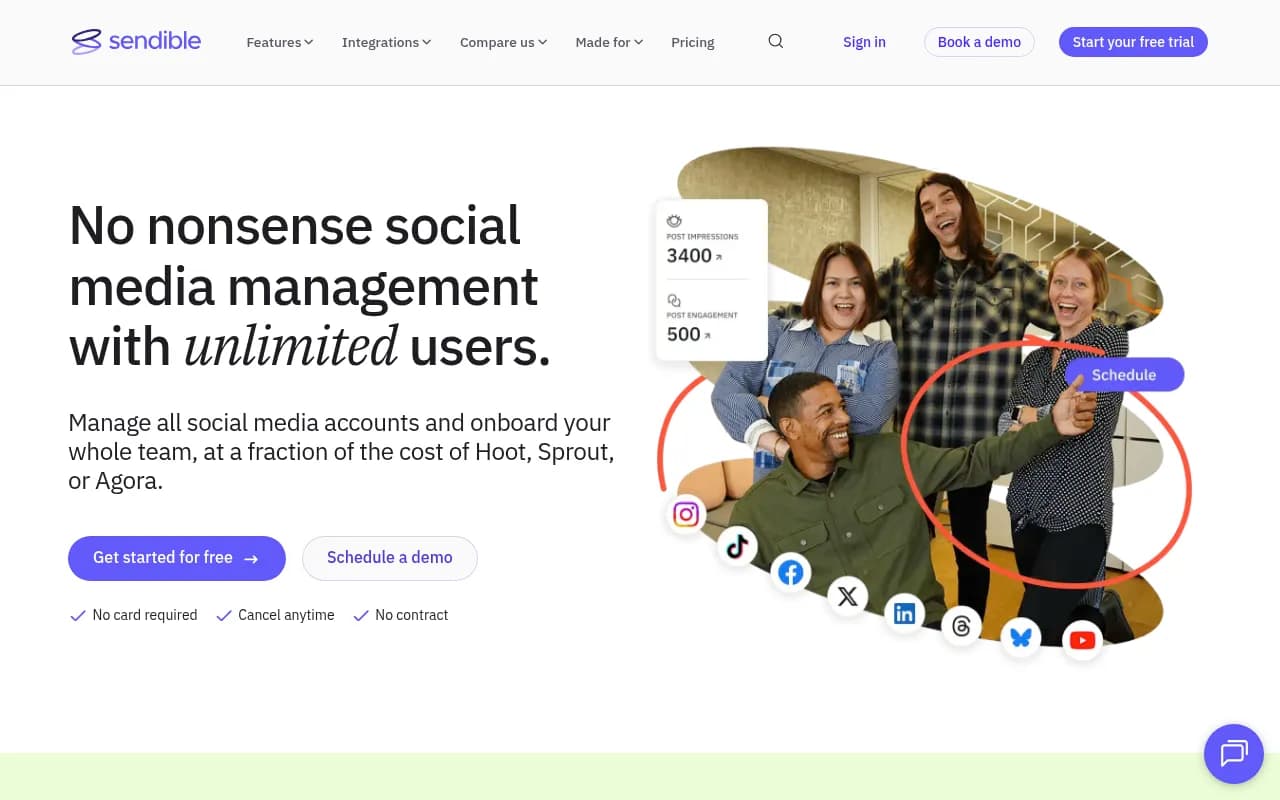
Sendible's pitch is unlimited users on every plan, scaling instead by workspaces and connected profiles. Plus ($99/month) gets you assignments and approvals; Premium ($199/month) adds custom branded reports. That sounds affordable for an agency with a big roster of junior staff, until you need white labeling, which is a paid add-on only available on the top two tiers and can push real monthly cost well past the advertised entry price (https://turrboo.com/blog/sendible-pricing).
Metricool and Iconosquare: analytics-first, lighter on team workflow
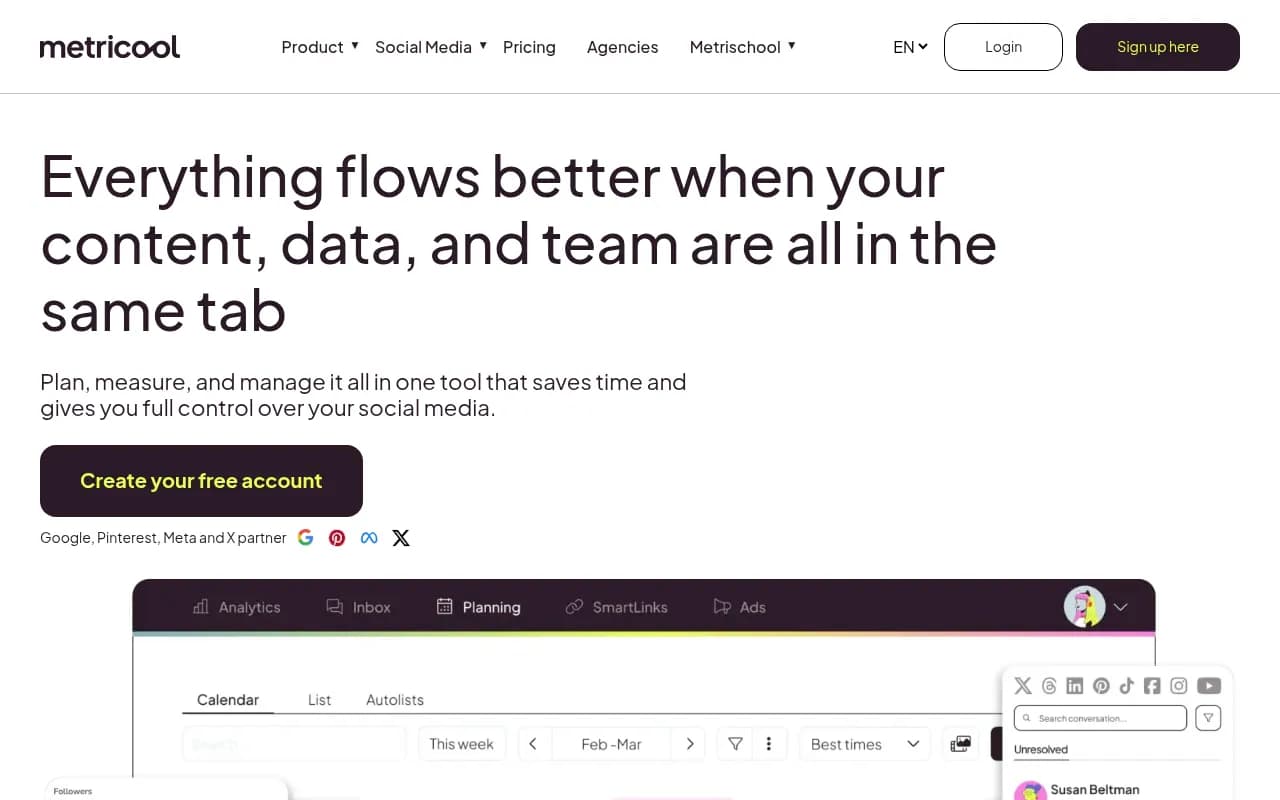
Metricool and Iconosquare both skew toward solo marketers and small teams that care more about dashboard depth than approval chains. Metricool's Advanced plan ($53-67/month) adds team/client management, Looker Studio integration, and a full API, but Starter has zero team access, so don't buy the free or Starter tier expecting collaboration features. Iconosquare markets itself as dramatically cheaper than Hootsuite and Sprout at entry level, and its Scale plan ($79/month) adds approval workflows and competitor benchmarking, a reasonable middle ground if your team is small but you still want sign-off before posts go live.

What good team reporting should actually include
Most platforms will sell you on dashboards. Fewer will tell you what to put in the report once you've built it. Based on how social reporting commonly goes wrong, here's what to check for before you commit to a tool, and what to build into your process regardless:
- Automated recurring report delivery in PDF, CSV, or slide format, not manual copy-paste from a dashboard (https://buffer.com/resources/best-social-media-analytics-tools/)
- A section for underperforming metrics, not just wins. A report that only shows growth is hiding something, whether that's rising CPA, falling completion rates, or a sentiment dip
- Acknowledgment of attribution gaps. With iOS tracking restrictions and cookie deprecation, 20-30% of social traffic can show up as unattributed "direct" traffic, so a tool that presents numbers as complete without a caveat is misleading you (https://improvado.io/blog/social-media-reporting)
- Context for engagement spikes. A sudden jump in comments or shares can mean a viral win or a PR problem; raw numbers without qualitative review tell you nothing useful
None of the platforms above solve this automatically. The dashboards give you the raw material; someone on your team still has to decide what the "warning signals" section says each month.
Platform limits that affect your scheduling strategy
A few 2026-specific constraints are worth knowing before you lean too hard on bulk scheduling:
- X's API moved to pay-per-use pricing, $0.20 per post containing a URL plus $0.001 per read, with no flat free tier anymore
- Instagram caps at roughly 100 posts per 24 hours per account
- Facebook limits to 25 posts per Page per 24-hour rolling window
- Reddit is closing public API access to new requests as of October 31, 2026, which affects any tool that cross-posts or pulls Reddit engagement data
(https://www.blotato.com/blog/social-media-api, https://postproxy.dev/blog/social-media-platform-api-rules-rate-limits-media-specs/)
If a tool advertises unlimited bulk scheduling, these platform-side caps still apply underneath. Sendible, for example, sets its own daily posting caps per tier (100 to 500 sends per workspace) partly because of this.
Where this fits with broader marketing analytics
Social media analytics inside a scheduling tool is useful, but it's siloed by design, it tells you about your social channels, not how social fits into the rest of your funnel. If your team needs to tie social performance to actual conversions and revenue, you'll likely end up layering a tool like [tool:improvado] or a BI platform like [tool:tableau] on top of whatever scheduler you pick.
If you're also tracking how your brand shows up in AI-generated answers (ChatGPT, Perplexity, Google AI Overviews), that's a separate discipline from social scheduling analytics entirely, but it's worth knowing it exists if your marketing team is being asked about AI visibility alongside social reporting. Promptwatch tracks that side of things, citations, AI crawler activity, and AI-driven traffic, which is a different problem than what any tool on this list solves.

Bottom line
If you want the deepest reporting and can absorb $399/seat, Sprout Social and Hootsuite are both legitimate choices, pick based on whether your team leans customer-care-heavy (Hootsuite) or campaign/tag-attribution-heavy (Sprout). If that price doesn't fit, Agorapulse at $119-149/user gets you real team performance reporting without the enterprise tax. For smaller teams that mostly need solid analytics without heavy approval workflows, Metricool and Iconosquare are the more honest value picks. Whatever you choose, build a habit of calling out what's not working in your reports, not just what is, because none of these tools will do that part for you.