Key Takeaways
- LLMrefs is 20% cheaper ($79/mo vs £99/mo starting price) and offers unlimited projects, domains, and team seats at every tier -- Authoritas charges per site and limits team access
- Authoritas combines AI search tracking with traditional SEO tools (rank tracking, backlinks, technical audits) in one platform -- LLMrefs is AI-search-only with no traditional SEO features
- LLMrefs uses a keyword-first approach with automated prompt generation -- Authoritas requires manual prompt setup but offers more granular control over query variations
- Authoritas tracks 7 AI engines vs LLMrefs' 11 engines -- LLMrefs covers Meta AI, Grok, and DeepSeek which Authoritas doesn't monitor
- For eCommerce brands and agencies managing multiple clients, Authoritas' bundled SEO suite justifies the higher price -- for pure AI visibility tracking, LLMrefs delivers better value
- Both platforms lack content generation and optimization features -- if you need to close the loop from tracking to action, tools like Promptwatch fill that gap with AI content creation and answer gap analysis

Overview
Authoritas AI Tracker

Authoritas positions itself as a complete SEO platform that happens to include AI search monitoring. It tracks brand mentions, sentiment, and visibility across ChatGPT, Perplexity, Claude, Gemini, DeepSeek, Google AI Overviews, and Bing AI. The platform targets eCommerce brands, publishers, and agencies who want traditional SEO data (rankings, backlinks, technical audits) alongside AI visibility metrics in a single dashboard. Pricing starts at £99/mo for the Essential plan and scales to £799/mo for Expert, with custom enterprise options.
LLMrefs
LLMrefs
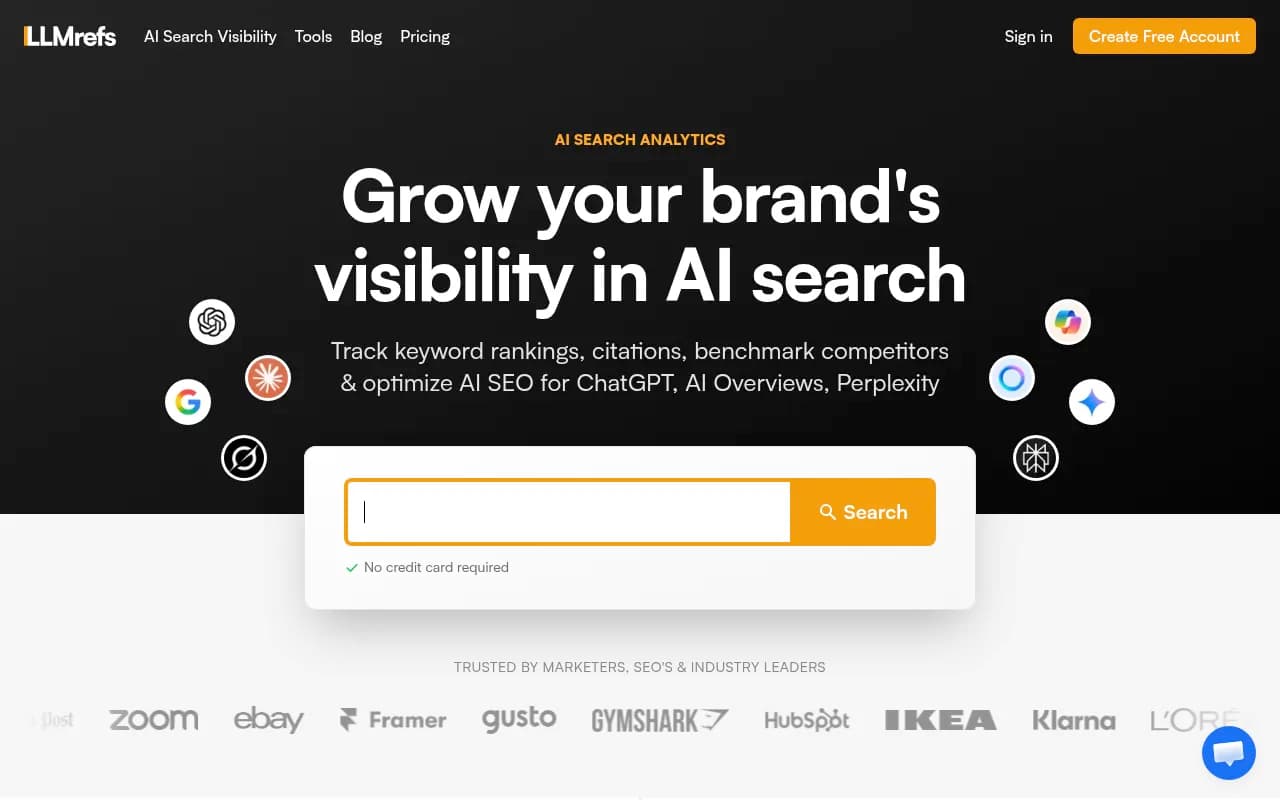
LLMrefs takes a focused approach: AI search analytics only, no traditional SEO. It monitors 11 generative AI engines including ChatGPT, Google AI Overviews, Perplexity, Claude, Gemini, Meta AI, Grok, and DeepSeek. The core difference is methodology -- LLMrefs organizes tracking around keywords instead of individual prompts, automatically generating prompt variations to test how AI engines respond. It's built for SEO teams and agencies who want simple, scalable AI visibility tracking without the complexity of prompt engineering. Pricing is flat: $79/mo for 500 prompts with unlimited projects, domains, and team seats. 7-day free trial, no credit card required.
Side-by-Side Comparison
| Feature | Authoritas AI Tracker | LLMrefs |
|---|---|---|
| Starting price | £99/mo (~$125/mo) | $79/mo |
| Free trial | Yes (demo required) | 7 days, no credit card |
| AI engines tracked | 7 (ChatGPT, Perplexity, Claude, Gemini, DeepSeek, Google AIO, Bing AI) | 11 (adds Meta AI, Grok, Copilot, Google AI Mode) |
| Tracking methodology | Manual prompt setup | Keyword-based with auto-generated prompts |
| Traditional SEO tools | ✓ (rank tracking, backlinks, technical audits) | ✗ (AI search only) |
| Multi-site support | Paid add-on per site | Unlimited domains included |
| Team seats | Limited by plan tier | Unlimited at all tiers |
| Competitor benchmarking | ✓ | ✓ |
| Citation/source analysis | ✓ | ✓ |
| Multi-language support | ✓ (50+ countries) | ✓ (50+ countries) |
| Content optimization | ✗ | ✗ |
| API access | Enterprise only | Not specified |
| Target audience | eCommerce, publishers, agencies needing full SEO suite | SEO teams focused on AI visibility |
Pricing comparison
| Plan | Authoritas AI Tracker | LLMrefs |
|---|---|---|
| Entry tier | £99/mo Essential (1 site, limited prompts) | $79/mo (500 prompts, unlimited sites/seats) |
| Mid tier | £299/mo Professional | Same flat pricing |
| High tier | £799/mo Expert | Same flat pricing |
| Enterprise | Custom pricing | Not offered |
| Per-site cost | Increases with each site | $0 (unlimited) |
| Team seats | Limited, varies by plan | Unlimited |
| Annual discount | Available | Not specified |
The pricing models reveal different philosophies. Authoritas charges based on sites tracked and team size, typical for enterprise SEO platforms. LLMrefs uses flat pricing with unlimited scaling on projects and users -- you pay for prompt volume, not organizational complexity. For a single-brand team, Authoritas is slightly more expensive. For agencies managing 5+ clients, LLMrefs becomes dramatically cheaper.
Tracking methodology
Authoritas: Manual prompt control
Authoritas requires you to define specific prompts you want to track. You input the exact query ("best winter surfing wetsuits"), select which AI engines to monitor, and the platform runs those prompts on a schedule. This gives granular control -- you can test very specific phrasings, personas, or query intents. The downside: it's labor-intensive. Scaling to hundreds of prompts means manually writing or importing each one.
The platform does offer prompt templates and journey mapping (grouping prompts by customer journey stage), but you're still building the prompt library yourself. For brands with well-defined customer questions, this works. For discovery and broad coverage, it's slow.
LLMrefs: Keyword-first automation
LLMrefs flips the model. You input a keyword ("winter surfing wetsuits"), and the platform automatically generates multiple prompt variations -- informational queries, buying intent questions, branded vs non-branded, location-based variants. It then tracks all those variations across 11 AI engines.
This approach scales faster. One keyword becomes 10-20 prompts without manual work. The trade-off: less control over exact phrasing. You're trusting the algorithm to generate relevant variations. In practice, this works well for most SEO use cases -- you care about keyword visibility, not whether a specific 12-word sentence gets answered.
Verdict: LLMrefs wins for speed and scale. Authoritas wins if you need to test very specific prompt phrasings or have compliance requirements around exact wording.
AI engine coverage
| Engine | Authoritas | LLMrefs |
|---|---|---|
| ChatGPT | ✓ | ✓ |
| Perplexity | ✓ | ✓ |
| Claude | ✓ | ✓ |
| Gemini | ✓ | ✓ |
| Google AI Overviews | ✓ | ✓ |
| Google AI Mode | ✗ | ✓ |
| Bing AI / Copilot | ✓ | ✓ |
| Meta AI | ✗ | ✓ |
| Grok | ✗ | ✓ |
| DeepSeek | ✓ | ✓ |
LLMrefs covers 4 additional engines. Meta AI and Grok matter for consumer-facing brands (Meta AI is embedded in Facebook/Instagram/WhatsApp, Grok reaches X/Twitter users). Google AI Mode is a distinct product from AI Overviews -- it's the conversational mode in Google Search. Missing these means blind spots in your visibility data.
Authoritas' 7-engine coverage hits the major players but leaves gaps. For most B2B brands, this is fine. For consumer brands or publishers trying to understand the full AI search landscape, LLMrefs' broader coverage is worth the switch.
Traditional SEO integration
This is where Authoritas pulls ahead. The platform includes:
- Rank tracking: Traditional SERP position monitoring for Google, Bing, etc.
- Backlink analysis: Link profile monitoring, toxic link detection, competitor backlink gaps
- Technical SEO audits: Crawl your site for broken links, duplicate content, schema issues, Core Web Vitals
- Keyword research: Search volume, difficulty scores, SERP feature analysis
- Reporting: White-label client reports combining AI visibility + traditional SEO metrics
For agencies and in-house teams managing both traditional SEO and AI search, having everything in one platform simplifies workflows. You're not juggling Ahrefs + LLMrefs + Screaming Frog. You log into Authoritas and see the full picture.
LLMrefs offers none of this. It's AI search visibility only. If you need backlink data or rank tracking, you're paying for a second tool.
Verdict: If you're already using Ahrefs, Semrush, or Screaming Frog and just need AI visibility tracking, LLMrefs slots in cleanly. If you want to consolidate tools, Authoritas makes sense despite the higher price.
Citation and source analysis
Both platforms track which sources AI engines cite when answering prompts. You see:
- Which domains get cited most often
- Whether your site appears in citations
- Competitor citation frequency
- Specific URLs cited per prompt
Authoritas presents this in a "Source Analysis" view with citation share of voice -- what percentage of total citations across your tracked prompts go to your domain vs competitors. It's clean and agency-friendly for client reporting.
LLMrefs shows citation data per keyword and per AI engine. You can drill down to see exactly which URLs ChatGPT cited for "best CRM software" vs which URLs Perplexity cited. The interface is more granular but less polished for presentation.
Neither platform tells you why a source got cited or how to fix missing citations. They show the data, you figure out the action. This is where the gap becomes obvious -- tracking is step one, but what do you do with a list of competitor citations? You need content that actually gets cited. Platforms like Promptwatch close this loop by showing answer gaps and generating optimized content, but if you're just comparing Authoritas vs LLMrefs, both stop at monitoring.
Verdict: Tie. Both deliver citation data competently. Authoritas has better reporting visuals, LLMrefs has more granular drill-downs.
Competitor benchmarking
Authoritas lets you add competitor domains and track their AI visibility alongside yours. You see:
- Share of voice trends over time
- Which prompts competitors rank for that you don't
- Sentiment comparison (positive/negative/neutral mentions)
- Citation frequency head-to-head
The "Share of Voice Trend" chart is particularly useful for executive reporting -- it's a single line graph showing your brand's visibility vs 5-10 competitors across all tracked prompts.
LLMrefs offers competitor tracking but with less visual polish. You can compare citation counts and keyword rankings, but the dashboards feel more utilitarian. For internal SEO teams, this is fine. For agencies presenting to clients, Authoritas' charts look better in slide decks.
Verdict: Authoritas wins on presentation. LLMrefs delivers the same data with less packaging.
Multi-language and geo-targeting
Both platforms support 50+ countries and multiple languages. You can track prompts in French, German, Spanish, Japanese, etc., and specify which country's AI results to monitor (e.g., ChatGPT responses for users in the UK vs US).
Authoritas emphasizes this for global eCommerce brands and publishers. LLMrefs treats it as table stakes -- it's available but not heavily marketed.
In practice, both work. Neither has a meaningful edge here.
Ease of use
LLMrefs is simpler. The interface is clean, the keyword-first model is intuitive ("I want to track 'project management software' -- done"), and onboarding takes 10 minutes. You don't need training.
Authoritas has more features, which means more complexity. The interface combines AI tracking, rank tracking, backlinks, technical audits, and reporting in one dashboard. It's powerful but has a learning curve. Expect a demo call and a week of poking around before you're comfortable.
For small teams or solo SEOs, LLMrefs' simplicity is a feature. For agencies with dedicated SEO analysts, Authoritas' depth is worth the ramp-up time.
Reporting and exports
Authoritas offers white-label reporting with customizable templates. You can generate PDF or web-based reports combining AI visibility, traditional rankings, backlinks, and technical SEO in one client-facing document. This is critical for agencies.
LLMrefs has basic CSV exports and dashboard sharing. You can pull data into Google Sheets or Looker Studio, but there's no built-in report builder. For internal use, this is fine. For client deliverables, you're doing manual work.
Verdict: Authoritas wins for agencies. LLMrefs works for in-house teams who don't need polished reports.
What's missing from both
Neither platform helps you act on the data. They show you:
- Your brand isn't cited for "best CRM software"
- Competitor X gets cited 40% of the time
- Your share of voice dropped 15% last month
But then what? You're left staring at a dashboard with no clear next step. You need to:
- Figure out which content is missing
- Write or optimize that content
- Get it indexed and cited by AI engines
Both tools stop at step zero (showing the problem). They don't identify content gaps, generate optimized articles, or track whether your new content actually gets picked up by AI engines.
This is the action gap. If you're serious about improving AI visibility, you need a platform that connects tracking to optimization. Promptwatch does this by showing answer gaps ("here's what competitors have that you don't"), generating citation-optimized content, and tracking results. But if you're choosing between Authoritas and LLMrefs, understand that both are monitoring-only tools.
Pros and cons
Authoritas AI Tracker
Pros:
- All-in-one platform combining AI search + traditional SEO (rank tracking, backlinks, technical audits)
- White-label reporting for agencies
- Strong competitor benchmarking with polished visuals
- Granular prompt control for specific use cases
- Sentiment analysis for brand monitoring
Cons:
- More expensive, especially for multi-site tracking
- Steeper learning curve due to feature breadth
- Only 7 AI engines (missing Meta AI, Grok, Google AI Mode)
- Manual prompt setup doesn't scale as easily
- Limited team seats on lower tiers
LLMrefs
Pros:
- 20% cheaper with flat pricing ($79/mo)
- Unlimited projects, domains, and team seats at every tier
- Tracks 11 AI engines (broadest coverage)
- Keyword-first approach with automated prompt generation scales faster
- Simple, intuitive interface with fast onboarding
- 7-day free trial, no credit card required
Cons:
- No traditional SEO features (you'll need a second tool for rank tracking, backlinks, etc.)
- Less polished reporting for client deliverables
- No white-label options
- Less control over exact prompt phrasing
- No API access mentioned
Who should pick which tool
Choose Authoritas if:
- You're an agency managing multiple clients and need white-label reporting
- You want to consolidate AI search tracking + traditional SEO in one platform
- You're already paying for an enterprise SEO tool and want to switch to an all-in-one solution
- You need granular control over specific prompt phrasings (e.g., compliance, brand safety)
- You're tracking a small number of high-value prompts rather than broad keyword coverage
- Budget isn't a primary constraint and you value feature depth over simplicity
Choose LLMrefs if:
- You're an in-house SEO team focused specifically on AI search visibility
- You already use Ahrefs, Semrush, or Screaming Frog for traditional SEO and just need AI tracking
- You're managing multiple brands or clients and need unlimited domain tracking
- You want to scale quickly to hundreds of keywords without manual prompt writing
- You need the broadest AI engine coverage (Meta AI, Grok, Google AI Mode matter to you)
- You prefer simple, focused tools over feature-heavy platforms
- You're budget-conscious or testing AI visibility tracking for the first time
Consider Promptwatch if:
- You need to go beyond monitoring and actually improve your AI visibility
- You want content gap analysis showing exactly what's missing from your site
- You need AI-generated content optimized for citations
- You want to track the full loop from visibility to traffic to revenue
- You're serious about GEO/AEO and want a platform built for optimization, not just tracking
Final verdict
LLMrefs wins for most teams. It's cheaper, simpler, covers more AI engines, and scales effortlessly with unlimited domains and seats. The keyword-first approach makes sense for SEO workflows -- you think in keywords, not individual prompts. For in-house teams or agencies already using traditional SEO tools, LLMrefs slots in as a focused AI visibility layer without redundant features or complexity.
Authoritas makes sense in two scenarios: (1) you're an agency that needs white-label reporting and wants to consolidate tools, or (2) you're a large eCommerce brand or publisher that values having AI search + traditional SEO + technical audits in one platform. The higher price buys you breadth and polish, but most teams don't need that breadth.
Both platforms share the same fundamental limitation: they show you the problem but don't help you fix it. You'll know your brand isn't cited for key prompts, but you're on your own to create content that changes that. For teams serious about AI search optimization, that's where the real work begins -- and where monitoring-only tools leave you hanging.