Key Takeaways
- Pricing model: Meteoria uses monthly subscriptions (€75-€300+/mo) with unlimited seats and projects. AI Rank Checker uses pay-as-you-go credits starting at $5 with no recurring fees.
- Prompt volume: Meteoria's Basic plan includes 25 prompts/month, Pro gets 100, Enterprise 200+. AI Rank Checker charges per keyword check with no monthly limits -- you pay only when you run a query.
- AI engine coverage: Meteoria tracks ChatGPT, Perplexity, Google AI Overview, Gemini, and Grok. AI Rank Checker adds Claude, Copilot, and Meta AI to that list.
- Feature depth: Meteoria offers sentiment analysis, competitor positioning heatmaps, and source analysis. AI Rank Checker focuses on ranking position tracking and CSV/PDF exports.
- Best for agencies: Meteoria's unlimited seats make it better for teams. AI Rank Checker's pay-per-use model works well for agencies billing clients per report.
- French vs global: Meteoria is a French platform with French-language support and EU-focused customers. AI Rank Checker is English-first and targets global markets.
Overview
Meteoria
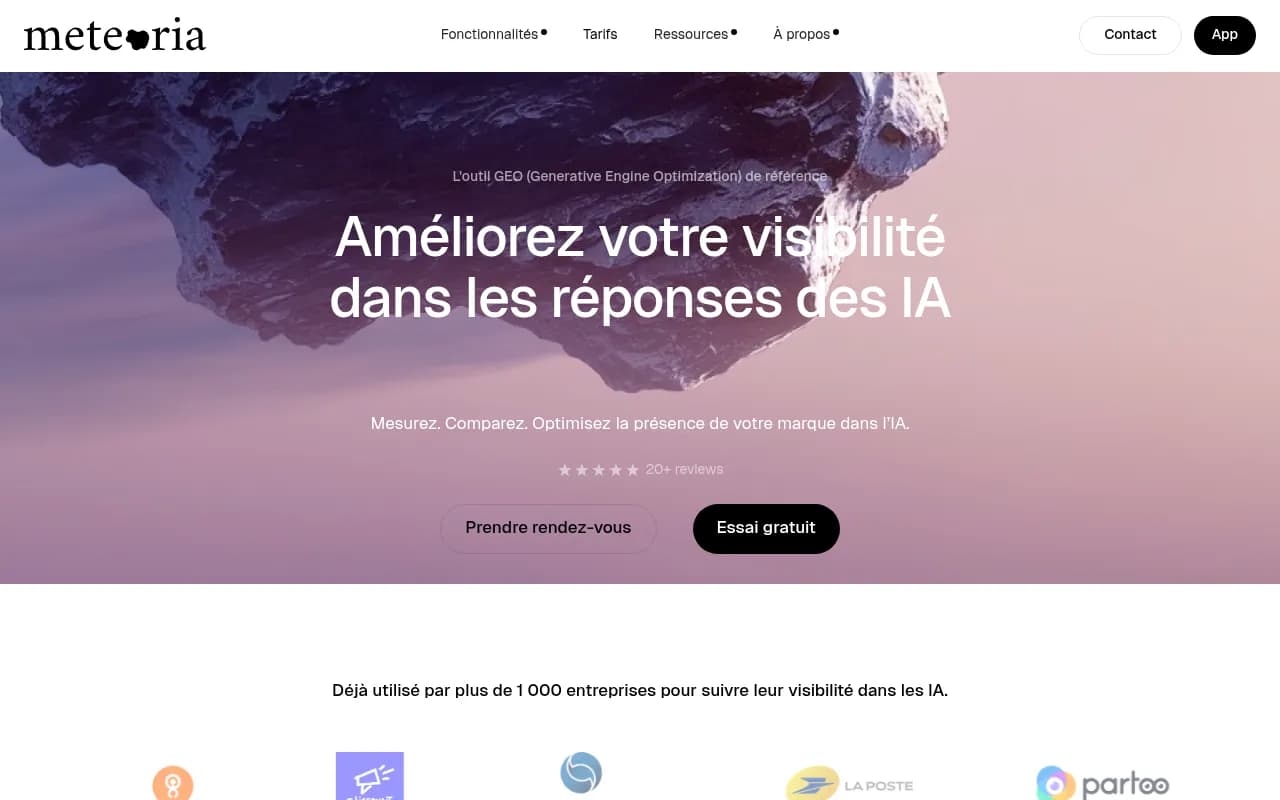
Meteoria is a French GEO (Generative Engine Optimization) platform built to track how AI models mention your brand. It monitors ChatGPT, Perplexity, Google AI Overview, Gemini, and Grok across custom prompts you define. The platform emphasizes measuring visibility scores, comparing competitor positioning, and analyzing sentiment -- both explicit and implicit -- in AI responses. Meteoria uses a subscription model with three tiers (Basic, Pro, Enterprise) and includes unlimited seats and projects at every level. Over 1,000 companies use it, including French brands like Cdiscount, Pierre Fabre, La Poste, and Partoo.
The platform is structured around three steps: measure (run prompts and quantify responses), compare (benchmark against competitors and surface sources), and optimize (improve your AI visibility based on the data). Meteoria claims 80% of brands are invisible in most AI responses, positioning itself as the tool to fix that gap.
AI Rank Checker
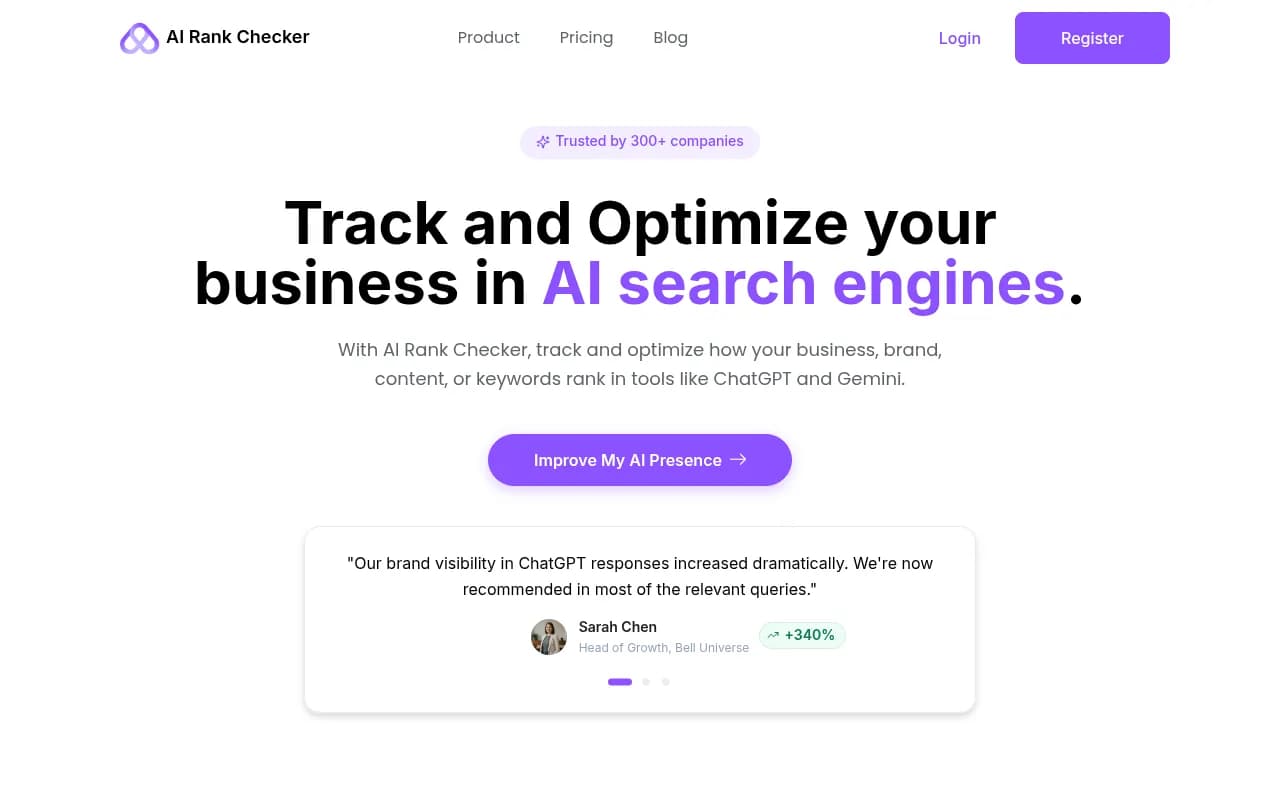
AI Rank Checker takes a simpler, more transactional approach. It tracks how your business, brand, or keywords rank in ChatGPT, Perplexity, Claude, Gemini, Copilot, Grok, and Meta AI. The core value proposition is straightforward: you enter keywords, select which AI engines to query, and see where you rank. The platform supports multi-domain tracking (useful for agencies managing multiple clients), CSV and PDF exports, and a pay-as-you-go wallet system with no monthly subscriptions.
AI Rank Checker is used by 300+ companies and targets marketers, agencies, and SEO teams who want visibility data without committing to a recurring plan. Top-ups start at $5, and you only pay for the keyword checks you actually run. The platform highlights testimonials showing 215-428% increases in AI mentions, though these are presented without context or methodology.
Side-by-Side Comparison
| Feature | Meteoria | AI Rank Checker |
|---|---|---|
| Pricing model | Monthly subscription (€75-€300+) | Pay-as-you-go credits (from $5) |
| Free trial | 7 days | No (pay per use) |
| AI engines tracked | ChatGPT, Perplexity, Google AI Overview, Gemini, Grok | ChatGPT, Perplexity, Claude, Gemini, Copilot, Grok, Meta AI |
| Prompt/keyword limits | 25 (Basic), 100 (Pro), 200+ (Enterprise) per month | No monthly limit -- pay per check |
| Sentiment analysis | Yes (explicit + implicit) | No |
| Competitor benchmarking | Yes (heatmaps, relative positioning) | Yes (basic comparison) |
| Source analysis | Yes (shows which sources AI models cite) | No |
| Multi-domain tracking | Yes (unlimited projects) | Yes |
| Team seats | Unlimited | Not specified |
| Exports | Not specified | CSV, PDF |
| Traffic analysis | Yes (content compatibility with LLMs) | No |
| Language/region targeting | Yes (persona and geo-specific prompts) | Not specified |
| Support | French company, French-language support | English-first |
Pricing: Subscription vs pay-per-use
This is the biggest difference between the two tools.
Meteoria uses a tiered subscription model:
| Plan | Price | Prompts/month | Notes |
|---|---|---|---|
| Basic | €75/mo | 25 | Unlimited seats and projects |
| Pro | €175/mo | 100 | Unlimited seats and projects |
| Enterprise | €300+/mo | 200+ | Custom pricing, unlimited seats and projects |
All plans include unlimited team seats and unlimited projects, which is unusual in this space. Most competitors charge per seat or per domain. If you're running an agency or managing multiple brands, this is a real cost advantage. The downside: you're locked into a monthly bill even if you only need to check visibility once or twice.
AI Rank Checker uses a wallet system with no subscriptions:
- Top up your account starting at $5
- Pay only for the keyword checks you run
- No monthly fees, no expiration on credits
- Pricing per check depends on which AI engines you select
This model makes sense if your needs are sporadic -- maybe you're checking visibility for a client campaign, running a quarterly audit, or testing a new content strategy. You're not paying for capacity you don't use. The tradeoff: if you're tracking dozens of keywords daily, the per-check costs add up fast and a subscription might be cheaper.
Neither tool publishes exact per-check pricing for AI Rank Checker, so you'll need to test with a small top-up to see if the economics work for your volume.
AI engine coverage
Meteoria covers five AI models:
- ChatGPT
- Perplexity
- Google AI Overview
- Gemini
- Grok
AI Rank Checker covers seven:
- ChatGPT
- Perplexity
- Claude
- Gemini
- Copilot
- Grok
- Meta AI
AI Rank Checker has the edge here. Claude is a major omission from Meteoria -- it's one of the most-used AI models for research and content discovery. Copilot matters if you're targeting enterprise users (it's built into Windows and Microsoft 365). Meta AI is less critical but still relevant for Facebook/Instagram-heavy audiences.
Google AI Overview is the standout inclusion in Meteoria's lineup. It's not a chatbot -- it's the AI-generated answer box that appears at the top of Google search results. If you care about traditional search visibility alongside AI chat, Meteoria covers both. AI Rank Checker doesn't mention Google AI Overview at all, which is a gap if you're trying to track the full AI search landscape.
For tools that help you optimize visibility across these engines once you know where you stand, Promptwatch offers content gap analysis and AI-optimized content generation grounded in citation data from 880M+ sources.

Feature depth: Tracking vs analysis
Meteoria is built around three workflows: measure, compare, optimize. The platform doesn't just tell you if you're mentioned -- it quantifies your visibility score, shows your relative position against competitors, and surfaces the sources AI models are citing. The sentiment analysis feature is interesting: it captures both explicit sentiment ("X is the best") and implicit sentiment (tone, framing, context) in AI responses. This matters for brand reputation, especially if you're in a category where AI models might associate your brand with negative topics.
The competitor benchmarking uses heatmaps to show where you're winning and losing across different prompt types, personas, and geographies. You can see which competitors dominate specific queries and reverse-engineer why. The source analysis shows which websites, articles, or databases the AI is pulling from -- useful if you're trying to figure out where to get mentioned (Reddit threads, industry blogs, review sites, etc.).
Meteoria also analyzes your own content and traffic to show how compatible your site is with LLM crawlers and whether you're actually getting traffic from AI referrals. This closes the loop between visibility and business impact.
AI Rank Checker is simpler. You track keyword rankings across AI engines, compare your position to competitors, and export the data. There's no sentiment analysis, no source tracking, no content compatibility scoring. It's a monitoring dashboard, not an optimization platform. If you just need to know "are we mentioned?" and "where do we rank?", that's fine. If you need to understand why you're not mentioned or how to fix it, you'll hit a wall.
The export functionality (CSV and PDF) is a nice touch for agencies that need to package reports for clients. Meteoria doesn't explicitly mention exports, which could be a friction point if you're presenting data to stakeholders who don't want to log into the platform.
Multi-domain and team access
Both tools support tracking multiple domains, but the implementation differs.
Meteoria includes unlimited projects and unlimited seats at every pricing tier. This is huge for agencies or companies with multiple brands. You can onboard your entire team, set up separate dashboards for each client or product line, and everyone gets access without per-seat fees. Most GEO platforms charge $50-100 per additional seat, so this is a real differentiator.
AI Rank Checker supports multi-domain tracking with "separate dashboards per brand," but the website doesn't specify seat limits or pricing. The pay-as-you-go model suggests you're paying per keyword check, not per user, so team access might be included -- but it's unclear. If you're managing 5+ clients, you'll want to confirm this before committing.
Prompt strategy and customization
Meteoria emphasizes custom prompts "adapted to your sector, your products, your personas, and your geographic zones." You define the queries that matter to your business -- not just generic brand searches, but specific use cases like "best CRM for small businesses in France" or "cheapest hotel booking site for families." The platform lets you segment by persona (decision-maker vs end-user), geography (city, region, country), and intent (informational, transactional, navigational).
This is important because AI models give different answers depending on how you ask. A prompt like "top project management tools" will surface different brands than "project management software for remote teams" or "Asana alternatives for startups." Meteoria's approach lets you map the full decision journey.
AI Rank Checker uses the term "keywords" instead of "prompts," which suggests a more traditional SEO mindset. You enter keywords, select AI engines, and see rankings. There's no mention of persona targeting, geographic segmentation, or prompt engineering. This works if your needs are straightforward ("track mentions of our brand name"), but it's limiting if you're trying to capture category-level visibility or long-tail queries.
Data and credibility
Meteoria claims "over 1,000 companies" use the platform and lists recognizable French brands (Cdiscount, Pierre Fabre, La Poste, Partoo). The "80% of brands are invisible in most AI responses" stat is a strong hook, though it's not sourced or explained. The platform has 20+ reviews (presumably on a third-party site, though it's not specified).
AI Rank Checker claims "300+ companies" and shows testimonials with specific percentage increases (Elena Rodriguez at Eskidji: +428%, Sarah Chen at Bell Universe: +340%, Marcus Webb at ERKE: +215%). These numbers are impressive but lack context -- 428% increase in what? Mentions? Ranking positions? Traffic? Over what time period? Without methodology, they're hard to evaluate.
Neither platform is as transparent as it could be about data sources, update frequency, or how they're actually querying the AI models. Are they using API access? Simulating user queries? How often do they refresh results? These details matter if you're making business decisions based on the data.
Who should pick Meteoria
Meteoria makes sense if:
- You need ongoing, high-volume AI visibility tracking (100+ prompts/month)
- You're managing multiple brands or clients and want unlimited seats
- Sentiment analysis and competitor benchmarking are important to your strategy
- You care about understanding which sources AI models cite
- You want to track Google AI Overview alongside chatbots
- You're comfortable with a monthly subscription and can justify the cost
- You're based in Europe or targeting French-speaking markets
The platform is overkill if you just need occasional spot-checks. The Basic plan at €75/month for 25 prompts works out to €3 per prompt, which is expensive if you're only checking a handful of keywords once in a while.
Who should pick AI Rank Checker
AI Rank Checker makes sense if:
- You need sporadic visibility checks (quarterly audits, campaign validation, client reports)
- You want to avoid monthly subscriptions and only pay for what you use
- You need to track Claude, Copilot, or Meta AI specifically
- CSV and PDF exports are a must-have for client reporting
- You're working with a tight budget and want to start small ($5 top-up)
- You don't need sentiment analysis or deep competitor insights
The pay-as-you-go model is limiting if you're tracking visibility daily or running large-scale prompt sets. You'll burn through credits fast, and the lack of bulk pricing or volume discounts means costs can spiral.
Pros and cons
Meteoria pros:
- Unlimited seats and projects at all tiers
- Sentiment analysis (explicit + implicit)
- Source tracking shows where AI models get their data
- Google AI Overview coverage
- Competitor heatmaps and relative positioning
- Content compatibility analysis
Meteoria cons:
- Monthly subscription required even for light usage
- No Claude, Copilot, or Meta AI support
- Pricing in euros may be awkward for non-EU customers
- Export functionality not clearly documented
- French-first platform may have language barriers
AI Rank Checker pros:
- Pay-as-you-go with no subscriptions
- Covers Claude, Copilot, and Meta AI
- CSV and PDF exports built in
- Low barrier to entry ($5 minimum)
- Multi-domain tracking for agencies
AI Rank Checker cons:
- No sentiment analysis
- No source tracking or citation analysis
- Per-check pricing can get expensive at scale
- Limited prompt customization (keyword-based, not persona or geo-targeted)
- No Google AI Overview support
- Testimonials lack methodology or context
Final verdict
Meteoria and AI Rank Checker solve the same problem -- tracking brand visibility in AI search engines -- but they're built for different workflows.
Meteoria is the better choice if you're serious about AI visibility as an ongoing channel. The unlimited seats, sentiment analysis, and competitor benchmarking make it a real optimization platform, not just a tracker. The €175/month Pro plan (100 prompts) is the sweet spot for most teams. You get enough volume to track category queries, brand mentions, and competitor positioning without hitting limits. The French focus is a plus if you're in Europe, a minus if you're not.
AI Rank Checker is the better choice if you need flexibility and low commitment. The pay-as-you-go model is perfect for agencies running monthly client reports, startups testing AI visibility before committing to a platform, or anyone who just needs occasional data. The broader AI engine coverage (Claude, Copilot, Meta AI) is a real advantage. But if you're checking 50+ keywords regularly, the per-check costs will quickly exceed a Meteoria subscription.
The real question is volume and frequency. If you're tracking AI visibility as a core KPI, Meteoria's subscription makes sense. If you're dipping in and out, AI Rank Checker's credits model is smarter. Neither tool helps you actually improve your visibility -- they just show you the current state. For that, you'll need content optimization, citation building, and prompt engineering on top of the tracking data.