Key Takeaways
- Meteoria is cheaper for small teams -- €75/mo gets you 25 prompts vs Peec AI's €89/mo for 50 prompts, but Peec AI includes more prompts at the entry level
- Both platforms track the same core LLMs (ChatGPT, Perplexity, Gemini, Claude) but neither offers crawler log analysis or content generation capabilities
- Meteoria is French-built with strong European focus and unlimited seats on all plans; Peec AI targets global marketing teams with workspace-based pricing
- Peec AI's interface emphasizes visual dashboards and trend charts; Meteoria focuses on sentiment analysis and source identification
- Neither platform helps you fix visibility gaps -- they show you the data but leave optimization entirely to you
- For teams that also want to track AI crawler behavior and generate optimized content, tools like Promptwatch fill the action gap that both Meteoria and Peec AI leave open
Overview
Meteoria
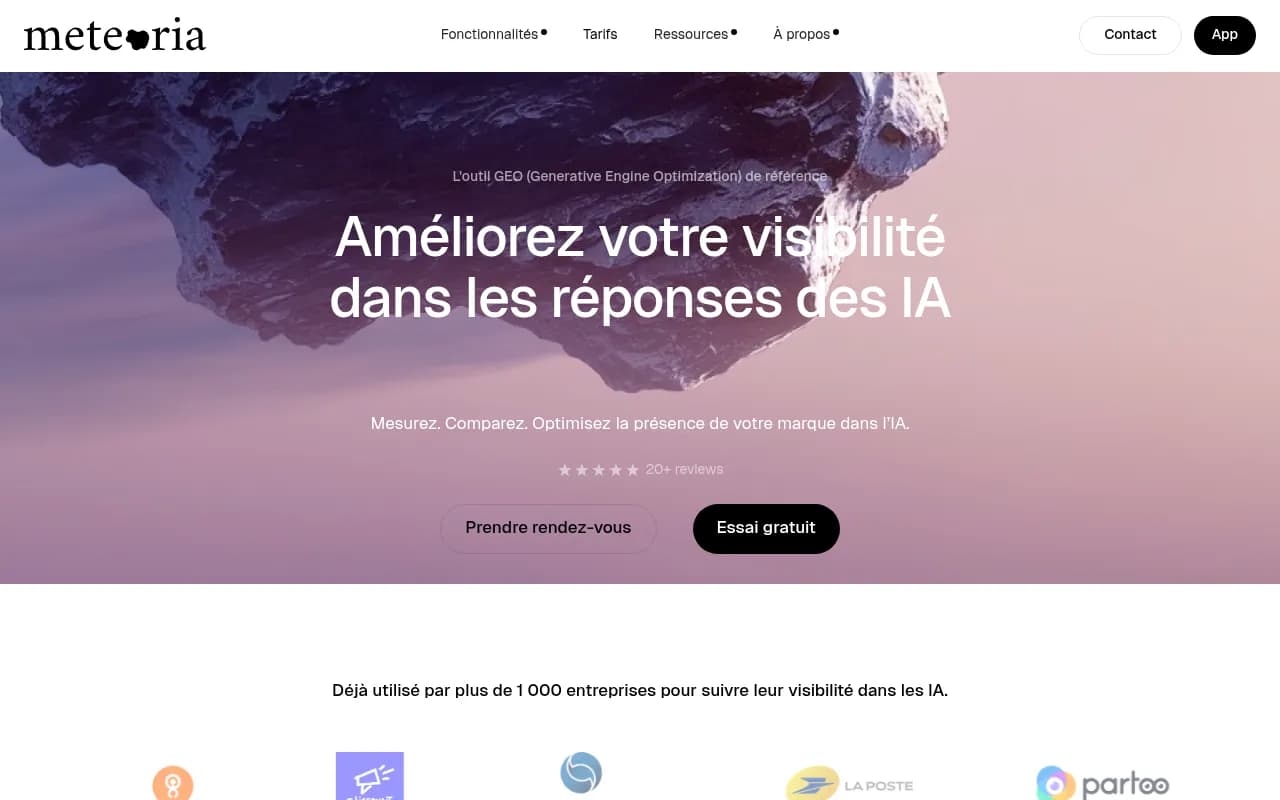
Meteoria is a French GEO (Generative Engine Optimization) platform that monitors brand mentions across ChatGPT, Perplexity, Google AI Overview, Gemini, and Grok. It tracks visibility scores, competitor positioning, and sentiment analysis across custom prompts. The platform is used by over 1,000 companies including Pierre Fabre, La Poste, and Cdiscount. Pricing starts at €75/month with unlimited seats and projects -- a structure that makes it attractive for agencies and multi-brand teams.
The core pitch: measure your brand's presence in AI responses, compare against competitors, and identify which sources LLMs are citing. Meteoria emphasizes sentiment tracking (both explicit and implicit) and geographic/persona-based prompt customization.
Peec AI

Peec AI is an AI search analytics platform built for marketing teams who need to track brand performance across ChatGPT, Perplexity, Claude, and Gemini. It measures visibility (share of chats mentioning your brand), position (ranking within AI responses), and sentiment (how AI perceives your brand). The platform is used by 1,500+ marketing teams and agencies including recognizable brands across Europe and North America.
Pricing starts at €89/month for 50 prompts and 10 models. Peec AI's interface leans heavily on visual dashboards with trend lines, competitor benchmarking, and tag-based prompt organization. The focus is on making AI search metrics accessible to non-technical marketers.
Side-by-Side Comparison
| Feature | Meteoria | Peec AI |
|---|---|---|
| Starting price | €75/mo (25 prompts) | €89/mo (50 prompts) |
| Free trial | 7 days | Yes (duration not specified) |
| LLMs tracked | ChatGPT, Perplexity, Google AI Overview, Gemini, Grok | ChatGPT, Perplexity, Claude, Gemini |
| Seats included | Unlimited on all plans | Varies by plan (1 workspace on Starter) |
| Custom prompts | Yes | Yes |
| Sentiment analysis | Yes (explicit + implicit) | Yes |
| Competitor benchmarking | Yes | Yes |
| Source tracking | Yes | Yes |
| Geographic targeting | Yes | Yes (all countries) |
| Persona customization | Yes | Via prompt tags |
| Content generation | No | No |
| Crawler log analysis | No | No |
| API access | Not mentioned | Not mentioned |
| Primary market | France/Europe | Global (strong European presence) |
Pricing comparison
| Plan | Meteoria | Peec AI |
|---|---|---|
| Entry tier | €75/mo (25 prompts, unlimited seats) | €89/mo (50 prompts, 10 models, 1 workspace) |
| Mid tier | €175/mo (100 prompts, unlimited seats) | €199/mo (150 prompts, 2 workspaces) |
| High tier | €300/mo (200+ prompts, unlimited seats) | Custom (Enterprise) |
| Annual discount | Not specified | Not specified |
| Free trial | 7 days | Yes |
Meteoria's unlimited seats model is a clear win for agencies managing multiple clients or brands managing multiple product lines. You're not paying per user. Peec AI's workspace model means you'll hit pricing tiers faster if you're tracking multiple brands or client accounts.
User interface and experience
Meteoria's interface (based on website screenshots) shows a data-heavy approach with tables, visibility percentages, and source breakdowns. The design feels functional rather than flashy -- you're here to extract insights, not admire charts. The French-language interface is the default, though English support is likely available.
Peec AI emphasizes visual storytelling. The dashboard shows trend lines, competitor comparison charts, and color-coded sentiment indicators. It's built for marketing teams who need to present AI visibility data to stakeholders who don't live in spreadsheets. The tag-based prompt organization makes it easy to group queries by campaign, product line, or region.
Verdict: Peec AI wins on visual polish and presentation-ready dashboards. Meteoria wins on data density and direct access to raw metrics.
LLM coverage and tracking depth
Meteoria tracks five LLMs: ChatGPT, Perplexity, Google AI Overview, Gemini, and Grok. The inclusion of Grok (X's AI) is notable -- most competitors skip it. Google AI Overview tracking is critical for brands worried about zero-click search results eating their organic traffic.
Peec AI tracks four LLMs: ChatGPT, Perplexity, Claude, and Gemini. The inclusion of Claude (Anthropic's model) is a differentiator -- Claude is increasingly used in enterprise contexts and by developers. No Google AI Overview or Grok coverage.
Neither platform tracks DeepSeek, Meta AI, Mistral, or Copilot -- all of which are monitored by more comprehensive platforms like Promptwatch.

Verdict: Meteoria has broader coverage for consumer-facing AI search (Google AI Overview, Grok). Peec AI covers Claude, which matters for B2B and developer-focused brands. Both leave gaps.
Prompt customization and query management
Both platforms let you create custom prompts tailored to your brand, products, personas, and geographies. This is table stakes for any GEO tool -- generic prompts don't reflect how real users search.
Meteoria emphasizes "strategic prompts" adapted to your sector, products, personas, and geographic zones. The website mentions analyzing "hundreds of prompts each day" and quantifying "thousands of responses." This suggests batch processing and volume-focused tracking.
Peec AI uses a tag-based system to organize prompts. You can group queries by campaign, product, region, or any custom taxonomy. The interface shows a "Recent Chats" view and supports tracking "across all countries." The visual approach makes it easier to see which prompt groups are performing vs underperforming.
Neither platform offers prompt volume estimates or difficulty scoring -- features that help you prioritize which prompts to optimize for. You're flying blind on which queries actually matter.
Verdict: Tie. Both handle custom prompts well. Peec AI's tagging system is cleaner for organization; Meteoria's batch approach suits high-volume tracking.
Competitor benchmarking
Meteoria lets you "confront your visibility and relative position with competitors according to your strategic criteria and for each LLM." The website shows heatmap-style visualizations comparing your brand against competitors across different dimensions. You can see which sources LLMs use to answer queries, helping you understand where competitors are getting cited.
Peec AI's competitor benchmarking shows up in the dashboard screenshots with side-by-side brand comparisons (e.g. Salesforce 62%, Attio 47%, HubSpot 65%). The visual presentation makes it easy to spot gaps and track relative performance over time. You can see visibility percentages, sentiment scores, and position rankings for each competitor.
Both platforms surface citation sources -- the websites, Reddit threads, YouTube videos, and other content that LLMs reference when mentioning brands. This is valuable for understanding where to publish or get backlinks.
Verdict: Tie. Both offer solid competitor tracking with source analysis. The difference is presentation style (Meteoria's data tables vs Peec AI's visual charts).
Sentiment analysis
Meteoria tracks both "implicit and explicit sentiment" of AI toward your brand across different prompts. This is a deeper approach than simple positive/negative classification -- it attempts to capture nuance in how LLMs frame your brand even when not explicitly stating an opinion.
Peec AI measures sentiment as one of three core metrics (alongside visibility and position). The dashboard shows sentiment scores numerically (e.g. "90" in the screenshot) with color coding. The focus is on tracking sentiment trends over time and identifying prompts where perception is negative.
Neither platform explains why sentiment is positive or negative, or what specific language patterns drive the score. You see the number, but you're left to manually review responses to understand the root cause.
Verdict: Meteoria's implicit/explicit distinction suggests more sophisticated analysis. Peec AI's trend tracking makes it easier to spot sentiment shifts over time. Slight edge to Meteoria for depth.
What's missing from both platforms
Here's what neither Meteoria nor Peec AI offers:
- Content gap analysis: They don't tell you which prompts competitors rank for but you don't, or what content you're missing
- AI content generation: No built-in tools to create articles, comparisons, or listicles optimized for AI citation
- Crawler log analysis: No visibility into which AI crawlers are hitting your website, what pages they read, or errors they encounter
- Prompt intelligence: No volume estimates, difficulty scores, or query fan-outs to help prioritize optimization efforts
- Traffic attribution: No way to connect AI visibility to actual website traffic or revenue
- Reddit/YouTube tracking: Limited insight into discussions and videos that influence AI recommendations
- API access: No programmatic access to data for custom reporting or workflows
These are monitoring-only platforms. They show you where you're invisible, but they don't help you fix it. For teams that want the full loop -- find gaps, generate content, track results -- platforms like Promptwatch add the optimization layer that Meteoria and Peec AI skip entirely.
Geographic and language support
Meteoria is French-built with strong European market focus. The website is in French by default, and client logos include major French brands (Pierre Fabre, La Poste, Cdiscount). Geographic targeting is explicitly mentioned as a feature -- you can customize prompts by "zones géographiques."
Peec AI markets globally with a clean English-first interface. The platform supports tracking "across all countries" and is used by brands and agencies across Europe and North America. The visual dashboard approach translates well across languages and regions.
Both platforms likely support multi-language prompt tracking, but neither website specifies which languages are supported or whether LLM responses are analyzed in non-English languages.
Verdict: Meteoria for French/European teams who want local support and French-language interface. Peec AI for global teams who need English-first tooling.
Team collaboration and access
Meteoria's killer feature: unlimited seats on all plans. Whether you're paying €75/mo or €300/mo, you can add as many team members as you want. This is huge for agencies managing multiple clients or brands with distributed marketing teams. No per-seat pricing means no budget negotiations when adding users.
Peec AI uses workspace-based pricing. The Starter plan (€89/mo) includes one workspace. The Growth plan (€199/mo) includes two workspaces. Each workspace presumably has its own set of users, but the website doesn't specify seat limits. This model works for single-brand teams but gets expensive fast for agencies.
Neither platform mentions role-based permissions, client reporting portals, or white-label options -- features that matter for agency use cases.
Verdict: Meteoria wins decisively for agencies and multi-brand teams. Unlimited seats at €75/mo is hard to beat.
Reporting and data export
Meteoria's website shows data tables and heatmaps but doesn't specify export formats or reporting capabilities. The focus is on in-platform analysis rather than external reporting.
Peec AI's dashboard includes an "Export" button (visible in screenshots), suggesting CSV or similar export options. The visual charts are presentation-ready, which helps for stakeholder reporting. No mention of scheduled reports, custom dashboards, or integrations with BI tools.
Neither platform offers Looker Studio integration, API access, or webhook support for automated reporting workflows.
Verdict: Peec AI's export functionality and visual dashboards give it a slight edge for reporting. Both platforms are limited compared to enterprise-grade tools.
Customer support and onboarding
Meteoria offers a "Prendre rendez-vous" (book a meeting) option prominently on the homepage, suggesting hands-on onboarding for new customers. The 7-day free trial gives you time to test before committing. No mention of documentation, video tutorials, or self-service resources.
Peec AI has a "Talk to Sales" button and free trial signup. The website mentions being used by 1,500+ marketing teams, suggesting a more self-service onboarding flow. No details on support channels (email, chat, phone) or response times.
Neither platform specifies support hours, SLAs, or whether support is included in all plans or reserved for higher tiers.
Verdict: Tie. Both offer sales-assisted onboarding but lack transparency on ongoing support.
Pros and cons
Meteoria pros
- Unlimited seats on all plans -- unbeatable for agencies and multi-brand teams
- Lower entry price (€75/mo vs €89/mo)
- Tracks Google AI Overview and Grok (broader LLM coverage)
- Implicit + explicit sentiment analysis
- Strong European market presence and French-language support
Meteoria cons
- Fewer prompts at entry tier (25 vs 50)
- Interface less polished than Peec AI
- No Claude tracking (matters for B2B/developer brands)
- Limited information on export and reporting capabilities
- No content generation or optimization tools
Peec AI pros
- More prompts at entry tier (50 vs 25)
- Tracks Claude (important for enterprise/developer audiences)
- Visual dashboards designed for stakeholder presentations
- Tag-based prompt organization
- Export functionality built in
Peec AI cons
- Workspace-based pricing gets expensive for agencies
- No Google AI Overview or Grok tracking
- Less transparent about seat limits and team collaboration
- No content generation or optimization tools
- Missing crawler log analysis and traffic attribution
Who should pick Meteoria
Pick Meteoria if you:
- Run an agency managing multiple client brands (unlimited seats = massive cost savings)
- Operate primarily in France or Europe and want French-language support
- Need to track Google AI Overview for zero-click search visibility
- Want implicit/explicit sentiment analysis for brand perception tracking
- Prefer data-dense interfaces over visual dashboards
- Have a smaller prompt volume (under 50/month) and want the lowest entry price
Who should pick Peec AI
Pick Peec AI if you:
- Manage a single brand or small portfolio (workspace model works fine)
- Need to track Claude for B2B or developer audience visibility
- Want presentation-ready dashboards for stakeholder reporting
- Prefer visual trend charts over data tables
- Need more prompts at the entry level (50 vs 25)
- Operate globally with English as primary language
Who should look elsewhere
Neither Meteoria nor Peec AI is the right choice if you:
- Need content gap analysis to identify what you're missing vs competitors
- Want AI content generation to create optimized articles and comparisons
- Require crawler log analysis to understand how AI models discover your content
- Need traffic attribution to connect AI visibility to revenue
- Want prompt volume estimates and difficulty scoring to prioritize efforts
- Need API access for custom reporting or workflow automation
For teams that want the full optimization loop -- not just monitoring -- platforms like Promptwatch combine visibility tracking with content gap analysis, AI writing tools, crawler logs, and traffic attribution. That's the difference between knowing you're invisible and actually fixing it.
Final verdict
Meteoria wins on pricing structure and team access. Unlimited seats at €75/mo is unbeatable for agencies and multi-brand operations. The broader LLM coverage (Google AI Overview, Grok) and deeper sentiment analysis make it a solid choice for European brands focused on consumer-facing AI search.
Peec AI wins on interface polish and prompt volume. The visual dashboards are easier to present to stakeholders, and 50 prompts at the entry tier gives you more room to test different query angles. Claude tracking matters if your audience includes developers or enterprise buyers.
Both platforms are monitoring-only tools. They show you the data but leave optimization entirely to you. If you just need visibility metrics and competitor benchmarking, either works. If you want to actually improve your AI search presence -- not just measure it -- you'll need to layer in content creation, crawler analysis, and gap identification from other tools or platforms that close the action loop.