Key takeaways
- Both Peec AI and AI Peekaboo are monitoring-only tools -- neither offers content generation, crawler logs, or traffic attribution. If you need to act on the data, not just see it, you'll need a more complete platform.
- Peec AI has transparent public pricing from $95/month; AI Peekaboo keeps pricing hidden, which makes direct cost comparison difficult.
- AI Peekaboo covers more AI models (including Google AI Mode and Google AI Overviews); Peec AI is limited to ChatGPT, Perplexity, and Gemini.
- Peec AI is built for in-house marketing teams; AI Peekaboo leans toward agencies with white-label and multi-client features.
- Peec AI's 115+ language support is a genuine differentiator for international brands -- Peekaboo's language coverage is not publicly documented.
- Neither tool provides prompt volume data, difficulty scoring, or query fan-outs, so you're flying somewhat blind on which prompts are worth tracking.
Overview
Peec AI

Peec AI is a clean, focused AI search analytics platform aimed squarely at marketing teams. It tracks three core metrics -- visibility (how often your brand appears), position (where you rank among mentioned brands), and sentiment (how AI models describe you) -- across ChatGPT, Perplexity, and Gemini. The interface is polished, the setup is quick, and the data is easy to read. It's trusted by 2,000+ marketing teams according to their site, and the pricing is refreshingly transparent for this category.
What it doesn't do: there's no content generation, no crawler log access, no traffic attribution, and no prompt intelligence. You get a clear picture of where you stand. What you do about it is entirely up to you.
AI Peekaboo
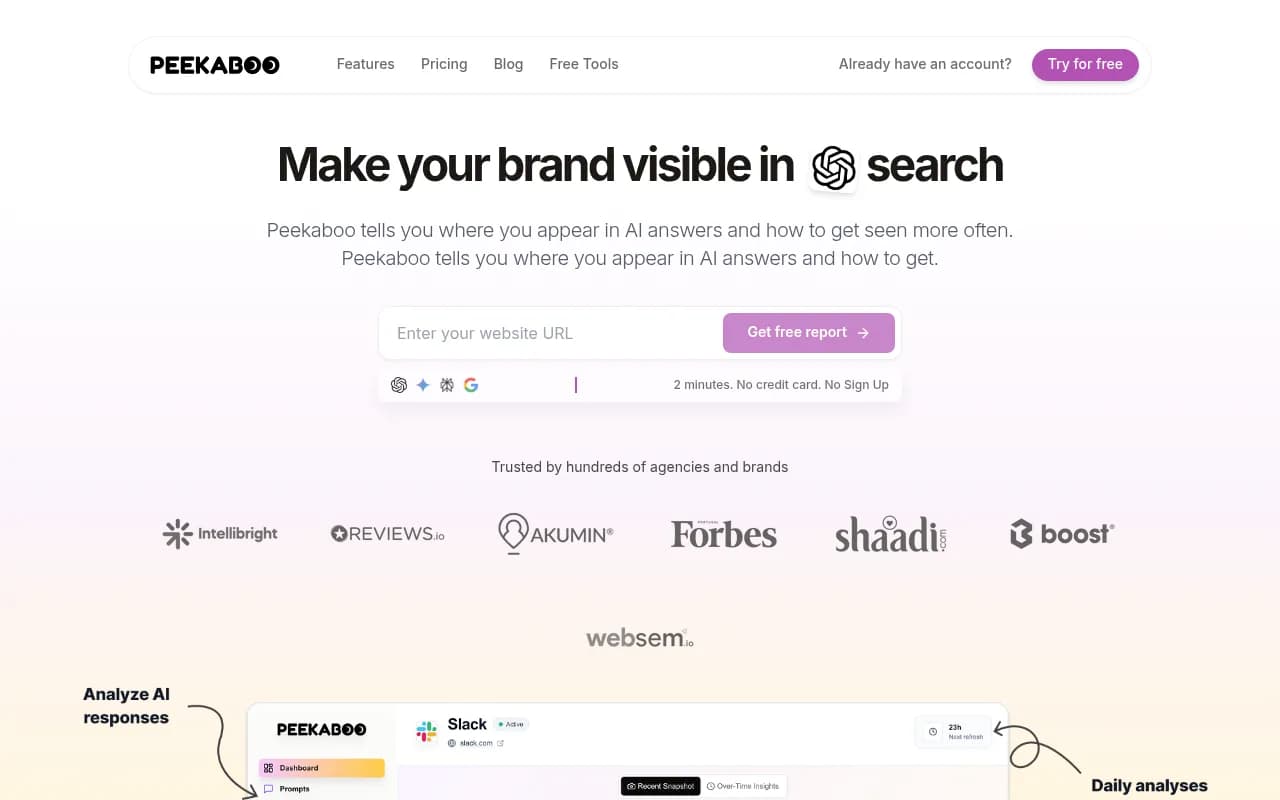
AI Peekaboo tracks brand mentions across ChatGPT, Gemini, Google AI Overviews, Perplexity, and Google AI Mode. Its model coverage is slightly broader than Peec AI's, and it's built with agencies in mind -- multi-client management and white-label reporting are part of the pitch. The interface shows visibility scores and lets you track custom prompts, which is table-stakes for this category.
Like Peec AI, it's a monitoring tool. No content gap analysis, no AI crawler logs, no content briefs. Pricing is not publicly listed, which is a friction point when you're evaluating options.
Side-by-side comparison
| Feature | Peec AI | AI Peekaboo |
|---|---|---|
| AI models tracked | ChatGPT, Perplexity, Gemini | ChatGPT, Gemini, Perplexity, Google AIO, Google AI Mode |
| Visibility tracking | Yes | Yes |
| Position tracking | Yes | Yes |
| Sentiment analysis | Yes | Limited |
| Competitor benchmarking | Yes | Yes |
| Custom prompt tracking | Yes | Yes |
| Language support | 115+ languages | Not publicly documented |
| White-label / agency features | No | Yes |
| Multi-client management | Limited | Yes |
| Content generation | No | No |
| Content gap analysis | No | No |
| AI crawler logs | No | No |
| Traffic attribution | No | No |
| Prompt volume / difficulty | No | No |
| Reddit / YouTube tracking | No | No |
| Free tier | Free trial | 7-day free trial |
| Public pricing | Yes ($95/mo+) | No (estimated $49-79/mo) |
| Primary audience | In-house marketing teams | Agencies |
Head-to-head feature deep-dive
AI model coverage
Peec AI monitors ChatGPT, Perplexity, and Gemini. That covers the three most widely used AI search interfaces, so for most brands it's sufficient. But Google AI Overviews and Google AI Mode are increasingly important channels -- especially for brands with strong organic search presence -- and Peec AI doesn't cover them.
AI Peekaboo covers all five: ChatGPT, Gemini, Perplexity, Google AI Overviews, and Google AI Mode. If Google's AI surfaces matter to you (and they increasingly do, given the traffic volume Google still commands), Peekaboo has a real edge here.
Verdict: AI Peekaboo wins on model coverage, particularly for brands where Google traffic is significant.
Core analytics and metrics
Peec AI's three-metric framework (visibility, position, sentiment) is well-executed. The visibility score tells you share-of-voice across tracked prompts. Position tells you where you rank among brands mentioned in the same response. Sentiment gives you a qualitative read on how AI models describe your brand. Together, these give a reasonably complete picture of AI search presence.
AI Peekaboo shows visibility scores and tracks mentions across prompts, but its sentiment analysis appears more limited based on available information. The dashboard is functional but less analytically deep than Peec AI's.
Verdict: Peec AI has the more developed analytics layer, particularly on sentiment.
Prompt tracking and intelligence
Both tools let you add custom prompts to track. This is the right approach -- you define the questions your potential customers are asking, and the tool monitors whether your brand appears in the answers.
Neither tool goes further than this. There's no data on how many real users are asking a given prompt, no difficulty score to tell you which prompts are winnable, and no query fan-out analysis showing how one prompt branches into related sub-queries. You're essentially picking prompts based on intuition.
For teams that want to prioritize which prompts to target based on actual data, both tools leave a gap here. Platforms like Promptwatch address this with prompt volume estimates and difficulty scoring, which changes how you prioritize.

Verdict: Tie -- both offer custom prompt tracking but neither provides prompt intelligence.
Agency and multi-client features
This is where the two tools diverge most clearly. Peec AI is built for a single brand's marketing team. You can track competitors, but the product isn't designed around managing multiple client accounts.
AI Peekaboo explicitly targets agencies. Multi-client management and white-label reporting are part of the offering, which means you can present data under your own brand to clients. For an agency running AI visibility reporting for 10+ clients, this matters a lot.
Verdict: AI Peekaboo wins for agencies. Peec AI is the better fit for in-house teams.
Language and international support
Peec AI's 115+ language support is one of its strongest differentiators in this category. Most AI visibility tools are English-first, and international brands often struggle to get useful data in other languages. Peec AI's multi-language support also includes country-level tracking.
AI Peekaboo's language coverage isn't documented publicly, which makes it hard to evaluate. It may support multiple languages, but the lack of transparency here is a red flag for international brands.
Verdict: Peec AI wins clearly for international and multilingual use cases.
Content optimization and gap analysis
Neither tool does this. Both show you monitoring data and stop there. You can see that a competitor appears in 62% of relevant AI responses while you appear in 47%, but neither platform tells you what content you'd need to create to close that gap, or helps you create it.
This is the fundamental limitation of both tools. Monitoring data is useful, but it's only the first step. Acting on it requires either a separate content strategy process or a platform that connects visibility data to content creation.
Verdict: Neither tool wins here -- this is a shared gap.
Ease of setup and UX
Peec AI's interface is clean and well-designed. The dashboard is intuitive, setup is fast, and the core metrics are easy to interpret. It's the kind of tool a marketing manager can get running in an afternoon without needing technical help.
AI Peekaboo's UX is functional. The prompt-tracking workflow is straightforward, and the multi-client structure is logical for agencies. It's not as polished as Peec AI's interface based on available screenshots, but it's competent.
Verdict: Peec AI has the edge on UX polish; Peekaboo's structure suits agency workflows better.
Pricing comparison
| Plan | Peec AI | AI Peekaboo |
|---|---|---|
| Free tier | Free trial (duration not specified) | 7-day free trial |
| Entry-level paid | ~$95/month | ~$49-79/month (estimated) |
| Mid-tier | Not publicly detailed | Not publicly disclosed |
| Enterprise | Custom | Custom |
| Pricing transparency | Public | Hidden |
Peec AI's pricing is transparent and starts at $95/month. That's on the higher end for a monitoring-only tool, but you know what you're paying before you commit.
AI Peekaboo doesn't publish pricing, which is frustrating. Based on market positioning and the tools it competes with, estimates put it in the $49-79/month range for entry-level plans, but you'll need to contact them or start a trial to find out. Hidden pricing is a minor annoyance for individual buyers and a bigger problem for agencies that need to budget client costs in advance.
Pros and cons
Peec AI
Pros:
- Clean, intuitive interface that marketing teams can use without training
- Three well-defined metrics (visibility, position, sentiment) give a complete monitoring picture
- 115+ language support -- genuinely useful for international brands
- Transparent public pricing
- Trusted by 2,000+ teams with a solid track record
Cons:
- Only covers three AI models (no Google AI Overviews or Google AI Mode)
- No content generation, gap analysis, or optimization features
- No AI crawler logs or traffic attribution
- No prompt volume or difficulty data
- Not built for agencies or multi-client management
AI Peekaboo
Pros:
- Covers five AI models including Google AI Overviews and Google AI Mode
- White-label and multi-client features make it viable for agencies
- 7-day free trial to test before committing
- Straightforward prompt tracking workflow
Cons:
- Pricing is not publicly disclosed
- Sentiment analysis appears less developed than Peec AI's
- Language coverage not documented
- No content generation, gap analysis, or crawler logs
- Less analytically deep than Peec AI on core metrics
Who should pick which tool
Choose Peec AI if:
- You're an in-house marketing team tracking one brand
- International markets matter -- you need multi-language and multi-country tracking
- You want clean, interpretable analytics with visibility, position, and sentiment in one view
- Transparent pricing is important to your budget process
- ChatGPT, Perplexity, and Gemini cover your priority AI channels
Choose AI Peekaboo if:
- You're an agency managing multiple client accounts and need white-label reporting
- Google AI Overviews and Google AI Mode are important channels for your clients
- You want a potentially lower entry price point (based on estimates)
- Multi-client management is a hard requirement
Consider neither if:
- You need to act on the data, not just see it -- both tools stop at monitoring
- You want prompt volume data to prioritize which prompts to target
- You need AI crawler logs to understand how AI engines are discovering your content
- Content gap analysis or AI-optimized content generation is part of your workflow
Final verdict
Peec AI is the better-built product for in-house marketing teams. The analytics are more developed, the language support is genuinely broad, and the transparent pricing makes it easier to evaluate. AI Peekaboo has a real advantage for agencies thanks to white-label features and broader model coverage including Google's AI surfaces -- but the hidden pricing and thinner analytics make it harder to recommend without a trial.
The honest truth about both tools: they're monitoring dashboards. They tell you where you stand. If you're looking for a platform that also helps you improve that standing -- through content gap analysis, AI-optimized content creation, and crawler log data -- you'll outgrow either of these quickly.