Key takeaways
- Promptwatch and CapGo AI are not really competing for the same job. Promptwatch is a visibility tracking and optimization platform; CapGo AI is a content production service. Most teams that need both will use both.
- If your question is "where do I show up in ChatGPT and why?" -- Promptwatch answers it. If your question is "how do I publish 5,000 SEO pages fast?" -- CapGo AI answers it.
- Promptwatch monitors 10 AI models in real user interfaces, logs AI crawler visits to your site, and shows you exactly which prompts competitors rank for that you don't. CapGo AI has no monitoring capability at all.
- CapGo AI is significantly cheaper to start: free tier available, paid plans from ~$18/mo. Promptwatch starts at $99/mo and scales to $579/mo for the Business plan.
- CapGo AI's programmatic SEO engine (CapGo Table) is genuinely impressive for SaaS and AI product companies sitting on large datasets. Promptwatch's content agents are more targeted -- fewer pages, but each one is grounded in real prompt gap data.
- For agencies: Promptwatch wins on reporting, visibility dashboards, and client-facing analytics. CapGo AI wins on content volume and production speed.
Overview
Promptwatch

Promptwatch is an AI Search Visibility and GEO platform used by 1,780+ brands and agencies -- including Duolingo, Yelp, Typeform, Shutterstock, and Bitvavo. The core idea is a closed loop: find the prompts where competitors are visible but you're not, generate content to fill those gaps, then track whether AI models start citing you. It monitors 10 AI engines (ChatGPT, Perplexity, Gemini, Claude, Google AI Overviews, Grok, DeepSeek, Copilot, Meta AI, Mistral), logs AI crawler visits to your site in real time, and connects visibility data to actual traffic and revenue. Rated 4.7/5 on G2.
CapGo AI
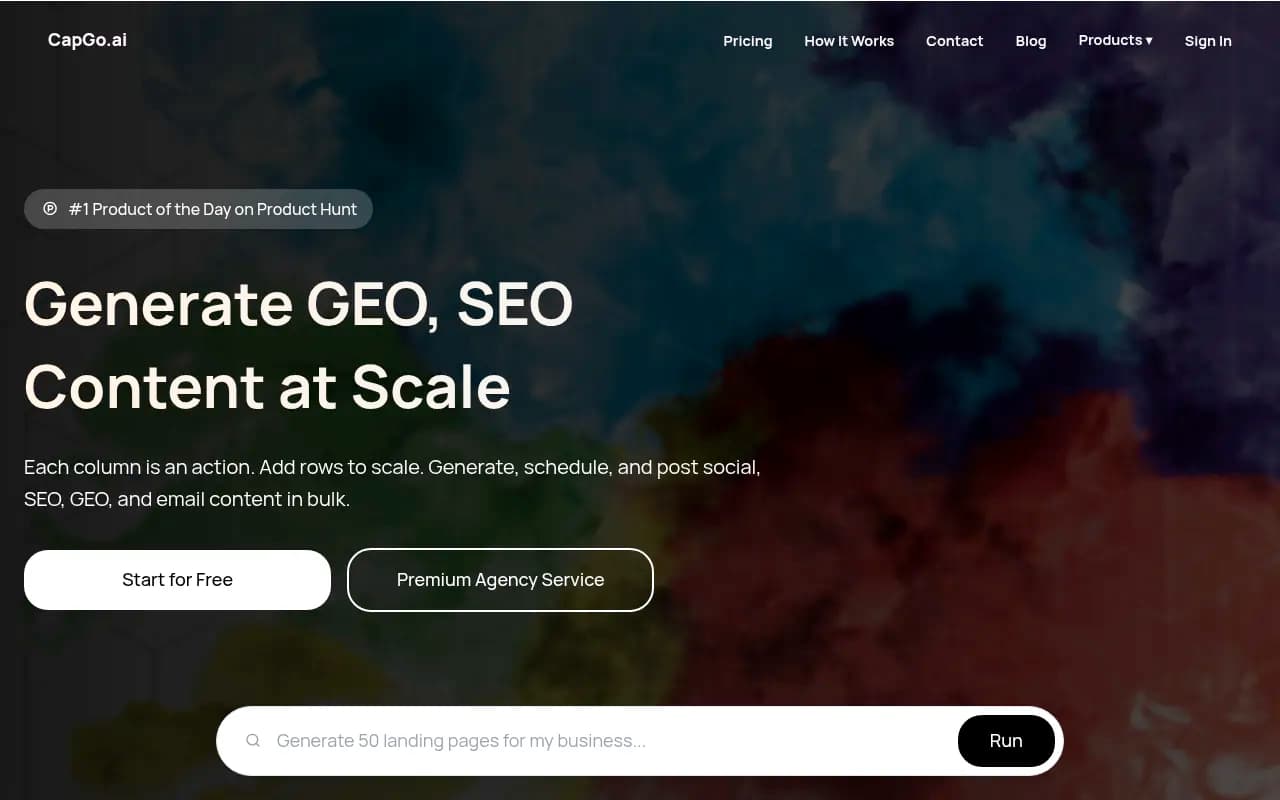
CapGo AI is a managed AI SEO and GEO service aimed at AI and SaaS companies. It's built around two products: CapGo Table (a spreadsheet-style tool that generates thousands of SEO and GEO pages from your data) and LayerArc (which turns user-generated AI content -- images, videos, creations -- into indexed pages). The pitch is volume: more pages, broader keyword coverage, more surface area for AI models to cite. Backed by Antler and Iterative, and the team has spoken at Ahrefs Evolve. It claims 10x organic traffic in months and 30%+ of pages cited by AI.
Side-by-side comparison
| Feature | Promptwatch | CapGo AI |
|---|---|---|
| Primary function | AI visibility monitoring + optimization | Programmatic content production |
| Free tier | Free trial (50 prompts) | Yes (free tier available) |
| Starting price | $99/mo (Essential) | ~$18/mo |
| AI models monitored | 10 (ChatGPT, Perplexity, Gemini, Claude, Grok, etc.) | None -- no monitoring |
| Prompt tracking | Yes -- real user interface tracking | No |
| Citation analytics | Yes -- page-level, domain-level, offsite | No |
| AI crawler logs | Yes -- real-time logs per AI agent | No |
| Content generation | Yes -- AI content agents (articles, briefs, comparisons) | Yes -- bulk programmatic pages |
| Programmatic SEO | No | Yes -- core product (CapGo Table) |
| UGC SEO | No | Yes -- LayerArc product |
| Competitor visibility heatmaps | Yes | No |
| Answer gap analysis | Yes | No |
| Traffic attribution | Yes -- connects visibility to revenue | No |
| Reddit/YouTube tracking | Yes | No |
| ChatGPT Shopping tracking | Yes | No |
| CMS publishing integrations | No | Yes -- Webflow, Framer, Shopify, WordPress |
| Target audience | Marketing/SEO teams, agencies | AI/SaaS companies, agencies |
| Agency tier | Yes -- custom pricing | Yes -- custom pricing |
| G2 rating | 4.7/5 | Not listed |
Head-to-head feature deep-dive
AI visibility monitoring
This is where the comparison is most lopsided. Promptwatch was built from the ground up to answer one question: "How visible is my brand in AI search, and why?" It tracks real user-interface responses (not just API outputs, which can differ), logs every AI crawler visit to your site, and shows you prompt-level data including volume estimates, difficulty scores, and query fan-outs.
CapGo AI does not monitor AI visibility. It has no dashboard showing where your brand appears in ChatGPT or Perplexity. Its GEO claim is on the production side -- it creates content that is structured to be cited -- but it cannot tell you whether that content is actually being cited, or by which models.
Verdict: Promptwatch wins, and it's not close. CapGo AI doesn't play in this space.
Content generation
Both tools generate content, but the approach is completely different.
Promptwatch's content agents generate individual articles, listicles, comparisons, and briefs. Each piece is grounded in real prompt gap data -- the specific questions AI models are already answering for competitors but not for you. You get brand guidance, search results, news context, screenshots, and competitor analysis baked into each brief. The Essential plan includes 5 articles/mo; Business goes up to 30/mo.
CapGo AI's CapGo Table generates content at a completely different scale. One template, thousands of pages. You define the structure once, connect your data (or pull from 10+ external databases), and it publishes to your CMS. This is proper programmatic SEO -- the kind that category leaders use to cover every long-tail variation of a keyword. LayerArc does something similar for UGC: it takes AI-generated images and videos and turns them into indexed pages automatically.
| Dimension | Promptwatch | CapGo AI |
|---|---|---|
| Content volume | 5-30 articles/mo (plan-dependent) | Thousands of pages |
| Grounded in prompt data | Yes | No |
| Programmatic templates | No | Yes |
| CMS publishing | No | Yes (Webflow, Framer, Shopify, WP) |
| UGC page generation | No | Yes (LayerArc) |
| Content briefs | Yes -- detailed with brand guidance | Template-based |
Verdict: Depends entirely on what you need. For targeted, prompt-informed content, Promptwatch. For bulk programmatic coverage, CapGo AI.
Pricing
CapGo AI is the more accessible option on price, especially for smaller teams or early-stage companies. Promptwatch's pricing reflects its monitoring infrastructure -- you're paying for real-time data across 10 AI models, not just a content tool.
| Plan | Promptwatch | CapGo AI |
|---|---|---|
| Free | Trial (50 prompts) | Yes -- free tier |
| Entry paid | $99/mo (Essential: 1 site, 50 prompts, 5 articles) | ~$18/mo |
| Mid-tier | $249/mo (Professional: 2 sites, 150 prompts, 15 articles, crawler logs) | Not publicly listed |
| Top tier | $579/mo (Business: 5 sites, 350 prompts, 30 articles) | Not publicly listed |
| Agency/Enterprise | Custom | Custom |
| Annual discount | Yes | Not confirmed |
Verdict: CapGo AI is cheaper to start. Promptwatch costs more but covers monitoring, analytics, and optimization that CapGo AI simply doesn't offer.
Integrations and publishing
CapGo AI has a clear advantage here. It publishes directly to Webflow, Framer, Shopify, WordPress, and more -- which matters a lot when you're generating thousands of pages. It also pulls live data from 10+ external databases into its spreadsheet interface.
Promptwatch integrates with Cloudflare, Fastly, Vercel, Google Search Console, and server logs for crawler tracking and traffic attribution. It also has a Looker Studio integration and an API. But it doesn't publish content to your CMS -- you export briefs and articles, then publish them yourself.
Verdict: CapGo AI wins on CMS publishing. Promptwatch wins on analytics integrations.
Competitor analysis
Promptwatch has a proper competitor intelligence layer: visibility heatmaps that show how your brand compares to competitors across every AI model and prompt, answer gap analysis that surfaces the specific prompts where competitors appear but you don't, and offsite citation tracking that shows which Reddit threads, YouTube videos, and third-party pages are driving competitor visibility.
CapGo AI doesn't offer competitor monitoring. Its comparison pages (generated programmatically) can target competitor-adjacent keywords, but that's a content strategy, not competitive intelligence.
Verdict: Promptwatch wins clearly.
Ease of use
CapGo AI's spreadsheet metaphor (CapGo Table) is genuinely clever -- most people understand how a spreadsheet works, so the learning curve for generating pages is low. The managed service model also means you're not doing everything yourself.
Promptwatch has invested in onboarding -- reviews consistently mention that setup is smooth and the UI is approachable. The platform is more complex by nature (you're looking at multi-model dashboards, crawler logs, citation timelines), but it's designed to surface the most important insights without requiring you to dig through raw data.
Verdict: CapGo AI is simpler to start. Promptwatch has more to learn but also more to gain.
Pros and cons
Promptwatch
Pros:
- The only platform that combines monitoring, gap analysis, content generation, and traffic attribution in one loop
- Real user-interface tracking (not just API) across 10 AI models
- AI crawler logs show exactly which pages AI agents are reading and when
- Competitor heatmaps and answer gap analysis are genuinely actionable
- Reddit and YouTube tracking, ChatGPT Shopping monitoring -- channels most tools ignore
- 4.7/5 on G2 with a strong agency and enterprise customer base
Cons:
- Starts at $99/mo -- not cheap for small teams or solo founders
- Content output volume is limited (5-30 articles/mo depending on plan)
- No CMS publishing -- you still need to handle the publishing workflow yourself
- Not designed for programmatic SEO at scale
CapGo AI
Pros:
- Free tier available; paid plans start around $18/mo
- Programmatic SEO at genuine scale -- thousands of pages from one template
- LayerArc is a smart solution for AI/SaaS products with large UGC libraries
- Direct CMS publishing to Webflow, Framer, Shopify, WordPress
- Managed service model means less internal resource required
- Strong positioning for AI and SaaS companies specifically
Cons:
- No AI visibility monitoring whatsoever -- you can't see if your content is being cited
- No competitor intelligence or prompt tracking
- No traffic attribution connecting content to revenue
- Pricing beyond the free tier is not fully transparent
- Content quality at scale can vary -- programmatic pages need careful QA
Who should pick which tool
Pick Promptwatch if:
- You need to know where your brand stands in ChatGPT, Perplexity, Gemini, and other AI engines right now
- You want to track how competitors are winning AI citations and close those gaps
- Your team needs to report on AI visibility to stakeholders with real data
- You're running an agency and need client-facing dashboards and multi-site management
- You want content recommendations grounded in actual prompt data, not just keyword guesses
Pick CapGo AI if:
- You're an AI or SaaS company with large amounts of first-party data sitting unused
- You need to generate thousands of SEO pages fast and publish them directly to your CMS
- You have UGC (AI images, videos, user creations) that isn't driving any traffic yet
- Budget is tight and you need to start somewhere affordable
- You want a managed service rather than a self-serve analytics platform
Use both if:
- You want to build content at scale (CapGo AI) and then track whether that content is actually getting cited by AI models (Promptwatch). This is the most complete GEO strategy -- produce at volume, measure what's working, iterate.
If you're serious about understanding and improving your AI search visibility beyond just content production, Promptwatch is worth a close look -- particularly for the crawler logs and answer gap analysis, which most content-focused tools don't touch.
Final verdict
These two tools solve different problems, and the honest answer is that they're not really competing. Promptwatch is the right choice if visibility tracking, competitive intelligence, and closing prompt gaps are your priority -- it's the more complete platform for understanding and improving how AI models talk about your brand. CapGo AI is the right choice if you need to publish content at scale and your biggest constraint is page volume, not insight depth. If you can only pick one and your goal is to actually know what's happening in AI search, Promptwatch is the clearer call.