Key takeaways
- B2B SaaS buyers increasingly use ChatGPT, Perplexity, and Claude to evaluate vendors before any human interaction -- if you're not cited in those answers, you're not on the shortlist.
- Most GEO platforms only monitor where you appear (or don't). The ones worth paying for also help you understand why and fix it.
- Promptwatch is the only platform in this comparison rated as a leader across monitoring, content generation, and traffic attribution -- making it the strongest fit for SaaS teams that want to close the loop between AI visibility and pipeline.
- For enterprise teams with existing Semrush contracts, Semrush's AI features are a reasonable starting point. For teams that need depth without enterprise pricing, Promptwatch or Profound are the better bets.
- Monitoring-only tools (Peec AI, Otterly.AI, AthenaHQ) are fine for early-stage awareness but will leave you stuck once you need to act on the data.
Here's the uncomfortable truth about B2B SaaS buying in 2026: a significant portion of your pipeline is being shaped before a prospect ever visits your website. Buyers are asking ChatGPT "what's the best project management tool for engineering teams" or Perplexity "Salesforce alternatives for mid-market companies" -- and the vendors that appear in those answers are getting shortlisted. The ones that don't are invisible, regardless of how good their Google rankings are.
That's the core problem GEO (Generative Engine Optimization) platforms are trying to solve. But the category is still young, and the quality gap between tools is enormous. Some platforms are genuinely useful. Others are dashboards that show you a visibility score, charge you $500/month, and leave you with no idea what to do next.
This guide focuses specifically on B2B SaaS use cases -- buyer research queries, competitive comparison prompts, integration questions, and category-level discovery. Those are the moments that matter most for pipeline, and not every GEO tool handles them equally well.
What makes a GEO platform actually useful for B2B SaaS
Before the tool breakdown, it's worth being clear about what "useful" means in this context.
B2B SaaS buyers ask AI engines a specific type of question. They're not just searching for brand names -- they're asking things like "what CRM integrates with HubSpot and Salesforce," "best data enrichment tools for outbound teams," or "how does [your product] compare to [competitor]." These are high-intent, bottom-of-funnel queries that happen before a demo request.
A useful GEO platform for B2B SaaS needs to:
- Track visibility across the AI engines your buyers actually use (ChatGPT, Perplexity, Claude, Gemini at minimum)
- Surface the specific prompts where competitors appear but you don't
- Help you understand what content would close those gaps
- Show you which pages on your site are being cited (and which aren't)
- Connect AI visibility to actual traffic and pipeline, not just a visibility score
Most platforms in this space handle the first point reasonably well. The second and third are where things fall apart. And the fourth and fifth are where almost everyone fails.
The 7 best GEO platforms for B2B SaaS in 2026
1. Promptwatch
Promptwatch is the most complete GEO platform available for B2B SaaS teams in 2026. It's the only tool in this comparison that covers the full loop: finding gaps, generating content to fill them, and tracking whether that content actually gets cited.

The feature that matters most for SaaS teams is Answer Gap Analysis. It shows you the specific prompts where competitors are being cited but you're not -- not just a list of keywords, but the actual questions buyers are asking AI engines, with volume estimates and difficulty scores. That's actionable in a way that a visibility score isn't.
From there, Promptwatch's built-in AI writing agent generates content grounded in citation data from over 880 million analyzed citations. The output isn't generic SEO filler -- it's structured to match what AI models actually pull from when generating answers. For B2B SaaS, that means comparison articles, integration guides, and use-case content that gets cited in the exact buyer research queries you care about.
The tracking side is equally strong. Page-level citation tracking shows which specific pages are being cited by which AI models, and traffic attribution (via a code snippet, GSC integration, or server log analysis) connects AI visibility to actual sessions and conversions. That's the kind of data a SaaS CMO can bring to a board meeting.
Other capabilities worth noting: AI crawler logs (see which pages ChatGPT, Claude, and Perplexity are actually reading on your site), Reddit and YouTube citation tracking (both heavily influence AI recommendations), and ChatGPT Shopping tracking for SaaS products that appear in product recommendation carousels.
Pricing starts at $99/month (Essential: 1 site, 50 prompts, 5 articles), $249/month (Professional: 2 sites, 150 prompts, 15 articles, crawler logs), and $579/month (Business: 5 sites, 350 prompts, 30 articles). A free trial is available.
The honest caveat: Promptwatch is a Dutch company (Promptwatch B.V.) and the platform is newer than some enterprise alternatives. Teams that need deep integrations with existing enterprise data stacks may need to evaluate the API and Looker Studio integration carefully.
2. Profound
Profound is the other serious contender for B2B SaaS teams with real budget. It covers 9+ AI engines, has strong prompt tracking, and is generally considered the most data-rich monitoring platform in the category.
Profound

Where Profound shines is depth of monitoring data. The platform surfaces citation sources, tracks share-of-voice across AI engines, and gives you a clear picture of how your brand is positioned relative to competitors in AI-generated answers. For enterprise SaaS teams doing competitive intelligence, it's genuinely impressive.
The limitation is that Profound is primarily a monitoring platform. It shows you where you're visible and where you're not, but the path from "I'm not being cited for this query" to "here's what I should publish" isn't built into the product. You'll need a separate content workflow to act on the data. Pricing is custom (enterprise-tier), which makes it harder to recommend for growth-stage SaaS companies watching budget.
3. AthenaHQ
AthenaHQ positions itself as an AI search optimization platform with a clean interface and solid prompt tracking. It's a reasonable choice for SaaS teams that are just getting started with GEO and want something approachable.

The platform tracks brand mentions across ChatGPT, Perplexity, Claude, and Gemini, and provides competitive benchmarking that's easy to read and share with stakeholders. The UI is genuinely good -- better than most competitors at this price point.
The gap is content optimization. AthenaHQ tells you where you're invisible but doesn't help you fix it. There's no content generation, no citation-grounded writing tools, and no traffic attribution. For a B2B SaaS team that wants to move from monitoring to optimization, you'll hit a ceiling quickly.
4. Semrush (AI features)
Semrush has been adding AI search tracking capabilities to its platform, and for teams already paying for Semrush, it's worth understanding what's actually there.
The AI visibility features in Semrush are real but limited. The platform tracks brand mentions in AI Overviews and some LLM responses, and the reporting is polished enough for executive presentations. The main issue for B2B SaaS teams is that Semrush uses a fixed prompt set -- you can't customize the queries to match your specific ICP's research behavior. A SaaS company selling to DevOps teams has very different buyer prompts than one selling to HR leaders, and Semrush doesn't let you differentiate.
There's also no AI traffic attribution, no crawler logs, and no content generation grounded in citation data. It's a useful addition to an existing Semrush subscription, not a standalone GEO solution.
5. Otterly.AI
Otterly.AI is a monitoring-focused platform that tracks brand mentions across ChatGPT, Perplexity, and Google AI Overviews. It's one of the more affordable options in the category and has a clean, straightforward interface.
Otterly.AI

For B2B SaaS teams at an early stage of GEO -- teams that just want to understand whether they're appearing in AI answers at all -- Otterly.AI is a reasonable starting point. The setup is fast, the data is easy to interpret, and the price is accessible.
The honest assessment: Otterly.AI is monitoring-only. No content gap analysis, no writing tools, no crawler logs, no traffic attribution. It's useful for awareness but not for optimization. If you're serious about improving your AI visibility, you'll outgrow it quickly.
6. Peec AI
Peec AI tracks brand visibility across ChatGPT, Perplexity, and Claude with a focus on share-of-voice metrics. It's a solid monitoring tool with a clean competitive benchmarking view.

The platform is particularly good at showing how your brand compares to competitors across different AI engines -- useful for competitive intelligence and for making the case internally that GEO matters. The prompt customization is decent, which is important for B2B SaaS teams with niche buyer personas.
Like Otterly.AI, Peec AI stops at monitoring. There's no content generation, no citation analysis at the page level, and no traffic attribution. It's a useful data source but not an optimization platform.
7. Scrunch AI
Scrunch AI is worth including because it takes a slightly different approach -- it focuses on helping you understand how AI models perceive your brand's authority and topical coverage, not just whether you appear in specific prompts.
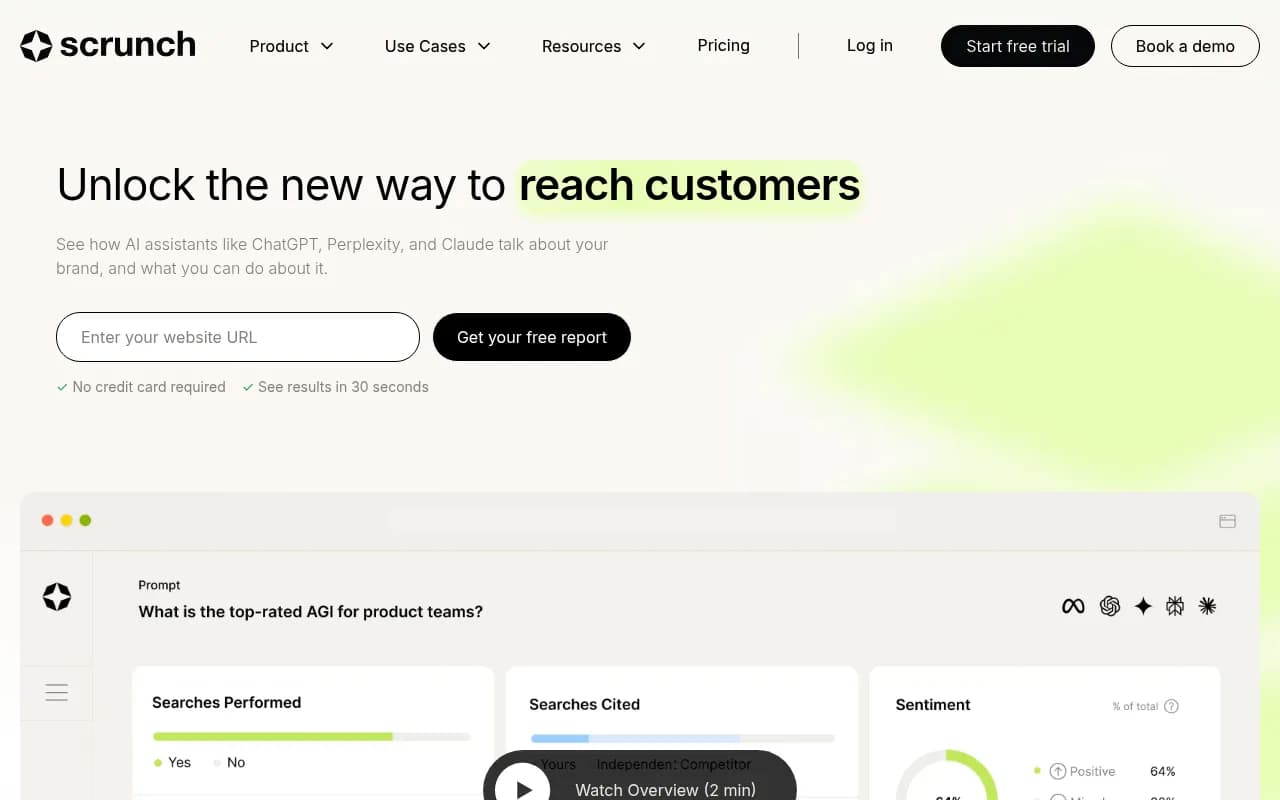
For B2B SaaS companies that have done some GEO work already and want to understand the structural reasons they're not being cited (topical gaps, authority signals, content depth), Scrunch AI offers a useful diagnostic lens. The platform surfaces which topics your site is seen as authoritative on and where the gaps are relative to competitors.
The limitation is that it's still primarily analytical. The path from insight to published content requires external tools. And the prompt-level tracking is less granular than Promptwatch or Profound.
Head-to-head comparison
| Platform | Prompt customization | Content gap analysis | AI content generation | Page-level citation tracking | Traffic attribution | AI crawler logs | Pricing |
|---|---|---|---|---|---|---|---|
| Promptwatch | Yes | Yes (Answer Gap Analysis) | Yes (citation-grounded) | Yes | Yes | Yes | From $99/mo |
| Profound | Yes | Partial | No | Partial | No | No | Custom (enterprise) |
| AthenaHQ | Yes | Partial | No | No | No | No | Custom |
| Semrush AI | Limited (fixed prompts) | No | No | No | No | No | Add-on to existing plan |
| Otterly.AI | Yes | No | No | No | No | No | From ~$49/mo |
| Peec AI | Yes | No | No | No | No | No | From ~$79/mo |
| Scrunch AI | Partial | Partial | No | No | No | No | Custom |
The pattern is clear. Most platforms cover monitoring reasonably well. The gap opens up the moment you need to act on the data.
How B2B SaaS buyer queries actually work in AI engines
It's worth spending a moment on the mechanics, because it changes how you think about GEO strategy.
When a buyer asks ChatGPT "what's the best CRM for a 50-person B2B SaaS company," the model isn't doing a live web search (in most cases). It's drawing on its training data plus, in some configurations, retrieval from indexed web content. The brands that appear in the answer are there because:
- They've been written about extensively in sources the model trusts (G2, Capterra, review sites, industry publications)
- They have content on their own site that directly answers the question the buyer is asking
- They're cited in Reddit threads, YouTube reviews, and comparison articles that the model has ingested
This is why "publish more blog posts" doesn't work as a GEO strategy. The content needs to be structured around the specific questions buyers ask, in formats that AI models can extract and cite. That's a different skill than traditional SEO content.
Tools like Promptwatch help because they show you the exact prompts buyers are using (with volume estimates), the sources currently being cited in those answers, and what content your site is missing. That's the research foundation for a GEO content strategy that actually moves the needle.
What to look for when evaluating a GEO platform for B2B SaaS
A few specific questions worth asking before you sign a contract:
Can you customize prompts to match your ICP's actual research behavior? Fixed prompt sets are a significant limitation for B2B SaaS. Your buyers ask different questions than a DTC brand's customers. You need to be able to input the specific queries your target personas use.
Does it track the AI engines your buyers actually use? ChatGPT and Perplexity are the most common starting points for B2B research. Claude is growing fast. Google AI Overviews matters for branded queries. Make sure the platform covers the engines relevant to your audience.
What happens after you find a gap? This is the question most platforms can't answer well. If the tool shows you that a competitor is being cited for "best data enrichment tool for outbound sales" and you're not -- what do you do next? The best platforms give you a clear path to creating content that closes that gap.
Can you connect AI visibility to pipeline? A visibility score is interesting. Revenue attribution is what gets budget approved. Look for platforms that offer traffic attribution through GSC integration, server log analysis, or a tracking snippet.
Does it show you what AI crawlers are actually doing on your site? If ChatGPT's crawler is hitting your homepage but ignoring your comparison pages, that's important to know. Most platforms don't surface this data at all.
The bottom line
GEO is no longer optional for B2B SaaS companies that care about pipeline. Buyers are using AI engines to research vendors, compare alternatives, and validate decisions -- often before your sales team knows they exist.
The tools in this guide range from basic monitoring (Otterly.AI, Peec AI) to full optimization platforms (Promptwatch, Profound). For most B2B SaaS marketing teams, the monitoring-only tools will feel useful for about 30 days and then frustrating. You'll see the gaps but have no structured way to close them.
If you're serious about GEO as a growth channel -- not just a reporting metric -- start with a platform that covers the full loop. Promptwatch is the strongest option for teams that want to find gaps, create content that gets cited, and track the results back to revenue. Profound is worth evaluating if you're at enterprise scale and need maximum data depth. Everything else is a stepping stone.
The buyers are already in AI engines. The question is whether your brand shows up when they get there.