
Key takeaways
- No published study splits AI visibility benchmarks by company size. Anyone handing you a clean "SMB vs enterprise" table is framing, not measuring. This guide says which parts are data and which are framing.
- Company size is a weak predictor. Monroya's 158-company B2B benchmark found no reliable link between size, age, or funding and visibility. Promptwatch's domain rank data points the same way: DR 1-30 sites still earn 11-12% of citations.
- Visibility is concentrated by industry, not size. In Sentic's 55-brand study, the top two brands hold 40% to 85% of share of voice depending on the vertical.
- MaxAEO reports a median mention rate of roughly 31% on non-branded prompts, but the number swings by industry and engine. Benchmark against your vertical, over at least a week of daily runs.
- Set targets by tier: first get crawled and mentioned, then get cited, then win share against named competitors.
The honest starting point: size is not the variable
I went looking for benchmarks split by company size and did not find any with real data behind them. What exists splits by industry, by engine, or by individual brand. So the tiers later in this guide (small, mid-market, enterprise) are a planning frame I built from the industry and citation data. They are not measured thresholds. Treat them accordingly.
The data that does exist suggests size matters less than people assume.
Monroya's 2026 benchmark scanned 158 B2B companies across 12 categories. The average score was 50.9 out of 100, the top company scored 84 and the lowest scored 22. Its main finding: company size, age, funding, and brand recognition do not reliably predict AI search visibility. Inside single categories the spreads were big. Among B2B SaaS marketing agencies, one scored 70 and another 38. Among AI visibility platforms the gap was 48 points.
Promptwatch's own citation data lines up. In Promptwatch Data's domain rank report (Nov 3-16, 2026), the median cited domain was DR 57 in ChatGPT and Perplexity and DR 56 in AI Overviews and AI Mode. Domains at DR 31-75 earned about 61% of ChatGPT citations. Sites at DR 1-30 earned 10.9% to 12.2% of citations in every engine. A small site is not shut out.
One caveat. A huge brand does have advantages that the DR data hides: it gets named in third-party listicles, forums and reviews without trying. But a large brand can still be badly positioned, and a small one can win a narrow category.
What the existing benchmarks actually say
Three third-party studies are worth knowing. They use different methods, so do not compare their numbers with each other or with Promptwatch's.
| Source | What it measures | Sample | Headline number |
|---|---|---|---|
| MaxAEO (July 2026) | Mention rate on non-branded prompts | Hundreds of brands, 8 engines, rolling 90 days | Median about 31% |
| Sentic (Oct 2026 data) | Share of voice and citations | 55 US brands, 5 engines, 5 industries | Top two brands hold 40-85% of share of voice |
| Monroya (2026) | Score out of 100 | 158 B2B companies, 12 categories | Average 50.9 |
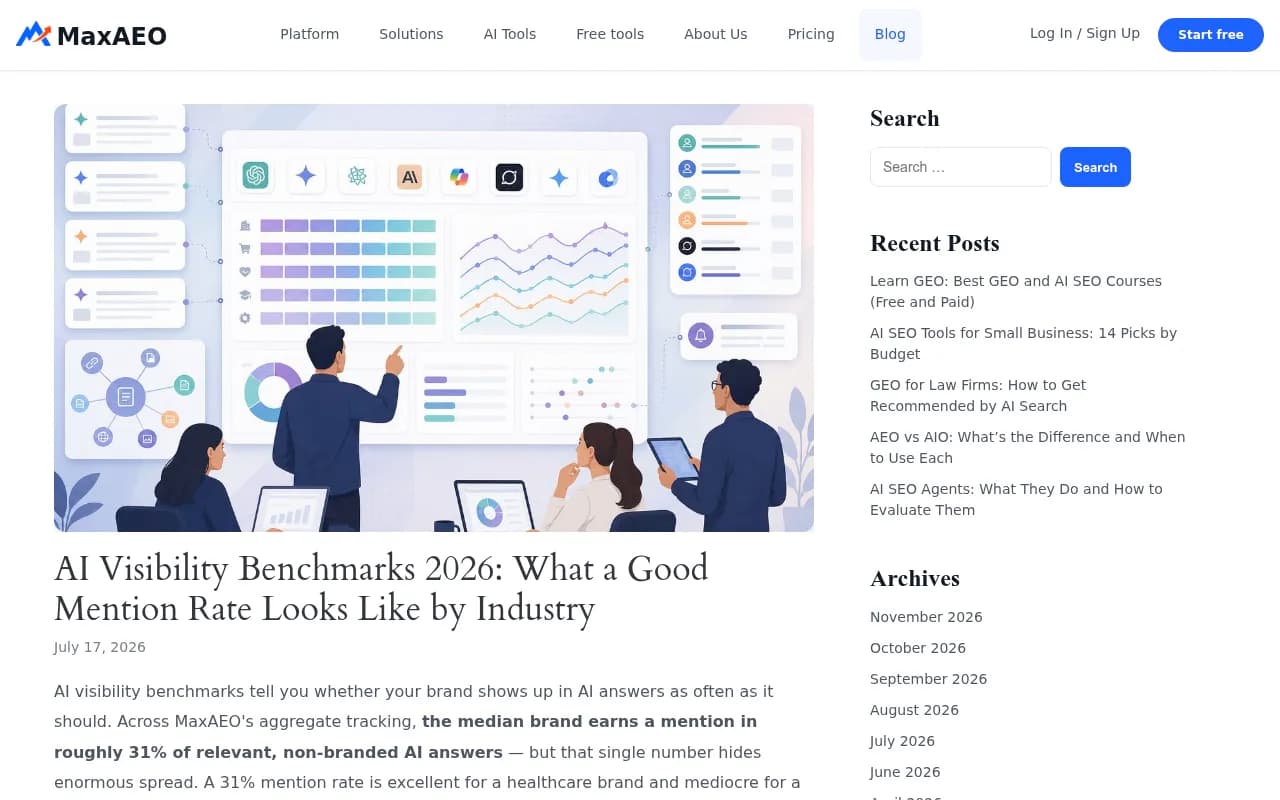
Mention rate by industry
MaxAEO's point is the useful one: a 31% mention rate is excellent for a healthcare brand and mediocre for a publisher. Regulated verticals like finance and healthcare carry a structural ceiling, because AI engines hedge on money and health. Even strong brands there see lower raw numbers. Professional services show the biggest gap between median and leader, since most firms publish case studies but skip structured data and earned mentions.
Concentration by industry
Sentic's table is the clearest picture of how lopsided this gets.
| Industry | Leader (share of voice) | Top two | Top three | Bottom five combined |
|---|---|---|---|---|
| Hospitality | Marriott (28.1%) | 49.9% | 60.4% | 16.3% |
| Healthcare | Cleveland Clinic (46.8%) | 85.3% | 92.2% | 1.7% |
| B2B SaaS | Salesforce (26.6%) | 40.2% | 53.3% | 17.6% |
| Ecommerce | Etsy (65.9%) | 76.6% | 86.4% | 2.7% |
Sentic also found that being named and being cited are different races. Slack had 13.2% of brand mentions in its B2B SaaS set but only 3.7% of citations, while monday.com had 0.4% of mentions and 5.5% of citations. In senior living, nine operators got 75.5% of mentions but only 24.9% of citations, because directories like A Place for Mom took the links.
The lesson for any company size: your benchmark is your vertical's concentration. If two brands own 85% of the conversation, a 5% share is a real result. In a more open market, 5% is weak.
Why single-prompt numbers mislead
AI answers are crowded. Promptwatch Data on unique domains per ChatGPT response (Sep 28 to Oct 4, 2026) found that 47.6% of cited responses cite 10 or more domains, and only 6% cite three or fewer. For organic prompts it was 52.5% citing 10+. Brand-specific prompts are tighter: 21.3% cite 10+, and the most common count is five.
Two consequences. You will share almost every answer with many other sites, so expect fractional citation share. And one prompt tells you almost nothing, so measure across a panel of prompts.
Citation share per domain is tiny too. In Promptwatch's November 2026 ChatGPT citation share report, the most cited popular site, Reddit, held 0.23% of ChatGPT citations. G2 and LinkedIn followed at 0.18% each, and the 20 listed sites together earned under 2%. Everything else is spread across hundreds of thousands of domains. A realistic share-of-citation target for a single brand is a fraction of a percent, not double digits.
MaxAEO's advice on noise also holds: never benchmark off one day. A 22% reading on Tuesday and 37% on Friday can be the same brand. Average at least a week of daily runs.
Targets by company tier (a planning frame)
Here is the framing, labeled as such. The tiers describe typical starting conditions, not measured bands. The numbers I quote come from the studies above; the rest is judgment.
| Tier | Typical starting position | First target | Second target | What to benchmark against |
|---|---|---|---|---|
| Small or early-stage | Little third-party coverage, thin content library | Pages crawlable; mentioned on a core set of category prompts | Appear on third-party listicles and review sites | Two or three direct competitors |
| Mid-market | Some mentions, uneven across engines | Match the median for your vertical (MaxAEO's cross-industry median is about 31% non-branded) | Win citations for your own pages, not just mentions | Your vertical's top quartile on your buyers' main engine |
| Enterprise | Strong brand, but fragmented content and many markets | Accurate narrative across engines and countries | Close the mention-to-citation gap | Category leader share of voice, by engine and country |
Small and early-stage brands
You will not out-mention Salesforce, and you do not have to. The DR data says low-authority sites still get 11-12% of citations. Promptwatch's own advice from that report: do not wait for a high DR before investing, and do not write off new or small sites.
Practical order of work:
- Confirm AI crawlers can fetch your pages. MaxAEO calls silent crawl failure a surprisingly common problem among weaker brands.
- Pick 20 to 50 prompts your buyers really ask, including comparisons.
- Get onto the third-party pages AI already cites for those prompts: listicles, reviews, forums.
- Aim guest content and PR at DR 61-90 sites if ChatGPT and Perplexity matter to you, since that band earns 41.2% and 40.1% of their citations.
Mid-market brands
This is where the benchmarks bite. You probably have some visibility and a few competitors who clearly have more. Compare your non-branded mention rate to your vertical, not the blended 31%, and check which engine your buyers use. Sentic found the leader changes by engine: in hospitality, Marriott led in Google AI Overviews, Hilton in AI Mode, and Best Western in Gemini.
Then separate mentions from citations. If AI names you but links to a directory or competitor, you have a content or crawlability problem, not a reputation one.
Enterprise brands
Big brands tend to have the share-of-voice lead and a different problem: accuracy and consistency. Claims about pricing, features or support can be wrong or outdated in some engines and countries. Benchmarks for you are per engine, per market, and per topic, plus the narrative AI tells. Regulated industries should only compare against their own vertical.
How to measure without fooling yourself
- Use non-branded prompts for the headline number. Branded prompts inflate everything.
- Report mention rate and citation rate separately.
- Average daily runs over at least a week, and compare periods of the same length.
- Track by engine. ChatGPT, AI Overviews, and Perplexity cite very different mixes. In Promptwatch's DR data, DR 100 sites earn 13.7% of AI Overviews citations but 0.3% of ChatGPT's, mostly because of social platforms like YouTube.
- Fix your baseline first, then judge movement against competitors, since AI answers drift.
Most teams are not doing this yet. A Scribewise survey found 45% are testing visibility across AI platforms, but just 33% analyze AI bot traffic.
Tools for tracking these numbers
The measurement job needs three things: a stable prompt panel across engines, citation data, and a view of whether AI crawlers can read your site. Promptwatch covers all three in one product: it tracks prompts in the real interfaces of ChatGPT, Gemini, Perplexity, Google AI Overviews and others, shows Visibility Score and Share of Voice against competitors, and logs AI crawler visits so you can tell an access problem from a content problem. Its Content Agent then writes the pages for the gaps and checks whether they get cited.

If you want to compare options, these tools also track AI visibility, mostly with a monitoring focus:
| Tool | Focus | Best for |
|---|---|---|
| Promptwatch | Tracking, crawler logs, content generation, traffic attribution | Teams that want to fix gaps, not just see them |
| Profound | Enterprise monitoring | Large brands with bigger budgets |
| Peec AI | Prompt tracking | Marketing teams wanting a lighter dashboard |
| Otterly.AI | Brand mention monitoring | Small teams starting out |
| Semrush | AI tracking inside an SEO suite | Teams already on Semrush |
Profound


Otterly.AI

For a wider list, the GEO software directory at bestgeosoftware.com is a good next stop. Promptwatch also publishes a free AI visibility report that gives a quick baseline with no login, and a 7-day free trial on paid plans if you want the full workflow.
A simple 90-day plan by tier
Days 1 to 30: baseline
Build a prompt panel of 30 to 100 non-branded prompts. Run it daily. Record mention rate, citation rate, position, and who beats you, by engine. Check crawler access and fix blockers first.
Days 31 to 60: close the cheap gaps
Publish or refresh pages for prompts where competitors are cited and you are not. Pursue third-party placements on listicles and review sites AI already cites. In Promptwatch's November data, review sites hold 5 of the top 10 spots by ChatGPT citation share, so a G2 or Capterra profile is not optional for software brands.
Days 61 to 90: compare and reset targets
Look at the weekly averages, not individual days. Compare against your vertical's top quartile. If your mention rate rose but citations did not, your own pages are the issue. If both rose on one engine and not another, that is an engine-specific play, such as YouTube for Google's surfaces.
And then reset. A benchmark you set in January is stale by April.
What good looks like, in one sentence
MaxAEO's definition is the most usable one: a good score clears your industry's top quartile on your buyers' main engine for non-branded prompts. Size does not change that definition. It only changes how long it takes to get there.
FAQ
What is a good AI visibility score in 2026?
There is no universal number. MaxAEO reports a median mention rate near 31% on non-branded prompts, but that varies widely by industry. Compare against your vertical's top quartile on the engine your buyers use.
Does company size affect AI visibility?
Not reliably. Monroya's 158-company benchmark found no dependable relationship between size, age, or funding and visibility, and Promptwatch's data shows DR 1-30 domains still earn 11-12% of citations. Brand strength within a category matters more.
Are there benchmarks for small businesses vs enterprise?
Not with measured data that I could find. Treat any tiered table, including the one in this guide, as a planning frame and validate it against your own prompt panel.
How many prompts do I need to track?
Enough that a single prompt cannot swing the result. Promptwatch's data shows nearly half of ChatGPT responses cite 10 or more domains, so individual answers vary a lot. A panel of at least a few dozen prompts, averaged over a week or more, is a reasonable floor.
Should I benchmark mentions or citations?
Both, separately. Sentic's data shows brands can win one and lose the other, and the fix is different for each.