
Key takeaways
- A visibility score is a model of reality, not a measurement of it. Two platforms can score the same brand 9% and 41% and both be internally consistent.
- There is no industry standard for AI visibility measurement yet, so the vendor has to disclose its method. If it won't, treat the number as decoration.
- The five things to check: where the data comes from, how the prompt set is built, whether scores are normalised per engine, how often prompts run, and how platform changes are handled.
- Engines change under you. ChatGPT, Copilot and AI Overviews all shift behaviour abruptly, and a score can move because the engine did, not because your brand did.
- Run a simple 30-day test on any vendor before you trust the number: repeat runs, a manual spot check, and a score-versus-traffic comparison.
Why the number deserves suspicion
A visibility score looks authoritative. It is a single figure, often 0 to 100 or a percentage, with a trend line and a competitor ranking attached. That packaging makes it easy to forget that someone chose the prompts, the engines, the sampling frequency and the maths.
I have seen the same brand look healthy in one dashboard and nearly invisible in another. Neither tool was lying. They just asked different questions of different engines, in different ways, and then compressed the answers into a number.
The SRP Design write-up on AI visibility audits says it plainly: no universal industry standard for AI visibility audits exists yet, so a credible audit should disclose its method. It also separates what can be automated from what needs live prompts and human review. That is a good starting frame. If there is no standard, the burden of proof sits with the vendor, and your job is to ask for it.
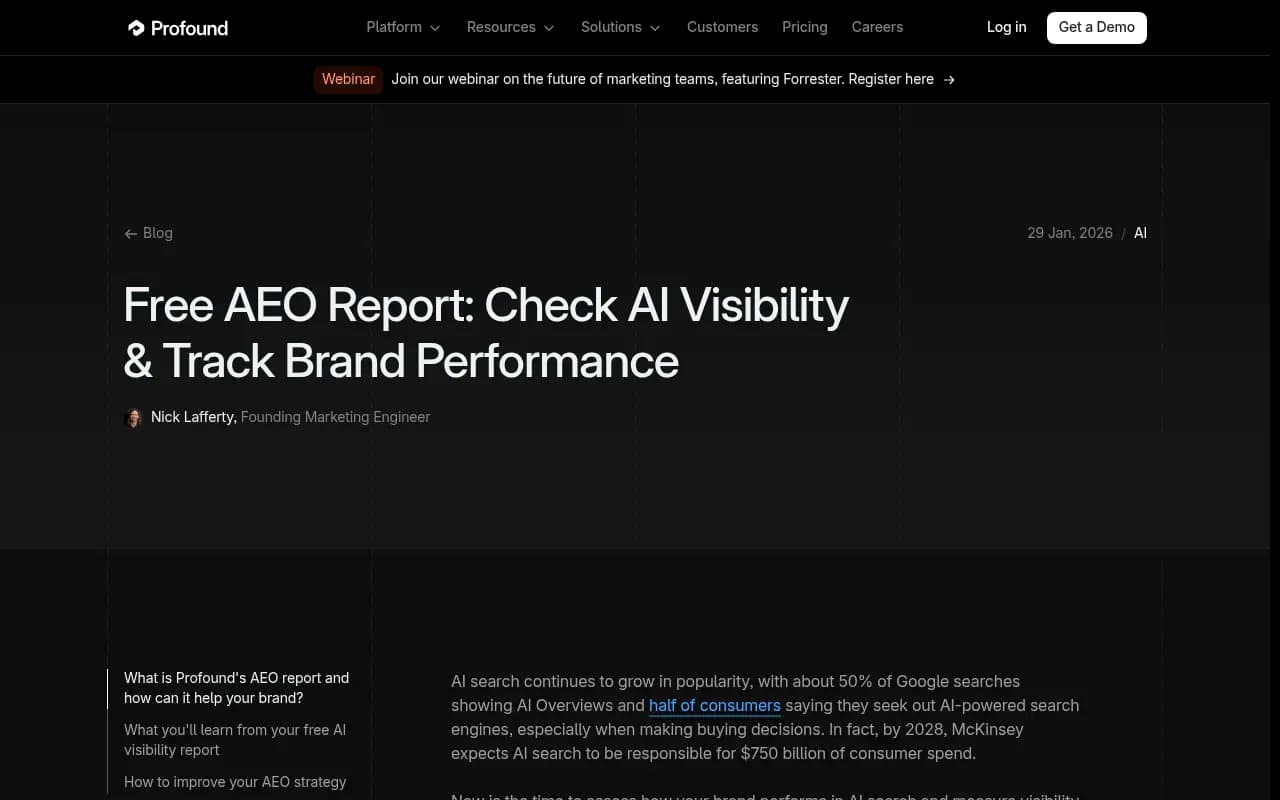
Take Profound's own definition as an example of a clear one. Its free report describes visibility score as the percentage of AI responses that mention your brand, computed relative to competitors, with an example brand ranked 16th at a 9.6% score against a leader above 30%. That is a readable definition. It still leaves open every question below: which prompts, which engines, how many runs, and what happens when an engine changes.
What a visibility score can and cannot tell you
Some scores are simple mention rates: out of N responses, how many named your brand. Others weight placement, depth of mention or sentiment. Promptwatch, for instance, scores each response on placement, share of attention and depth, averages them, and counts responses that don't mention the brand as zero. Share of Voice, Position and Sentiment are kept as separate metrics. Read together they point to different problems. Low share of voice is a coverage problem, a late position is a prominence problem, and weak sentiment is a reputation problem.
A single blended number hides that diagnosis. So the first question to ask any vendor is what is inside the score and whether you can see the components.
What no score can tell you is that AI will recommend you tomorrow. The SRP piece is blunt that an audit cannot guarantee any platform will mention, cite or recommend your business. A score describes a sample of past answers.
The audit checklist
1. Where does the data come from?
Ask whether responses are collected from the real consumer interfaces or from APIs. The answers can differ. Citations, shopping carousels, AI Overviews and personalisation behave differently in the user-facing product than through an API call. A tool that only hits APIs is measuring what the model says in a lab, not what your customer sees.
Also ask about location and language. A monitor that mixes markets will average away the differences you care about.
Promptwatch collects from the real interfaces of ChatGPT, Gemini, Perplexity, Claude and Google AI Overviews, and describes a dataset of 26B+ data points. Whatever vendor you evaluate, get the equivalent statement in writing.
2. Who chose the prompts?
This is the biggest lever and the least visible one. A prompt set full of branded queries will flatter you. A set built from generic category questions will punish a niche brand. Ask:
- How many prompts, and how were they chosen?
- What share are branded, informational, commercial, competitor comparisons?
- Can you see and edit the full list, or only the vendor's pre-built set?
- Do the prompts reflect your real buyers, including different personas?
If the vendor generated prompts with an LLM from your homepage, expect them to sound like marketing copy, not like how people actually ask. Prompt volume and difficulty data help here, because they show which prompts matter at all.
3. Is the score normalised per engine?
Engines do not give you the same number of citation slots. In Promptwatch's average sources per response data, ChatGPT cites about 5 sources per web-search answer, while Google AI Overviews and Perplexity cite about 10. Perplexity is almost exactly 10 every day. Copilot's average swung from under 2 to nearly 17 sources within a few weeks before settling low, which Promptwatch reads as a retrieval re-architecture and advises judging on monthly trends, not weekly snapshots.
The audit implication is straightforward. A blended score that isn't normalised per engine can move because an engine changed its behaviour, not because your brand did. Ask to see the score broken out by engine, and ask how the blend is weighted.
Perplexity's stability makes it a decent test bench. If your pickup changes there, it is more likely something you did than engine noise.
4. How often do prompts run, and how many times?
AI answers are non-deterministic. Ask the same prompt twice and you can get different brands. A score from one run per prompt per week is noisy, especially on a small prompt set. Ask:
- How often does each prompt run (daily, weekly, faster)?
- Is a prompt run once or several times per period?
- What sample size sits behind each data point on the chart?
- Does the tool show confidence ranges or just a line?
Most tools run daily at minimum. Some let you go to 12, 6 or 1-hour intervals, which steadies the number during a launch. Weekly scoring on a fixed prompt set is a legitimate approach, but then you need the prompt set to stay fixed, which brings us to the next point.
5. How are platform changes handled?
This is the question most vendors dodge. AI engines change in steps, and those steps break trend lines. A few documented examples from Promptwatch Data:
- ChatGPT's average fanouts per response were 2.15 in early December and about 1.84 by early March, then came back in April at exactly 1.0, with average query length falling from about 117 characters to about 53 (ChatGPT query fanouts).
- Average citations per ChatGPT response dropped across GPT-5.3, GPT-5.4 and GPT-5-Mini around the March 4, 2026 rollout (ChatGPT citation drop).
- ChatGPT started using the site: operator at scale on August 8, 2026, jumping from about 0.4% to about 17% of fanout queries overnight (site: operator report).
- reddit.com's share of ChatGPT citations fell from roughly 4% to 0.5% on August 14, 2026 (Reddit citations report).
If your score fell 15% that week, was it you? Probably not. A trustworthy platform annotates these events on the chart, keeps the model and sampling fixed where it can, and tells you when it cannot. Ask: "Show me how your dashboard looked around March 4." The answer is revealing.
Citations also decay. In Promptwatch's content half-life data, news loses half its cited pages within 36 days, while landing pages and docs last longest. A score can drop simply because your content type has a short shelf life.
6. What counts as a mention?
Brand names that are also common words wreck naive string matching. So do aliases, product names, misspellings and competitors who share a name fragment. Ask how mentions are detected, whether you can write rules for edge cases, and whether a mention in a negative context counts the same as a positive one. Some platforms let you write plain-language analysis instructions for exactly this. Sentiment should be scored separately from visibility, otherwise a brand being criticised looks like a brand winning.
7. Can you trace the score back to raw responses?
The single best trust signal is drill-down. Click the number, see the prompts, read the actual responses, see the citations and the snippets. If the platform only gives you the aggregate, you cannot audit it, full stop. Exports (CSV, API) matter for the same reason: you want to recompute the score yourself.
Questions to put to any vendor
| Area | Question | Red flag |
|---|---|---|
| Data source | Real UI or API? Which engines, countries, languages? | "Proprietary model queries" with no detail |
| Prompt set | Who chose it, can I edit it, what is the branded share? | Locked, auto-generated set |
| Scoring | What goes into the formula? Are components visible? | One opaque number |
| Normalisation | Is the score per engine? How is the blend weighted? | Only a blended score |
| Sampling | Runs per prompt, frequency, sample size? | One run, weekly, no ranges |
| Change handling | Are platform changes annotated? | No answer, or "our model adapts" |
| Mention logic | How are brand aliases and ambiguous names handled? | No rules, no override |
| Traceability | Can I see raw responses and export them? | Aggregate only |
| Outcome link | Can I compare the score with crawler or traffic data? | Score stands alone |
Cross-checking the score against things that are not the score
A visibility score is a proxy. The real question is whether AI is reading your pages, citing them and sending people. Three cross-checks help.
Crawler logs
If AI bots never fetch a page, it won't get cited, and a score that says otherwise deserves scrutiny. IP-verified crawler logs separate an access problem from a content problem. Promptwatch's crawler log feature does this, and plenty of CDN-level log tools can too. For context on what bots are doing in aggregate, see Promptwatch's AI crawler traffic data.
AI referral traffic
See whether the score's direction matches sessions and conversions from ChatGPT, Perplexity and others. Attribution got harder when ChatGPT stopped sending a referrer on October 8, 2026, so tagged links and landing page patterns matter. The attributing AI traffic guide covers the workarounds. A score that climbs for three months with flat AI traffic is a warning.
Search Console and Bing
Pages that rank in Google but never get cited by AI are the interesting ones. Layering Search Console data onto AI citation data tells you whether a gap is an authority problem or an AI-specific one.
A 30-day test you can run on any platform
You don't need a consultant for this. During a trial:
- Pick 20 prompts you know matter. Run each one yourself, manually, in the real interface, and record whether you were mentioned and cited.
- Compare your notes with the platform's data for the same prompts. Disagreement on more than a handful tells you something about collection.
- Check repeatability. Look at how much one prompt's result swings day to day. High swing with a low sample means a noisy score.
- Mark any known engine changes inside the window and see whether the vendor flagged them.
- Compare the score with crawler activity and AI sessions.
- Ask the vendor to explain one surprising result from raw response to final number. If they can't, you have your answer.
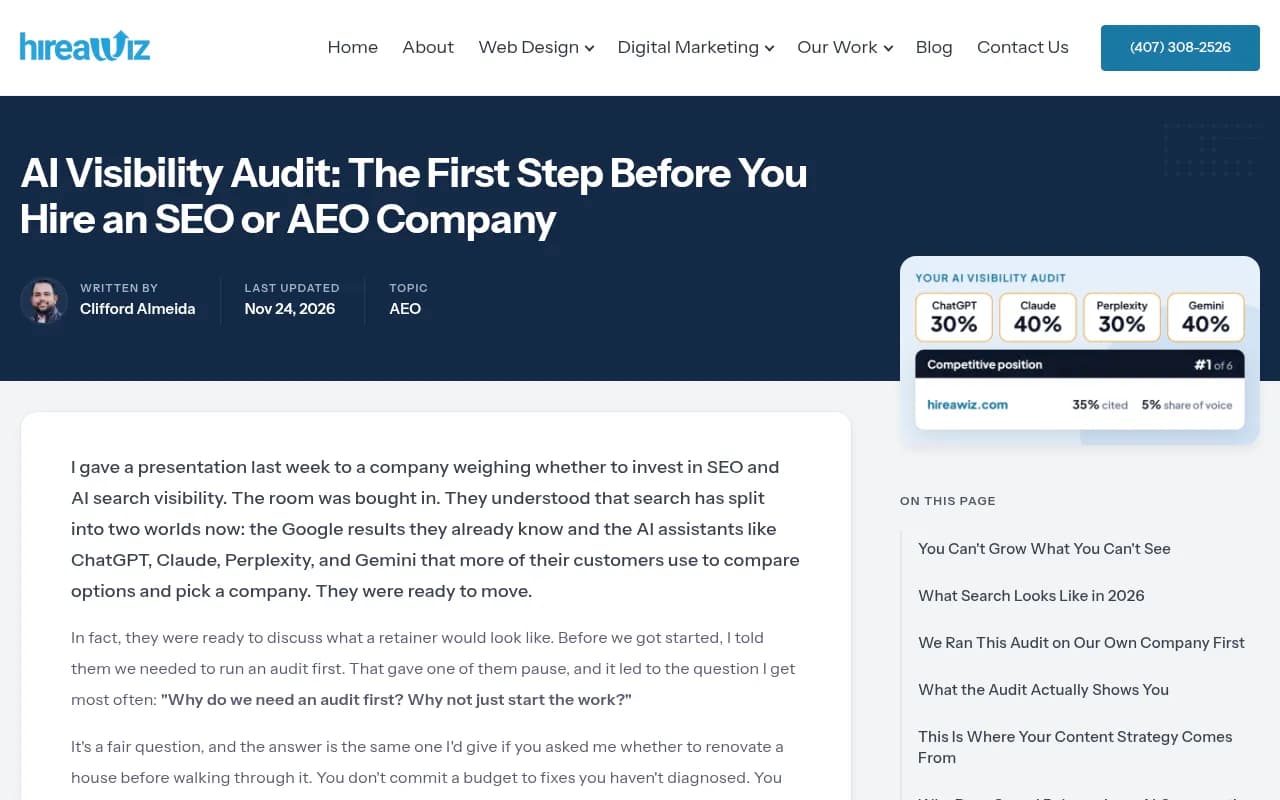
The Hire a Wiz walkthrough on AI visibility audits makes a similar point from the agency side: diagnose first, then spend. The same logic applies to measurement tools.
A layered audit beats a single score
The SRP framework splits an audit into five layers: access, entity clarity, answer usefulness, evidence, and observed presence. Only the last one is about what appears in tested AI answers, and it is the only one that needs repeatable live prompt testing. The first four are about whether your site can be read, understood and verified. A visibility score only covers layer five. If your access layer is broken, no amount of score-watching fixes it.
That is also why I prefer platforms that connect the layers. Tools that stop at mention tracking tell you the thermometer reading and nothing else.
Tools worth putting through this audit
I have not verified the scoring formulas of any specific vendor beyond what they publish, so treat this as a shortlist to interrogate, not a ranking. All of them should survive the checklist above, or tell you plainly where they don't.
Promptwatch collects from the real interfaces of the AI engines per country and language, lets you drill from the score into prompts, responses and citations, and ties it to crawler logs and visitor analytics so you can check the number against outcomes. It also keeps Share of Voice, Position and Sentiment as separate metrics, which helps you locate a problem instead of staring at one figure. Its metrics overview and data collection explainer are useful reading even if you end up buying something else.

Profound publishes a clear definition of its visibility score and a free report to test against.
Profound

Otterly.AI and Peec AI are focused monitoring tools, worth testing for prompt-set flexibility and export access.
Otterly.AI


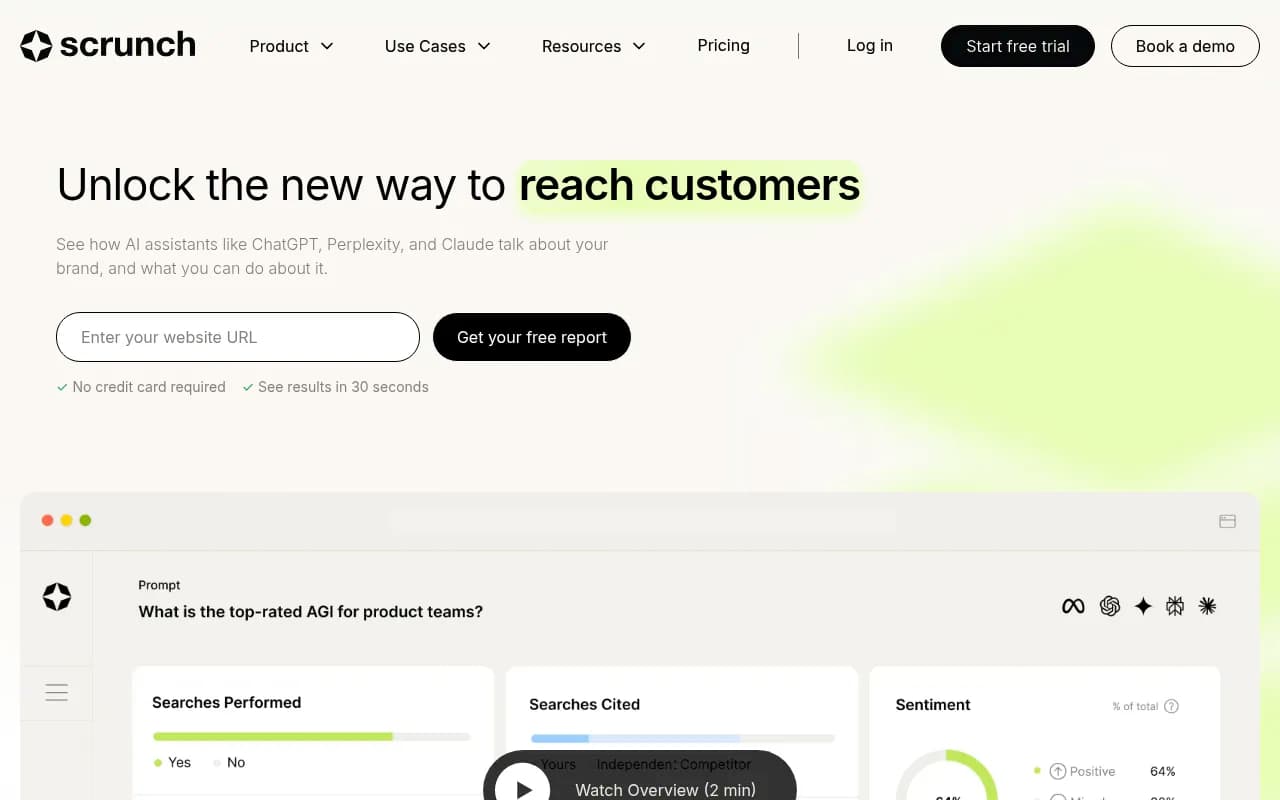
AthenaHQ, Scrunch AI and Rankshift are other options in the same category, so run the same checks on them.


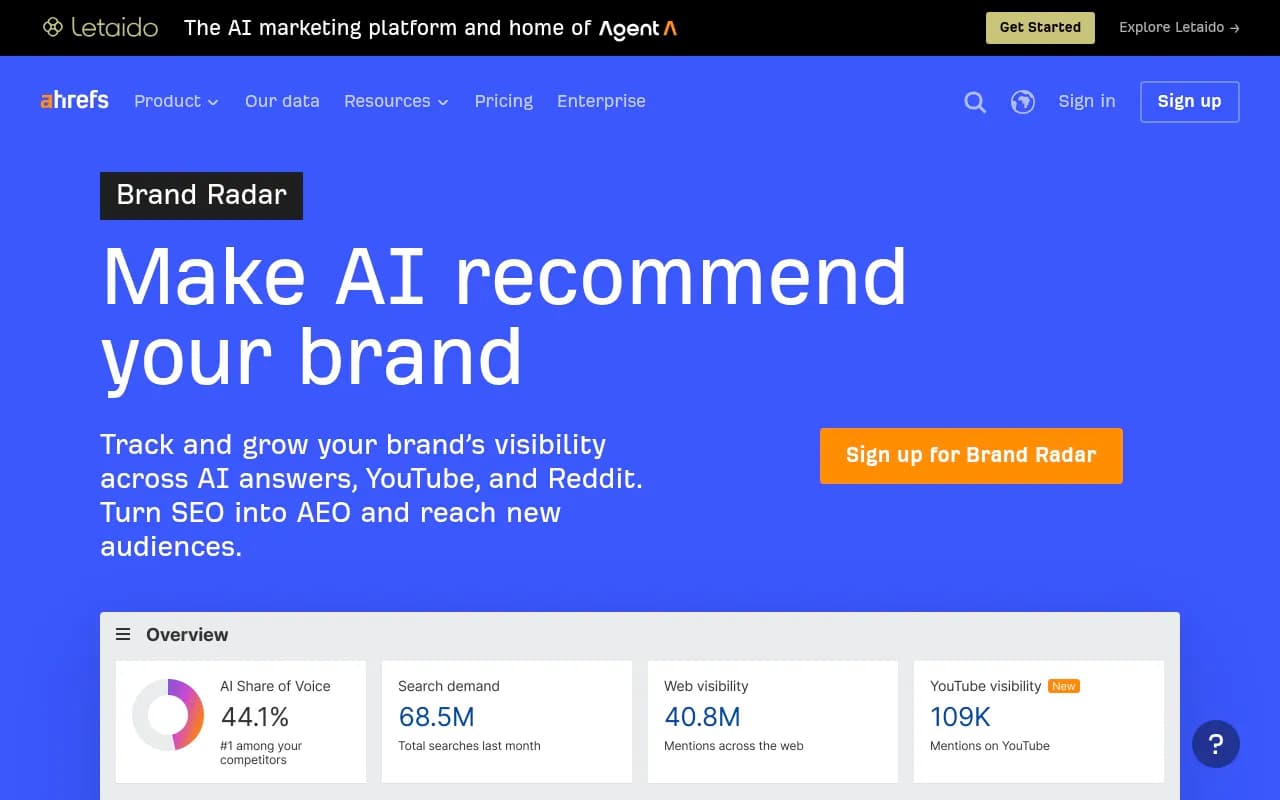
If you are also weighing established SEO suites that added AI tracking, put Semrush and Ahrefs Brand Radar through the same prompt-set and sampling questions.
For a wider list of options, the GEO software directory at bestgeosoftware.com is a decent place to browse.
Comparing how scores are typically built
| Design choice | Looks like | Risk | What to ask for |
|---|---|---|---|
| Simple mention rate | % of responses naming the brand | Ignores placement and tone | Position and sentiment alongside |
| Weighted composite | Placement, depth and mention blended | Hard to see why it moved | Component breakdown |
| Relative rank | Score vs competitor set | Moves when competitors change | Absolute and relative views |
| Fixed weekly prompt set | Same prompts scored weekly | Breaks when engine behaviour shifts | Change annotations |
| Rolling or expanding set | Prompts added over time | Trend line not comparable | Frozen baseline set |
None of these is wrong. Each has a failure mode, and you should know which one you are buying.
When the audit is the wrong tool
If you cannot get answers to the questions above, you have two choices: buy on price and treat the number as directional, or pick a tool that shows its work. For agencies pitching clients, directional is risky, because the client will ask why the number moved and you need an answer better than "the engines changed." If you want help interpreting measurement or choosing a GEO approach, an SEO and AI search agency such as 1001 SEO Media can run the evaluation with you, and it works with Promptwatch for AI visibility tracking.
What I would actually do
Pick two or three platforms. Run the 30-day test. Lock a prompt set of 50 to 150 prompts that reflect real buyers, branded and unbranded, and do not touch it for a quarter. Review the score per engine, not blended. Annotate engine changes yourself if the vendor doesn't. Compare against crawler logs and AI sessions monthly. Treat any move under a few points as noise.
A score you can reproduce is worth more than a score that looks good. If you want a quick baseline before any of this, Promptwatch's free AI visibility report will scan how ChatGPT, Gemini and Perplexity talk about your brand, and you can compare that against whatever your current tool says.
FAQ
Is a higher visibility score always better?
No. A high score on easy, branded prompts is worth less than a moderate score on commercial prompts your buyers actually use. Look at the prompt mix before the number.
Why does my score differ between two tools?
Different prompts, engines, sampling, mention rules and formulas. Differences are expected. What matters is whether each tool is stable and traceable on its own.
How often should I check the score?
Watch weekly for anomalies, judge trends monthly. Engines like Copilot have swung wildly over a few weeks, so weekly moves are weak evidence.
Can a score guarantee AI will recommend me?
No. It describes a sample of observed answers. It cannot guarantee future mentions, citations or recommendations.