
Key takeaways
- Write down your workload (prompts, engines, brands, countries, SSO needs) before you take a single vendor call.
- Headline prices are not comparable. Tools meter engines, prompts, or brands, so two $295 plans can differ tenfold on the unit you care about.
- Decide whether you are buying measurement or improvement. Every platform measures. Fewer help you change pages and then check whether the change worked.
- Insist on per-engine reporting. ChatGPT, AI Overviews and Perplexity behave differently, and a blended score hides that.
- Run a 14-day trial on your own prompts with Search Console connected, then compare results across two or three finalists.
Why this decision is harder than it looks
The AEO tool market filled up fast. The catalog behind this site lists well over a hundred products that claim some form of AI visibility tracking, and most of them look nearly identical on a landing page. A dashboard, a score, a list of prompts, a competitor chart.
The second problem is the reading material. A lot of "best AEO tools" pages are written by vendors who rank themselves well. When I went through the buyer guides for this article, several of the most detailed ones came from companies selling a competing product. They still contain useful checklists, but treat their rankings as marketing.
So here is a process that doesn't depend on anyone's ranking. It takes about two to three weeks if you work through it properly.
Step 1: Define what you are actually buying
AEO (answer engine optimization) covers getting cited in Google AI Overviews, AI Mode, ChatGPT, Perplexity, Gemini and similar surfaces. The term overlaps with GEO, AI SEO and LLM SEO. Vendors use them interchangeably, so don't filter on the label.
Instead, decide which of these jobs you need done:
- Monitoring only. You want to know whether you are mentioned, where, and against whom.
- Diagnosis. You want to know why: which pages get cited, whether AI crawlers can read your site, what content gaps exist.
- Execution. You want help writing, refreshing and publishing the content that fixes gaps.
- Attribution. You want to see traffic and conversions from AI search in your own analytics.
Most cheap tools cover the first job. A few cover the first two. Fewer still cover all four. Knowing which jobs you need keeps you from paying for a dashboard when you needed a workflow, or the reverse.
Step 2: Write down your workload
This is the step almost everyone skips, and it is the one that makes pricing comparable. Before vendor calls, put numbers on:
- How many prompts you need to track. A single product line might need 50. A multi-product B2B company often needs 150 to 350.
- Which engines matter. ChatGPT and Google AI Overviews are the obvious two. Perplexity, Gemini, Copilot, Claude and AI Mode may or may not matter for your buyers.
- How many brands, clients or domains you manage.
- Which countries and languages you need. A monitor tied to one market is not the same as true multi-country tracking.
- Whether you need SSO, SOC 2 or ISO 27001, and a data processing agreement.
- Who will use it. Unlimited seats versus per-seat pricing changes the math for a team of ten.
One suggestion from the research I like: trial a free tier for a few weeks purely to see how quickly credits burn. Credit-metered tools can look cheap until you track your real prompt set daily.
Step 3: Understand why per-engine reporting matters
Engines do not behave alike, and your tool has to show that. Promptwatch Data's sources-per-response report found ChatGPT citing about five sources per web-search answer, Google AI Overviews about ten, and Perplexity almost exactly ten every day. Copilot swung from under two sources to nearly seventeen before settling at the low end. The page notes these figures drift over time, so treat them as a snapshot, but the direction is clear: the same metric means different things on different engines.
The citation mix differs too. In Promptwatch's domain rank distribution report (Nov 3 to Nov 16, 2026), the median cited domain was DR 57 in ChatGPT and Perplexity and DR 56 in AI Overviews and AI Mode. But DR 100 sites earned 13.7% of AI Overviews citations and only 0.3% of ChatGPT's. And in the November social citations report (Oct 11 to Nov 9), social platforms made up 13.16% of AI Overviews citations versus 0.64% for ChatGPT.
What this means for selection: a single blended "AI visibility score" will mislead you. Ask any vendor to show visibility, position and citations broken out by engine, country and prompt. If they can't, move on.
Step 4: Compare real cost, not headline price
This is where most buyers get burned. Three different units are metered across the market: engines, prompts and brands. A cheap plan might cover 15 prompts on four engines. A pricier one might cover 350 prompts on every engine. Compare cost per tracked prompt per engine, at the tier you would really buy.
Here is a snapshot of published pricing from vendor pages read in September and October 2026. Prices change often, so verify before you decide.
| Tool | Entry price | What the plan covers | Notes |
|---|---|---|---|
| Otterly.AI | $29/mo Lite | 4 engines, 15 prompts | Claude, Gemini and AI Mode are add-ons from $9/mo |
| Peec AI | $95/mo Starter | 50 prompts, 3 models, unlimited users | Perplexity is a paid add-on; Pro $245, Advanced $495 |
| AthenaHQ | Free tier, then $295/mo | Credit-based, 1 credit per AI response | Starter covers 10 to 11 models |
| Scrunch | $250/mo Core | 125 prompts, 4 LLMs, 5 seats | Focus on what AI agents see on your site |
| Semrush AI Visibility | $199/mo Starter | 50 prompts daily plus 500 keywords | Pro+ $299, Advanced $549 |
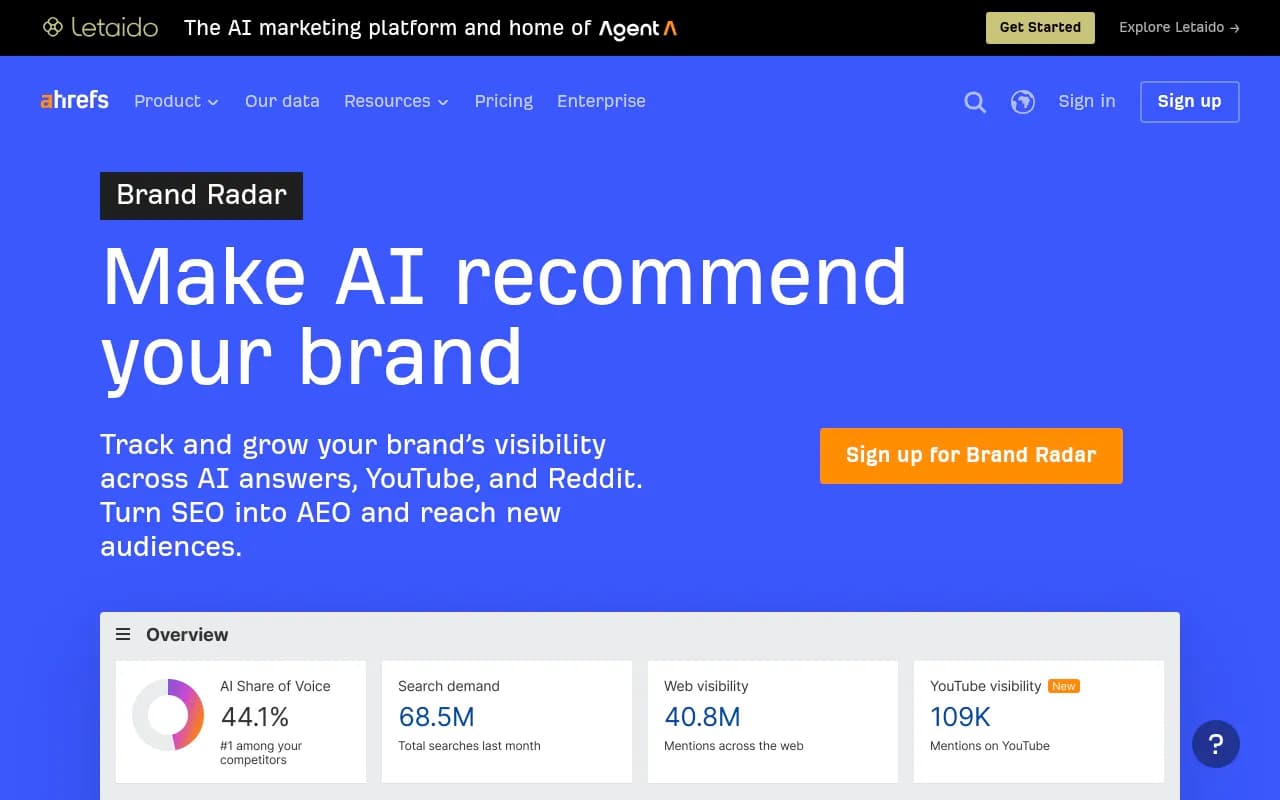
| Ahrefs Brand Radar | From $199/mo | Prompt packages at $50, $100, $250 | One check is one prompt on one platform in one location |
| Profound | Enterprise quote | Trial covers 3 engines, 50 prompts a day | Stopped publishing prices around Sep 2026 |
| Promptwatch | Free Explore, then $95/mo Essential | 50 prompts, all models, Agent Chat, 6,000 responses | Professional $245, Business $579; confirm on the pricing page |
Two things to notice. First, Profound's pricing is now "customized enterprise". One competing vendor reported a buyer being quoted $2,250/mo for 600 prompts, but that author sells a rival product, so take it as a data point and not a fact. Second, agency and multi-client pricing is quoted rather than published almost everywhere. If you manage clients, ask what the second client and the tenth client cost.
Also price the full stack. If you would keep a Semrush or Ahrefs subscription alongside a tracker, that is part of the cost.
Step 5: Decide between measurement and improvement
This is the single biggest fork in the road. Every tool on the market measures. Changing your pages and re-measuring is separate work, and it is the work that moves the number.
Three tiers of platform exist:
- Trackers. Prompts in, mentions and sentiment out. Tools like Otterly.AI and Peec AI sit here, and they are fine if you already have a content team that knows what to do with the data.
- Diagnostic platforms. They add citation analysis, crawler data or site audits so you can tell an access problem from a content problem.
- Optimization platforms. They close the loop: find gaps, produce content, publish, and check whether the page was crawled, cited and clicked.
Promptwatch is the one I would point to in that third group. It tracks the real interfaces of ChatGPT, Google AI Overviews, AI Mode, Gemini, Perplexity, Copilot and others, then goes further: IP-verified AI crawler logs show whether bots can read a page, a Content Agent writes and publishes to WordPress, Webflow or Framer, and visitor analytics show whether any of it sends traffic. Weekly site audits and an Action Board keep the to-do list prioritized. The Content Agent starts on the Business plan, so budget accordingly.

If you want a head-to-head view against specific rivals, the 2026 platform comparison and pages like Promptwatch vs Profound and Promptwatch vs Peec are a reasonable starting point, bearing in mind that Promptwatch published them.
On the other side, Profound has repositioned itself as an "AI Marketer" agent covering research, writing, reporting and correction, so it should be judged as an agent purchase and not as a tracker.
Profound

Some other tools in the middle of the field are worth a look depending on your situation:


Otterly.AI

For broader directories, the GEO software directory at bestgeosoftware.com and ai-rank-tools.com list many more options by category.
Step 6: Check the data source and methodology
Boring questions, big consequences. Ask every vendor:
- Where do responses come from? Real user interfaces and APIs can return different answers, citations and shopping results. A tool that only queries APIs may describe a world your buyers never see.
- Is each prompt run once or multiple times? Single ChatGPT queries are not measurement. Answers vary run to run, so look for a multi-pass method.
- Can I choose country, language and, if relevant, city? Monitors that mix markets give you mush.
- Can I export everything? CSV, API and an MCP server matter if your analysts or agents need the data.
- How are brand mentions defined? If your brand name is a common word, you need rules to stop false positives.
- What do I get on crawlers and traffic? Knowing whether GPTBot or OAI-SearchBot reached a page separates an access problem from a content problem. Most trackers lack this entirely.
Search crawlers such as OAI-SearchBot and PerplexityBot decide citations, while training crawlers do not, so be wary of any tool or advice that treats all AI bots as one block.
For enterprise buyers, add the security checks: SSO, SOC 2 or ISO/IEC 27001, GDPR posture and a data processing agreement. Do this early, because procurement reviews eat weeks.
Step 7: Run a 14-day trial on your own prompts
Demos are scripted. Your prompts are not. Pick two or three finalists and run the same test in each:
- Load the same 30 to 50 prompts, including branded, competitor comparison and informational ones.
- Select the same engines and countries.
- Connect Google Search Console so you can see AI data next to search data.
- Let it run for 14 days.
- Compare: do the tools agree on your visibility? Where they disagree, which one can show you the underlying response?
- Ask each tool a real question, such as "which pages rank in Google but never get cited by AI?" and see how much work it takes to get an answer.
- Count how many credits or checks you burned.
Promptwatch has a free Explore plan (ChatGPT only, 10 prompts) and a 7-day free trial on paid monthly plans, so you can test the full product. There is also a free AI visibility report that scans how ChatGPT, Gemini and Perplexity describe your brand without a login. Use it as a baseline before you talk to anyone.
Scorecard: putting it together
Score each finalist from 1 to 5 on the criteria below, weighted by what matters to you.
| Criterion | What to look for | Red flag |
|---|---|---|
| Engine coverage | All the engines your buyers use, at the tier you would buy | Key engines are paid add-ons or Enterprise-only |
| Per-engine reporting | Visibility, position and citations by engine, country and topic | One blended score |
| Data collection | Real UI collection plus API models, multi-pass | Single API call per prompt |
| Pricing clarity | Unit costs you can compute | "Contact sales" for everything, including agencies |
| Diagnosis | Citation sources, crawler logs, site audit, Search Console | Mentions only |
| Execution | Content gap analysis, content creation, CMS publishing | You export a CSV and start from scratch |
| Attribution | AI-referred traffic and conversions | No link to your analytics |
| Security and scale | SSO, audit logs, ISO 27001 or SOC 2, API | No documentation available |
If two tools tie, pick the one that does more of the work after the report. A dashboard you have to interpret yourself will cost you staff time long after the subscription fee looks cheap.
Common mistakes
- Buying on the lowest headline price without computing cost per prompt per engine.
- Trusting vendor-written comparison pages. This includes ours when it comes to Promptwatch, which is why the trial matters.
- Treating a visibility score as the goal. Revenue and conversions from AI traffic are the goal. Crisp, for example, reported 2x higher conversion rates from AI traffic than from traditional channels, which is the kind of outcome to measure, per its case study.
- Confusing paid placement services with software. Services like Noble and Anchorial sell placement, not tracking, so they aren't comparable to trackers.
- Skipping the agency question. If you lack in-house capacity, a tool alone may not move the number. An agency such as 1001 SEO Media pairs technical SEO and content with AI search work, and the right setup is often a platform plus people who know how to act on it.
- Forgetting that pricing pages change. Peec and Otterly pages were unreadable to automated fetchers when research for this guide was gathered, so always confirm on the vendor's site.
A short decision shortcut
If you are short on time:
- You have a strong content team and a small budget: start with a tracker such as Otterly.AI or Peec AI and revisit in six months.
- You already live in Semrush or Ahrefs and just need a first look: try their AI add-ons, knowing the prompt sets and depth are limited.
- You want measurement plus diagnosis plus content execution in one place: shortlist Promptwatch and one enterprise-oriented rival, and trial both.
- You are an agency: compare Peec AI's agency plans with Promptwatch's Kick-off, Growth and Scale plans ($199, $399 and $799 per month) and ask each vendor what the tenth client costs.
Whichever way you go, the tool is only as good as what you do with its output. Pick the one that makes the next action obvious, and cancel the one that only gives you a chart.