
Key takeaways
- Monitoring is now a commodity. Pay for platforms that explain why AI picks a competitor and help you fix it, not for a dashboard of charts.
- The biggest red flags are a single global score, no way to read the actual answers, before-and-after "proof" with no control, and any promise of guaranteed citations or revenue.
- Engines behave very differently from each other and change without warning, so a trend line that moves is not automatically evidence your work did anything.
- Never accept a demo on a sample brand. Ask to see your own category, then run a short pilot where you read the raw answers yourself.
- Ask for specifics: which engines, from which interface, how often, and how repeat runs are handled. Vague answers like "we track all major engines" fail.
Why demos of AI visibility tools are easy to get wrong
I have watched a lot of software demos, and AI visibility demos are the most slippery I have seen. The numbers move daily. Every vendor counts differently. And the demo account always looks fantastic, because it was built to look fantastic.
That is not necessarily dishonesty. It is the nature of the category. Sending prompts to AI assistants and counting brand mentions is table stakes now, so vendors compete on everything layered on top: scores, recommendations, "proof" of impact. Those layers are where buyers get burned.
This guide is organized around what to ask and what to verify. Each red flag comes with a question that exposes it and a check you can run yourself.
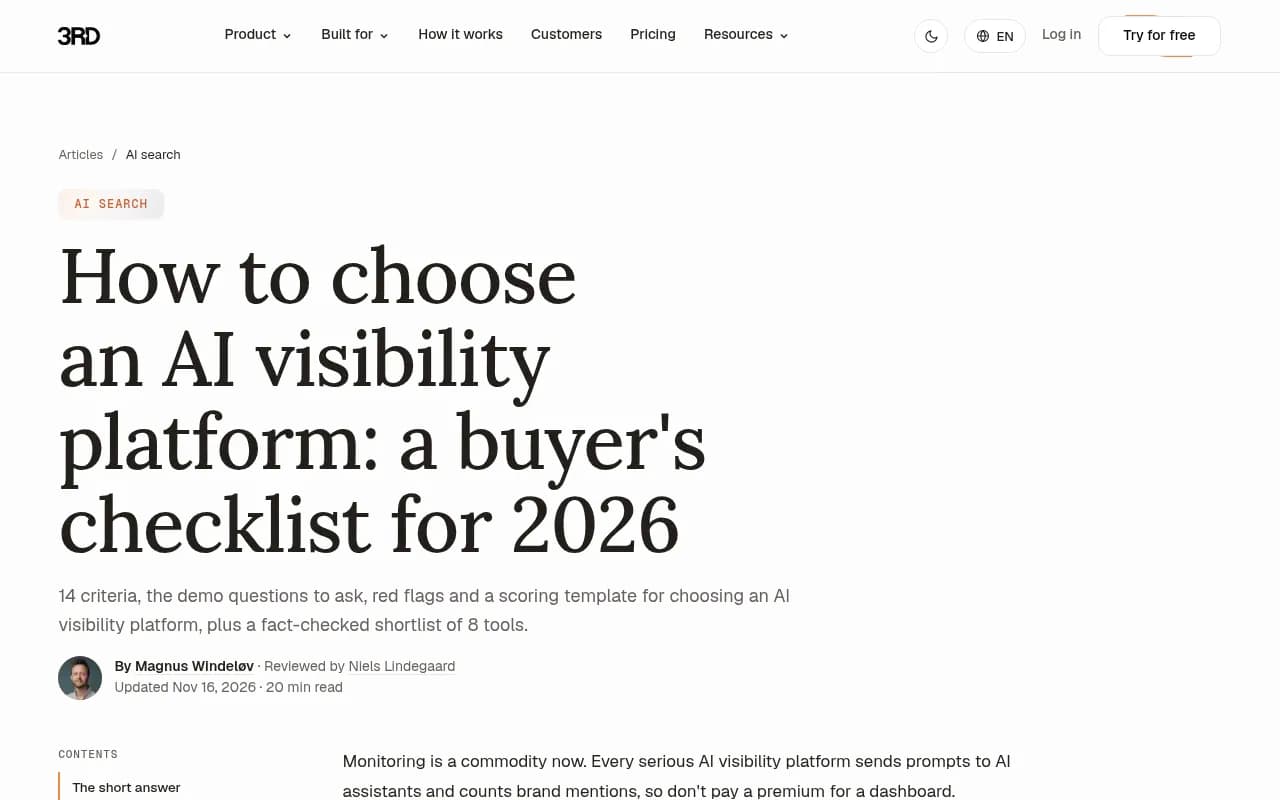
The checklist from 3RD, which I leaned on while writing this, is worth a read. One disclosure on their side: they are a vendor on their own shortlist, so treat the red flags as useful and the rankings with a grain of salt.
The red flags, ranked by how often they cost buyers money
A single global score with no filters
One brand can sit at 50% visibility on one model and 30% on another for the same questions. An average of those two hides precisely the model where you are losing.
Ask: "Can you break this score down by model, country, language, topic and persona, and show me the lowest cell?" If the answer is a dropdown that only changes the date range, you have found your first problem.
A good platform lets you put models, topics, countries or personas on either axis of a heatmap. You want to find the weak cell in under a minute.
No way to see the answers
If the vendor shows only charts, you cannot verify anything. Every number should trace back to a real response you can open and read, along with the sources the AI cited.
Ask: "Show me one of our competitors' answers and the sources the AI cited for it." Then ask: "Why does our top competitor win this question? Show me the evidence." A vendor with real diagnostics will open the response, point at the cited pages, and tell you what those pages have that yours do not. A vendor with a dashboard will change the subject.
Data from APIs, with no explanation
User-facing answers, citations and shopping recommendations can differ from what the same model returns through an API. That matters, because your buyers use the app, not the API.
Ask: "Which interfaces do you collect from, per engine? Are any numbers from API calls?" The SolCrys buyer's guide frames this well: the red flag is "we track all major engines" without specifics. A passing answer names the engines, the collection method and the countries and languages covered. Also ask about retail engines if you sell products. "Coming soon" for something that has been live for more than a year is a bad sign.
"Search volume" for prompts
No platform has real search volume for AI prompts. Any demand score is an estimate. That is fine, if the vendor says so and explains how the number is built.
Ask: "Where does this volume come from, and how would I validate it?" Good answers mention sources like Search Console queries, keyword data or People Also Ask, and are upfront about the margin of error. A bad answer treats the number as measured fact.
Before-and-after "proof" without a control
A raw before-and-after reading goes up about as often as it goes down. A vendor who shows a chart climbing after you adopted their recommendations has shown you very little.
Promptwatch's own data illustrates why. According to Promptwatch Data on sources per response, Google AI Overviews cites about 10 sources per answer and Perplexity almost exactly 10 every day, while ChatGPT cites about 5 for web-search answers, and the average drifts with model and retrieval updates. Microsoft Copilot's average swung from under 2 sources to nearly 17 within a few weeks before settling low. Move that much and your visibility can change with zero input from you.
Platform-wide events do the same thing:
- ChatGPT's average citations per response dropped around the GPT-5.3 rollout on March 4, 2026.
- reddit.com's share of ChatGPT citations fell from roughly 4% to 0.5% on August 14, 2026.
- ChatGPT began using the site: operator at scale on August 8, 2026, taking it from about 0.4% to about 17% of fanout queries overnight.
Ask: "Does the platform annotate engine-level changes? How do you separate those from the effect of our work? Is there a control group of pages or prompts we did not touch?" If the vendor attributes a jump to their own recommendations without addressing events like these, discount the claim.
Tips that would fit any company
If the recommendations do not name your competitors, your pages and the specific sources involved, they were not written for you. "Add more FAQ content" is not a recommendation. "Your pricing page is not cited for these six prompts, while these two competitor pages are, and here is what they cover that yours does not" is.
Ask the vendor to generate recommendations live on your domain. Read the first three and see whether you could have written them without the tool.
Revenue promises
No platform can reliably attribute organic AI visibility to revenue today, because most AI answers produce no click. Vendors can measure AI-referred visits and conversions on your site, which is real and useful. They cannot honestly promise that a visibility score maps to dollars.
Ask: "What exactly do you measure between an AI answer and a conversion, and what do you estimate?" Be wary of anyone who blurs the line.
A demo that only uses a sample brand
Sample brands are curated. Ask to see your own category, your competitors and your markets. If they cannot do that live, insist on a trial.
Guarantees
Guaranteed citations or rankings are the oldest red flag in SEO and they have simply been renamed. Even Google says meeting its requirements does not guarantee indexing or serving. Any promise to control what models say fails. A credible vendor or agency lists controlled deliverables, like pages shipped, fixes made and outreach completed, and says plainly that AI outputs are not on the list.
Questions to ask, and the answers that should satisfy you
| Question | A good answer | Red flag |
|---|---|---|
| Which engines do you track and how do you collect data? | Named engines, real interfaces, per country and language | "All major engines" with no list |
| Can I see the raw answers and cited sources? | Yes, one click from any chart | Charts only |
| How is the visibility score built? | Documented formula, filterable by model | One global number |
| How often do prompts run, and how are repeat runs handled? | Defined schedule, repeat runs averaged or shown | "Continuous" with no detail |
| Where does prompt volume come from? | Estimated, with the method explained | Presented as real search volume |
| How do you prove a fix worked? | Page-level tracking plus a control | Before-and-after chart |
| Can you detect our brand correctly? | Configurable rules for names that are also common words | No mention rules |
| Do you tell me what to do, or just what happened? | Prioritized, evidence-backed actions naming our pages | Generic tips |
| Can you attribute traffic and revenue? | Measures AI-referred visits; honest about the rest | Promises revenue attribution |
| Show me a customer of our size and category | Specific reference | None available |
What to verify that a demo cannot show you
Brand detection
If your brand name is short or also a common word, unrelated pages can get counted as mentions. This one quietly wrecks numbers. Ask how the platform decides what counts as a mention of you and your competitors, and whether you can write rules to correct it. In the pilot, read a sample of flagged mentions and count how many are wrong.
Prompt construction
Promptwatch's query fanout data shows that average fanout queries per response ran around 2.15 in early December 2025 and about 1.84 by early March 2026, while average query length fell from about 117 characters to the high 80s, then about 53 in April. Behavior shifts in steps. If a vendor sells fanout or prompt-volume features, ask to see their own fanout data and how it reconciles with changes like these. Also ask whether tracked prompts resemble how your buyers actually phrase questions.
Technical visibility
A monitoring-only tool can tell you that you are not cited. It usually cannot tell you whether AI crawlers can even read your site. Ask whether the platform includes IP-verified crawler logs, whether it distinguishes an access problem from a content problem, and whether it flags technical issues weekly. Tools like Promptwatch and a handful of others do this; most trackers do not.

Agencies and services: the same red flags, plus a few more
Many of the same problems appear when you hire a provider instead of buying software. Seen's guide to AI SEO agencies and Google's own AI optimization guidance converge on a few questions:
- What exactly is guaranteed? A credible answer lists deliverables, not outcomes.
- Which AI platforms do you test, how often, and how are repeat runs handled? "We monitor all of AI search" fails.
- Do you sell llms.txt files, content chunking or rewrites for AI? Google says there is "no requirement to break your content into tiny pieces".
- How will you measure results? Search Console's reporting plus tracked prompts is credible. A proprietary "AI score" alone is not, since no third party can see Google's internal AI systems.
- Do you build mentions or reviews for us? Earned coverage only. Paid or fake mentions are a tactic Google tells site owners to ignore.
A legitimate service should cover a search audit, content restructuring, schema, entity work and citation tracking, built on solid SEO foundations. If you want a partner that combines technical SEO, content, digital PR and AI search work, agencies like 1001 SEO Media publish their approach openly, and the same questions above apply to them, and to any agency you consider.
A two-week pilot that settles the decision
Demos persuade. Pilots decide. Here is a schedule that works for most teams.
- Day 1: Set up your real brand, your real competitors and 30 to 50 prompts your buyers would actually use. Do not accept a pre-built template without editing it.
- Days 2 to 7: Do not react to daily numbers. Read the answers. Check that the platform detects your brand and competitors correctly, and count false mentions.
- Days 8 to 10: Test the diagnostics. Pick three prompts where a competitor wins and ask the platform to explain why. Verify the cited pages yourself.
- Days 11 to 12: Test the recommendations. Are they specific to your pages and sources, or boilerplate?
- Days 13 to 14: Test reporting and export. Can you pull raw responses, citations and crawler data into your own tools? If the data is locked in, so are you.
Score each vendor against the same sheet. Weight verifiability and diagnostics above polish.
Where the tools actually differ
At a high level, the category splits into trackers and platforms that go further. This is a simplified view, based on each vendor's public positioning. Confirm anything that matters in your own pilot.
| Type | Examples | Typically covers | Typically missing |
|---|---|---|---|
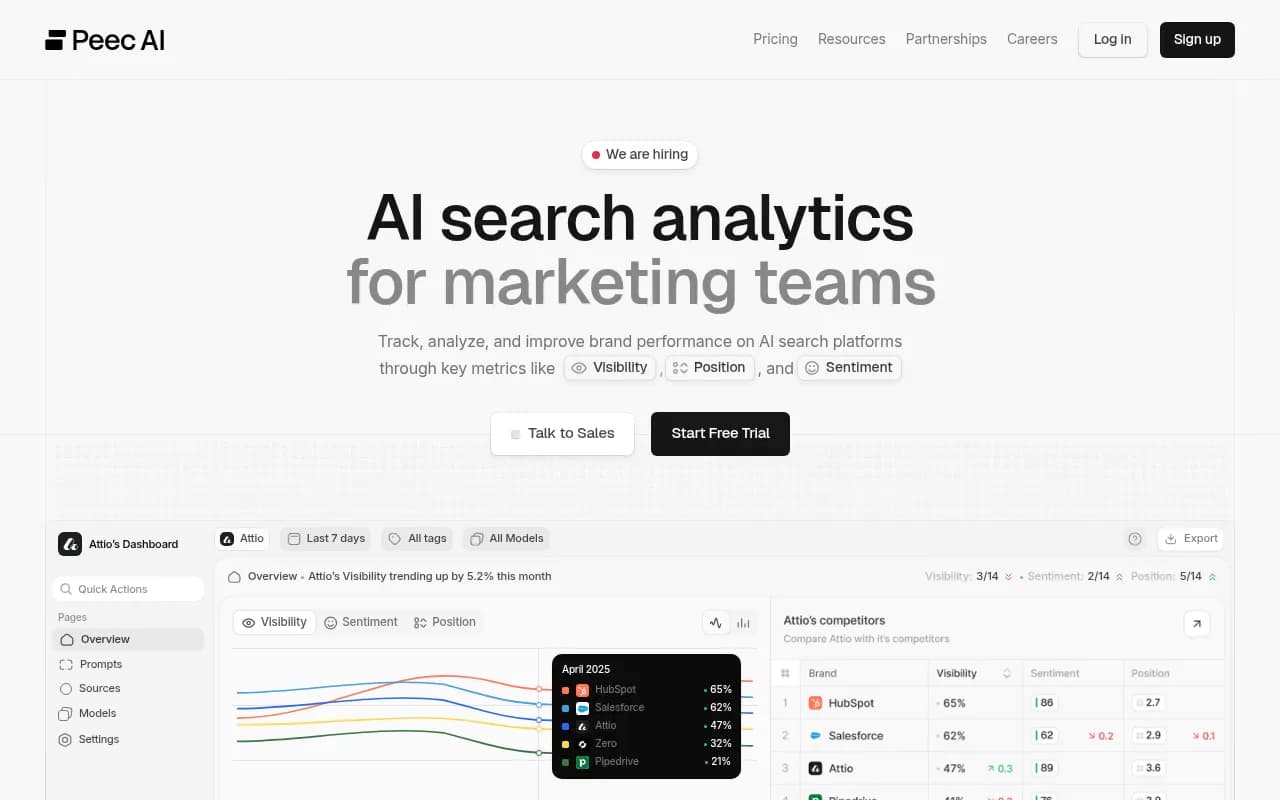
| Prompt trackers | Otterly.AI, Peec AI, Rankshift | Mentions, visibility trends, competitors | Crawler logs, content generation, traffic attribution |
| Enterprise monitoring | Profound, Scrunch AI | Broad engine coverage, enterprise reporting | Often higher price points, less execution |
| SEO suites with AI add-ons | Semrush, Ahrefs Brand Radar | Familiar workflow, some AI tracking | Fixed prompt sets, shallower AI-specific data |
| End-to-end platforms | Promptwatch | Tracking, citations, crawler logs, content creation, publishing, traffic | Agencies need Partner for white-label |
Otterly.AI

Profound

Promptwatch's approach is to close the loop: monitor, trace citations, act through content gap analysis, the Action Board and the Content Agent, then measure with IP-verified crawler logs and visitor analytics. That is the kind of loop to look for in any vendor, whichever you pick. Details on pricing are at promptwatch.com/pricing, and there is a 7-day free trial on monthly billing for paid plans. For a side-by-side of the whole category, see Promptwatch's 2026 GEO platform comparison, and for wider directories, the GEO software directory at bestgeosoftware.com is a useful starting list.
A short script for the sales call
If you only remember a handful of lines, use these:
- "Open one answer where a competitor beats us and show me the cited sources."
- "Filter that score by model and country. Which cell is lowest?"
- "How did you build this prompt volume number?"
- "If our visibility rose last month, how would we know your tool caused it?"
- "What do you promise, and what do you refuse to promise?"
- "Can we run this on our own category for two weeks?"
A vendor with a real product will enjoy these questions. A vendor selling a dashboard will start talking about roadmap.
Final word
The best signal in any demo is how comfortable the vendor is with you reading the raw answers. Everything else, the scores, the trend lines, the confident recommendations, is only as good as the responses underneath. Insist on seeing those, run the pilot, and treat any guarantee as the end of the conversation.
FAQ
What is the single biggest red flag in an AI visibility demo?
Charts with no path to the underlying answers. If you cannot open a response and see the sources the AI cited, you cannot verify any number the vendor shows you.
Can any platform guarantee AI citations or rankings?
No. AI outputs are not something a vendor controls. Credible providers promise deliverables such as pages shipped and fixes made, and measure outcomes honestly instead of guaranteeing them.
Is prompt search volume real?
No platform has true search volume for AI prompts. Treat any demand score as an estimate, and ask the vendor to explain exactly how it was built.
How long should a pilot last?
Two weeks is enough to check brand detection, answer quality, diagnostics and export. Avoid judging daily fluctuations, since engines shift on their own.
Should I trust a before-and-after chart?
Only with a control. Engine updates and platform-wide citation shifts can move your numbers without any change on your side.