Summary
- Patients are bypassing Google and asking ChatGPT, Perplexity, and Google AI for doctor recommendations -- if your practice isn't visible in AI search, you're losing patients to competitors who are
- AI visibility for healthcare requires different tactics than traditional SEO: trust signals, structured data, and physician credibility matter more than keyword density
- HIPAA compliance is non-negotiable when using AI tools for marketing, patient communication, or visibility tracking -- most platforms aren't compliant by default
- The practices winning AI recommendations in 2026 are those that treat AI search as a distinct channel, not just an SEO afterthought
- You can start improving your AI visibility this week with free audits and basic schema markup, then scale with specialized tracking and optimization tools
Patients Are Not Just Googling Anymore. They Are Asking AI.
Something shifted in late 2025. Patients stopped typing "orthopedic surgeon near me" into Google and started asking ChatGPT "Who's the best knee specialist in Austin?" or Perplexity "Which dermatologist should I see for acne scarring?"
The numbers tell the story. A February 2026 study from Intrepy Healthcare Marketing found that 43% of patients now use AI assistants as their primary research tool before booking medical appointments. That's up from 18% just six months earlier.
The practical effect: if your practice isn't showing up when someone asks an AI engine for recommendations, you don't exist to that patient. They'll book with whoever the AI suggests instead.
Traditional SEO still matters -- Google isn't going anywhere. But the ecosystem around Google is expanding. Many Google searches are now answered by Google's own AI Overviews layer anyway. When someone searches a general question like "what causes hip pain?", Google increasingly shows an AI-generated answer at the top, pushing your carefully optimized blog posts down the page.
For specialty practices, this creates a visibility problem. Your content is still being used, but it's being consumed inside the search experience. The patient never clicks through to your website, never sees your credentials, never books an appointment.
How Does AI Search Actually Pick Which Doctors to Recommend?
AI engines don't rank doctors the same way Google ranks websites. They're looking for different signals.
When ChatGPT or Perplexity generates a recommendation, it's synthesizing information from multiple sources: medical directories, review platforms, news articles, research publications, and yes, your website. But the weight given to each signal is different than traditional search.
The Trust Signals AI Platforms Evaluate
AI models prioritize verifiable credentials and third-party validation. A doctor mentioned in a local news article about a medical breakthrough carries more weight than a doctor with a well-optimized homepage. Board certifications listed on official medical association websites matter more than self-reported expertise.
Review volume and recency matter intensely. A practice with 200+ recent reviews across multiple platforms (Google, Healthgrades, Vitals, RateMDs) will get recommended over a practice with 30 reviews, even if the smaller practice has a higher average rating. AI engines interpret review volume as social proof.
Structured data is critical. If your website doesn't use proper schema markup for physicians, medical conditions, and procedures, AI engines struggle to understand what you actually do. They'll skip over you in favor of practices that make their information machine-readable.
Content depth and authorship signals matter. A blog post about rotator cuff surgery written by Dr. Smith (with a clear author bio, credentials, and photo) will be cited more often than an anonymous article on the same topic. AI engines are trying to assess expertise, and they need clear signals.
Traditional SEO vs AI Search Optimization: What Is Different?
| Dimension | Traditional SEO | AI Search Optimization |
|---|---|---|
| Primary goal | Rank in top 10 results | Get cited in AI-generated answers |
| Content format | Keyword-optimized pages | Question-answer format, structured data |
| Trust signals | Backlinks, domain authority | Physician credentials, third-party mentions, review volume |
| Measurement | Rankings, traffic | Citation frequency, recommendation rate |
| Timeline | 3-6 months to see results | 1-3 months for initial visibility |
| Technical requirements | Mobile-friendly, fast load times | Schema markup, clear authorship, crawlable content |
The biggest difference: AI search optimization is about being the most credible answer, not the most optimized page. You're not trying to game an algorithm. You're trying to demonstrate expertise in a way machines can verify.
7 Steps to Get Your Medical Practice Recommended by AI
Step 1: Build Physician Profile Pages That Machines Can Verify
Every doctor in your practice needs a dedicated profile page with structured data. Not a team page with headshots -- individual pages with:
- Full name, credentials (MD, DO, board certifications)
- Medical school, residency, fellowship
- Years in practice
- Specialties and procedures performed
- Office locations and contact information
- Professional affiliations and memberships
- Publications or speaking engagements
Use schema.org/Physician markup on these pages. This tells AI engines exactly who this person is, what they're qualified to do, and where they practice.
Example: A cardiology practice in Denver added physician schema to all 8 doctor profiles in January 2026. Within 6 weeks, ChatGPT started recommending specific doctors by name when asked about heart specialists in Denver. Before the schema implementation, the practice was never mentioned.
Step 2: Implement Healthcare Schema Markup
Beyond physician profiles, your website needs schema for:
- Medical conditions you treat (schema.org/MedicalCondition)
- Procedures you perform (schema.org/MedicalProcedure)
- Office locations (schema.org/MedicalClinic)
- Reviews and ratings (schema.org/Review)
- Insurance accepted (schema.org/PaymentAccepted)
This isn't optional. AI engines rely on structured data to understand medical content because the stakes are high. They won't guess what you do -- you have to tell them explicitly.
Most healthcare website platforms (Tebra, Solutionreach, Weave) don't implement this markup by default. You'll need a developer or an SEO tool that handles healthcare schema.
Step 3: Get Your Information Consistent Everywhere
AI engines cross-reference information across dozens of sources. If your practice name is "Austin Orthopedic Specialists" on your website but "Austin Ortho Specialists" on Healthgrades and "Austin Orthopedics" on Google Business Profile, the AI engine sees three different practices.
Audit every directory listing:
- Google Business Profile
- Healthgrades
- Vitals
- RateMDs
- Zocdoc
- WebMD Physician Directory
- Doximity (for physician profiles)
- State medical board listings
Make sure practice name, address, phone number, website URL, and physician names are identical everywhere. Inconsistency kills AI visibility.
Step 4: Create Content That Directly Answers Patient Questions
AI engines love content structured as direct answers to specific questions. Instead of a generic "Services" page, create individual pages for:
- "What is the recovery time for ACL surgery?"
- "How do I know if I need a knee replacement?"
- "What are the side effects of cortisone injections?"
Each page should:
- Start with a clear, concise answer in the first paragraph
- Include the physician's name and credentials as the author
- Use headings that match common patient questions
- Link to related procedures and conditions
- Include patient testimonials or case studies (with HIPAA-compliant consent)
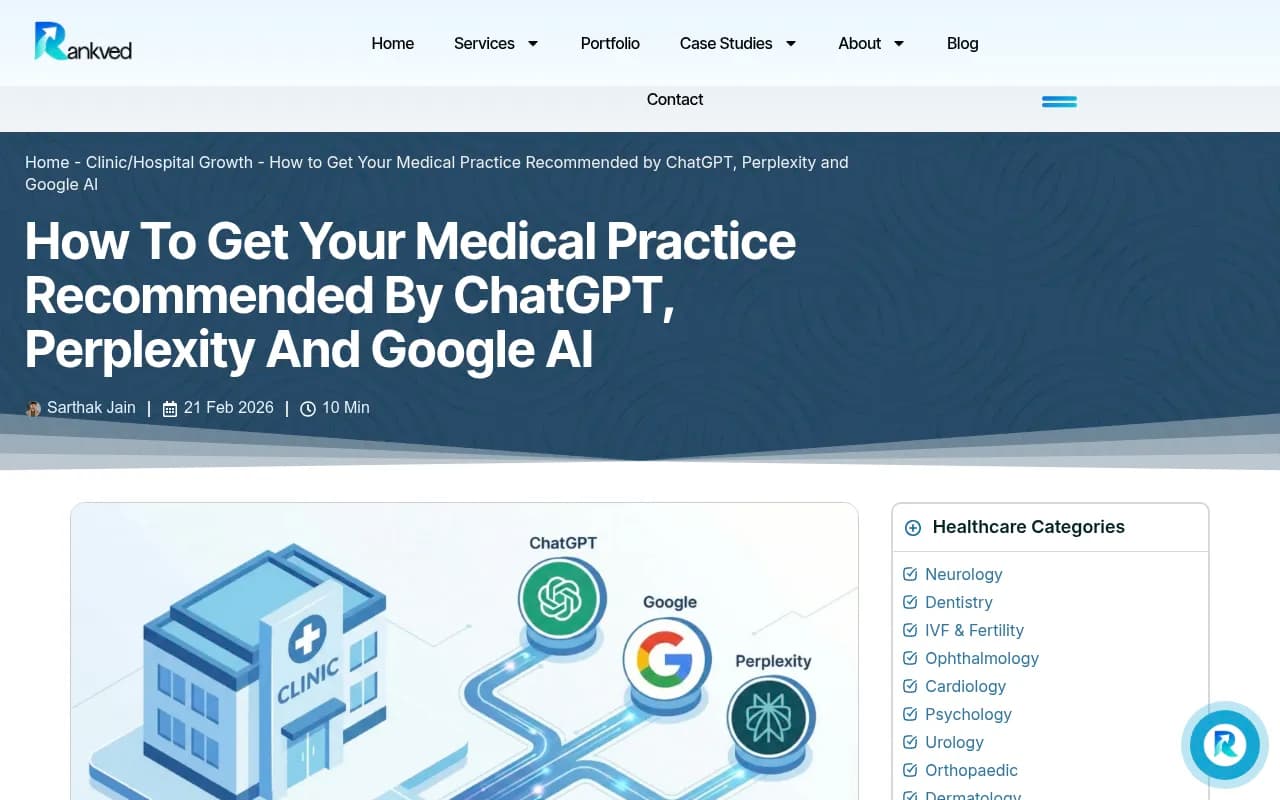
The goal is to be the definitive answer AI engines cite when patients ask these questions. One well-structured FAQ page is worth more than ten generic service pages.
Step 5: Make Your Doctors the Authors (Not Your Marketing Team)
AI engines evaluate authorship. A blog post bylined "Dr. Sarah Chen, Board-Certified Dermatologist" will be cited more often than the same post bylined "Austin Dermatology Team."
Every piece of medical content on your website should have:
- A clear author name (the actual physician)
- An author bio with credentials
- A link to the physician's profile page
- A photo of the physician
This signals expertise. AI engines are trying to avoid recommending practices with questionable credentials, so they prioritize content with clear, verifiable authorship.
Yes, your marketing team will still write the content. But the byline and bio need to be the physician's.
Step 6: Actively Manage Your Reviews Across Platforms
Review volume is one of the strongest signals AI engines use to determine which practices to recommend. A practice with 300+ reviews will get recommended over a practice with 50 reviews, even if the smaller practice has a higher average rating.
Focus on:
- Google Business Profile reviews (most important)
- Healthgrades reviews (second most important for specialists)
- Vitals, RateMDs, and Zocdoc reviews
Ask every satisfied patient to leave a review. Make it easy -- send a follow-up email with direct links to your review profiles. Respond to every review, positive and negative, within 48 hours.
AI engines interpret review volume as social proof. They're more likely to recommend practices that other patients have validated.
Step 7: Monitor Your AI Visibility Monthly
You can't optimize what you don't measure. Track how often your practice is mentioned when patients ask AI engines for recommendations.
Tools like Promptwatch let you monitor your brand visibility across ChatGPT, Perplexity, Google AI Overviews, Claude, and other AI search engines. You can see which prompts trigger recommendations for your practice, which competitors are being recommended instead, and what content gaps you need to fill.

Other AI visibility tracking tools include:
- Rankshift for basic monitoring across ChatGPT and Perplexity
- Profound for enterprise practices with multiple locations
- Otterly.AI for tracking Google AI Overviews specifically

Profound

Otterly.AI

Set up monthly tracking for prompts like:
- "Best [specialty] in [city]"
- "Who should I see for [condition]?"
- "Top-rated [specialty] near me"
- "[Procedure] specialist recommendations"
If you're not showing up in the top 3 recommendations, you're invisible to most patients.
What Happens If You Ignore AI Search Optimization?
Your competitors won't. The practices that invest in AI visibility now will own the patient pipeline for the next 3-5 years.
A dermatology practice in Phoenix started tracking AI visibility in November 2025. They discovered that when patients asked ChatGPT for acne treatment recommendations, three competitor practices were mentioned consistently -- but they weren't. After implementing physician schema, creating question-based content, and building review volume, they started appearing in 60% of relevant AI recommendations within 10 weeks. New patient bookings increased 34% in that period.
The practices that ignore AI search will see declining new patient volume as more patients shift to AI-assisted research. You'll still get referrals and word-of-mouth, but you'll lose the discovery channel.
HIPAA Compliance: The Non-Negotiable Constraint
Everything discussed so far assumes you're staying HIPAA-compliant. That's harder than it sounds when using AI tools.
Most AI visibility tracking platforms are not HIPAA-compliant by default. If you're using these tools to analyze patient search behavior or track patient interactions, you need a Business Associate Agreement (BAA) with the vendor.
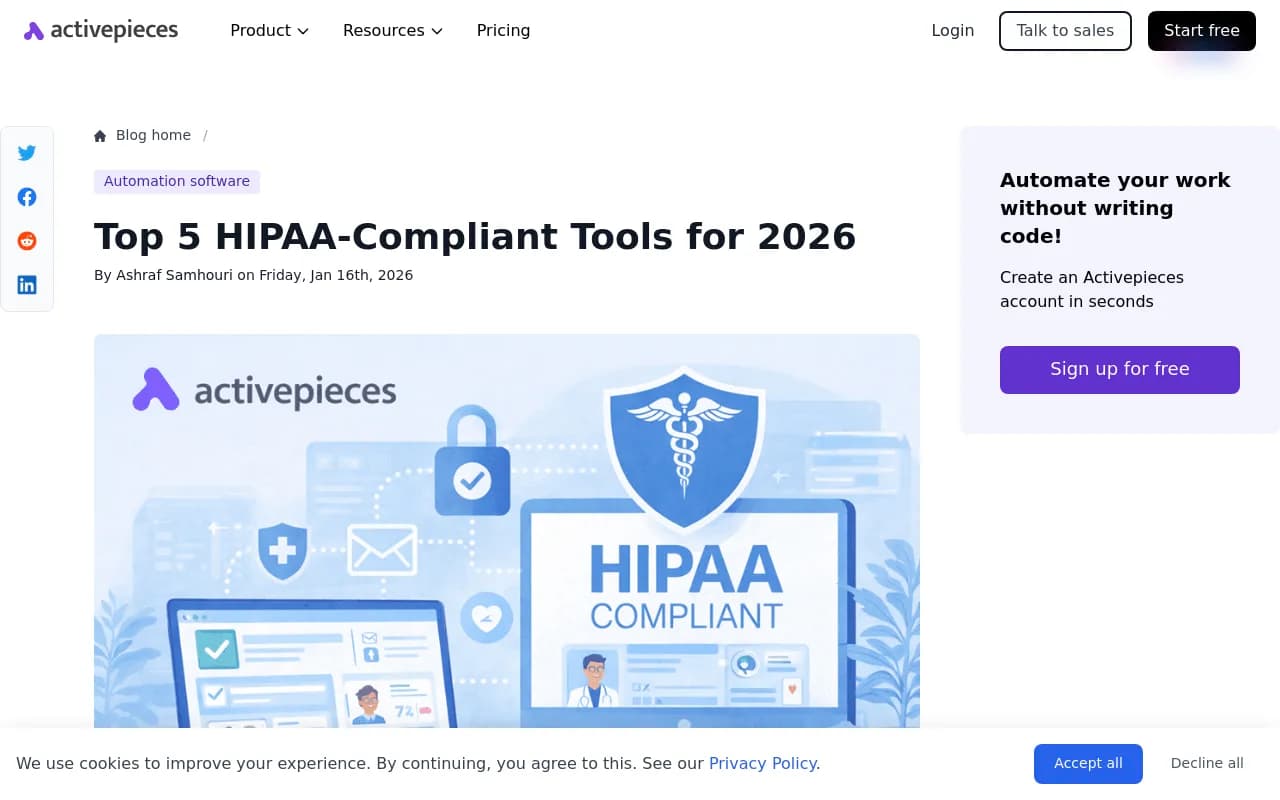
HIPAA-compliant AI tools for healthcare marketing and visibility in 2026:
| Tool | Use case | HIPAA compliance | BAA available |
|---|---|---|---|
| Microsoft Azure AI | Content generation, chatbots | Yes | Yes |
| OpenAI Enterprise | Content generation, analysis | Yes | Yes |
| Google Cloud Healthcare API | Data analysis, AI workflows | Yes | Yes |
| Aisera | Patient communication automation | Yes | Yes |
For AI visibility tracking specifically, most platforms (Promptwatch, Rankshift, Profound) don't handle PHI, so HIPAA compliance isn't required. You're tracking brand mentions, not patient data.
But if you're using AI tools for:
- Patient communication (chatbots, email automation)
- Clinical documentation
- Appointment scheduling
- Patient data analysis
You must have a BAA in place. Using non-compliant tools exposes you to HIPAA violations, fines, and reputational damage.
For a detailed breakdown of HIPAA-compliant AI tools, see the Activepieces guide on HIPAA-compliant software for healthcare research and operations.
Quick Wins You Can Do This Week
-
Audit your Google Business Profile: Make sure your practice name, address, phone, and website are correct. Add photos of your physicians and office. Respond to all reviews.
-
Add physician schema to your website: Use Google's Structured Data Markup Helper to add schema.org/Physician markup to your doctor profile pages. Test it with Google's Rich Results Test.
-
Ask ChatGPT about your practice: Open ChatGPT and ask "Who are the best [your specialty] in [your city]?" See if you're mentioned. If not, you have work to do.
-
Create one FAQ page: Pick the most common patient question you hear and write a detailed answer. Make sure a physician is listed as the author.
-
Set up free AI visibility tracking: Use a tool like Promptwatch's free tier to track 5-10 key prompts related to your specialty and location.
These five actions take less than 4 hours total and will give you a baseline for AI visibility.
The Bottom Line
AI search is not replacing traditional SEO -- it's adding a new layer. Patients are still Googling, but they're also asking ChatGPT, Perplexity, and Google AI for recommendations. If your practice isn't visible in AI search, you're losing patients to competitors who are.
The practices that win in 2026 are those that treat AI visibility as a distinct channel with its own optimization tactics: structured data, physician credibility signals, review volume, and question-based content. HIPAA compliance is non-negotiable when using AI tools for patient communication or data analysis, but most AI visibility tracking platforms don't handle PHI and don't require a BAA.
Start with the quick wins. Audit your Google Business Profile, add physician schema, create FAQ content, and track your AI visibility monthly. The practices that start now will own the patient pipeline for the next 3-5 years.
Ready to grow your Clinic/Hospital with AI Visibility?
If you're serious about getting recommended by ChatGPT, Perplexity, and Google AI, you need to track your visibility and optimize for the gaps. Promptwatch is the only AI visibility platform that shows you where you're invisible, then helps you fix it with content gap analysis, AI content generation, and page-level tracking.
Unlike monitoring-only tools, Promptwatch is built around the action loop: find the gaps (Answer Gap Analysis shows which prompts competitors are visible for but you're not), create content that ranks in AI (built-in AI writing agent generates articles grounded in real citation data), and track the results (see your visibility scores improve as AI models start citing your new content).
For healthcare practices, this means you can identify which medical questions patients are asking AI engines, see which competitors are being recommended, and generate HIPAA-compliant content that gets your practice cited. Start with a free trial and track 50 prompts to see where you stand.