Summary
- Most AI visibility tools now offer 7-14 day free trials, but what you can test varies wildly -- some lock core features behind paywalls while others give full access
- The best trials let you track real prompts across multiple AI engines (ChatGPT, Perplexity, Claude, Gemini), analyze competitor visibility, and see citation sources -- not just vanity metrics
- Promptwatch stands out by combining monitoring with action: its trial includes Answer Gap Analysis (showing exactly which prompts competitors rank for but you don't) and an AI writing agent that generates content engineered to get cited

- Budget-conscious teams should prioritize trials that reveal actionable insights over raw data dumps -- tools like Otterly.AI ($25/mo) and Peec AI (€89/mo) offer affordable entry points after trial periods
- Enterprise teams need trials that test scalability: multi-brand tracking, API access, custom reporting, and integration with existing SEO workflows
AI search has flipped the script on brand visibility. When someone asks ChatGPT "best project management tools" or Perplexity "alternatives to Salesforce," your brand either shows up or it doesn't. No second page. No chance to optimize later. The citation is the ranking.
That shift makes AI visibility tools essential, but here's the problem: most platforms cost $200-$600/month, and their marketing pages all promise the same thing. Free trials are your only way to separate real capabilities from feature-list theater.
This guide breaks down what you can actually test during trial periods, which features matter, and how to pick a tool that fits your team's workflow and budget.
What AI visibility tools actually do
Before we dig into trials, let's clarify what these platforms track. AI visibility tools monitor how your brand appears when people prompt AI search engines. They answer questions like:
- Does ChatGPT mention your brand when users ask about your category?
- Which competitors get cited instead of you, and why?
- What content gaps are costing you visibility?
- How often do AI engines crawl your website?
- Which pages get cited, and which get ignored?
The best tools go beyond monitoring to help you fix visibility gaps. That means identifying missing content, generating optimized articles, and tracking results as AI models start citing your new pages.
The trial testing framework: what to check in 7-14 days
Most free trials last 7-14 days. That's enough time to evaluate core capabilities if you know what to test. Here's the checklist:
Day 1-2: Setup and baseline tracking
- How easy is onboarding? Can you add your domain and start tracking in under 10 minutes?
- Which AI engines does the tool monitor? (Minimum: ChatGPT, Perplexity, Google AI Overviews. Bonus: Claude, Gemini, Grok, DeepSeek)
- Can you input custom prompts that match how your customers actually search?
- Does the platform show historical data or do you start from zero?
Day 3-5: Competitor analysis and gap identification
- Can you compare your visibility against 3-5 competitors?
- Does the tool show which specific prompts competitors rank for but you don't?
- Are citation sources visible? (Which URLs, Reddit threads, or YouTube videos get cited?)
- Can you see prompt volume estimates and difficulty scores?
Day 6-7: Actionable insights and content recommendations
- Does the platform suggest specific content to create?
- Are recommendations generic ("write about X") or specific ("create a comparison guide covering Y features")?
- Can you generate content directly in the tool, or do you export a brief?
- Does the tool track page-level performance so you know which content is working?
Bonus: Advanced features to test if available
- AI crawler logs: Can you see when ChatGPT, Claude, or Perplexity bots visit your site?
- Traffic attribution: Does the tool connect AI visibility to actual website traffic?
- API access: Can you export data for custom reporting?
- Multi-language and multi-region tracking: Does it support non-English prompts?
Top AI visibility tools with free trials in 2026
Promptwatch: The action-oriented platform
Promptwatch is the only AI visibility tool rated as a "Leader" across all categories in a 2026 comparison of 12 platforms. The difference: it doesn't just show you where you're invisible -- it helps you fix it.
What you can test in the trial:
- Track your brand across 10 AI models (ChatGPT, Perplexity, Google AI Overviews, Claude, Gemini, Meta AI, DeepSeek, Grok, Mistral, Copilot)
- Answer Gap Analysis: See exactly which prompts competitors rank for but you don't, with specific content recommendations
- AI writing agent: Generate articles, listicles, and comparison guides grounded in 880M+ citations analyzed
- AI crawler logs: Real-time monitoring of which pages AI bots visit and errors they encounter
- Citation and source analysis: Identify which Reddit threads, YouTube videos, and domains influence AI recommendations
- Page-level tracking: See which specific pages get cited and how often
Trial limitations: The free trial includes 50 prompts and 5 AI-generated articles. That's enough to validate the platform's core value: find gaps, create content, track results.
Pricing after trial:
- Essential: $99/mo (1 site, 50 prompts, 5 articles)
- Professional: $249/mo (2 sites, 150 prompts, 15 articles, crawler logs)
- Business: $579/mo (5 sites, 350 prompts, 30 articles)
Best for: Marketing teams that want to close visibility gaps fast, not just monitor them.
Otterly.AI: The budget-friendly monitor
Otterly.AI offers one of the most affordable entry points in the AI visibility market. The platform focuses on core monitoring without the optimization bells and whistles.
Otterly.AI

What you can test in the trial:
- Brand mention tracking across ChatGPT, Perplexity, and Google AI Overviews
- Competitor comparison for up to 5 brands
- Citation source identification
- Basic sentiment analysis
Trial limitations: Otterly.AI's trial is genuinely useful for small teams that need visibility monitoring without content generation. You won't get crawler logs, traffic attribution, or optimization recommendations.
Pricing after trial: From $25/month when billed annually -- the lowest price point among established platforms.
Best for: Freelancers and small teams that need basic monitoring on a tight budget.
Peec AI: Smart suggestions without heavy lifting
Peec AI sits between monitoring-only tools and full optimization platforms. It tracks visibility and suggests improvements, but doesn't generate content for you.

What you can test in the trial:
- Multi-engine tracking (ChatGPT, Perplexity, Claude, Gemini)
- Competitor visibility heatmaps
- Content gap identification with specific topic suggestions
- Prompt volume and difficulty scoring
Trial limitations: Peec AI shows you what's missing but leaves content creation to you. No built-in writing agent or crawler monitoring.
Pricing after trial: From €89/month -- mid-range pricing for European teams.
Best for: Small agencies that want clear recommendations without paying for features they won't use.
Profound: The analyst's platform
Profound targets enterprise teams with analyst-driven workflows. The platform emphasizes raw data, APIs, and near real-time monitoring over out-of-the-box recommendations.
Profound

What you can test in the trial:
- Tracking across 9+ AI engines
- Granular citation analysis with source URLs
- API access for custom reporting
- Multi-brand and multi-region tracking
- Historical data (if available)
Trial limitations: Profound assumes you have analysts who can interpret data and build custom dashboards. If you need plug-and-play recommendations, this isn't it.
Pricing after trial: Enterprise pricing (typically $500+/month). Contact sales for specifics.
Best for: Fortune 500 brands with dedicated analytics teams.
Semrush AI Visibility Toolkit: For existing Semrush users
If you already use Semrush for traditional SEO, the AI Visibility Toolkit integrates AI search tracking into your existing workflow.
What you can test in the trial:
- AI visibility tracking alongside traditional SEO metrics
- Competitor analysis using Semrush's existing database
- Content recommendations based on AI search trends
- Integration with Semrush's keyword research and site audit tools
Trial limitations: Semrush's AI features are newer and less mature than dedicated platforms. You get breadth (SEO + AI search in one tool) but not the depth of specialized tools like Promptwatch or Profound.
Pricing after trial: AI features are included in higher-tier Semrush plans (typically $200+/month).
Best for: Teams already invested in Semrush who want to add AI search monitoring without switching platforms.
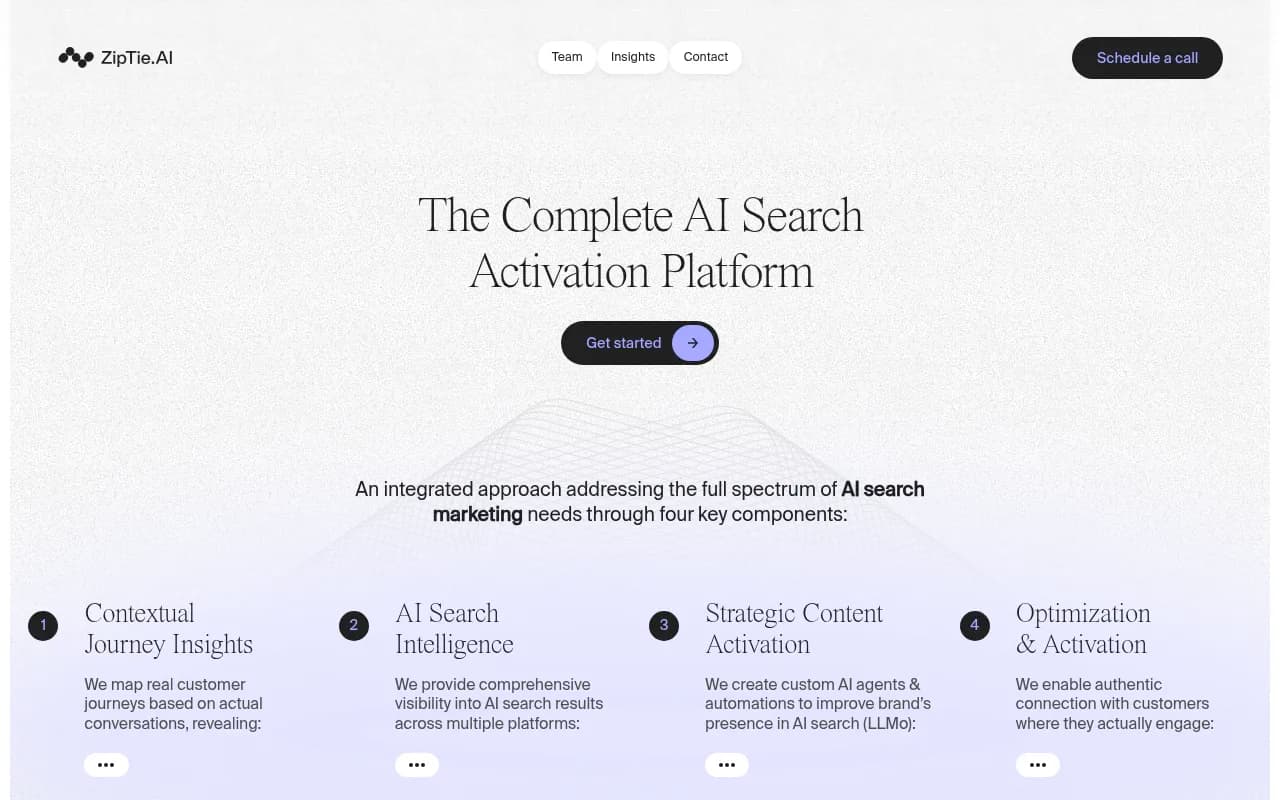
ZipTie: Deep analysis and reporting
ZipTie focuses on detailed reporting and analysis, making it a strong choice for teams that need to present AI visibility data to executives or clients.
What you can test in the trial:
- Multi-engine tracking with detailed breakdowns
- Custom reporting templates
- Competitor benchmarking
- Citation source analysis
Trial limitations: ZipTie is reporting-heavy but light on optimization features. You'll get great dashboards but limited guidance on what to do next.
Pricing after trial: Mid-range pricing (typically $200-$400/month).
Best for: Agencies that need client-ready reports and dashboards.
Comparison table: trial features at a glance
| Tool | AI engines tracked | Competitor analysis | Content generation | Crawler logs | Traffic attribution | Starting price |
|---|---|---|---|---|---|---|
| Promptwatch | 10 | Yes | Yes (AI agent) | Yes | Yes | $99/mo |
| Otterly.AI | 3 | Yes | No | No | No | $25/mo |
| Peec AI | 4+ | Yes | Suggestions only | No | No | €89/mo |
| Profound | 9+ | Yes | No | Limited | No | Enterprise |
| Semrush | 3+ | Yes | Recommendations | No | Limited | $200+/mo |
| ZipTie | Multiple | Yes | No | No | No | $200+/mo |
What most trials won't tell you (but you need to know)
Free trials are designed to show you the best-case scenario. Here's what to watch for:
Prompt limits hide scalability issues
Most trials cap you at 25-100 prompts. That's fine for testing, but real-world monitoring requires 200+ prompts to cover:
- Core product/service terms
- Competitor comparison queries
- Problem-solution prompts
- Alternative/vs. searches
- Regional and persona variations
Ask: What happens when I hit the prompt limit? Can I upgrade mid-trial?
Historical data isn't always available
Some platforms start tracking from the day you sign up. That means you can't see how your visibility has changed over the past 3-6 months unless you pay for historical data.
Ask: Do I get historical visibility data, or am I starting from zero?
"AI-generated content" varies wildly in quality
Tools that offer content generation aren't equal. Some produce generic SEO filler. Others (like Promptwatch) generate articles grounded in real citation data, competitor analysis, and prompt volume insights.
Test this: Generate 2-3 articles during your trial and evaluate whether they're publish-ready or require heavy editing.
Integration friction kills adoption
The best AI visibility tool is worthless if your team won't use it. During trials, test:
- Can you export data to Google Sheets or Looker Studio?
- Does the API work with your existing reporting stack?
- Can you set up automated alerts for visibility drops?
How to pick the right tool for your team
Small teams and solopreneurs
Prioritize affordability and ease of use. You need a tool that shows you what's broken and helps you fix it without a steep learning curve.
Best trial to start with: Otterly.AI for pure monitoring, or Promptwatch if you want optimization features.
Mid-market companies
You need a balance of monitoring, analysis, and action. Look for tools that integrate with your existing SEO and content workflows.
Best trial to start with: Promptwatch (action-oriented) or Peec AI (recommendation-focused).
Enterprise teams
You need scalability, API access, and multi-brand tracking. Analyst-friendly platforms with raw data exports are essential.
Best trial to start with: Profound for deep analysis, or Promptwatch if you want optimization at scale.
Agencies
You need client-ready reporting, white-label options, and the ability to manage multiple brands efficiently.
Best trial to start with: ZipTie for reporting, or Promptwatch for end-to-end client workflows.
Red flags to watch for during trials
Not all trials are created equal. Here's what should make you pause:
Credit card required upfront
Some platforms require payment details before starting a trial. That's fine if cancellation is easy, but check the terms: Do they auto-charge after 7 days? Is there a cancellation fee?
Feature lockouts
Some trials restrict access to core features (e.g., competitor analysis, crawler logs, API access). If the trial doesn't let you test what you'll actually use, it's not a real trial.
Vanity metrics without action
Tools that show you "visibility scores" or "mention counts" without explaining what to do next are monitoring dashboards, not optimization platforms. You'll see the problem but not the solution.
No support during trial
If you can't get help during the trial period, assume support will be worse after you pay. Look for platforms with live chat, onboarding calls, or detailed documentation.
The trial testing checklist
Before you commit to any platform, run through this checklist:
- I can track my brand across at least 3 AI engines (ChatGPT, Perplexity, Google AI Overviews)
- I can compare my visibility to 3-5 competitors
- The tool shows specific content gaps or prompts I'm missing
- I can see which pages get cited (or don't get cited)
- The platform provides actionable recommendations, not just data
- I can export data or integrate with my existing tools
- The pricing is transparent and fits my budget
- I received adequate support during the trial period
If you can't check at least 6 of these boxes, keep testing.
What happens after the trial?
Most teams make one of three mistakes after a trial ends:
- Paralysis by analysis: They test 5+ tools and never commit because they're waiting for the "perfect" platform.
- Feature creep: They pick the tool with the most features, even if they'll never use half of them.
- Sunk cost fallacy: They stick with the first tool they tried because they've already invested time learning it.
Here's a better approach: Pick the tool that solves your biggest problem right now. If your brand is invisible in AI search, you need a platform that helps you create content and close gaps fast (Promptwatch). If you just need to monitor mentions, a simpler tool (Otterly.AI) works fine.
You can always switch later. AI visibility tools are still evolving, and the market will consolidate over the next 12-18 months. Don't overthink it.
Final thoughts
AI search is the new battleground for brand visibility, and free trials are your chance to test tools without risk. The best platforms don't just show you data -- they help you act on it.
Promptwatch leads the pack by combining monitoring, gap analysis, content generation, and tracking in one workflow. But the right tool for you depends on your team size, budget, and how much you want to DIY vs. automate.
Start with a trial. Test the checklist above. Pick the tool that fits your workflow. Then get back to the work that actually matters: creating content that AI engines want to cite.