Key takeaways
- Peec AI is the stronger analytics platform at the mid-market level, with transparent pricing starting around $89-100/month and solid share-of-voice tracking across ChatGPT, Perplexity, and Google AI Overviews.
- Brandlight.ai focuses on brand discovery and recommendation tracking, with a slightly narrower feature set but a cleaner onboarding experience for smaller teams.
- Both tools are monitoring-only -- they show you where you're invisible but don't help you fix it. That's the core limitation to understand before buying either.
- If you're choosing between these two, Peec AI wins on depth of analytics; Brandlight.ai wins on simplicity.
- For teams that need to actually improve their AI visibility (not just measure it), a more complete platform like Promptwatch is worth considering alongside these two.
The AI visibility tool market has gotten crowded fast. In 2025 alone, over $300 million in venture funding poured into this category, and now there are dozens of tools claiming to tell you whether ChatGPT recommends your brand. Most of them do roughly the same thing: run prompts, scrape responses, count mentions, show you a dashboard.
Brandlight.ai and Peec AI sit in the budget-to-mid-tier range -- both accessible enough for marketing teams without enterprise budgets, both focused on monitoring rather than optimization. But they're not identical, and the differences matter depending on what you're actually trying to accomplish.
This guide breaks down both tools honestly, compares them on the dimensions that matter, and tells you which one to pick (and when neither might be the right answer).
What these tools actually do
Before getting into the comparison, it's worth being clear about what "AI visibility monitoring" means in practice.
Both Brandlight.ai and Peec AI work by simulating real user queries across AI search engines -- ChatGPT, Perplexity, Google AI Overviews, and a handful of others. They run those prompts on a schedule, capture the responses, and analyze whether your brand appears, how often, and in what context. The output is typically a share-of-voice metric, a citation count, and some competitive benchmarking.
That's genuinely useful data. Knowing that Perplexity recommends your competitor three times more often than you in response to "best [your category] tool" is actionable intelligence -- at least in theory. The question is what you do with it.

Peec AI: the mid-market analytics play
Peec AI has had a strong 2025-2026 run. According to Surmado's analysis of the AI visibility market, the company raised $29 million and hit $4M+ ARR in roughly ten months -- which is fast for a niche B2B SaaS tool. That growth has translated into a reasonably mature product.
What Peec AI does well
The platform uses UI scraping (not just API calls) to simulate how real users experience AI search engines. This matters because what you see in a ChatGPT conversation and what you get from the OpenAI API can differ -- the user-facing product sometimes surfaces different sources, shopping recommendations, and citations.
Peec AI's core output is share-of-voice data: what percentage of relevant AI responses mention your brand versus competitors. You can slice this by prompt, by AI engine, and by competitor. The interface is clean and the data is relatively easy to interpret without a data analyst on hand.
Pricing starts at around $89-100/month (EUR 89 on some plans), which puts it in genuine mid-market territory. That's not cheap for a small team, but it's accessible compared to enterprise platforms like Profound, which is aimed squarely at Fortune 500 budgets.
Where Peec AI falls short
The honest limitation is that Peec AI stops at the dashboard. It tells you that you're invisible for certain prompts. It doesn't tell you why, and it doesn't help you fix it. There's no content generation, no gap analysis that maps to specific content recommendations, and no crawler log data showing how AI engines are actually interacting with your site.
For B2B marketing leaders who want to move the needle on AI citations, not just measure them, this is a real gap. You'll need a separate content strategy and execution layer on top of Peec AI's data.
Brandlight.ai: simpler, narrower, and built for brand discovery
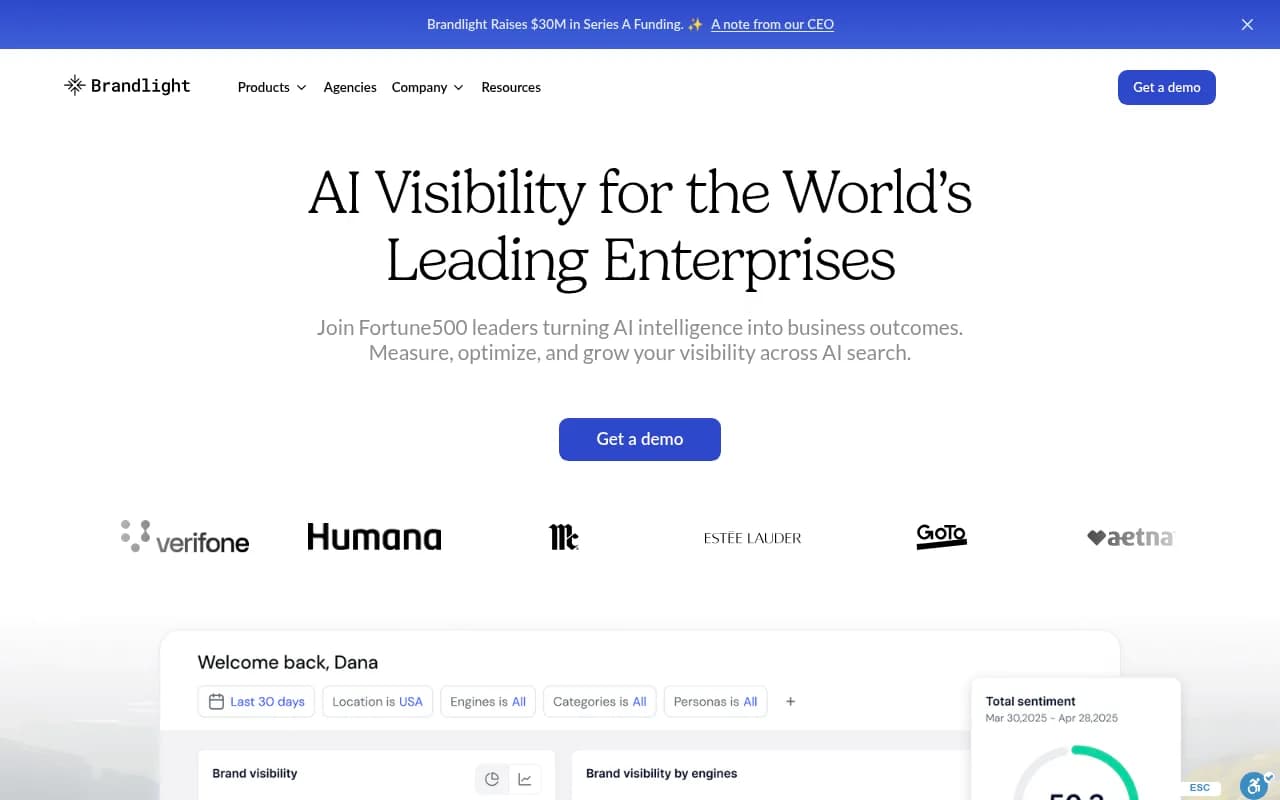
Brandlight.ai takes a slightly different angle. Where Peec AI leans into competitive analytics and share-of-voice metrics, Brandlight.ai focuses more on brand discovery -- specifically, tracking when and how AI engines recommend your brand in response to product or service queries.
What Brandlight.ai does well
The onboarding is faster and the interface is more approachable for teams that don't have a dedicated SEO or analytics person. If you're a founder or a small marketing team that just wants to know "does ChatGPT mention us when someone asks about [our category]?", Brandlight.ai answers that question without requiring you to configure a lot of prompt infrastructure.
It also tracks brand sentiment in AI responses -- not just whether you're mentioned, but how you're described. That's a useful dimension that pure citation-count tools sometimes miss.
Where Brandlight.ai falls short
The feature set is narrower. Competitive benchmarking is less detailed than Peec AI's share-of-voice analysis. Coverage across AI engines is more limited. And like Peec AI, there's no optimization layer -- you're getting a monitoring dashboard, not a tool that helps you improve your position.
Brandlight.ai is also a smaller, less-funded player. That's not inherently a problem, but it's worth factoring in when evaluating long-term product roadmap and support quality.
Head-to-head comparison
| Feature | Brandlight.ai | Peec AI |
|---|---|---|
| Starting price | Lower (budget tier) | ~$89-100/month |
| AI engines covered | Limited | ChatGPT, Perplexity, Google AI Overviews + more |
| Share-of-voice tracking | Basic | Strong |
| Competitive benchmarking | Limited | Solid |
| Sentiment tracking | Yes | Limited |
| Content generation | No | No |
| Crawler log data | No | No |
| Content gap analysis | No | No |
| UI scraping (vs API only) | Unclear | Yes |
| Onboarding complexity | Low | Medium |
| Best for | Small teams, brand discovery | Mid-market analytics |
The monitoring-only problem
Here's the thing both tools share that's worth naming directly: they're both diagnostic tools, not optimization tools.
This is the defining split in the AI visibility market right now. Some platforms show you the problem. Others help you fix it. Brandlight.ai and Peec AI are firmly in the "show you the problem" camp.
That's fine if you have a content team that can take the data and run with it. But for most marketing teams, knowing you're invisible in Perplexity for "best CRM for small business" doesn't automatically translate into knowing what content to create, which pages to update, or how to build the authority signals that would actually move the needle.
Peec AI's own reviewers have noted this explicitly -- the platform "stops at diagnosis" and doesn't write content, build authority signals, or implement technical optimizations. Brandlight.ai has the same limitation.
If you're evaluating these tools, be honest with yourself about whether you have the internal capacity to act on the data they provide. If you do, either tool can be a useful input. If you don't, you may end up paying for a dashboard that tells you something is wrong without giving you a path to fix it.
When to choose Peec AI
Peec AI makes sense if:
- You're a B2B marketing team that wants serious competitive benchmarking across AI engines
- You have the internal resources to translate share-of-voice data into content strategy
- You're comfortable with a $89-100/month price point for monitoring data
- You want UI-scraped data (not just API outputs) for more accurate real-world representation
It's the stronger analytical tool of the two, and for mid-market teams that know what they want to do with the data, it delivers.
When to choose Brandlight.ai
Brandlight.ai makes sense if:
- You're a smaller team or founder who wants simple, fast answers about brand visibility
- Sentiment tracking (how AI describes your brand, not just whether it mentions you) is a priority
- You want lower complexity and faster time-to-insight
- Budget is a constraint and you don't need deep competitive analytics
It's a more accessible entry point, but you'll hit its ceiling faster as your AI visibility program matures.
What to consider beyond these two
If you're in the market for an AI visibility tool and you're evaluating Brandlight.ai and Peec AI, it's worth knowing what the broader market looks like -- because both tools represent only part of what's possible.
At the entry level, tools like Otterly.AI offer basic monitoring at lower price points.
Otterly.AI

At the mid-market level, Peec AI is genuinely competitive. But if you want to go further -- actually improving your AI visibility rather than just tracking it -- the gap between monitoring tools and optimization platforms is significant.
Promptwatch is one of the few platforms that closes that gap. It tracks AI visibility across 10 models (ChatGPT, Perplexity, Claude, Gemini, Google AI Overviews, and more), but it also includes content gap analysis that shows exactly which prompts competitors are visible for and you're not, plus Content Agents that generate articles and briefs grounded in real prompt data. That's a fundamentally different workflow from what Brandlight.ai or Peec AI offer.

For enterprise needs, Profound has the deepest feature set and the biggest client roster (Fortune 500 brands), but the price reflects that.
Profound

The honest framing: if you're just starting to measure AI visibility and want to understand the landscape, Peec AI or Brandlight.ai can get you there. If you want to actually move your numbers, you'll eventually need a tool that goes beyond the dashboard.
The bottom line
Peec AI is the better tool for most teams comparing these two. It has stronger analytics, more AI engine coverage, UI-scraped data for accuracy, and a track record of product development backed by real funding. The $89-100/month price is reasonable for what you get.
Brandlight.ai is a legitimate option for smaller teams that prioritize simplicity and sentiment tracking over competitive depth. It's not a bad tool -- it just has a narrower scope.
Neither tool will help you fix the gaps they find. That's not a criticism unique to them -- it's true of most monitoring-only platforms. But it's the most important thing to understand before you buy: you're purchasing visibility into a problem, not a solution to it. Make sure you have a plan for what happens after the dashboard tells you something is wrong.
If your goal is to actually improve how often AI engines recommend your brand -- not just measure it -- factor that into your evaluation from the start.