Key takeaways
- Answer gap analysis -- finding which prompts your competitors rank for but you don't -- is the most valuable feature in any AI visibility platform, and most tools either don't have it or treat it as an afterthought.
- Promptwatch is the only platform in this comparison that closes the full loop: it finds your gaps, generates content to fill them, and tracks whether that content gets cited.
- Profound has strong enterprise-grade monitoring and handles citation drift well, but its gap analysis doesn't connect to content creation.
- Otterly.AI is a solid monitoring tool for teams that just want to track mentions, but it stops well short of gap analysis.
- Brandlight.ai sits somewhere in the middle -- more than basic monitoring, but not yet a full optimization platform.
- If your goal is to actually improve your AI visibility (not just measure it), the platform you choose matters enormously.
Profound's own data shows that brands experience 40-60% citation drift every month across major AI platforms. That means roughly half of what you're visible for today could disappear by next month -- and half of what you're invisible for today could become an opportunity. That's not a monitoring problem. That's an optimization problem.
Most AI visibility tools were built to solve the monitoring problem. They show you where you appear, how often, and which models cite you. That's useful. But it doesn't tell you what you're missing, why you're missing it, or what to do about it.
Answer gap analysis is the feature that changes this. It maps the prompts where your competitors are getting cited and you're not -- giving you a concrete list of content opportunities grounded in real AI behavior. Done well, it's the most actionable output any GEO platform can produce.
This comparison focuses specifically on that capability across four platforms: Brandlight.ai, Promptwatch, Profound, and Otterly.AI. We'll look at how each approaches gap analysis, what you can actually do with the output, and which platform makes the most sense depending on your situation.
What answer gap analysis actually means
Before comparing tools, it's worth being precise about what "answer gap analysis" means -- because platforms use the term loosely.
At its most basic, gap analysis means: "Here are prompts where Competitor A gets cited and you don't." That's a visibility gap. Useful, but incomplete.
A more useful version adds: "Here's the specific content your site is missing that would make AI models cite you for these prompts." That's a content gap. This is where monitoring ends and optimization begins.
The best implementations go further: they connect gap data to content generation, so you can move from "we're missing this" to "here's a draft article that addresses it" in a single workflow. Then they track whether the new content actually gets picked up by AI crawlers and cited in responses.
Most platforms in this space do the first thing. A few do the second. Almost none do all three.
Promptwatch: the full loop
Promptwatch is built around what it calls the Action Loop: find gaps, create content, track results. Answer gap analysis is step one of that loop, and it's designed to feed directly into the other two steps.

The Answer Gap Analysis feature shows you exactly which prompts competitors are visible for that you're not. This isn't just a list of prompts -- it includes prompt volume estimates, difficulty scores, and query fan-outs that show how one prompt branches into related sub-queries. So instead of getting a flat list of gaps, you get a prioritized view of which gaps are worth pursuing first.
What separates Promptwatch from every other tool in this comparison is what happens after the gap analysis. Content Agents take the gap data and generate articles, listicles, comparisons, and briefs grounded in real prompt data, citation patterns, competitor analysis, and brand guidance. This isn't generic content -- it's written specifically to answer the prompts where you're currently invisible.
Then, AI Crawler Logs and Agent Analytics show you when AI crawlers (ChatGPT, Claude, Perplexity, etc.) visit those new pages, and when those pages move from "crawled" to "cited." You can see the timeline from publish to citation, and traffic attribution connects that visibility to actual revenue.
Promptwatch also tracks AI responses from real user interfaces, not just APIs. This matters because what ChatGPT shows a real user can differ from what the API returns -- and you want to know what your customers actually see.
Coverage spans 10 AI models: ChatGPT, Perplexity, Google AI Overviews, Google AI Mode, Claude, Gemini, Meta/Llama, DeepSeek, Grok, and Copilot. It also tracks Reddit and YouTube as citation sources -- a channel most competitors ignore entirely -- and monitors ChatGPT Shopping recommendations and entity mentions.
Pricing starts at $99/month (Essential: 1 site, 50 prompts, 5 articles), $249/month (Professional: 2 sites, 150 prompts, 15 articles, crawler logs), and $579/month (Business: 5 sites, 350 prompts, 30 articles). A free trial is available.
The honest limitation: the content generation features are most useful if you're willing to treat them as a starting point and edit from there. Promptwatch generates content grounded in real data, but your team still needs to review and refine it.
Profound: strong monitoring, limited action
Profound is a well-regarded enterprise platform with solid citation tracking and good model coverage. It handles the monitoring side of AI visibility competently, and its data on citation drift (that 40-60% monthly figure) reflects genuine research depth.
Profound

On gap analysis specifically, Profound does surface competitive visibility comparisons. You can see which prompts competitors appear in that you don't. The data quality is good, and the interface is clean for enterprise teams.
The gap, so to speak, is what happens next. Profound's gap analysis outputs are primarily analytical -- they show you the problem without providing a clear path to solving it. There's no content generation layer, no AI crawler monitoring, and no direct connection between "here's what you're missing" and "here's how to fix it."
For enterprise teams with dedicated content teams who can take gap data and run with it independently, this might be fine. But for most marketing teams, the missing link between insight and action is a real friction point.
Profound also doesn't track Reddit or YouTube as citation sources, and there's no ChatGPT Shopping monitoring. At its price point (custom enterprise pricing, generally higher than mid-market alternatives), the lack of these features is noticeable.
Where Profound genuinely excels is in handling large-scale prompt sets and providing reliable data for enterprise reporting. If you're a Fortune 500 brand with a dedicated SEO team and you primarily need monitoring and reporting, Profound is a credible choice. If you need the gap analysis to actually drive content output, you'll need to build that workflow yourself.
Otterly.AI: monitoring done well, gap analysis done minimally
Otterly.AI is a monitoring-first platform. It tracks brand mentions across ChatGPT, Perplexity, and Google AI Overviews, and it does this reliably. The interface is clean, setup is fast, and for teams that just want to know "are we being cited?" it works.
Otterly.AI

Gap analysis in Otterly.AI is limited. You can compare your visibility against competitors at a high level, but there's no prompt-level gap breakdown, no prioritization by volume or difficulty, and no content recommendations. It's closer to "here's a visibility score comparison" than "here are the specific prompts you're missing."
There are no AI crawler logs, no visitor analytics, no content generation features, and no Reddit or YouTube tracking. The platform is essentially a dashboard that shows you data and leaves you to figure out what to do with it.
That's not a criticism of what Otterly.AI is -- it's a good monitoring tool. But if you're evaluating platforms specifically for answer gap analysis, Otterly.AI isn't built for that use case.
Pricing is accessible (starting around the $49-99/month range depending on plan), which makes it a reasonable entry point for teams that are just starting to track AI visibility and aren't ready to invest in a full optimization platform.
Brandlight.ai: more than monitoring, less than optimization
Brandlight.ai sits between monitoring-only tools and full optimization platforms. It tracks how AI engines discover and recommend your brand, with some competitive comparison features that go beyond what Otterly.AI offers.
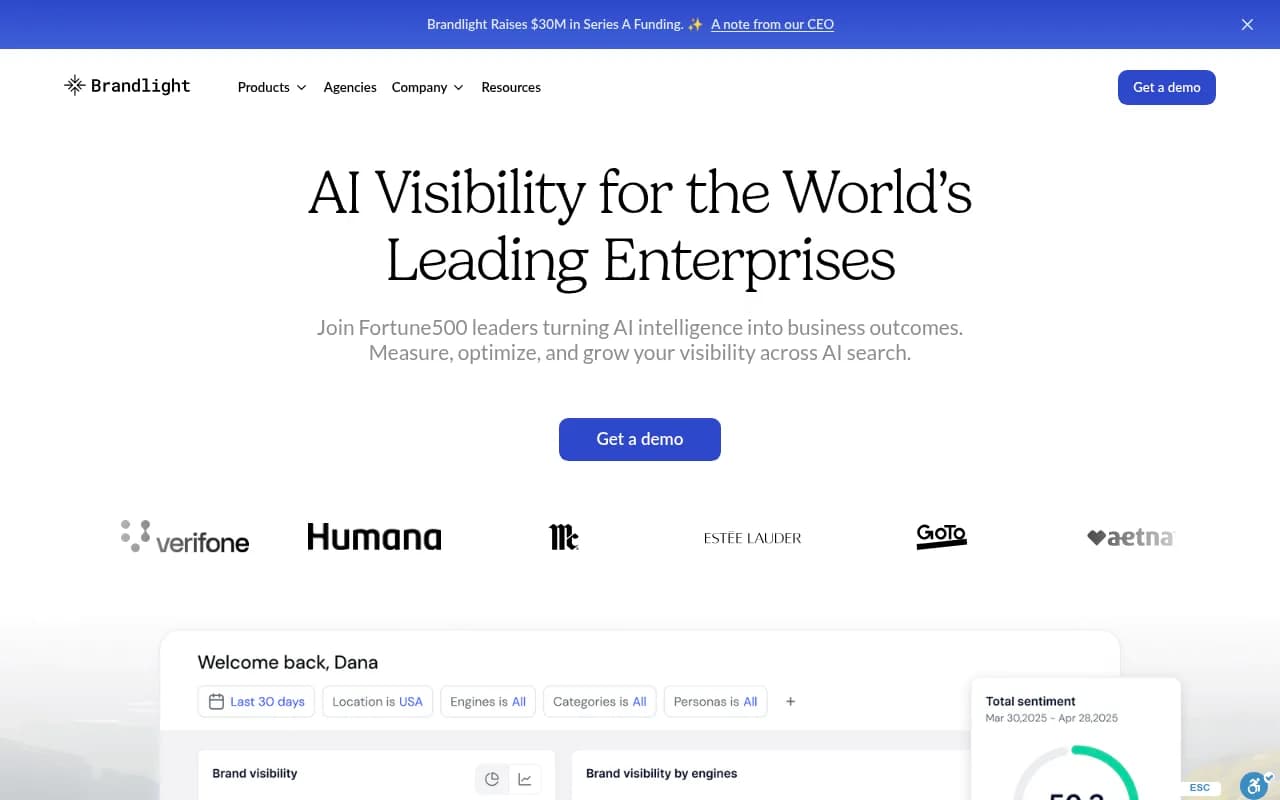
On gap analysis, Brandlight.ai provides competitive visibility comparisons and some prompt-level data. It's more granular than Otterly.AI's high-level scores, but it doesn't reach the depth of Promptwatch's prioritized gap lists with volume and difficulty scoring.
The platform doesn't have content generation capabilities, AI crawler logs, or Reddit/YouTube tracking. There's no direct path from "here's your gap" to "here's content that fills it." Like Profound, it surfaces the insight but leaves the action to you.
Brandlight.ai's positioning seems aimed at brands that want more than basic monitoring but aren't ready for the full complexity of an enterprise platform. It's a reasonable middle ground for that specific use case, but it's worth being clear-eyed about what you're getting: better visibility data than Otterly.AI, but still a monitoring tool at its core.
Feature comparison
| Feature | Promptwatch | Profound | Otterly.AI | Brandlight.ai |
|---|---|---|---|---|
| Answer gap analysis | Full (prompt-level, prioritized) | Partial (analytical only) | Minimal (high-level) | Partial (competitive comparison) |
| Prompt volume & difficulty scoring | Yes | No | No | No |
| Query fan-outs | Yes | No | No | No |
| Content generation from gaps | Yes (Content Agents) | No | No | No |
| AI crawler logs | Yes | No | No | No |
| Traffic attribution | Yes | No | No | No |
| Reddit & YouTube tracking | Yes | No | No | No |
| ChatGPT Shopping tracking | Yes | No | No | No |
| AI model coverage | 10 models | 9+ models | 3 models | Limited |
| Real UI monitoring (not just API) | Yes | Partial | No | No |
| Pricing (entry) | $99/mo | Custom (enterprise) | ~$49/mo | Custom |
| Free trial | Yes | Limited | Yes | Yes |
Which platform should you choose?
The right answer depends on what you actually need from gap analysis.
If you want to find gaps and fix them in a single workflow, Promptwatch is the clear choice. It's the only platform here that connects gap discovery to content creation to citation tracking. The 1,480+ brands using it -- including Booking.com and Center Parcs -- aren't there for the monitoring dashboards. They're there because the Action Loop actually produces results.
If you're an enterprise team with existing content resources and you primarily need reliable monitoring and reporting, Profound is worth evaluating. The data quality is strong and it handles large-scale prompt sets well. Just go in knowing you'll need to build your own workflow to act on the gap data.
If you're just starting out and want to understand your AI visibility without committing to a full platform, Otterly.AI is a reasonable starting point. It won't give you meaningful gap analysis, but it will tell you where you stand.
If you want something between monitoring and optimization and Profound's pricing is out of reach, Brandlight.ai is worth a look. It offers more competitive depth than Otterly.AI, even if it doesn't close the loop to content creation.
The question worth asking
Before choosing a platform, ask yourself: what happens after I see the gap?
If the answer is "my team will figure it out," then monitoring tools like Otterly.AI or Brandlight.ai might be enough. If the answer is "we need a system that helps us act on it," then the choice narrows considerably.
Citation drift is real. Profound's 40-60% monthly figure means the AI visibility landscape is constantly shifting. A monitoring dashboard tells you when you've drifted. An optimization platform helps you drift in the right direction.
That distinction -- between knowing and doing -- is what this comparison ultimately comes down to.