Key takeaways
- Brandlight and Semrush's AI Visibility Toolkit solve different problems for different buyers. Brandlight is a dedicated, enterprise-grade GEO platform with managed strategy support and custom (opaque) pricing. Semrush's toolkit is a $99/month add-on bolted onto an existing SEO suite.
- Pricing is the clearest differentiator. Semrush starts at $99/mo with 25 tracked prompts, but per-domain, per-user, and per-prompt-block fees add up fast. Brandlight has no public pricing at all, with third-party estimates ranging from ~$199/mo entry to $4K–$25K+/mo for enterprise contracts.
- Semrush wins on convenience if you already use Semrush. Brandlight wins on depth, multi-brand governance, compliance (SOC 2, SSO, RBAC), and hands-on strategy help.
- Neither is ideal for agencies or lean teams that need monitoring and execution at a predictable price. A third option like Promptwatch covers the full loop, from crawler logs to automated content publishing, at published prices.
AI search has split the SEO tool market into two camps. On one side, dedicated GEO platforms built from scratch to answer one question: how do I get cited and recommended inside AI answers? On the other, legacy SEO suites bolting AI visibility modules onto existing products.
Brandlight.ai sits firmly in the first camp. Semrush's AI Visibility Toolkit sits in the second. Comparing them head-to-head is useful precisely because they represent the two dominant buying strategies in 2026: buy a purpose-built platform with strategy support, or extend a tool you already pay for.
This guide breaks down where each one wins, where each one falls short, and when you should pick neither.
What each tool actually is
Before comparing features, it helps to understand what each product is trying to be. The philosophical difference matters more than any individual feature checkbox.
Brandlight: a dedicated GEO platform with a service layer
Brandlight markets itself as an enterprise AEO/GEO platform running a full "See → Shape → Act → Transform" loop across owned, third-party, social, retail, and emerging agentic-commerce surfaces. The pitch is that AI visibility isn't won on your own domain. Brandlight's own analysis estimates roughly 85% of sources AI engines cite for category questions are third-party or social, so a visibility tool has to see and act on that whole ecosystem.
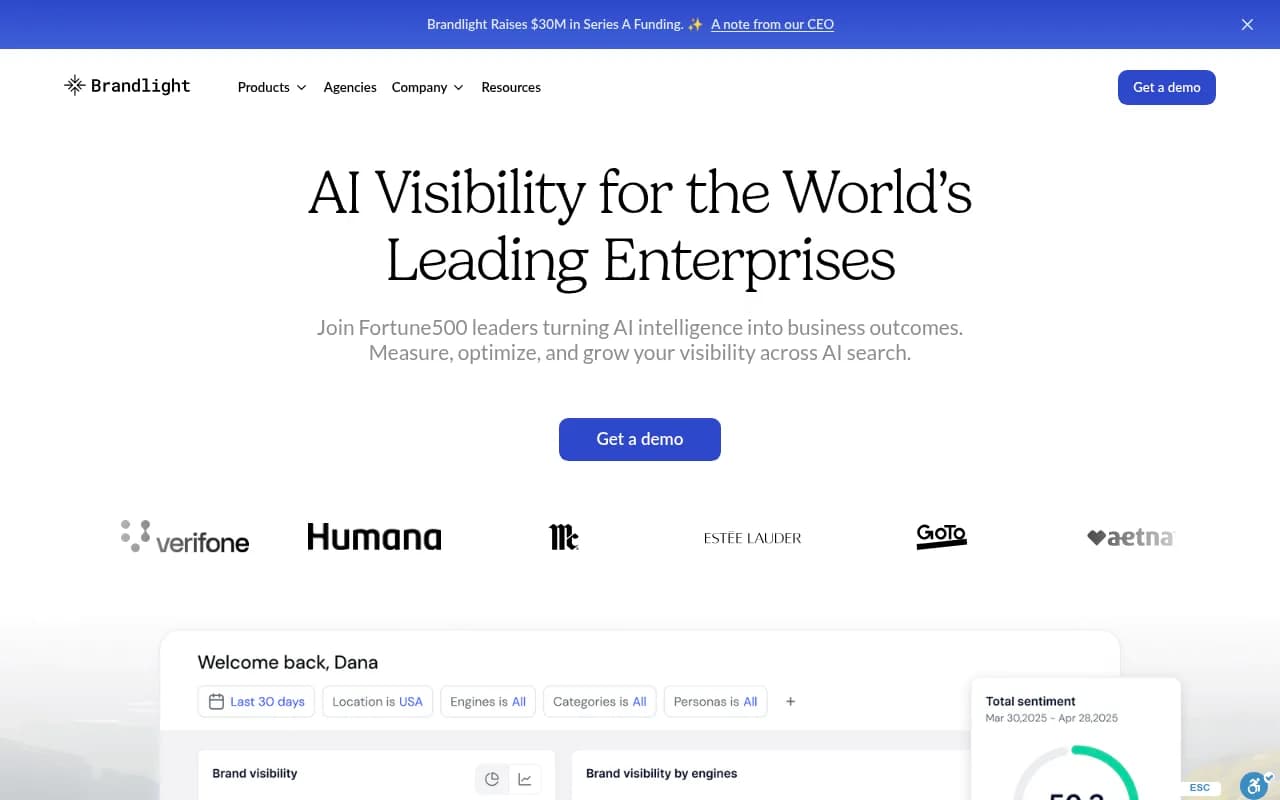
In practice, Brandlight bundles four modules: Visibility Insights, Content, Partnerships, and Commerce. It targets Fortune 500 and multi-brand enterprises, with named customers including Volkswagen Group, Publicis Groupe, Caesars Entertainment, LG, Kimberly-Clark, and several regulated-industry brands like Humana, Aetna, The Hartford, and Prudential. Compliance features (SOC 2 Type II, SSO, RBAC) are a big part of why healthcare and financial services buyers choose it.
There's also a managed service layer. A dedicated AI strategist works with your team, which explains both the pricing model and the implementation timelines. G2 reviewers report an average of two months to implement and seven months to see ROI. That's a serious commitment, not a self-serve subscription.
Semrush AI Visibility Toolkit: an add-on to a familiar suite
Semrush needs less introduction. Its AI Visibility Toolkit is an add-on module that brings AI search data into the same interface as your keyword research, rank tracking, and site audits.
The toolkit includes four core pieces: Prompt Research (topic-level volume, difficulty, and intent, essentially keyword research for AI), Brand Performance (share of voice, sentiment, narratives, and AI-generated strategic recommendations), Prompt Tracking (daily visibility monitoring on Google AI Mode and ChatGPT), and AI Search Site Audit (a health widget that flags crawler-blocking issues on up to 100 pages).
Engine coverage is ChatGPT, Perplexity, Gemini, and Google AI Mode. That's a reasonable list, but reviewers consistently note it's narrower than dedicated platforms, and the language and regional coverage is limited enough to frustrate global brands.
Head-to-head comparison
Pricing
Pricing is where these two products diverge most sharply, and where both have real problems.
| Semrush AI Visibility Toolkit | Brandlight | |
|---|---|---|
| Entry price | $99/mo standalone | Custom quote only (no public pricing) |
| What entry includes | 1 domain, 25 prompts, 300 daily AI-analysis queries, 100-page AI site audit | Full platform + managed strategy support |
| Scaling costs | +$99/mo per domain, +$99/mo per user, +$60/mo per 50 extra prompts | Third-party estimates: ~$199/mo entry, $4K–$25K+/mo enterprise (unverified) |
| Free trial | Unclear (Semrush's own KB says no; some reviewers cite a 7-day trial) | No, contact sales only |
| Bundle option | Semrush One at $199/mo (SEO + AI, 50 prompts, 5 websites) | N/A |
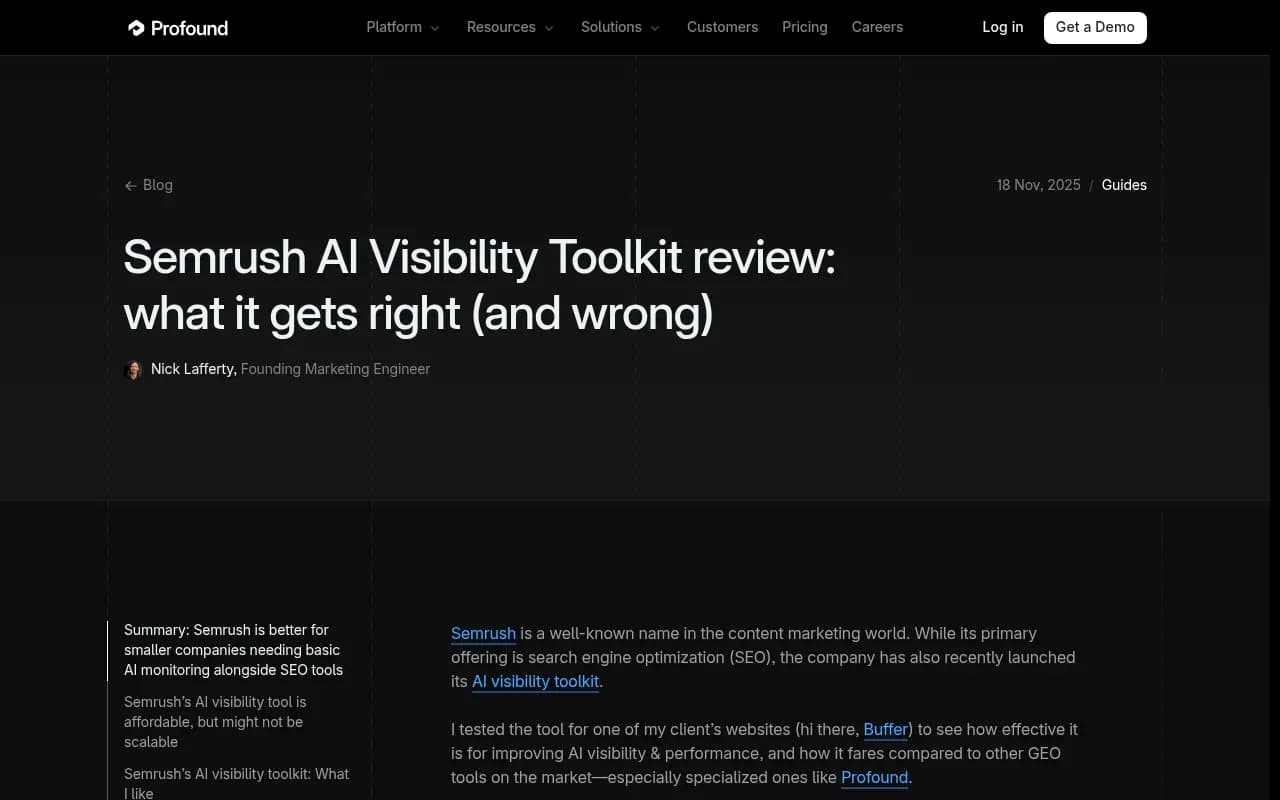
Semrush's pricing looks cheap at first glance, but the add-on structure invites cost creep. Profound's review worked out that adding one extra teammate plus 50 extra prompts pushes the bill to $258/month, before you've added a second domain. For an agency managing ten client domains, the math gets ugly fast: ten domains alone is $990/month.
Brandlight's pricing opacity is a different problem. There's no public pricing page at all (the /pricing URL returns a 404), which CheckThat.ai's review notes extends sales cycles and makes competitive RFPs harder for CMOs. Third-party estimates suggest entry around $199/month with enterprise contracts in the four-to-five figures, but these are unverified and vary by source. If your procurement process requires three comparable quotes, expect friction.
Feature depth and actionability
Both tools promise insights, but they differ in what you can actually do with them.
Semrush's Brand Performance module generates AI-powered strategic recommendations, but Profound's teardown found them informative rather than prescriptive. The review's verdict: the insights "aren't suggestions you can implement quickly." There's also no audience-segmentation feature, which limits how well you can tailor analysis to different buyer personas.
Brandlight's whole positioning is the "Shape" and "Act" stages: content optimization, partnership identification, and commerce surface management, all informed by the visibility data. G2 reviewers echo this. One senior SEO manager noted that Brandlight "goes beyond the basic AEO/GEO data and tactics" and "fills in gaps that our other data sets cannot." The trade-off is complexity. Multiple reviews mention a learning curve due to the platform's extensive feature set.
Engine and regional coverage
Semrush covers ChatGPT, Perplexity, Gemini, and Google AI Mode. That's the big four, but it's missing Claude, Grok, Copilot, and the fast-moving long tail of new models. Its language and regional coverage is limited, which Profound flags as a real constraint for global brands.
Brandlight doesn't publish a detailed coverage matrix, but its multi-brand, multi-market positioning (and customer base spanning global enterprises) suggests broader coverage is part of the enterprise package. If you operate in multiple languages and regions, this is a question to put directly to their sales team.
Support and onboarding
Semrush is self-serve. You get documentation, standard support channels, and a cancellation process that at least one reviewer described as "roundabout." Brandlight includes a dedicated AI strategist as part of the package, which is genuinely valuable if your team is still building AI search expertise, but it's also why the product requires a sales conversation and a two-month average implementation.
What the AI search data says about which problems actually matter
Feature lists only tell part of the story. The behavior of AI engines themselves should shape what you need from a visibility tool.
ChatGPT typically cites around 5 sources per web-search answer, while Google AI Overviews cites about 10, according to Promptwatch's analysis of average sources per response. That scarcity matters: with only ~5 citation slots per ChatGPT answer, each one is heavily contested. A monitoring tool that tells you you're invisible is table stakes. What you need is a path to actually claiming one of those slots.
The content format being cited is also shifting. In July 2026, product pages were the single most-cited content type in ChatGPT Search at 32.8% of daily citations, nearly double their share from March 2026, per Promptwatch's ChatGPT citation type data. Listicles were the fastest-growing format within the month. If your GEO strategy is still built around blog posts alone, both of these tools will show you the gap, but only a platform with content execution built in will help you close it.
Where each tool wins
Choose Semrush AI Visibility Toolkit if...
- You already use Semrush for SEO and want AI data beside your existing stack without adding another vendor
- You have one domain and a modest prompt set (25 prompts covers a focused brand)
- Your team can translate strategic insights into action on their own
- Budget is tight and $99/month fits, with limited add-ons
The honest summary from multiple reviews: Semrush's toolkit is "perfect for someone already using Semrush" who wants basic AI monitoring bundled with familiar SEO data. As a standalone purchase, it's harder to justify.
Choose Brandlight if...
- You're a multi-brand enterprise needing governance, SSO, RBAC, and SOC 2 compliance
- You operate in regulated industries where those compliance features are non-negotiable
- You want strategy help built into the product, not just a dashboard
- You have the budget and patience for a two-month implementation and a custom contract
Brandlight's G2 profile tells an interesting story here. Despite enterprise-only marketing, the review breakdown skews mid-market: 110 mid-market reviews versus 36 enterprise reviews. Smaller companies are buying it too, likely drawn by the managed support model.
Consider a third option if...
Both tools have the same structural weakness from different directions: Semrush monitors but doesn't deeply execute, and Brandlight executes but at enterprise cost and complexity. If you're an agency, a lean in-house team, or a mid-market brand that needs the full loop, monitoring plus optimization plus content execution, at a predictable published price, neither is an obvious fit.
Promptwatch covers that middle ground. It tracks visibility across ChatGPT, Claude, Gemini, Perplexity, Grok, and Google AI Overviews and AI Mode, shows why you're visible or not through AI crawler logs, and closes the loop with automated content generation and CMS publishing. Pricing is published and starts at $95/month with a free tier for testing.

Quick decision framework
| Your situation | Best fit |
|---|---|
| Existing Semrush customer, single domain, focused prompt set | Semrush AI Visibility Toolkit |
| Multi-brand enterprise, regulated industry, compliance requirements | Brandlight |
| Agency managing many client domains on a budget | Neither, consider Promptwatch or another dedicated GEO platform |
| Team that needs monitoring and hands-on optimization | Promptwatch or Brandlight, depending on budget |
| Global brand needing multi-language, multi-region tracking | Brandlight (verify coverage in sales call) or Promptwatch |
The bottom line
The "dedicated platform vs. add-on" question doesn't have a universal answer, because it's really a question about your team. If you have a mature SEO operation already running on Semrush and you want a first, low-cost window into AI visibility, the add-on is a sensible start. If you're a multi-brand enterprise with compliance requirements and budget for a strategic partner, Brandlight's dedicated approach earns its premium.
What neither extreme handles well is the messy middle: teams that need real optimization capability, published pricing, and broad engine coverage without enterprise procurement overhead. That gap is exactly why the dedicated GEO platform category keeps growing. If you're weighing options beyond these two, the GEO software directory at bestgeosoftware.com has a wider field to compare.