Key Takeaways
- AI search will overtake traditional search by end of 2027: AI platforms like ChatGPT, Perplexity, and Google AI Overviews are rapidly becoming the primary way customers discover local businesses, fundamentally changing how visibility works
- 86% of AI recommendations come from three sources you control: Your website content, business listings (Google Business Profile, Yelp, Apple Maps), and customer reviews across platforms determine whether AI engines cite your business
- Local search is no longer about rankings—it's about trust signals: AI systems evaluate behavioral data, engagement metrics, and data consistency across platforms to determine which businesses to recommend
- The visibility gap is widening fast: 88% of local markets already show declining visibility for businesses that haven't adapted to AI search, and the gap accelerates as AI adoption grows
- Action beats monitoring: Most businesses are stuck tracking their decline in dashboards. The winners are fixing data gaps, generating AI-optimized content, and building the trust signals AI systems reward
The Platform Shift Nobody Warned You About
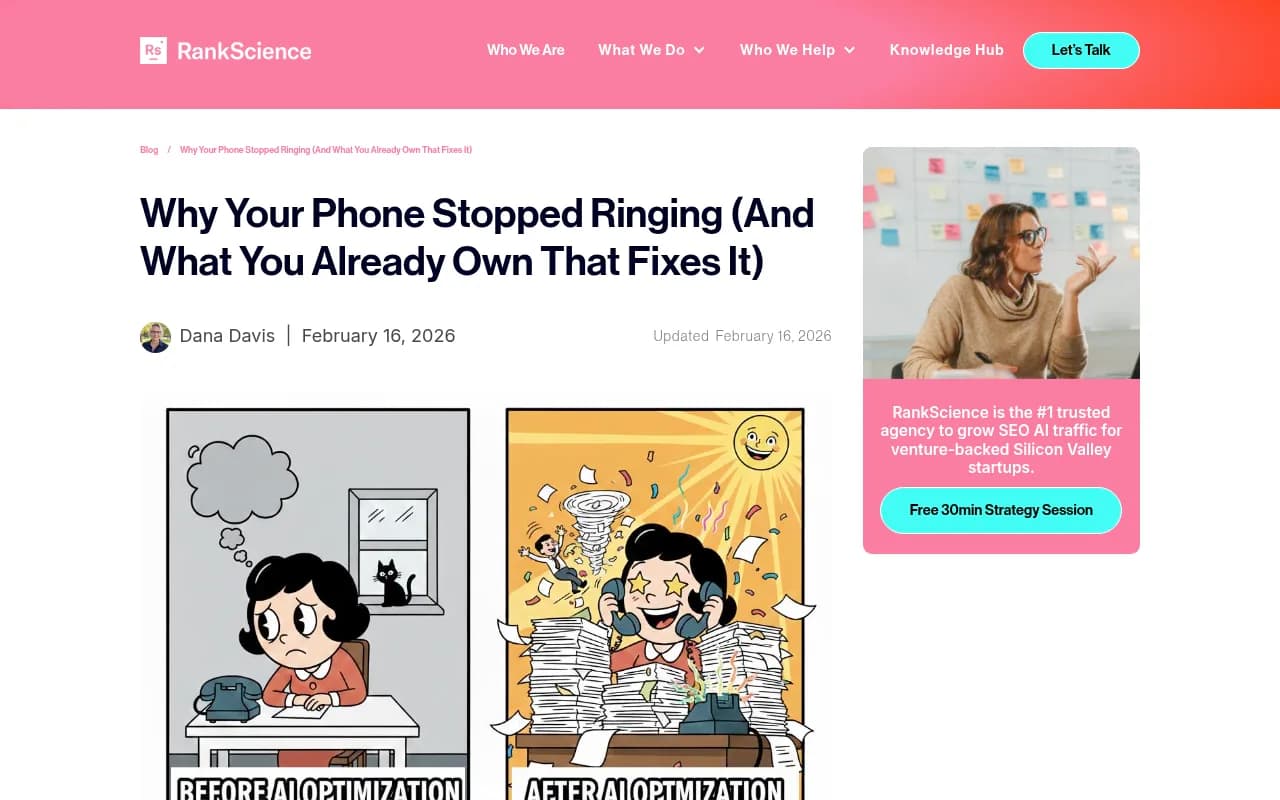
Your Google rankings look fine. Your Google Business Profile is claimed and verified. Your reviews are decent. But your phone stopped ringing.
This isn't a seasonal dip or a marketing problem. It's a platform shift.
By the end of 2027, AI-driven search will surpass traditional search as the primary way customers discover local businesses. This isn't speculation—it's already happening. In February 2026, 45% of consumers reported using AI tools like ChatGPT for local business recommendations, up from just 6% one year earlier.
The difference between traditional search and AI search isn't just interface design. It's fundamentally different in how decisions get made:
Traditional search retrieves results from a database based on keyword matching and ranking signals. You search "plumber near me," Google shows you a list of plumbers ranked by relevance, proximity, and authority.
AI search uses machine inference to compose answers from multiple sources. You ask "I need a plumber who can fix a burst pipe tonight," and ChatGPT or Perplexity synthesizes information from your website, reviews, business listings, Reddit discussions, and other sources to recommend specific businesses that match your exact need.
The shift isn't just about technology—it's about customer behavior. AI search answers questions instead of returning links. It makes recommendations instead of showing options. It acts on behalf of users, increasingly without requiring them to click through to your website or even see your business listing.
This creates a fundamental problem: the data that determines whether AI recommends your business exists outside your control. Your website is just one input. Your Google Business Profile is another. Your Yelp reviews, Facebook page, Apple Maps listing, Reddit mentions, YouTube videos about your business—all of these feed into AI systems that decide whether to cite you.
And if that data is incomplete, inconsistent, or outdated, you become invisible.
How AI Composes Local Recommendations (And Why Most Businesses Are Failing)
AI platforms don't rank businesses the way Google does. They evaluate trust, relevance, and data quality across multiple sources, then compose recommendations based on what they find.
According to the 2026 Whitespark Local Search Ranking Factors report, AI platforms cite your website, business listings, and reviews for 86% of their recommendations. The remaining 14% comes from third-party sources like Reddit discussions, YouTube videos, news articles, and other user-generated content.
Here's what that means in practice:
Your Website Content Determines Topical Relevance
AI systems crawl your website to understand what services you offer, what problems you solve, and what makes you different from competitors. If your website lacks detailed service pages, location-specific content, or clear answers to common customer questions, AI models have nothing to cite.
Example: A customer asks ChatGPT, "Which HVAC company in Austin can install a heat pump in a historic home?" If your website has a dedicated page about heat pump installations with case studies from historic properties, you get cited. If your website just says "HVAC services in Austin," you don't.
Business Listings Provide Structured Data
Google Business Profile, Yelp, Apple Maps, Bing Places, and Facebook all provide structured data that AI systems use to verify your business exists, confirm your hours and location, and understand your category and services.
Inconsistent data across platforms creates trust issues. If your Google Business Profile says you're open until 8pm but your Yelp listing says 6pm, AI systems flag this as unreliable and deprioritize your business.
Reviews Signal Trust and Quality
AI platforms analyze review sentiment, recency, volume, and specificity to determine whether to recommend your business. A business with 200 reviews averaging 4.8 stars gets cited more often than a business with 20 reviews averaging 5.0 stars—because volume and consistency signal legitimacy.
But it's not just about star ratings. AI systems read review text to understand what customers actually say about your business. Reviews that mention specific services, employee names, or problem-solving get weighted more heavily than generic "great service" reviews.
Third-Party Mentions Validate Authority
Reddit discussions, YouTube videos, local news coverage, and industry blogs all contribute to how AI systems perceive your authority. A plumbing company mentioned in a Reddit thread about "best emergency plumbers in Denver" carries more weight than one that only exists in business directories.
This is where most local businesses fail. They optimize for Google but ignore the broader data ecosystem that AI systems rely on.
The Local 4.0 Journey: From Listings Management to AI Visibility
Local search has evolved through four distinct phases, and most businesses are still stuck in phase two:
Local 1.0: Print Directories (1990s-2000s) Yellow Pages, print ads, direct mail. Visibility meant being listed in the right category with a compelling ad.
Local 2.0: Online Listings (2000s-2010s) Google My Business, Yelp, Citysearch. Visibility meant claiming your listings and getting reviews.
Local 3.0: Local SEO (2010s-2020s) Google Maps optimization, citation building, review management, local content. Visibility meant ranking in the local pack and organic results.
Local 4.0: AI-Driven Discovery (2024-2027) ChatGPT, Perplexity, Google AI Overviews, voice assistants, autonomous systems. Visibility means being cited by AI models across multiple platforms and contexts.
The transition to Local 4.0 requires a fundamentally different approach. It's no longer about ranking for keywords—it's about being the answer AI systems choose when users ask questions.
This means:
- Data consistency across all platforms: AI systems cross-reference information from multiple sources. Inconsistencies reduce trust and visibility.
- Content that answers specific questions: Generic service pages don't get cited. Detailed, question-focused content does.
- Active review management across platforms: AI systems don't just look at Google reviews—they analyze Yelp, Facebook, industry-specific platforms, and even Reddit discussions.
- Monitoring AI crawler behavior: AI models like ChatGPT, Claude, and Perplexity send crawlers to your website. If those crawlers encounter errors, slow load times, or blocked pages, your visibility suffers.
What AI Search Means for Maps, Reviews, and Recommendations
The shift to AI search fundamentally changes how customers interact with maps, reviews, and recommendations:
Maps Are Becoming AI-Powered Recommendation Engines
Google Maps, Apple Maps, and other navigation platforms are integrating AI to provide contextual recommendations. Instead of showing you the nearest coffee shop, they show you the coffee shop that matches your preferences based on your history, time of day, and current context.
This means proximity alone is no longer enough. AI-powered maps evaluate:
- Behavioral signals: How often do people click on your listing? How long do they stay on your profile? Do they call or get directions?
- Engagement metrics: Are your photos recent? Do you respond to reviews? Is your information up to date?
- Contextual relevance: Does your business match the user's intent based on their search history and current location?
Businesses that optimize for these signals get recommended. Businesses that don't become invisible, even if they're physically closer.
Reviews Are Being Analyzed for Semantic Meaning
AI systems don't just count stars—they read and understand review text to extract semantic meaning. This changes what matters:
- Specificity beats volume: A review that says "John fixed our burst pipe in 30 minutes on Christmas Eve" carries more weight than ten reviews that say "great service."
- Recency matters more: AI systems prioritize recent reviews because they signal current quality. A business with 500 reviews but none in the past six months looks stale.
- Cross-platform consistency: AI systems compare reviews across Google, Yelp, Facebook, and industry platforms. Consistent themes increase trust; contradictions reduce it.
- Response quality: How you respond to reviews—especially negative ones—signals professionalism and customer care. AI systems evaluate response tone, speed, and resolution.
Recommendations Are Personalized and Context-Aware
AI search doesn't show everyone the same results. Recommendations are personalized based on:
- User intent: "Best pizza near me" gets different results than "pizza delivery open now" or "authentic Neapolitan pizza."
- User history: If you've previously searched for vegan restaurants, AI systems prioritize businesses with vegan options.
- Time and location context: A search at 2am prioritizes 24-hour businesses. A search while traveling prioritizes businesses near your current location, not your home.
- Trust signals: AI systems evaluate your digital footprint across platforms to determine credibility and authority.
This means generic optimization doesn't work. You need to understand the specific questions your customers ask and ensure your data answers those questions across all platforms.
How to Optimize Your Local Business for AI Search in 2026-2027
Adapting to AI search requires a systematic approach across three areas: data quality, content optimization, and trust signals.
1. Audit and Fix Your Data Across All Platforms
Start by auditing your business information across every platform AI systems use:
- Google Business Profile: Verify your name, address, phone, hours, services, and categories are accurate and complete
- Apple Maps: Claim and optimize your Apple Business Connect listing
- Bing Places: Claim and verify your Bing listing
- Yelp: Ensure your Yelp profile is complete and up to date
- Facebook: Update your Facebook Business Page with current information
- Industry-specific directories: Depending on your business type, this might include Angi, Thumbtack, Houzz, or others
Look for inconsistencies in:
- Business name formatting
- Address (suite numbers, abbreviations)
- Phone number
- Hours of operation
- Service descriptions
- Categories and attributes
AI systems flag inconsistencies as trust issues. Fix them.
2. Create Content That Answers Specific Questions
AI systems cite content that directly answers user questions. Generic service pages don't cut it. You need:
Service-specific pages that explain:
- What the service is
- When customers need it
- How you deliver it
- What makes your approach different
- Common problems you solve
- Pricing (if appropriate)
Location-specific pages that cover:
- Areas you serve
- Local expertise (e.g., "We understand Denver's unique plumbing challenges")
- Local case studies or examples
Question-focused content like:
- "How much does it cost to replace a water heater in Austin?"
- "What's the best HVAC system for a 2,000 sq ft home in Phoenix?"
- "How long does roof replacement take in Seattle?"
These pages should be detailed (1,500+ words), include real examples, and provide actionable information. AI systems reward depth and specificity.
3. Build Trust Signals Across Platforms
Review management:
- Request reviews from satisfied customers across multiple platforms (Google, Yelp, Facebook, industry sites)
- Respond to all reviews—positive and negative—professionally and promptly
- Encourage detailed reviews by asking specific questions ("What did you think of our emergency response time?")
Social proof:
- Publish case studies and customer success stories on your website
- Create video testimonials and upload them to YouTube
- Participate in local community discussions on Reddit, Nextdoor, and local Facebook groups
- Get featured in local news or industry publications
Technical optimization:
- Ensure your website loads quickly (under 3 seconds)
- Make sure AI crawlers can access your content (check robots.txt and server logs)
- Use structured data markup (Schema.org) to help AI systems understand your content
- Fix broken links and 404 errors
4. Monitor AI Crawler Activity and Visibility
AI models send crawlers to your website to gather information. If those crawlers encounter errors, your visibility suffers.
Check your server logs for:
- ChatGPT crawler (ChatGPT-User)
- Claude crawler (Anthropic-AI)
- Perplexity crawler (PerplexityBot)
- Google AI crawler (Google-Extended)
Look for:
- Crawl frequency (how often they visit)
- Pages they access
- Errors they encounter (404s, 500s, timeouts)
- Blocked pages (robots.txt restrictions)
If AI crawlers can't access your content, they can't cite you.
Tools like Promptwatch can help you track which AI models are crawling your site, which pages they're reading, and how often they return. This visibility lets you fix indexing issues before they impact your AI search visibility.
5. Track Your AI Visibility and Iterate
Unlike traditional SEO where you can check your Google rankings, AI search visibility is harder to measure. You need to:
- Monitor brand mentions: Track how often AI models cite your business when users ask relevant questions
- Analyze citation sources: Understand which pages, reviews, and listings AI systems reference
- Test different prompts: See how AI models respond to various customer questions in your category
- Compare against competitors: Identify where competitors are being cited and you're not
This feedback loop—find gaps, fix content, track results—is what separates businesses that thrive in AI search from those that become invisible.
The Action Loop: Find Gaps, Create Content, Track Results
Most local businesses are stuck in monitoring mode. They track their declining visibility in dashboards but don't know what to do about it.
The businesses winning in AI search follow a different approach:
Step 1: Find the gaps Identify the specific prompts and questions where competitors are being cited but you're not. This reveals the exact content your website is missing—the topics, angles, and questions AI models want answers to but can't find on your site.
Step 2: Create content that ranks in AI Generate articles, service pages, and FAQ content grounded in real citation data, prompt volumes, and competitor analysis. This isn't generic SEO filler—it's content engineered to get cited by ChatGPT, Claude, Perplexity, and other AI models.
Step 3: Track the results Monitor your visibility scores as AI models start citing your new content. Page-level tracking shows exactly which pages are being cited, how often, and by which models. Close the loop by connecting visibility to actual phone calls, form submissions, and revenue.
This cycle—find gaps, generate content, track results—is what makes the difference between monitoring your decline and actively improving your AI search visibility.
Real-World Impact: What Happens When You Ignore AI Search
The data is clear: businesses in 88% of local markets are already experiencing declining visibility due to AI search.
Here's what that looks like in practice:
Scenario 1: The Invisible Plumber A plumbing company in Denver ranks #3 in Google's local pack for "emergency plumber Denver." Their Google Business Profile is optimized, they have 150+ reviews averaging 4.7 stars, and their website ranks well organically.
But when customers ask ChatGPT or Perplexity "which plumber in Denver can fix a burst pipe tonight," they're not mentioned. Why? Their website lacks detailed content about emergency services, their hours aren't consistent across platforms, and they have no presence in Reddit discussions where locals share plumber recommendations.
Result: Their phone rings less despite maintaining their Google rankings.
Scenario 2: The AI-Ready HVAC Company An HVAC company in Austin created detailed service pages answering specific questions: "How much does it cost to replace an AC unit in Austin?" "What size AC do I need for a 2,000 sq ft home?" "Which HVAC brands are most reliable in Texas heat?"
They ensured their business information was consistent across Google, Yelp, Apple Maps, and Bing. They actively requested and responded to reviews. They participated in local Reddit discussions and got featured in a local news article about energy efficiency.
Result: When customers ask AI tools about HVAC services in Austin, this company gets cited consistently. Their leads increased 40% year-over-year despite overall search volume declining.
The difference isn't luck—it's strategy.
The 2027 Timeline: What to Expect
AI search adoption is accelerating faster than any previous platform shift. Here's what to expect:
Q1-Q2 2026 (Now): Early adopters are already optimizing for AI search. The visibility gap between optimized and non-optimized businesses is widening.
Q3-Q4 2026: AI search becomes mainstream. ChatGPT, Perplexity, and Google AI Overviews handle 30-40% of local business discovery queries. Businesses that haven't adapted see significant traffic and lead declines.
Q1-Q2 2027: AI search surpasses traditional search for local discovery. Voice assistants, in-car navigation, and autonomous systems rely primarily on AI recommendations. Businesses invisible to AI are effectively invisible to customers.
Q3-Q4 2027: The platform shift is complete. Traditional SEO still matters but represents a minority of local discovery traffic. Businesses that adapted early dominate their markets. Businesses that waited struggle to catch up.
The window to adapt is now. Waiting until 2027 means competing against businesses that have been building AI visibility for 18+ months.
Frequently Asked Questions
Does traditional SEO still matter for local businesses? Yes, but it's no longer sufficient. Google organic rankings and local pack visibility still drive traffic, but that traffic is declining as AI search grows. You need both traditional SEO and AI optimization.
How do I know if AI search is affecting my business? Look for these signs: Your Google rankings are stable but traffic is declining. Your phone rings less despite maintaining review volume. Competitors with worse Google rankings are getting more business. These indicate AI search is redirecting customers away from traditional search results.
Which AI platforms should I optimize for? Prioritize ChatGPT, Perplexity, Google AI Overviews, Claude, and Gemini. These are the most widely used AI search platforms as of 2026. Also ensure your business is discoverable in voice assistants (Siri, Alexa, Google Assistant) and in-car navigation systems.
How long does it take to see results from AI optimization? Unlike traditional SEO which can take 3-6 months, AI visibility can improve within weeks if you fix critical data gaps and create targeted content. However, building comprehensive AI visibility across all platforms and queries takes 3-6 months of consistent effort.
Can I do this myself or do I need an agency? Small businesses with 1-2 locations can handle basic AI optimization themselves: fix data inconsistencies, create question-focused content, manage reviews across platforms. Multi-location businesses or those in competitive markets typically need specialized tools or agency support to scale effectively.
What's the biggest mistake local businesses make with AI search? Treating it like traditional SEO. AI search requires different content, different data management, and different monitoring. Businesses that just optimize their Google Business Profile and hope for the best get left behind.
The Bottom Line: Adapt Now or Become Invisible
AI search isn't coming—it's here. By 2027, it will be the dominant way customers discover local businesses.
The businesses that win are the ones that adapt now:
- Fix data inconsistencies across all platforms
- Create content that answers specific customer questions
- Build trust signals through reviews, mentions, and engagement
- Monitor AI crawler activity and visibility
- Iterate based on what's working
The businesses that lose are the ones that wait:
- They watch their traffic decline while maintaining Google rankings
- They see competitors with worse traditional SEO metrics steal their customers
- They realize too late that the game changed and they're playing by old rules
The platform shift is happening now. The question isn't whether to adapt—it's whether you'll adapt in time to maintain your market position or spend years trying to catch up.
Your phone stopped ringing for a reason. AI search changed the rules. The good news? You already own most of what you need to fix it. The question is whether you'll act before your competitors do.