Key takeaways
- Ads appear alongside AI Overviews on roughly 25-26% of AIO-containing SERPs as of late 2025/early 2026 data from Semrush, up from about 3-5% in early 2025, a jump of nearly 400% in under a year.
- Ads placed above or below the AI Overview box are live in all 200+ markets where AI Overviews exist. Ads placed inside the box are far more limited: English only, mobile and desktop, in just 12 countries (including the US, Canada, Australia, India).
- More than 80% of AIO ad impressions land below the AI box; only 18-20% show above it, and Google excludes sensitive verticals (health, finance, politics, gambling, alcohol) from in-box placements entirely.
- Google reports there's no separate bidding system. The same auction, the same Search/Shopping/Performance Max campaigns, just a new slot competing for attention next to AI-written text.
- For context, ChatGPT runs a similar experiment: Promptwatch's tracking shows ChatGPT went from zero ads to a 7-day average of 32.4% of search-triggered responses carrying ads by mid-August 2026, a useful cross-platform comparison if you're trying to figure out whether ads-in-AI is a passing phase or the new normal.
The short answer
Not that often a year ago. Pretty often now. Semrush's analysis of more than 10 million tracked keywords found ads appearing on just 5.17% of SERPs that triggered an AI Overview back in March 2025. By October 2025 that number had climbed to 25.56%, a roughly 394% increase in eight months. Other trackers (BrightEdge, memeburn's aggregation of multiple sources) put the November 2025 peak closer to 40% for certain commercial query categories, before it settled back toward the mid-20s in early 2026 as Google recalibrated which queries actually get an ad.
So depending on which month and which dataset you're looking at, the honest range is somewhere between one in five and two in five AI Overview SERPs carrying at least one ad. That's a big range, and it's worth understanding why the numbers disagree before you make any decisions based on them.
Why the numbers don't line up across sources
Three things explain most of the discrepancy:
- Sample differences. Semrush, BrightEdge, Seer Interactive, and Conductor each track different keyword sets, different industries, and different geographies. A dataset weighted toward e-commerce and "near me" queries will show more ads than one weighted toward informational research queries, because ads trigger on commercial intent.
- Timing of the snapshot. AI Overview ad placement was changing fast through 2025. A figure from March 2025 and a figure from November 2025 aren't measuring the same product. Google was actively testing placements, intent triggers, and even swapping which campaign types were eligible.
- Blurring "above/below" with "inside." This is the one most articles get wrong. Ads shown above or below the AI Overview box use the exact same inventory and targeting as regular Search ads, just a new position on the page, and they're live everywhere AI Overviews exist (200+ markets). Ads shown inside the AI Overview box are a narrower, newer rollout, limited to English, 12 countries, and only Text and Shopping ad formats. When a stat says "X% of AIO SERPs have an ad," it usually means the first, much broader category. When someone says "ads inside AI Overviews," that's the second, much smaller rollout.
What Google's own documentation says
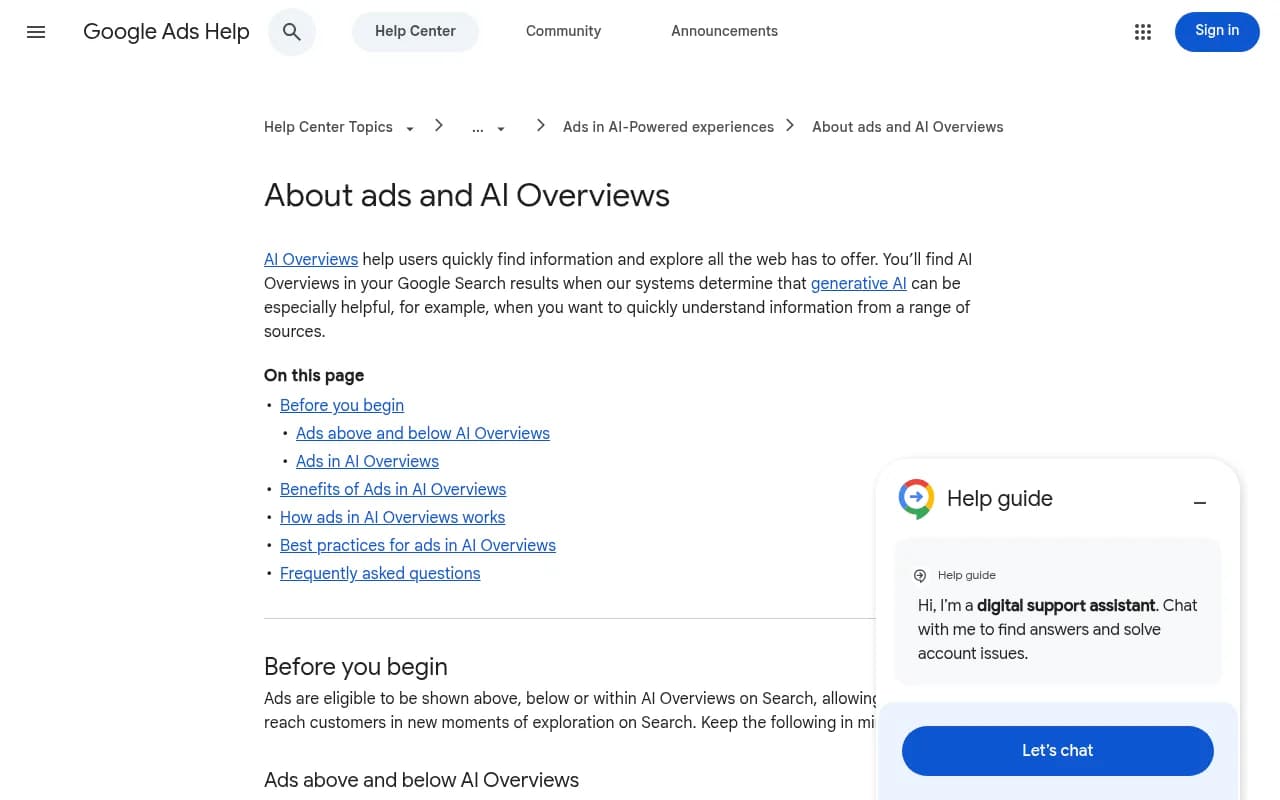
Google's help center page on ads and AI Overviews is worth reading directly rather than trusting secondhand summaries, because it clears up a few things that third-party trackers can only infer.
Ads above and below the AI Overview run through the existing auction, no separate bidding mechanism, no special campaign type required. If you already run Search, Shopping, Performance Max, or App campaigns, you're automatically eligible to show in these slots in any market where AI Overviews exist. There's no opt-in and, notably, no opt-out either.
Ads inside the box are a different story. They're limited to English-language queries on mobile and desktop in Australia, Canada, India, Indonesia, Kenya, Malaysia, New Zealand, Nigeria, Pakistan, Philippines, Singapore, and the US. Only Text and Shopping ads from Search, Shopping, and Performance Max campaigns qualify. Google also explicitly excludes several verticals from this in-box placement, including health, finance, politics, alcohol, and adult content, even though those same advertisers can still show up in the above/below slots.
Google's own matching logic is more interesting than most advertisers realize. Ad eligibility doesn't just look at the query, it also considers the content of the generated AI Overview itself. Google's published example: someone searching "why is my pool green and how do I clean it" isn't making a commercial query on its face, but the system can infer downstream commercial intent and still surface a "pool vacuum cleaners" ad. That means keyword-based targeting assumptions from traditional search don't map cleanly onto AIO ad triggering, which is part of why Google recommends broad match, Performance Max, or keywordless targeting with Smart Bidding for advertisers chasing this inventory.
One more practical detail buried in the FAQ: ads shown in AI Overviews get reported as "Top Ads" inside Google Ads reporting, with no segmented breakout. If you're running campaigns today, you genuinely cannot isolate how much of your spend or performance is coming specifically from the AIO slot versus a regular top-of-page ad. Google's own framing, in their words, is that "ads in AI Overviews are still in early stages."
The placement breakdown
When an ad does show up on an AI Overview SERP, where does it land? Semrush's placement data (through October 2025) is the most granular public breakdown available:
| Placement | Share of AIO SERPs with ads | Trend |
|---|---|---|
| Bottom of SERP | ~25% | Largest and fastest-growing placement |
| Middle of SERP | ~13% (by October 2025) | Grew through September, then stabilized |
| Top of SERP | Smaller share | Grew more slowly than bottom/middle |
The practical read: if an AI Overview query triggers an ad at all, it's almost certainly showing up below the AI box, not above it. Over 80% of AIO ad impressions land in that bottom slot, with only 18-20% appearing above the summary. That matters for CTR expectations. A bottom-of-page ad on a SERP where the user already got their answer from the AI summary above it is competing for a very different kind of attention than a traditional top-of-page ad.
What's driving the increase
It isn't just that Google decided to show more ads. The mix of queries triggering AI Overviews shifted at the same time the ad rate climbed, and Semrush's data ties the two together directly. Between January and October 2025, informational queries fell from 91.3% to 57.1% of all AIO triggers, while commercial queries rose from 8.15% to 18.57%, transactional queries rose from 1.98% to 13.94%, and navigational queries rose from 0.84% to 10.33%. More commercial and transactional queries getting an AI Overview means more opportunities for an advertiser to show up next to one. The ad increase looks less like Google cranking a dial and more like a natural consequence of AI Overviews expanding into query types that were always going to attract paid demand.
The timing detail worth flagging: from March through August 2025, ad occurrence stayed under 10% across every placement type. Then in September 2025, all three placement types jumped at once. That's not gradual drift, that's a deliberate policy or algorithm change landing on a specific date, which is the kind of thing that should make anyone citing a single month's figure nervous about treating it as a permanent baseline.
AI Mode is testing even more aggressively
AI Overviews aren't the only Google surface in play. Google AI Mode has been moving faster. Search Engine Watch spotted AI Mode shifting from two ads to three at the bottom of results in October 2026, and separate traffic analysis identified 816 unique experiment IDs tied to a dedicated "AI Mode Bottom Ads" placement Google has built and is actively A/B testing. That's not a finished feature, it's clearly still in the experimentation phase, but the direction is obvious: more ad inventory, tested in smaller increments, rolled out once the numbers look right.
How this compares to ChatGPT's ad rollout
Google isn't the only AI search surface experimenting with ads, and seeing how ChatGPT's rollout compares gives useful context for whether this is a Google-specific move or an industry-wide shift. Promptwatch's tracking shows ChatGPT served zero ads in search-triggered responses until May 27, 2026, when they appeared in just 1.69% of responses. From there the rate climbed in bursts, jumping past 30% on July 1, 2026 and largely staying in that range since. As of mid-August 2026, ChatGPT's 7-day average ad rate sat at 32.4%, with a 30-day average of 29.6% and a daily peak as high as 43.9%.

That's a strikingly similar trajectory to what Google did with AI Overviews a few months earlier: start near zero, ramp fast once the infrastructure is ready, land somewhere in the 25-35% range, and keep testing from there. Promptwatch's breakdown of which prompt types carry ChatGPT ads is also instructive: organic prompts account for 73.3% of ad-bearing responses, brand-specific prompts 18.0%, and competitor-comparison prompts 8.6%, a mix that suggests ads are following general search-intent volume rather than targeting brand or competitor queries specifically. Full detail is in Promptwatch's ChatGPT ad frequency report.
What this means if you run paid search
A few practical takeaways, separate from the raw stats:
- You're already eligible. If you run Search, Shopping, or Performance Max campaigns, you're automatically showing in above/below AIO slots in every market where AI Overviews exist. There's nothing to turn on.
- You can't isolate performance. Because AIO ads report as generic "Top Ads," you won't get a clean read on how this specific placement is performing versus a standard SERP ad. If your overall paid CTR is moving, AIO exposure is one possible contributor, but you can't cleanly attribute it.
- Broad match matters more here. Because the system is matching against the generated AI Overview content, not just your keyword list, narrow exact-match campaigns will miss a lot of this inventory. Google's own recommendation leans toward Performance Max, Dynamic Search Ads, and Smart Bidding.
- Paid CTR on AIO SERPs is holding up better than organic. Seer Interactive's Q1 2026 data found paid CTR on AI Overview-containing SERPs actually rose slightly, from 14.6% to 16.2%, while paid CTR on non-AIO SERPs declined from 26% to 21.8% over the same period. Organic CTR on AIO queries, by contrast, dropped as much as 65% at its worst point in late 2025 before partially rebounding to around 2.4% by February 2026, a gap that's roughly 37% below equivalent non-AIO queries even after the recovery.
If you're tracking AI visibility rather than ads
Most of the discussion above concerns advertisers bidding for placement next to AI Overviews. A related, often conflated question is whether your brand's content is getting cited inside the AI Overview itself, which is a separate (unpaid) channel entirely. If that's what you're actually trying to monitor, tools built for AI visibility tracking, including Promptwatch, track citation share across Google AI Overviews, AI Mode, ChatGPT, Perplexity, and other surfaces so you can see whether your pages are showing up at all before worrying about where the ads land. You can browse more options in the GEO software directory at bestgeosoftware.com if you want to compare a handful of platforms side by side.
A quick comparison of the data sources
| Source | Period measured | Ad frequency reported | Scope |
|---|---|---|---|
| Semrush | March 2025 vs. October 2025 | 5.17% -> 25.56% of AIO SERPs | 10M+ tracked US keywords |
| BrightEdge / memeburn aggregation | Jan 2025 - Nov 2025 | ~3% -> ~40% at peak | 9-industry commercial tracker |
| Digital Applied | March 2026 | ~25.5% of AIO SERPs | Mixed query sample |
| Google (official) | Ongoing | Not disclosed as a single rate | Policy and eligibility documentation only |
| Promptwatch (ChatGPT, for comparison) | May-Aug 2026 | ~32.4% (7-day avg, mid-Aug 2026) | Search-triggered ChatGPT responses |
The honest bottom line
If someone asks "how often do Google AI Overviews show ads," the most defensible answer right now is: roughly a quarter of the time overall, with a strong bias toward the bottom of the page, and that figure has moved fast enough in the past year that any number you quote should come with a date attached. The in-box placement, which is what people often picture when they hear "ads in AI Overviews," is still a narrow, English-only, 12-country experiment that excludes several major verticals outright. Above-and-below placement is the much bigger story, it's everywhere AI Overviews are, it uses your existing campaigns, and it's already part of your account whether you noticed or not.