Key Takeaways
- Traditional click-based attribution breaks down in AI search because most visibility happens inside zero-click answers, not on your website
- Modern GEO attribution requires tracking brand mentions, citations, and AI-driven traffic alongside traditional metrics to connect visibility to revenue
- Multi-touch attribution models that include AI search touchpoints provide the most accurate picture of how GEO contributes to conversions
- Tools like Promptwatch help close the loop by tracking AI visibility, generating optimized content, and measuring traffic from AI sources
- The key is treating AI search as a top-of-funnel awareness channel that influences later conversions, not just a direct-response channel
What Attribution Means in the Era of AI Search
For years, organic visibility meant ranking high and earning clicks. Analytics platforms recorded the visit, the source, and any resulting action. Visibility translated directly into measurable traffic. That model is breaking down.
With AI-generated summaries appearing at the top of search results, users often get complete answers without visiting a website. According to recent data, zero-click searches now make up 58% of US queries. ChatGPT, Gemini, Perplexity, Claude, and Google AI Overviews deliver answers directly -- and when they do cite sources, those citations don't always translate into clicks.
AI overview attribution is the practice of tracking and measuring how your content is referenced, cited, or mentioned inside AI-generated responses -- and connecting that visibility to downstream business outcomes. Instead of competing for blue links, brands now compete to become cited sources inside AI answers.
This shift requires a different approach to measurement. You can't rely solely on clicks anymore. Much of the influence happens before a click, within the generated response itself, where brands are mentioned, compared, or implicitly recommended.
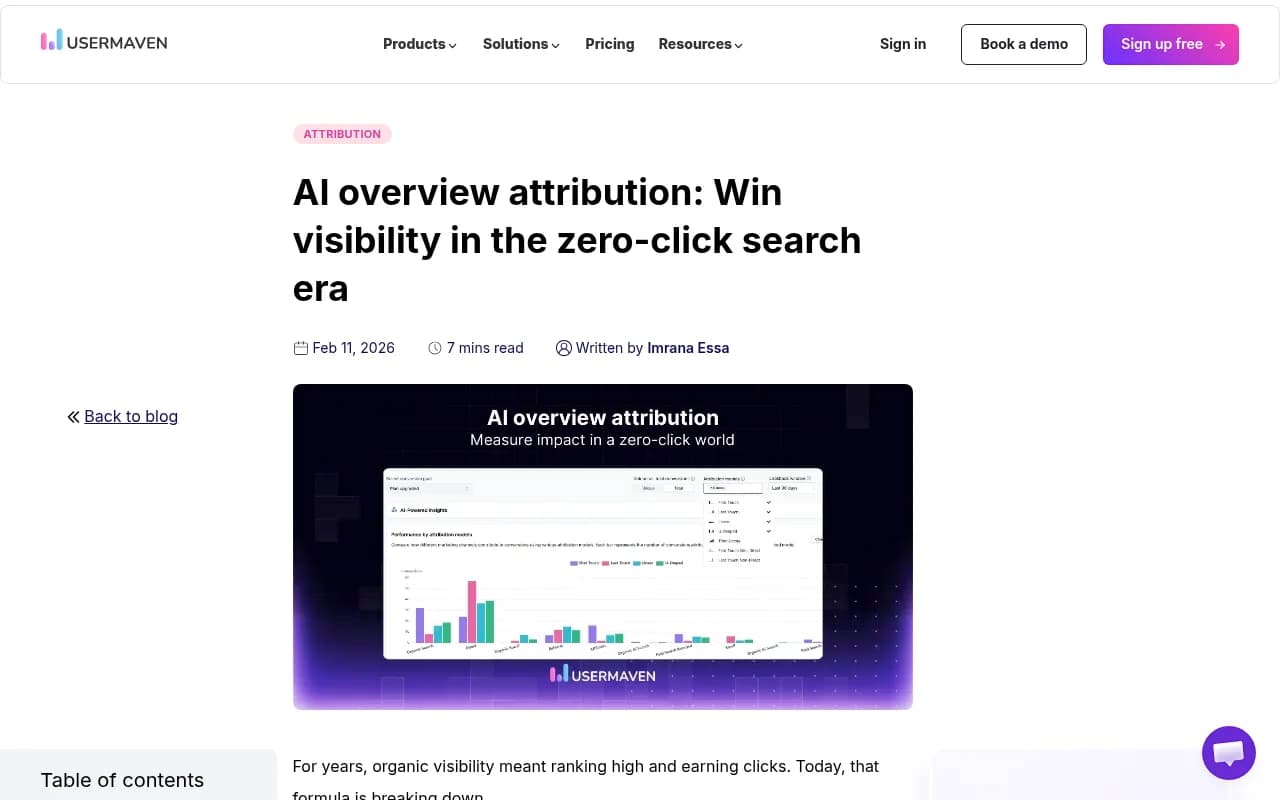
How Attribution Differs from Rankings in AI-Generated Search
In traditional SEO, attribution was straightforward:
- A page ranked in search results
- A user clicked that link
- Analytics recorded the visit and any conversions
- You attributed revenue to that organic session
AI-driven search disrupts every step of that chain.
The Zero-Click Problem
When ChatGPT or Perplexity answers a question, the user may never click through to your site -- even if your content was the primary source for that answer. You provided the value, but you don't see the traffic. Traditional analytics tools show nothing.
This creates a visibility gap: your brand is being seen and considered, but you have no record of it in Google Analytics or your CRM.
Citations vs Clicks
Even when AI models do include citations or source links, click-through rates are dramatically lower than traditional search results. Users trust the AI's synthesis and don't feel the need to verify sources. A citation in ChatGPT might generate 10-20x fewer clicks than a position 3 ranking in Google for the same query.
But that citation still matters. It builds brand awareness, establishes authority, and influences future search behavior. Someone who sees your brand cited in an AI answer is more likely to search for you directly later, visit your site from a different channel, or recognize your brand when they see it elsewhere.
The Influence Layer
AI search creates a new layer of influence that sits above traditional conversion funnels. A user might:
- Ask ChatGPT for software recommendations
- See your brand mentioned alongside competitors
- Not click anything
- Three days later, Google your brand name directly
- Sign up for a trial
Traditional attribution would credit that conversion to "direct" or "branded search." But the real driver was the AI search visibility three days earlier. Without tracking AI mentions, you're missing the top of your funnel.
Why This Shift Matters for Measurement and Visibility
The move from click-based to citation-based visibility has profound implications for how marketing teams measure success and allocate resources.
Traditional Metrics Become Incomplete
If you're only tracking organic traffic from Google, you're missing a growing share of how people discover and evaluate brands. AI search engines are being used for research, comparison, and recommendation -- all high-intent activities that traditionally drove organic traffic.
Teams that ignore AI search visibility are flying blind. They see branded search traffic increasing but can't explain why. They see competitors gaining market share but don't know where the perception shift is happening.
Attribution Windows Need to Expand
AI search visibility often acts as a top-of-funnel touchpoint that influences conversions days or weeks later. If your attribution window is set to 7 days or "last-click," you'll systematically undervalue GEO efforts.
Modern attribution models need to account for:
- Assisted conversions: AI mentions that don't generate immediate clicks but influence later behavior
- Brand lift: Increases in branded search volume correlated with AI visibility improvements
- Multi-touch journeys: Users who encounter your brand in AI search, then return via other channels
Content Strategy Requires New Signals
Without AI attribution data, content teams optimize for the wrong signals. They chase traditional keyword rankings while competitors dominate AI search for the same topics. They create content that ranks in Google but gets ignored by ChatGPT and Claude.
Tracking AI citations, brand mentions, and source attribution helps content teams understand:
- Which topics and formats AI models prefer to cite
- Which competitors are winning AI visibility and why
- Which content gaps are costing you citations
- Which pages are already performing well in AI search and should be amplified
How AI Systems Select and Attribute Organic Sources
Understanding how AI models choose which sources to cite is critical for building an effective attribution strategy. The selection process is different from traditional search ranking.
What AI Models Look For
AI search engines like ChatGPT, Perplexity, and Claude prioritize:
- Authoritative sources: Established domains with strong topical authority and backlink profiles
- Clear, structured content: Well-organized information with headings, lists, and concise explanations
- Recent, up-to-date information: Fresh content that reflects current best practices and data
- Comprehensive coverage: Pages that answer the full question, not just part of it
- Accessible formatting: Content that's easy for AI models to parse and extract key points from
Unlike Google, which heavily weights backlinks and domain authority, AI models also consider:
- Semantic relevance: How well the content matches the user's intent and query context
- Diversity of perspectives: Multiple sources that provide different angles on the same topic
- User engagement signals: Content that users find helpful when they do click through
The Role of Structured Data
Structured data (schema markup) plays an increasingly important role in AI attribution. Models use schema to understand:
- What type of content a page contains (article, product, FAQ, how-to guide)
- Key entities mentioned (people, organizations, products, concepts)
- Relationships between pieces of information
- Dates, authors, and credibility signals
Pages with proper schema markup are more likely to be cited accurately and in the right context.
Citation Patterns Across Models
Different AI models have different citation behaviors:
- Perplexity: Cites sources inline and shows them prominently, often pulling from 5-10 sources per answer
- ChatGPT: Cites sources when browsing is enabled, but less consistently than Perplexity
- Google AI Overviews: Cites sources from the traditional search index, favoring high-authority domains
- Claude: Rarely cites sources directly unless explicitly asked, but does draw from web content when enabled
A comprehensive attribution strategy needs to track all of these models separately, as visibility in one doesn't guarantee visibility in others.
Best Practices to Improve Attribution in AI Overviews
Building a revenue-connected GEO attribution system requires both technical tracking and strategic content optimization. Here's how to do it.
1. Implement Multi-Source Tracking
Don't rely on a single attribution method. Layer multiple tracking approaches:
AI Visibility Monitoring: Use a platform like Promptwatch to track when and how your brand is mentioned across ChatGPT, Perplexity, Gemini, and other AI search engines. Monitor:

- Brand mention frequency and sentiment
- Citation rates (how often you're cited as a source)
- Share of voice vs competitors
- Prompt categories where you're visible or invisible
AI Traffic Attribution: Track visitors who arrive from AI sources using:
- UTM parameters in citations (when possible)
- Referrer data from AI search engines
- Custom tracking scripts that identify AI-referred sessions
- Server log analysis to spot AI crawler activity and subsequent traffic patterns
Branded Search Correlation: Monitor branded search volume in Google Search Console and correlate spikes with AI visibility improvements. If you see a 30% increase in branded searches after improving ChatGPT visibility for key topics, that's a strong attribution signal.
Multi-Touch Attribution Models: Implement a marketing attribution platform that can track the full customer journey, including AI touchpoints. Tools like HubSpot, Dreamdata, or Ruler Analytics can help connect AI visibility to downstream conversions.
2. Build Content That AI Models Want to Cite
Optimizing for AI citations requires a different content approach than traditional SEO:
Answer Questions Directly: AI models prefer content that gets straight to the point. Use clear headings that match common questions, then provide concise, accurate answers in the first paragraph.
Use Structured Formats: Lists, tables, step-by-step guides, and comparison charts are easy for AI models to parse and cite. Break complex topics into scannable sections.
Cite Your Own Sources: AI models trust content that references authoritative sources. Include data, statistics, and expert quotes with proper attribution.
Update Regularly: Fresh content signals relevance and accuracy. Update key pages quarterly with new data, examples, and insights.
Optimize for Entities: Make sure AI models understand who you are and what you do. Use schema markup for Organization, Product, Article, and FAQ types. Mention key entities (brands, people, concepts) consistently.
Tools like Promptwatch can help identify content gaps by showing which prompts competitors are cited for but you're not. The platform's AI writing agent then generates articles optimized for AI search based on real citation data from 880M+ analyzed citations.
3. Close the Loop with Revenue Data
The final step is connecting AI visibility improvements to actual revenue. This requires:
Define Clear KPIs: Decide which metrics matter most for your business:
- AI citation rate (% of relevant prompts where you're cited)
- AI share of voice (your citations vs competitors)
- AI-referred traffic (sessions from AI sources)
- Assisted conversions (conversions with AI touchpoints in the journey)
- Brand lift (increase in branded search after AI visibility gains)
Set Up Conversion Tracking: Make sure you can track conversions from AI-referred traffic separately. Use UTM parameters, custom dimensions in Google Analytics, or a dedicated attribution platform.
Run Controlled Tests: Improve AI visibility for a specific topic cluster, then measure the impact on:
- Branded search volume for related terms
- Direct traffic to relevant landing pages
- Trial signups or demo requests
- Sales pipeline velocity for leads exposed to AI mentions
Calculate Incremental Revenue: Compare conversion rates and revenue from users who encountered your brand in AI search vs those who didn't. Even a small lift can justify significant GEO investment when multiplied across thousands of monthly AI searches.
4. Use Competitor Benchmarking
You can't improve what you don't measure -- and you can't measure success without context. Track your AI visibility relative to competitors:
- Which competitors are cited most often for your target topics?
- What content formats and angles are they using?
- Which AI models favor them, and why?
- Where are the biggest gaps in your coverage?
Tools like Promptwatch, Profound, and LLM Pulse offer competitor heatmaps that show exactly where you're winning and losing in AI search. Use this data to prioritize content creation and optimization efforts.
5. Build a Feedback Loop
The most effective GEO programs operate as continuous improvement cycles:
- Find the gaps: Use Answer Gap Analysis to identify prompts where competitors are visible but you're not
- Create optimized content: Generate or update content specifically designed to earn AI citations
- Track the results: Monitor citation rates, traffic, and conversions
- Iterate and improve: Double down on what works, fix what doesn't
This is where Promptwatch's end-to-end platform shines. Unlike monitoring-only tools (Otterly.AI, Peec.ai, AthenaHQ), Promptwatch helps you take action -- showing you exactly what content is missing, then helping you create it with AI-powered writing tools grounded in real citation data. You can then track how those new pages perform in AI search and measure the traffic impact.
Attribution Models for GEO: Which One to Use
Choosing the right attribution model depends on your business model, sales cycle, and how AI search fits into your customer journey.
Last-Click Attribution
How it works: Gives 100% credit to the final touchpoint before conversion.
When to use it: Short sales cycles, direct-response campaigns, or when you need simple reporting.
GEO limitation: Systematically undervalues AI search visibility, which rarely drives immediate conversions. Avoid this model for GEO measurement.
First-Click Attribution
How it works: Gives 100% credit to the first touchpoint in the customer journey.
When to use it: When you want to understand what drives initial awareness and consideration.
GEO fit: Better than last-click for GEO, since AI search often acts as a discovery channel. But still oversimplifies multi-touch journeys.
Linear Attribution
How it works: Distributes credit equally across all touchpoints in the customer journey.
When to use it: When you want a balanced view of how different channels contribute.
GEO fit: Decent starting point for GEO attribution. Gives AI search visibility credit without overweighting it.
Time-Decay Attribution
How it works: Gives more credit to touchpoints closer to conversion, with exponential decay for earlier touches.
When to use it: When you want to balance awareness and conversion influence.
GEO fit: Works well if AI search is primarily a mid-funnel channel for your audience. Less ideal if it's driving top-of-funnel awareness.
Position-Based (U-Shaped) Attribution
How it works: Gives 40% credit to the first touch, 40% to the last touch, and splits the remaining 20% among middle touches.
When to use it: When you want to emphasize both discovery and conversion while acknowledging the journey in between.
GEO fit: Strong choice for GEO attribution. Recognizes AI search's role in discovery while still crediting conversion drivers.
Data-Driven Attribution
How it works: Uses machine learning to assign credit based on actual conversion patterns in your data.
When to use it: When you have enough conversion volume (typically 1000+ conversions per month) to train accurate models.
GEO fit: The gold standard for GEO attribution, but requires significant data volume and sophisticated analytics infrastructure. Platforms like Google Analytics 4, HubSpot, or Dreamdata can help.
Custom GEO Attribution Model
For many teams, the best approach is a custom model that explicitly accounts for AI search visibility:
- Track AI mentions as a separate touchpoint type in your attribution system
- Assign a fixed credit percentage (e.g., 20%) to any conversion where the user was exposed to your brand in AI search within the attribution window
- Measure brand lift separately: track increases in branded search, direct traffic, and conversions correlated with AI visibility improvements
- Use cohort analysis: compare conversion rates and LTV for users exposed to AI mentions vs those who weren't
This hybrid approach combines the simplicity of rule-based attribution with the nuance of data-driven insights.
The Bottom Line
AI search is rewriting the rules of attribution. The old model -- rank high, get clicks, measure conversions -- no longer captures the full picture of how people discover and evaluate brands.
Modern GEO attribution requires:
- Tracking visibility, not just traffic: Monitor brand mentions, citations, and share of voice across AI search engines
- Expanding attribution windows: Account for AI search's role as a top-of-funnel awareness driver
- Using multi-touch models: Give credit to AI visibility alongside other touchpoints in the customer journey
- Connecting to revenue: Track assisted conversions, brand lift, and incremental revenue from AI-referred users
- Building a feedback loop: Find gaps, create optimized content, track results, iterate
The teams that master GEO attribution in 2026 will have a significant competitive advantage. They'll understand where their visibility is coming from, which content is driving results, and how to optimize for the channels that actually influence buying decisions -- not just the ones that are easiest to measure.
Start by implementing basic AI visibility tracking, then layer in more sophisticated attribution as you gather data and refine your approach. The sooner you start measuring AI search impact, the sooner you can optimize for it -- and prove its value to your organization.