Key takeaways
- Otterly.AI is a solid entry-level AI search monitoring tool, with plans starting at $29/month and broad coverage across ChatGPT, Perplexity, and Google AI Overviews
- The platform is monitoring-only -- it shows you where you're invisible but doesn't help you fix it, which limits ROI for teams that need to act on the data
- ROI is real but indirect: you're paying for visibility data, not leads or revenue, so you need to pair it with a content workflow to see results
- For small teams or consultants doing basic brand tracking, Otterly.AI can pay for itself quickly; for larger teams needing optimization, the ceiling is low
- If you need content generation, crawler logs, or deeper competitive analysis, you'll outgrow Otterly.AI fast and should evaluate more complete platforms
AI search is no longer a future concern. About 80% of search users now rely on AI summaries for at least 40% of their searches, according to Bain & Company. If your brand isn't being cited in ChatGPT, Perplexity, or Google AI Overviews, you're losing consideration before a potential customer ever visits your site.
Otterly.AI was one of the first tools built specifically to track this problem. But "first" doesn't mean "best," and "monitoring" doesn't mean "optimizing." Before you hand over a credit card, let's work through what Otterly.AI actually does, what it costs, and whether the math makes sense for your team.
What Otterly.AI actually does
Otterly.AI automatically scans AI-generated responses from Google AI Overviews, ChatGPT Search, and Perplexity, then aggregates data on how often your brand appears, how it's framed, which links are cited, and which prompts trigger mentions.
The core features:
- Brand Visibility Index -- a score tracking how often your brand appears across monitored AI platforms
- Link Citations Analysis -- which URLs are being cited in AI responses
- Prompt and keyword tracking -- which conversational queries trigger your brand mentions
- GEO Audit with SWOT analysis -- a structured breakdown of your AI visibility strengths and gaps
- Competitor tracking -- see how rivals are performing in the same AI responses
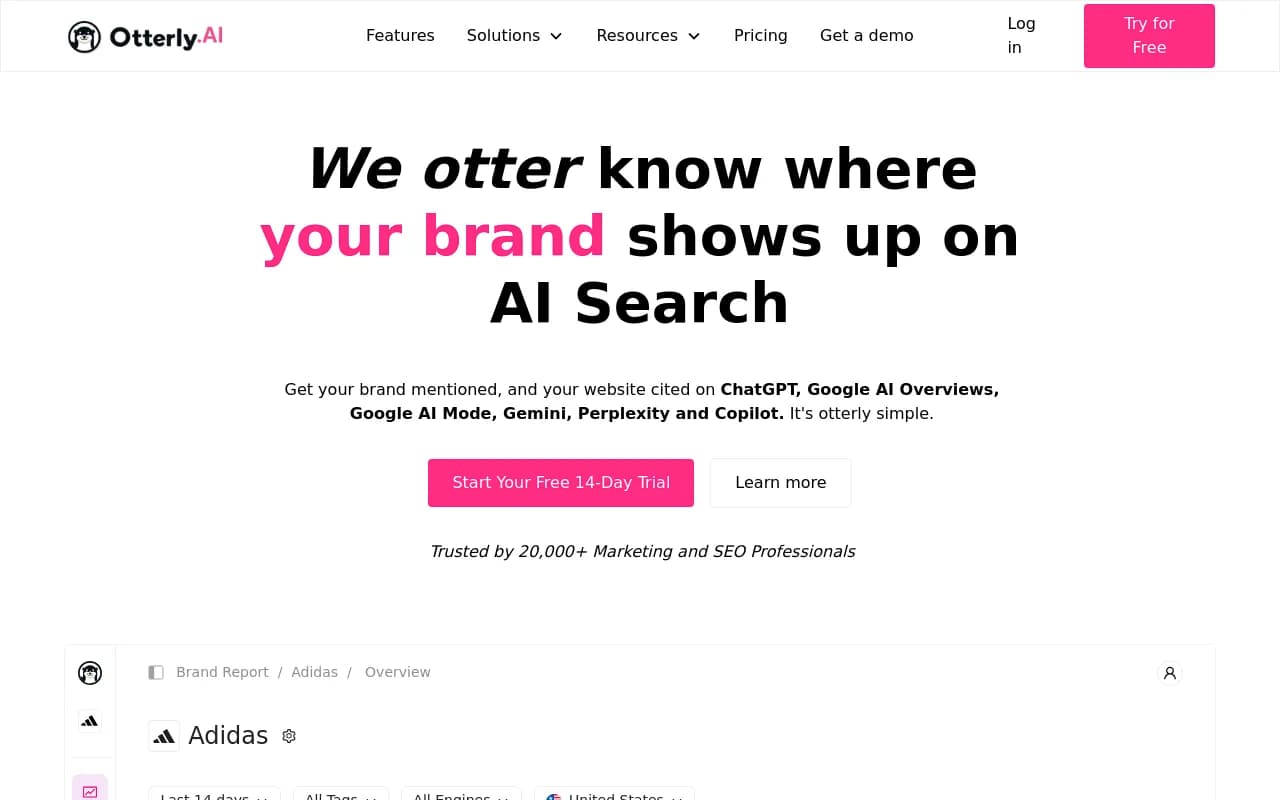
It's a clean, well-designed monitoring layer. The interface is approachable, setup is fast, and the data is genuinely useful for understanding where you stand.
What it doesn't do: help you change where you stand. There's no content generation, no content brief builder, no crawler log analysis, and no built-in workflow for acting on the gaps it identifies. You get the diagnosis; the treatment is up to you.
Pricing breakdown
Otterly.AI's pricing tiers (as of mid-2026):
| Plan | Price | Best for |
|---|---|---|
| Lite | $29/month | Solo marketers, basic brand tracking |
| Starter | ~$99/month | Small teams, limited prompts |
| Growth | ~$299/month | Growing teams, broader tracking |
| Pro | $989/month | Agencies, high-volume monitoring |
The entry price is genuinely low for this category. Unlimited team members across plans is a nice touch -- no per-seat pricing surprises. But the jump from Growth to Pro is steep, and at the Pro tier, you're paying nearly $1,000/month for monitoring without optimization.
For comparison:
| Tool | Starting price | Monitoring | Content generation | Crawler logs |
|---|---|---|---|---|
| Otterly.AI | $29/month | Yes | No | No |
| Peec.AI | ~$49/month | Yes | No | No |
| AthenaHQ | Higher | Yes | Limited | No |
| Promptwatch | $99/month | Yes | Yes | Yes |
| Profound | Higher | Yes | No | No |

The ROI question: what are you actually buying?
This is where most Otterly.AI reviews go soft. Let's be direct.
You're not buying leads. You're not buying traffic. You're buying data about where your brand appears (or doesn't appear) in AI-generated answers. That data has value -- but only if you do something with it.
Forbes reported in January 2026 that 56% of CEOs see zero ROI from AI tools. The reason isn't that the tools are bad -- it's that "AI spend does not become ROI simply because usage goes up. Value capture requires workflow redesign, not just license purchases." That applies directly here.
Otterly.AI's ROI depends entirely on what happens after you look at the dashboard.
Scenario 1: You use it for reporting
If your team needs to show leadership that AI visibility is a real concern, Otterly.AI pays for itself at the Lite tier. A $29/month tool that produces a monthly slide showing your Brand Visibility Index trend is cheap justification for a larger GEO investment. ROI: high, but indirect.
Scenario 2: You use it to guide content strategy
If you take the prompt data, identify gaps, and then build a content calendar around the queries where competitors are cited but you're not -- that's where real ROI starts. The problem is Otterly.AI doesn't help you do that second part. You'll need a separate content workflow. Teams that build this process see results, but it takes 60-90 days minimum before AI models start citing new content.
SQ Magazine's 2026 marketing statistics found that teams using AI across multiple core functions report an average 44% increase in marketing output versus non-AI peers. But that's AI across multiple functions -- not a single monitoring tool.
Scenario 3: You use it and wait
This is the most common outcome. You set up tracking, watch the dashboard, feel informed, and don't systematically change anything. ROI: zero. This isn't Otterly.AI's fault -- it's a tool adoption problem -- but the platform's monitoring-only design makes it easier to fall into passive observation.
Where Otterly.AI earns its money
To be fair, there are real use cases where Otterly.AI delivers clear value:
Competitive benchmarking: If you need to know whether a competitor is gaining AI visibility faster than you, Otterly.AI gives you that data cleanly. That's worth paying for.
Brand sentiment in AI responses: The tool tracks not just whether you're mentioned but how you're framed. A brand being cited negatively in AI responses is a problem worth knowing about.
Client reporting for agencies: At the Lite or Starter tier, Otterly.AI is cheap enough to run for multiple clients and produce credible AI visibility reports. The data looks professional.
Early-stage GEO programs: If your team is just starting to think about AI search visibility, Otterly.AI is a low-risk way to get oriented before committing to a more expensive platform.
Where Otterly.AI falls short
No crawler log data: You can see that AI models aren't citing you, but you can't see whether they're even crawling your site. That's a significant blind spot. If ChatGPT's crawler is hitting your site and encountering errors, you won't know from Otterly.AI.
No content generation: The gap between "I see the problem" and "I fixed the problem" is wide. Otterly.AI sits entirely on the left side of that gap.
Limited model coverage: Otterly.AI focuses primarily on ChatGPT, Perplexity, and Google AI Overviews. Teams that need to track Gemini, Claude, Grok, DeepSeek, or Mistral will find coverage thin.
Prompt volume data is limited: Knowing that you're not cited for a prompt is useful. Knowing whether that prompt gets 500 or 50,000 queries per month is more useful. Otterly.AI doesn't give you that prioritization layer.
No traffic attribution: You can't connect AI visibility changes to actual website traffic or revenue. That makes it hard to close the loop on ROI.
How it compares to alternatives
If you're evaluating Otterly.AI, you're probably also looking at a few other tools. Here's the honest breakdown:
Peec.AI is similarly priced and similarly monitoring-focused. Neither has a clear edge on the other for basic tracking.

AthenaHQ goes deeper on enterprise-style reporting and optimization workflows, but at a higher price point. Better for larger teams that need structured optimization processes.

Profound has a strong feature set for enterprise brands but comes in at a higher price and lacks Reddit tracking and ChatGPT Shopping visibility.
Profound

Promptwatch is the most complete option if you need the full loop: find gaps, create content, track results. It includes crawler logs, content agents that generate briefs and articles based on real prompt data, page-level citation tracking, and traffic attribution. It starts at $99/month -- more than Otterly.AI's Lite tier, but it's doing fundamentally more work.
The distinction matters: Otterly.AI tells you that you're invisible for a prompt. Promptwatch tells you that, then helps you write the content to fix it, then shows you when AI models start citing the new page.
What the data says about AI search in 2026
Otterly.AI published its own research analyzing over one million website citations across major AI platforms during 2025-2026. The findings confirm what most GEO practitioners already suspect: citation patterns are highly concentrated, a small number of domains capture most AI citations, and the gap between cited and uncited brands is widening.
That research is actually a good argument for taking AI visibility seriously. Whether Otterly.AI is the right tool to act on it is a separate question.
A realistic ROI framework for marketing teams
Before buying any AI visibility tool, run this quick calculation:
- What's the average deal value or customer LTV for your business?
- How many customers per month come through organic/search channels?
- What percentage of your target audience uses AI search tools regularly?
- If AI visibility drove even one additional customer per month, what's that worth?
For most B2B companies with deal values above $5,000, one additional customer from improved AI visibility pays for a year of any tool in this category. The question isn't whether the category is worth investing in -- it is. The question is whether a monitoring-only tool gives you enough leverage to capture that value.
If you have a strong in-house content team that can take prompt gap data and turn it into published content quickly, Otterly.AI at the Lite or Starter tier is a reasonable starting point. You're paying for the intelligence; your team provides the execution.
If you don't have that content capacity, or if you want the intelligence and execution in one place, you'll need something more complete.
The verdict
Otterly.AI is worth it under specific conditions:
- You're a small team or consultant who needs basic AI visibility tracking
- You want a low-cost way to benchmark against competitors in AI search
- You have a content team that can act on the gap data independently
- You're building a business case for a larger GEO investment and need data to support it
It's not worth it if:
- You need to actually improve your AI visibility, not just measure it
- You need crawler log data to diagnose technical issues
- You need coverage beyond ChatGPT, Perplexity, and Google AI Overviews
- You're at a scale where $989/month for monitoring-only is hard to justify
The honest summary: Otterly.AI is a good monitoring tool that does what it says. The ROI ceiling is just lower than most marketing teams need, because monitoring without optimization is only half the job.
If you're serious about AI search visibility in 2026, start with a clear answer to this question: do you need to know where you stand, or do you need to change where you stand? Otterly.AI answers the first question well. For the second, you'll need more.