Key takeaways
- Both Nimt.ai and Promptwatch track brand mentions across major AI search engines like ChatGPT, Perplexity, and Gemini
- Nimt.ai is a monitoring tool — it shows you where you appear (and where you don't), but stops there
- Promptwatch goes further with answer gap analysis, AI content generation, crawler logs, and traffic attribution
- If your goal is to understand your current AI visibility, Nimt.ai can work. If your goal is to actually improve it, Promptwatch is the more complete platform
- Pricing is comparable at entry level, but Promptwatch's feature set at each tier is substantially broader
The AI search visibility space has gotten crowded fast. Eighteen months ago, most marketing teams had never heard of "GEO" (Generative Engine Optimization). Now there are dozens of tools claiming to help you rank in ChatGPT, Perplexity, and Google AI Overviews — and they vary wildly in what they actually do.
Nimt.ai and Promptwatch are two names that come up regularly. They're both positioned as AI visibility platforms, both track brand mentions across LLMs, and both target marketing teams who want to understand how they appear in AI-generated answers. But they're not the same product, and the difference matters a lot depending on what you're trying to accomplish.
This guide breaks down exactly what each platform does, where they differ, and which one is worth your money.
What these tools are actually trying to solve
Before getting into features, it's worth being clear about the problem both tools are addressing.
When someone asks ChatGPT "what's the best project management tool for remote teams?" or "which CRM should I use for a 50-person sales team?" — your brand either shows up in that answer or it doesn't. Traditional SEO rank tracking doesn't capture this. Google Search Console doesn't capture it. You're essentially invisible to a growing slice of your potential audience unless you're specifically monitoring AI-generated responses.
That's the core problem. Both Nimt.ai and Promptwatch are built to make that invisible layer visible.
Where they diverge is in what happens next.
Nimt.ai: what it does
Nimt.ai is an AI search visibility platform that monitors how your brand appears across large language models. The core functionality is tracking brand mentions — whether you're cited, how often, in what context, and how competitors compare.
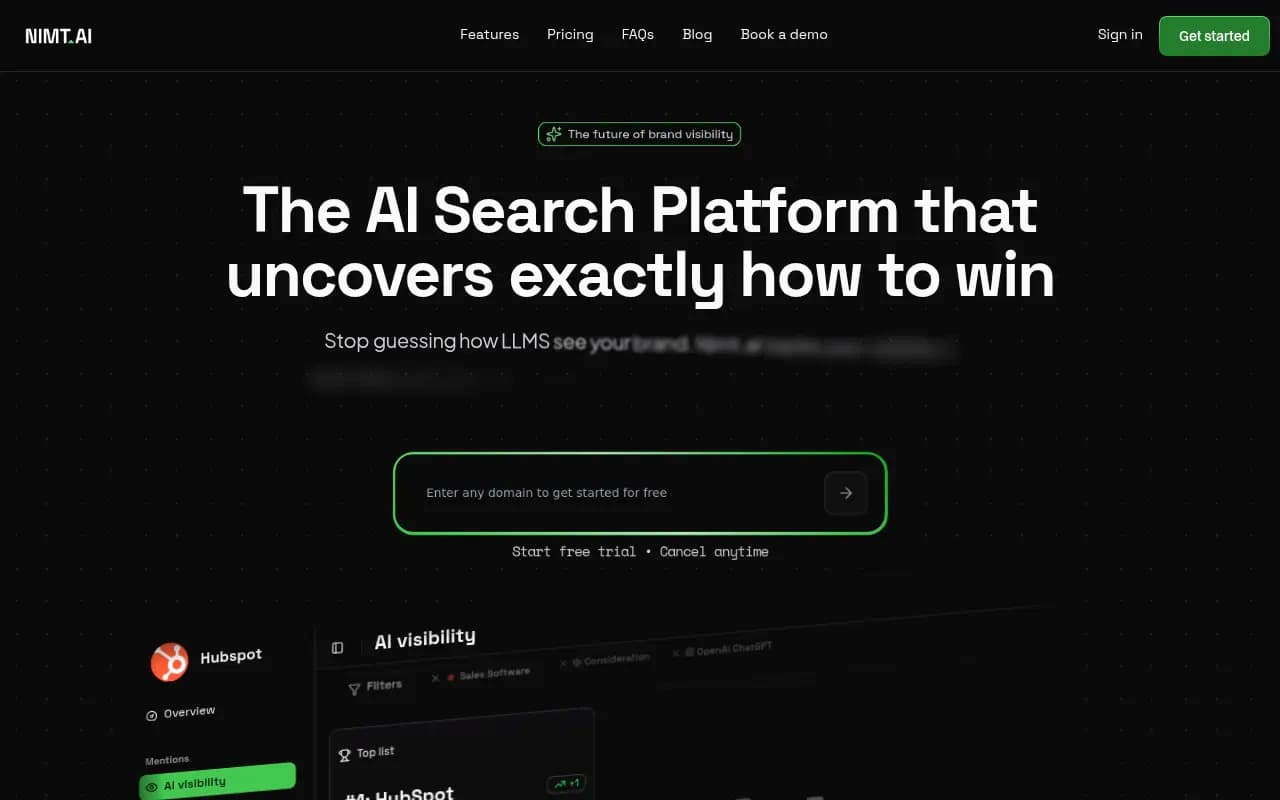
From what's publicly available, Nimt.ai covers the main AI engines (ChatGPT, Perplexity, Gemini, Claude) and gives you a dashboard view of your visibility scores over time. It's designed to be accessible for marketing teams who want a quick read on their AI presence without a steep learning curve.
The appeal is simplicity. You set up your brand, add your competitors, define some prompts, and start seeing data. For teams that are just getting started with AI visibility and want a baseline understanding of where they stand, that's genuinely useful.
The limitation is also simplicity. Nimt.ai is, at its core, a monitoring tool. It tells you what's happening. It doesn't tell you why, and it doesn't help you change it.
Promptwatch: what it does differently
Promptwatch is built around a different premise: monitoring is only useful if it leads to action.

The platform tracks brand mentions across 10 AI models — ChatGPT, Perplexity, Google AI Overviews, Google AI Mode, Claude, Gemini, Meta/Llama, DeepSeek, Grok, Mistral, and Copilot. That's a broader coverage set than most competitors. But the tracking is really just the entry point.
What makes Promptwatch different is the loop it creates:
Step 1 — Find the gaps. Answer Gap Analysis shows you exactly which prompts your competitors are appearing for that you're not. Not just "you're missing from 40% of responses" but the specific questions, the specific topics, the specific angles where AI models are citing someone else because your site doesn't have the right content.
Step 2 — Create content that fills those gaps. Content Agents generate articles, listicles, comparisons, and briefs grounded in real prompt data, citation patterns, and competitor analysis. This isn't generic AI content — it's built around the specific gaps the analysis identified.
Step 3 — Track whether it worked. Page-level tracking shows which pages are being cited, by which models, and how often. The crawler log feature shows when AI bots visit your pages, what they read, and when those visits convert to citations. Traffic attribution connects AI visibility to actual site visits and revenue.
That cycle — find gaps, generate content, track results — is what separates Promptwatch from tools that only do step one.
Feature comparison
| Feature | Nimt.ai | Promptwatch |
|---|---|---|
| Brand mention tracking | Yes | Yes |
| Competitor comparison | Yes | Yes |
| Number of AI models covered | ~4-5 | 10 |
| Answer gap analysis | No | Yes |
| AI content generation | No | Yes (Content Agents) |
| AI crawler logs | No | Yes |
| Traffic attribution | No | Yes |
| Prompt volume & difficulty scoring | No | Yes |
| Query fan-outs | No | Yes |
| Reddit & YouTube insights | No | Yes |
| ChatGPT Shopping tracking | No | Yes |
| Offsite citation analysis | No | Yes |
| Multi-language / multi-region | Limited | Yes |
| Page-level citation tracking | No | Yes |
| Looker Studio integration | No | Yes |
The gap in capabilities is significant. Nimt.ai covers the monitoring column. Promptwatch covers monitoring plus everything you'd need to actually do something about what you find.
Who each tool is built for
Nimt.ai makes sense if:
- You're in early-stage exploration and just want to know if AI visibility is a problem worth solving for your brand
- You have a small budget and need a basic dashboard to report AI presence to stakeholders
- You're not yet ready to invest in a full optimization workflow
Promptwatch makes sense if:
- You want to actively improve your AI visibility, not just measure it
- You're running content programs and want them informed by real AI search data
- You need to connect AI visibility to traffic and revenue (not just mention counts)
- You're an agency managing multiple brands across different markets
- You want to understand the technical side — how AI crawlers interact with your site, which pages they read, where they encounter errors
The honest version: if you're a marketing team that's serious about AI search as a channel, Nimt.ai will quickly feel like a speedometer without a steering wheel. You'll know how fast you're going, but you won't have the tools to change direction.
Pricing
Promptwatch's pricing is public and tiered:
- Essential: $99/month — 1 site, 50 prompts, 5 articles
- Professional: $249/month — 2 sites, 150 prompts, 15 articles, crawler logs, state/city tracking
- Business: $579/month — 5 sites, 350 prompts, 30 articles
- Agency/Enterprise: Custom pricing
A free trial is available. Annual billing reduces costs further.
Nimt.ai's pricing isn't as prominently published, which makes direct comparison harder. Based on available information, it sits in a similar entry-level range for basic monitoring. But when you're comparing $99/month for monitoring-only versus $99/month for monitoring plus content generation plus gap analysis, the value calculation shifts considerably.
The monitoring-only trap
This is worth naming directly, because it's a pattern across this whole category of tools.
A lot of AI visibility platforms — Nimt.ai included — are built on the assumption that if you show marketers their visibility scores, those marketers will figure out what to do next. In practice, that's not how it works. Most teams look at the dashboard, feel vaguely concerned about their numbers, and then don't change anything because they don't know what to change.
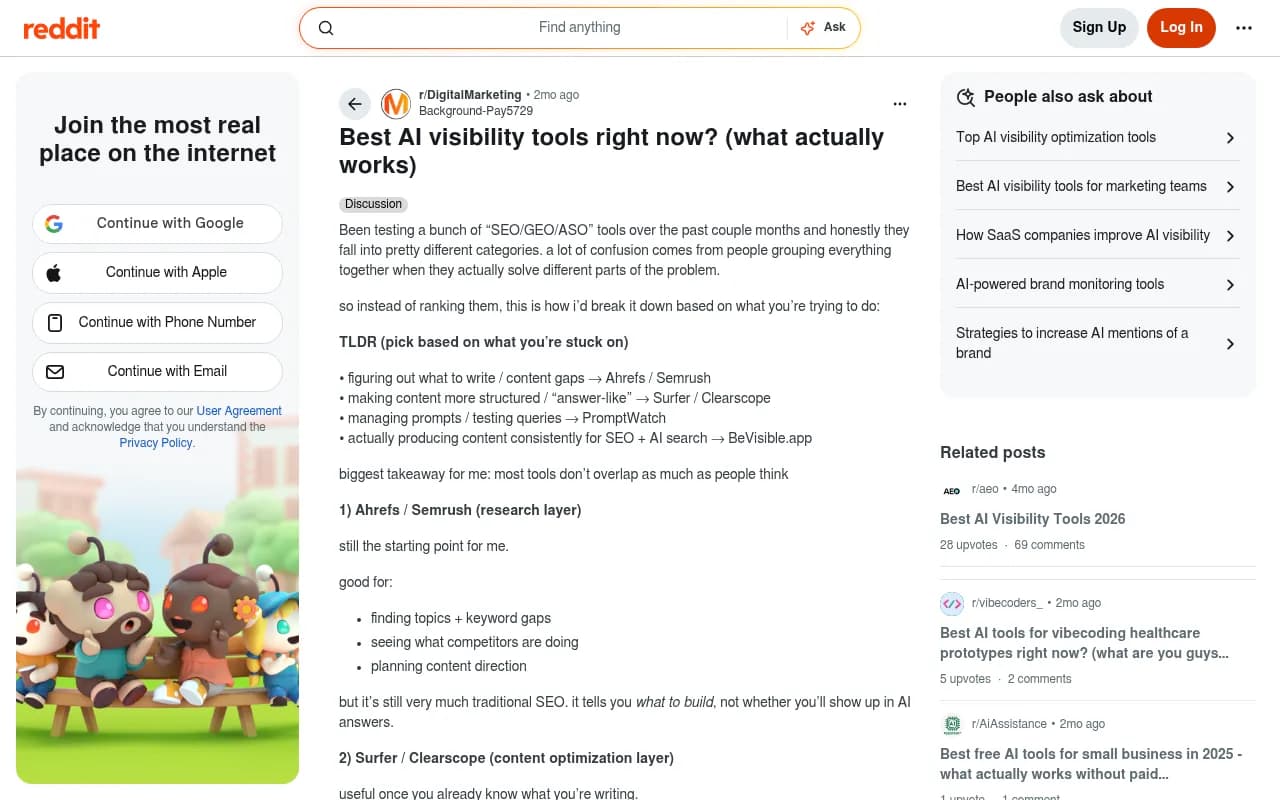
The data from a Reddit thread on AI visibility tools (r/DigitalMarketing) reflects this frustration: people are using monitoring tools but struggling to translate the data into actual improvements. The tools that get traction are the ones that close the loop between "here's your problem" and "here's how to fix it."
Promptwatch's content generation feature is a direct response to this. When the gap analysis shows you're missing from prompts about "enterprise CRM for manufacturing," the Content Agent can generate a piece specifically targeting that gap — grounded in what AI models are already citing, what competitors have published, and what prompt volumes suggest about demand.
That's a different product category than a monitoring dashboard, even if both tools show up in the same "AI visibility" searches.
A note on data quality
One thing worth considering when evaluating any AI visibility tool: how does it actually collect data?
Some platforms query AI models through APIs. Others simulate real user interactions in actual interfaces. The difference matters because user-facing AI answers can differ from API outputs — especially for shopping recommendations, local results, and anything where personalization or recency plays a role.
Promptwatch tracks how AI search engines behave in real user interfaces, not just through API calls. With over 4.5 billion citations, clicks, and prompts processed, the data reflects what real users actually see when they ask questions — not a sanitized API response.
Nimt.ai's data collection methodology isn't as clearly documented publicly, which makes it harder to assess data fidelity. For teams making content and strategy decisions based on this data, that's a meaningful consideration.
Other tools worth knowing about
If you're evaluating this space more broadly, a few other platforms are worth a look depending on your needs:
Otterly.AI — solid monitoring tool, similar to Nimt.ai in scope, good for teams that want a clean UI without complexity.
Otterly.AI

Profound — stronger enterprise feature set, higher price point, still primarily monitoring-focused without the content generation layer.
Profound

AthenaHQ — good for tracking AI visibility trends, but lacks optimization and content creation capabilities.

Peec AI — lightweight monitoring for marketing teams, straightforward to set up.

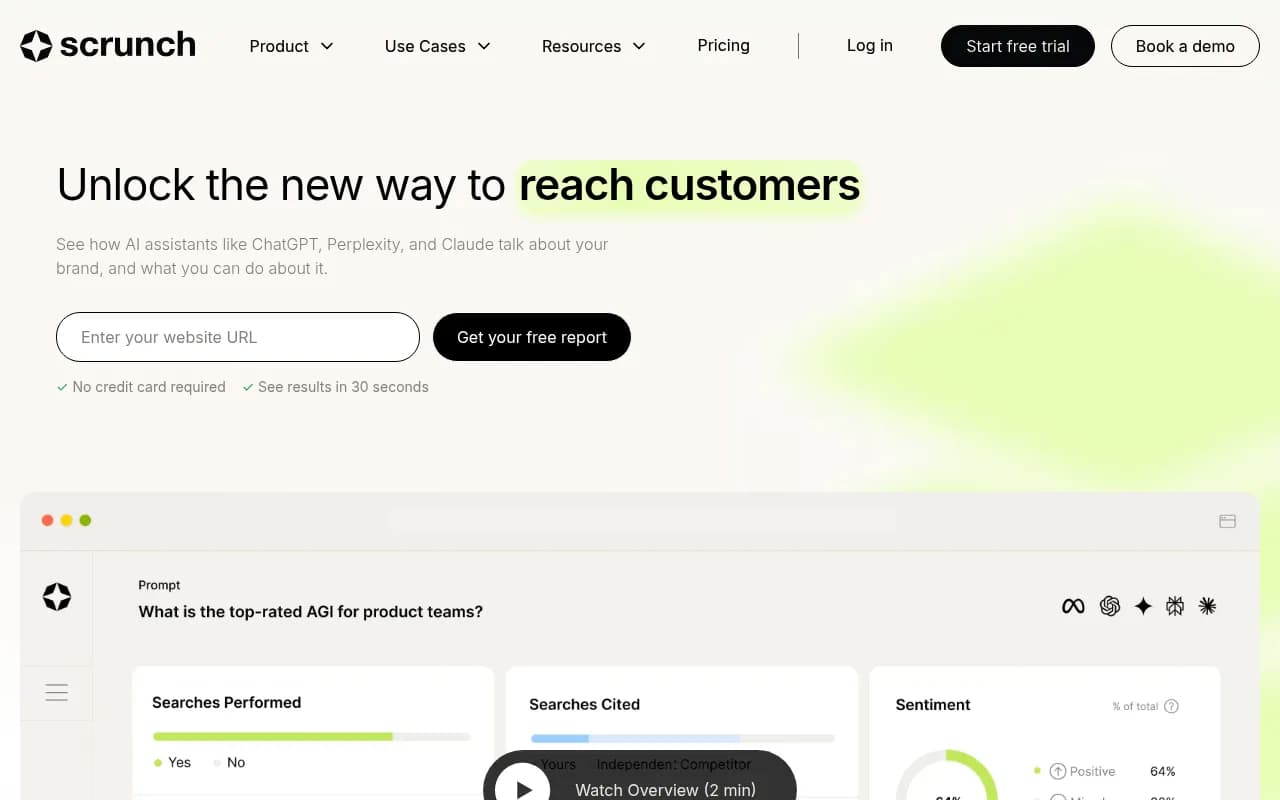
Scrunch AI — covers tracking and some analysis, but gaps in content workflow and crawler monitoring.
None of these close the full loop the way Promptwatch does. They're all, to varying degrees, monitoring tools with varying levels of analytical depth.
The verdict
If you're choosing between Nimt.ai and Promptwatch, the decision comes down to what you're actually trying to do.
Nimt.ai is a reasonable starting point if you want to understand your current AI visibility baseline. It's accessible, relatively simple, and will give you a sense of where your brand stands across major AI engines.
Promptwatch is the better choice if you want to do something about it. The combination of answer gap analysis, AI content generation, crawler logs, and traffic attribution makes it a platform you can actually run an optimization program on — not just a dashboard you check occasionally and feel anxious about.
For most marketing teams in 2026, the question isn't whether AI search visibility matters. It clearly does, and it's growing. The question is whether your tools are built to help you improve it or just measure it. That's the real distinction here.