Key takeaways
- The AI visibility category has more than doubled in a year, to roughly 44 products, which means vendor claims are getting louder while the underlying data quality varies wildly.
- AI answers are not stable. Academic testing found less than a 1-in-100 chance that ChatGPT or Google AI returns the same brand list twice in 100 runs, so a single-snapshot "visibility score" from a demo means almost nothing.
- Pricing units (per prompt, per credit, per seat, per domain) differ so much between vendors that normalized cost per tracked prompt ranges from roughly $0.86 to $3.96 a month for the same category of plan.
- Most AI visibility contracts contain at least six of ten common red-flag clauses, including auto-renewal notice traps and vendor-retained data ownership, so read the contract, not just the pricing page.
- Ask whether the tool only monitors or whether it can also act, because the gap between "you're invisible here" and "here's the content that fixes it" is where most of this year's budget gets wasted.
Why the checklist exists
Every marketing team I talk to this year is fielding the same cold email: "Track your brand in ChatGPT before your competitors do." Fair enough, that's a real problem. Google AI Overviews and AI Mode now sit above the fold on a huge share of commercial queries, and ChatGPT Search has become a legitimate discovery channel. The issue isn't whether to buy a prompt tracker. It's that the category went from maybe a dozen serious players to something like 44 products in a year, according to Capterra's review of 337 verified practitioner reviews across 18 platforms, and a lot of them are selling the same six features with different paint jobs.
That growth is exactly why you need a checklist instead of a gut decision after a good demo. A slick dashboard tells you nothing about data collection methodology, contract terms, or whether the vendor will still exist (or still be affordable) in 18 months. Below are the 12 questions worth asking before you sign, grouped into four areas: methodology, coverage, pricing, and what happens after the dashboard loads.
Part 1: how the data actually gets collected
1. Do you collect from the real interface, or from the API?
This sounds technical but it changes everything downstream. Vendors that query the API directly are skipping the rendering and retrieval layer that real users actually see, including personalization, post-processing, and how citations get displayed. One practitioner comparison found API-based tools matched manual, live verification only about 60% of the time, versus tools that simulate the actual browser UI. Ask the vendor point blank: "Do you monitor the live ChatGPT, Gemini, and AI Overviews interfaces, or the raw API?" If they hesitate or give you a marketing answer instead of a technical one, that's informative on its own.
2. How many times do you sample each prompt, and how do you report consistency?
AI answers are not deterministic. A SparkToro and Gumshoe.ai study ran 12 prompts across ChatGPT, Claude, and Google AI a combined 2,961 times and found there's less than a 1-in-100 chance of getting the same brand list twice in 100 runs on ChatGPT or Google AI, and the ordering matches even less often than that. If a vendor reports a single "visibility score" per prompt without telling you how many times they sampled it, you're looking at a coin flip dressed up as analytics. Ask for the sampling protocol in writing, not just in the sales call.
3. Can I see the exact prompts and the exact responses that produced my score?
If the dashboard shows you a percentage with no way to drill into the underlying prompt-response pairs, you have no way to audit it. You should be able to click any score and see the literal text the AI returned, the date, and the model version. If that's not available even on a trial, assume it's being aggregated in a way you can't verify.
Part 2: coverage and prompt design
4. Which models does my actual pricing tier cover, not just the marketing page?
This is the single most common bait-and-switch in the category. A vendor's homepage says "track ChatGPT, Gemini, Claude, and Perplexity," but the entry tier only includes ChatGPT, and the rest sit behind a higher plan or paid add-ons. Otterly.AI, for example, includes four engines on its base plans but gates Gemini, Claude, and AI Mode as add-ons. Semrush's AI Toolkit covers only four engines total at any tier. Get the tier-by-tier model list in writing before you sign, not after.
5. Who builds my prompt set, and is it customized to my market?
A vendor's default prompt library is not representative of your brand by default. Common mistakes include tracking only generic category prompts, tracking only branded prompts, reusing one prompt set across every country and language, and ignoring where a prompt sits in the buyer journey. You want a vendor that will validate and customize your prompt set with you, and ideally let you build and edit prompts yourself without filing a support ticket.
6. Do you track where I actually get cited, not just whether I'm mentioned?
Being named in a response and being the cited source are different things with different business value. A platform worth paying for should break down citation types and sources, not just mention counts. Promptwatch Data's research on citation share by content type shows product pages led ChatGPT citations at roughly a third of the total in July 2026, with listicles the fastest-growing format, which is the kind of granularity that actually tells you what to build next, rather than just whether your name showed up somewhere.
7. Do you cover Reddit and YouTube specifically, or treat them as an afterthought?
These two channels move fast and most vendors don't bother with them in any depth. That's a real gap: ChatGPT's reliance on Reddit for citations collapsed from roughly 4% to 0.5% in a single day on August 14, 2026, a shift that would completely change your content strategy if you'd been leaning on Reddit visibility and had no way to see it happen. If your tracker doesn't flag platform-level shifts like that as they occur, you're flying blind on two channels that genuinely move the needle.
8. Can you see AI crawler activity on my own site, not just third-party citations?
Citation data tells you what AI engines show users. Crawler logs tell you why, by showing which of your pages GPTBot, ClaudeBot, PerplexityBot, and similar crawlers actually visited, and whether they hit errors. This matters more than people assume: OpenAI's share of verified AI crawler traffic fell from 94.8% in early June 2026 to 79.8% by early September, meaning the provider mix you're optimizing for is not static. Most monitoring-only tools skip this layer entirely.
Part 3: pricing and contract terms
9. What's the actual billing unit, and what does it cost per tracked prompt per month?
Vendors price on four different units: per tracked prompt, per domain or brand, per user seat, or per credit (usually one prompt times one model times one day). The unit chosen drives your real cost far more than the tier name does. Normalized across the category, entry-tier pricing spreads from roughly $0.86 to $3.96 per tracked prompt per month for essentially the same scope. Do the math yourself before comparing sticker prices; a $99/month plan tracking 25 prompts on one engine can cost more per data point than a $245/month plan tracking 150 prompts across every major model.
10. What happens to my cost when I add a second brand, extra seats, or more models?
Seat pricing is the easiest axis to get wrong. Teams typically buy based on the two people running the pilot, then discover in month six that five more people need logins. Some platforms charge $25 per extra seat per month beyond a base allotment; others include unlimited seats. Agencies have it worse: tracking 50 prompts across three models daily for one client burns roughly 4,500 credits a month, meaning a "10,000 credit" plan might only cover two clients at real-world scope, not the five-plus most agencies assume when they sign.
11. What's in the contract that isn't on the pricing page?
A review of AI visibility and GEO contracts from the last 18 months found they typically contain at least six of ten common red-flag clauses: a 90-day cancellation notice buried inside auto-renewal terms, the vendor retaining ownership of generated content or schema, undefined performance metrics, vague reporting cadence, no SLA, restricted data export, silent mid-term price increases, unilateral scope changes, undisclosed subcontracting, and one-sided indemnification. The encouraging part is that most vendors will accept 60 to 80 percent of a short negotiated addendum removing these terms without pushback, so it's worth drafting one and bringing it to the signature meeting rather than assuming the standard contract is fixed.
12. Can I run a paid pilot or a free audit before the annual contract, and does the data carry forward?
Enterprise AI visibility contracts move slowly and almost never come with refunds once signed. Run a free or low-cost audit first, and ask explicitly whether any data collected during a trial or pilot period transfers into the paid account, or whether you're starting from zero on day one of the real contract. If a vendor won't offer even a short paid pilot before a 12-month commitment, treat that as a negotiating point, not a dealbreaker on its own.
Monitoring vs. optimization: the distinction that decides your ROI
Here's the split that matters most and gets blurred in almost every sales deck. Monitoring tools answer "was my brand mentioned, how often, and in what context." Optimization platforms answer "what content should I create or fix, and will you help me do it." Capterra's own category analysis flags this directly: many platforms claim to do both, but lead with monitoring and treat optimization as a thin bolt-on feature rather than a real workflow.
This is where Promptwatch sits differently in the comparisons I've run. It covers the monitoring side (prompt volumes and difficulty scoring, citation trends across 22 content types, Reddit and YouTube-specific reports, ChatGPT Shopping and Ads Radar, crawler logs showing exactly which pages GPTBot and ClaudeBot read) but it doesn't stop at a dashboard. Content Agents plan, write, and publish GEO-optimized pages directly to Webflow, Framer, or WordPress on a schedule, Unified Actions turns all that data into a prioritized to-do list, and Agent Chat lets you ask a live analyst questions about your own visibility data instead of exporting a CSV and figuring it out yourself. Crisp, one of its customers, scaled to 5-10 published articles a day using that workflow and saw 2x higher conversion rates from AI-driven traffic than from traditional channels.

A quick side-by-side
| Tool | Model coverage (entry tier) | Pricing unit | Crawler logs | Content generation + publishing |
|---|---|---|---|---|
| Promptwatch | ChatGPT, Gemini, Claude, Perplexity, Grok, Copilot and more | Per response | Yes | Yes, CMS auto-publish |
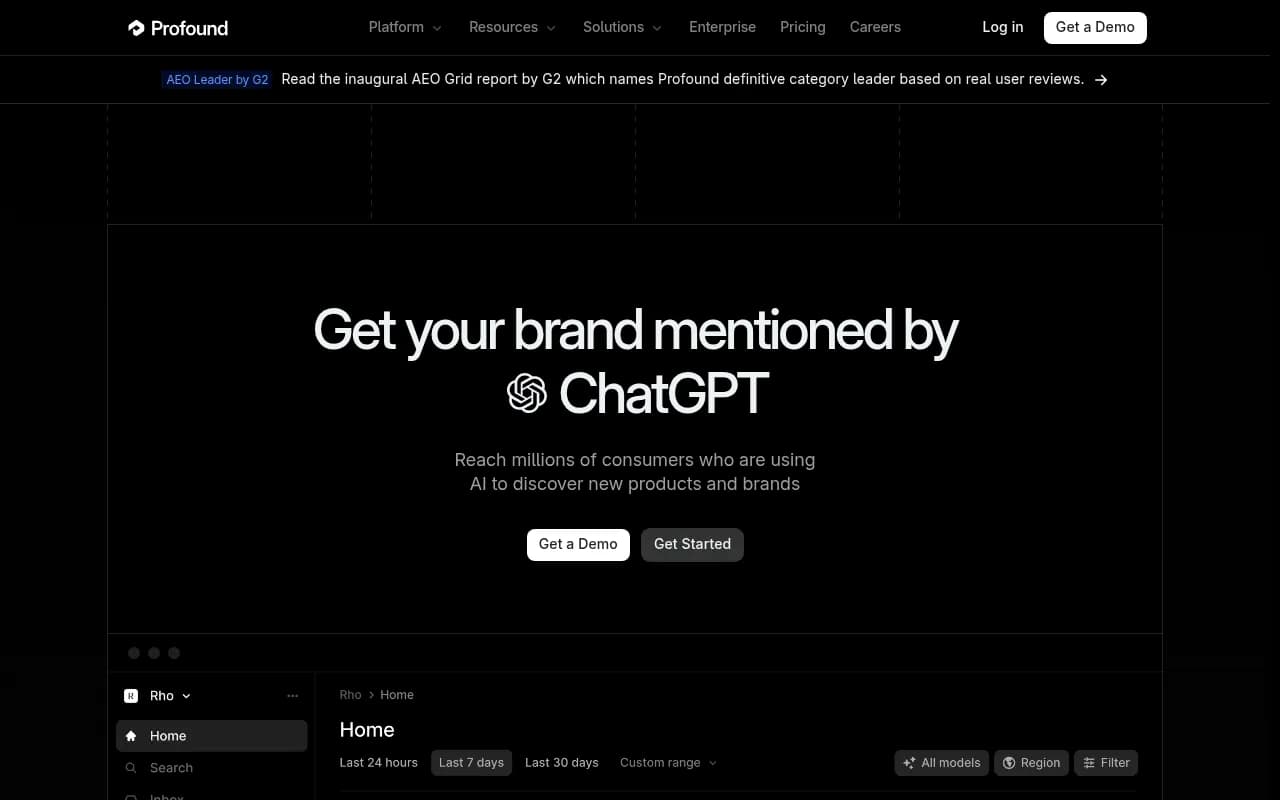
| Profound | ChatGPT only on Starter | Per domain/seat | Limited | No |
| Otterly.AI | 4 engines, others as add-ons | Per prompt | No | No |
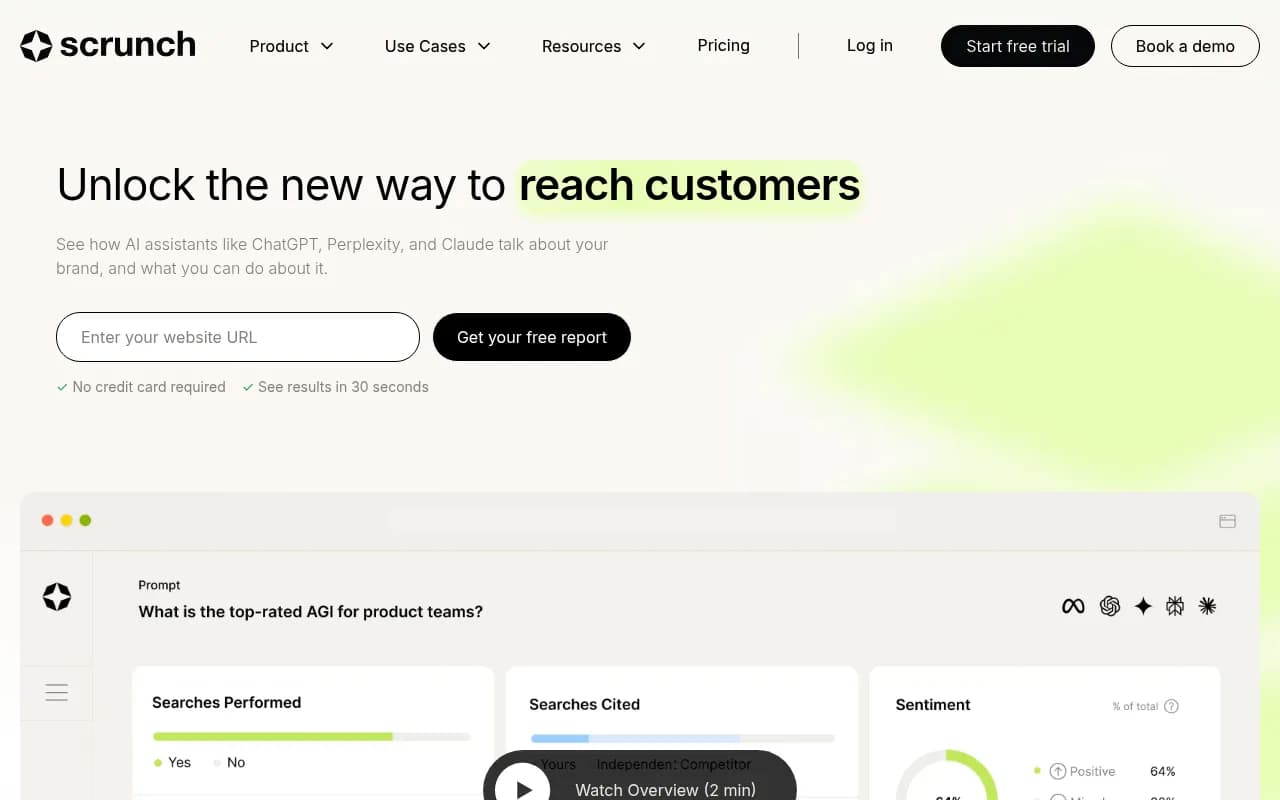
| Scrunch AI | 7 platforms incl. Meta AI | Per seat/prompt | Partial | Limited |
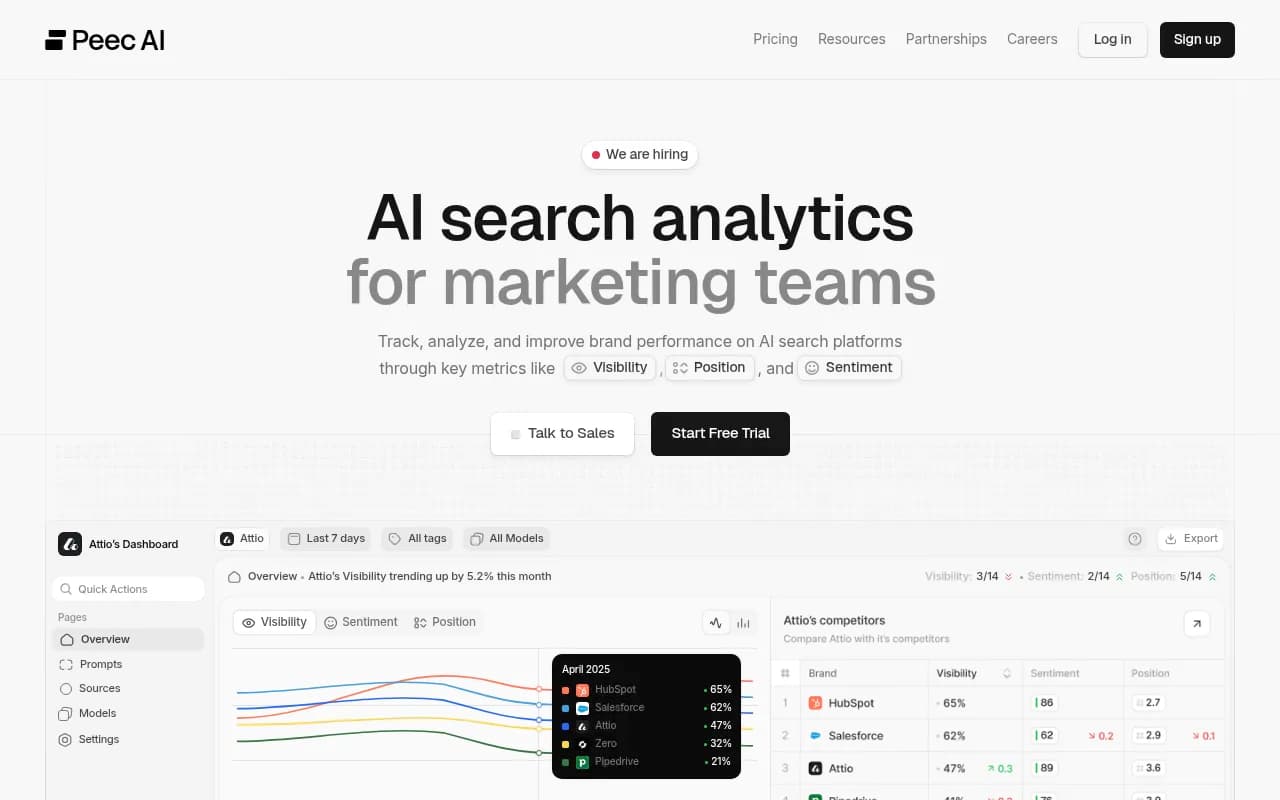
| Peec AI | Multiple, credit-pooled on agency tiers | Per credit | No | No |
| Semrush AI Toolkit | 4 engines only | Per domain | No | Basic |
Profound
Otterly.AI

Take the exact figures with a grain of salt; vendors adjust tiers constantly, and some of the above (like Scrunch's crawler coverage) sit in a gray area between "has it" and "has a version of it." Confirm live pricing and feature scope before signing, since this is exactly the kind of thing question 4 above is designed to catch.
Putting the checklist to work
Print the 12 questions, or better, turn them into a scoring sheet and run every vendor through the same questions in the same order. Score each answer 0 to 2 and total it up. You'll be surprised how fast a polished demo loses to a plainer dashboard once you force an apples-to-apples comparison on methodology, contract terms, and whether the tool actually helps you fix what it finds.
If you want to browse more of the category before narrowing your shortlist, the GEO software directory at bestgeosoftware.com lists a wider set of platforms worth scanning, and it's a reasonable second stop once you've run your top three or four candidates through this checklist. Whatever you pick, get the pilot period in writing and bring your own contract addendum to the signing call. The vendors worth working with will say yes to both.