Key takeaways
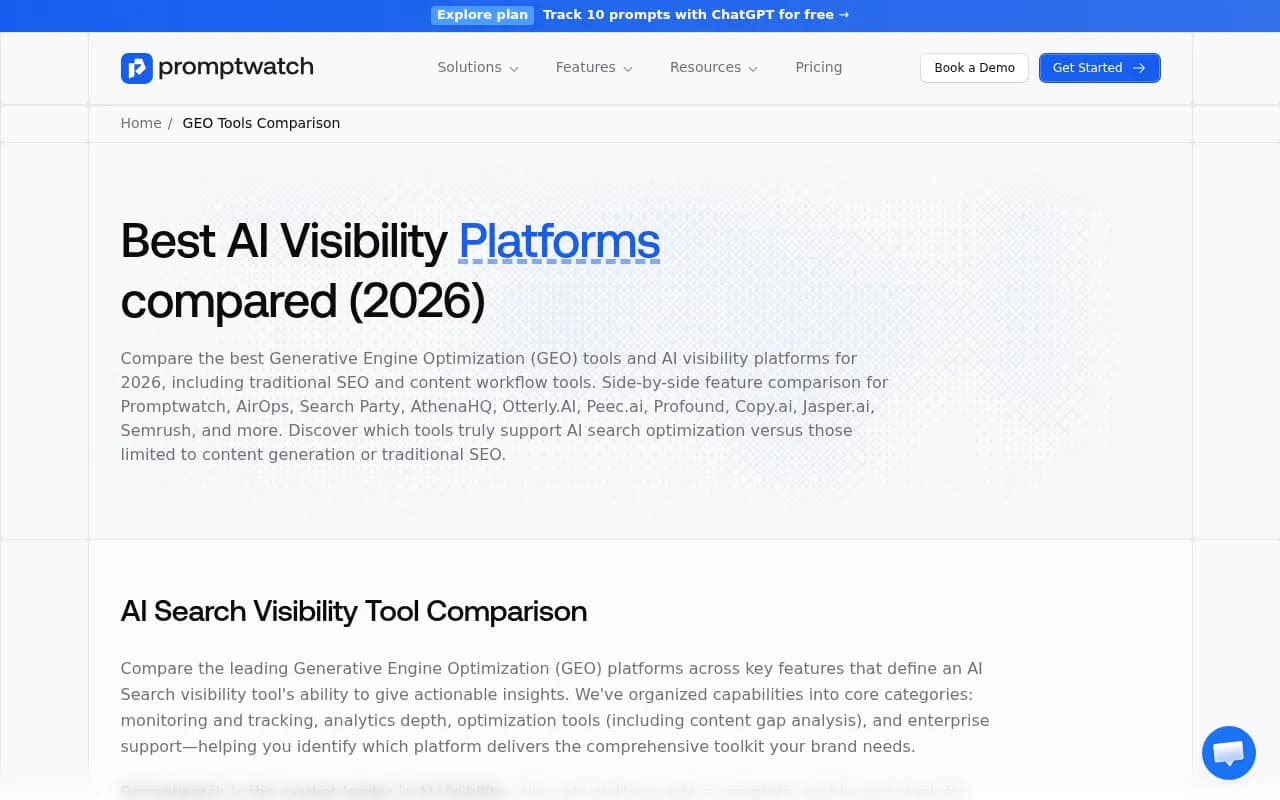
- Promptwatch is the only AI visibility platform rated "Leader" across all categories in a 2026 comparison of 12 GEO tools, including Profound, AthenaHQ, Otterly.AI, and Semrush.
- Most competitors are monitoring-only dashboards. Promptwatch closes the loop: find visibility gaps, generate content to fix them, then track the results.
- It monitors 10 AI models (ChatGPT, Perplexity, Claude, Gemini, Grok, DeepSeek, Copilot, Mistral, Meta AI, Google AI Overviews) with over 1.1 billion citations and prompts processed.
- Pricing starts at $99/mo for the Essential plan, with a free trial available.
- Independent reviewers consistently rate it the top pick out of 15+ AI visibility tools evaluated.
What Promptwatch actually does
AI search has changed how people find brands. When someone asks ChatGPT "what's the best project management tool for remote teams?" or Perplexity "which CRM is easiest to set up?", the answer they get is shaped by what AI models have read, cited, and decided to recommend. If your brand isn't in those answers, you're invisible to a growing share of buyers.
Promptwatch is built to fix that. It tracks where your brand appears (and doesn't appear) across 10 AI search engines, shows you exactly what content gaps are keeping you out of the answers, and gives you tools to create content that gets cited.

That last part is what separates it from the rest of the market. Most GEO tools will tell you your visibility score. Promptwatch tells you your score AND gives you a path to improve it.
How the platform works
The core of Promptwatch is what they call the action loop: find gaps, create content, track results. It sounds simple, but the execution is where most competitors fall short.
Finding the gaps
The Answer Gap Analysis is the most practically useful feature in the platform. It shows you which prompts your competitors are appearing in that you're not. Not vague topic areas -- specific prompts, with data on volume and difficulty.
So instead of knowing "we have low AI visibility in the CRM category," you know "we're not appearing when people ask 'what CRM is best for small sales teams?' and our competitor X is cited in that answer by ChatGPT, Claude, and Perplexity."
That's actionable. You know what to write.
The Prompt Intelligence layer adds volume estimates and difficulty scores to each prompt, plus query fan-outs that show how a single prompt branches into related sub-queries. This helps you prioritize -- go after high-volume, winnable prompts first rather than spending resources on prompts that are either too competitive or too niche to matter.
Creating content that gets cited
This is where Promptwatch genuinely differentiates itself. The built-in AI writing agent generates articles, listicles, and comparisons grounded in citation data from 880M+ citations analyzed. It's not generic AI content -- it's content engineered around what AI models actually cite.
The agent factors in prompt volumes, persona targeting, and competitor analysis. You can specify the audience (e.g., "marketing managers at mid-market SaaS companies") and the output is shaped accordingly.
For teams that have struggled to connect content production to AI visibility outcomes, this is a meaningful workflow change. You're not guessing what to write. You're writing what the data says AI models want to cite.
Tracking the results
Page-level tracking shows exactly which of your pages are being cited, how often, and by which AI models. This granularity matters -- knowing that your pricing page gets cited by Perplexity but not ChatGPT tells you something specific about what to optimize.
Traffic attribution closes the loop between AI visibility and actual revenue. You can implement it three ways: a code snippet, Google Search Console integration, or server log analysis. Each connects AI citations to real site visits and conversions.
Features that most competitors don't have
AI crawler logs
Real-time logs of AI crawlers (ChatGPT's GPTBot, Claude's ClaudeBot, Perplexity's PerplexityBot, etc.) hitting your website. You can see which pages they read, which they skip, errors they encounter, and how often they return.
This is genuinely rare. Most GEO platforms have no visibility into the crawling side of the equation. If an AI model isn't citing your best content, it might be because it's never crawled it -- and without crawler logs, you'd never know.
Reddit and YouTube insights
AI models frequently cite Reddit threads and YouTube videos in their answers. Promptwatch surfaces the specific discussions and videos that are influencing AI recommendations in your category. This tells you where to publish, what angles to take, and which community conversations are shaping how AI describes your space.
Most competitors ignore this channel entirely.
ChatGPT Shopping tracking
If you sell products, Promptwatch monitors when your brand appears in ChatGPT's product recommendations and shopping carousels. This is a relatively new AI surface that's increasingly influencing purchase decisions, and it's not tracked by most platforms.
Competitor heatmaps
A visual comparison of your AI visibility vs. competitors across different LLMs. You can see who's winning for each prompt and which models favor which brands. Useful for competitive strategy and for explaining AI visibility performance to stakeholders who want a simple visual.
Multi-language and multi-region monitoring
Monitor AI responses in any language, from any country, with customizable personas that match how your actual customers prompt. This matters for international brands -- a brand's AI visibility in German-language Perplexity results can look very different from its English-language visibility.
What independent reviewers say
The review from Lari Numminen at generatemore.ai is worth looking at. After evaluating 15+ AI visibility tools over six months, they rated Promptwatch their top pick with an overall 4.0/5.
The standout scores: 5/5 for multi-AI engine coverage, 5/5 for AI traffic attribution, and 5/5 for brand presence overview. The lower scores: 3/5 for data accuracy (no specific issues identified, but the reviewer noted it) and 3/5 for competitor analysis ("could have more ways to diagnose why competitors are visible per prompt").
The honest criticism from that review: Promptwatch has more UX bugs than other solutions, and the platform is developing fast enough that it can be hard to keep track of new features. These are real friction points, not marketing spin.
The Airefs comparison guide notes that US-based teams sometimes find the Amsterdam-based support team creates timezone challenges. That's worth knowing if your team is US-based and needs responsive support.
How Promptwatch compares to the main alternatives
| Platform | Monitoring | Content generation | Crawler logs | Reddit/YouTube | ChatGPT Shopping | Starting price |
|---|---|---|---|---|---|---|
| Promptwatch | 10 AI models | Yes (built-in agent) | Yes | Yes | Yes | $99/mo |
| Profound | 10+ AI models | No | No | No | No | $99/mo |
| AthenaHQ | Multiple models | No | No | No | No | Self-serve |
| Otterly.AI | Multiple models | No | No | No | No | ~$29/mo |
| Peec.ai | Multiple models | No | No | No | No | Varies |
| Semrush | Limited | No | No | No | No | $139/mo |
| Ahrefs Brand Radar | Limited | No | No | No | No | Included in plans |
The pattern is clear: most competitors are monitoring dashboards. They show you data. Promptwatch shows you data and helps you act on it.
Profound is the closest competitor in terms of comprehensiveness and is well-funded with G2 Leader status. But it doesn't have content generation, Reddit tracking, or ChatGPT Shopping monitoring. Otterly.AI is cheaper and has earned recognition (Gartner Cool Vendor 2025), but it's firmly in the monitoring-only camp.
For teams that want to track AI visibility and do something about it without switching between five different tools, Promptwatch is the most complete option available.
Here are some of the main alternatives worth evaluating:
Profound -- strong enterprise option with solid multi-model coverage:
Profound

AthenaHQ -- good for teams that need native GA4 and Google Search Console integrations:

Otterly.AI -- the most affordable entry point if you only need monitoring:
Otterly.AI

Peec.ai -- UI scraping accuracy and 115+ language support:

Pricing
| Plan | Price | Sites | Prompts | Articles | Key features |
|---|---|---|---|---|---|
| Essential | $99/mo | 1 | 50 | 5 | Core monitoring, 10 AI models |
| Professional | $249/mo | 2 | 150 | 15 | Crawler logs, state/city tracking |
| Business | $579/mo | 5 | 350 | 30 | Full feature set, multi-site |
| Agency/Enterprise | Custom | Custom | Custom | Custom | White-label, API, custom workflows |
Annual billing discounts are available, and there's a free trial. There's also a free Explore plan that lets you track 10 prompts with ChatGPT before committing.
The Professional plan at $249/mo is the sweet spot for most marketing teams -- it includes crawler logs (which are genuinely useful for diagnosing indexing issues) and state/city-level tracking for brands with regional visibility needs.
For context: Profound's equivalent plan starts at $399/mo. Otterly.AI undercuts Promptwatch's Essential plan, but you're giving up content generation, crawler logs, Reddit tracking, and ChatGPT Shopping monitoring.
Who should use Promptwatch
Promptwatch makes the most sense for:
- Marketing and SEO teams at brands where AI search visibility is becoming a meaningful traffic and revenue channel
- Digital agencies managing AI visibility for multiple clients (the Agency plan handles this)
- Any brand that's already tracking traditional SEO and wants to extend that into AI search without building a separate workflow
- Teams that want to move beyond monitoring into actual optimization -- creating content, fixing crawl issues, tracking attribution
It's probably overkill if you just want to check occasionally whether your brand shows up in ChatGPT. For that use case, a cheaper monitoring-only tool works fine.
The honest verdict
Promptwatch has earned its "Leader" positioning. The combination of monitoring depth, content generation, crawler logs, and traffic attribution is genuinely unique in the market. No other platform in the 2026 comparison offers all of these in one place.
The caveats are real: the platform moves fast and can feel rough around the edges, the UX has bugs that don't always have a clear resolution path, and US-based teams should factor in the timezone gap with support.
But for teams serious about AI search visibility -- not just tracking it, but actually improving it -- Promptwatch is the most complete tool available right now.