
Key takeaways
- These four tools are not like-for-like. Seology is a technical SEO fixer, Nuwtonic is an SEO plus GEO hybrid, Whitebox is an enterprise GEO and ChatGPT ads platform, and Promptwatch is a full visibility and content platform.
- "Autonomous" means different things in each product. Seology's GitHub fixes still need a pull request merge, Nuwtonic fixes reportedly happen with approval, and Whitebox's enterprise site audit is implemented by a specialist.
- Seology starts free and tops out at $99/mo, but it does not measure AI citations at all. Nuwtonic runs $99 to $199/mo on credits. Whitebox has no public paid tier. Promptwatch runs $95 to $579/mo.
- If you need to know whether a fix worked, you need tracking, crawler data and traffic attribution next to the fixing. Only some of these tools have all of that.
What "autonomous fixes" actually means in GEO
Every vendor in this space now says its agents "fix" things for you. I have read enough of the pricing pages and product docs to say the word is doing a lot of work. A fix can mean a pull request waiting in your GitHub repo. It can mean an article drafted into a review inbox. It can mean a consultant on the vendor side doing the implementation. Those are three very different things to buy.
A useful way to sort them is by four jobs: measure AI visibility, diagnose why pages get skipped, fix the gap, and verify the fix was picked up. Most tools do one or two well. The question is how many of the four you get in one subscription, and how much human sign-off sits between a finding and a published change.
This guide compares four platforms that all claim some version of the fix step. One note on disclosure: this site is published by 1001 SEO Media, which uses Promptwatch as its own GEO platform, so Promptwatch is included and I have tried to be specific about where the others are the better fit.
The four platforms at a glance
| Platform | What it really is | AI visibility tracking | Fix mechanism | Entry price |
|---|---|---|---|---|
| Seology | SEO-first AI agent that audits a URL and ships fixes | No (says so itself) | GitHub pull requests, Shopify updates | Free, then $29/mo |
| Nuwtonic | Agentic SEO + GEO platform on Search Console data | Yes, credit-based prompt limits | On-page fixes, content generation, with approval | $99/mo |
| Whitebox | Enterprise GEO and ChatGPT ads platform | Yes, weekly refresh on Enterprise | Content generation, ads optimization, specialist-led audits | Free tier, then custom quote |
| Promptwatch | AI visibility and GEO platform with a content agent | Yes, 12+ AI platforms from real interfaces | Content Agent drafts and publishes to the CMS | $95/mo |
Prices come from each vendor's own pricing pages as gathered during research. Confirm current numbers before you buy.
Seology: the technical fixer
Seology positions itself as an AI SEO agent. You point it at a public URL, it audits the page, and it turns findings into fixes. The examples on its site are the unglamorous ones: meta descriptions, broken links, schema markup, image alt text and canonical tags.
To its credit, Seology is honest about scope. Its site says the audit scores are not keyword rankings or AI citation measurements, and that AI search inclusion is not guaranteed. So this is not a GEO tracker. If you buy it, you still need something else to find out whether ChatGPT or Perplexity cites you.
How the autonomy works
There are three execution modes. Plan mode, where you approve one batch of fixes, is on every plan. Approve mode (sign off on each fix) and Automatic mode (it applies safe fixes itself) are limited to Growth and Scale. Automatic and Approve modes come with a 90-day rollback and a full change log, though rollback coverage depends on the fix type and the saved before-state.
The connectors are narrow. Self-service covers GitHub and Shopify only. On GitHub, fixes arrive as pull requests that you review, merge and deploy, so even the "hands-off" story ends at your merge button. On Shopify, updates run on the store permissions you authorize. If you run WordPress, Webflow or Framer, this is not available to you yet.
Pricing
| Plan | Price | Sites | Fixes per month | Notes |
|---|---|---|---|---|
| Starter | Free | 1 | 200 | 30 AI actions, Plan mode only |
| Growth | $29/mo | Up to 3 | 3,000 | All modes, API access |
| Scale | $99/mo | Up to 10 | 15,000 | White-label reports, 10 users per site |
One caveat from the research: the activity feed on its site, including a task labeled "Reviewing FAQ structure for AI search", is explicitly simulated. Treat it as a demo, not evidence of GEO results.
Best for: small Shopify or GitHub-hosted sites that want cheap, bulk technical cleanup. Skip it if you need citation data.
Nuwtonic: the SEO and GEO hybrid
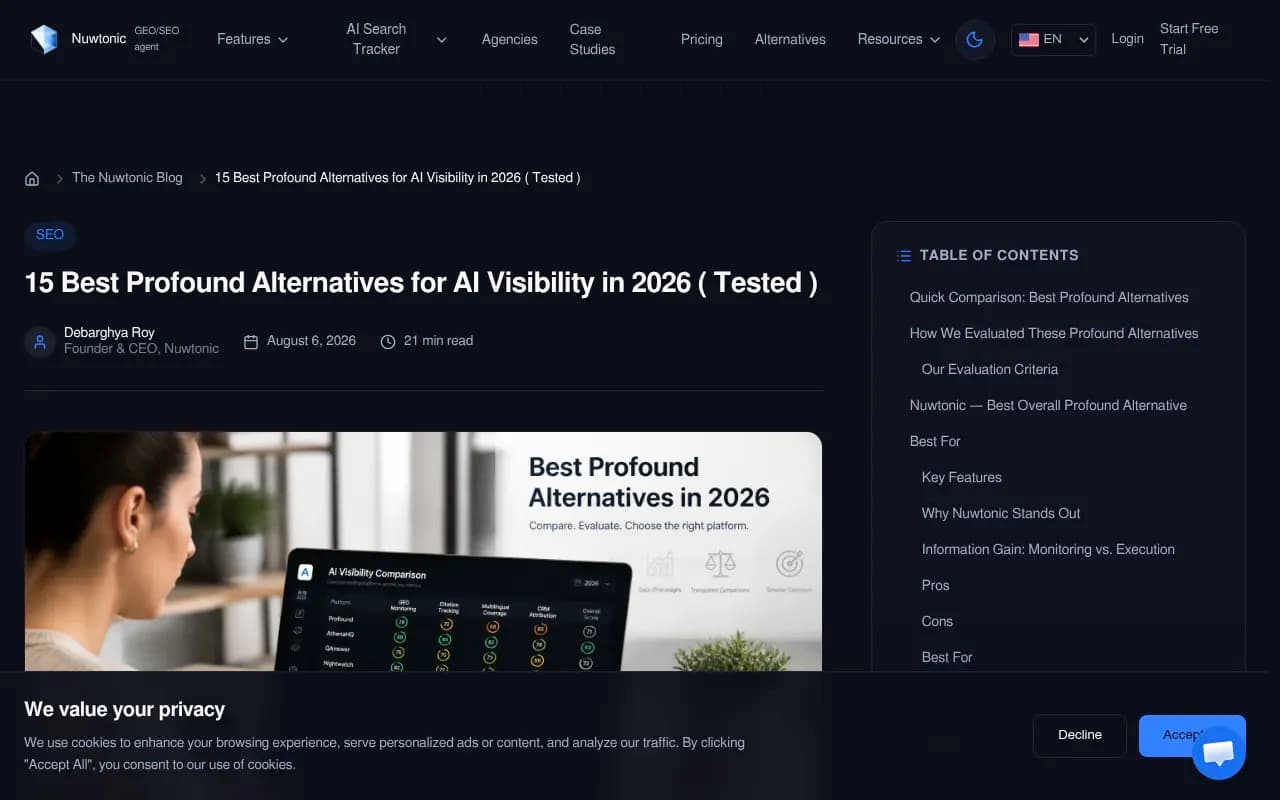
Nuwtonic bills itself as an agentic SEO and GEO platform. It pulls in Search Console data, runs on-page audits and fixes, generates content, and tracks AI visibility, all in one credit-based product. The pitch is that you stop juggling a monitoring tool, a technical SEO tool and a writing tool.
Pricing and credits
| Plan | Price | Domains / seats | Credits per month | AI prompts tracked |
|---|---|---|---|---|
| Bronze | $99/mo | 1 / 1 | 1,200 | 15 |
| Silver | $199/mo | 5 / 3 | 2,400 | 60 |
| Gold | Custom | 15+ / 10+ | 7,500+ | 200+ |
Yearly billing gives two months free. Full AI content generation costs 150 credits, advanced SEO/GEO optimization 100, and a GEO/AI search audit 5. Some things are included without touching credits: 30 agentic action items, on-page audits and fixes (150 per month on Bronze, 500 on Silver, 1,500+ on Gold), Search Console keyword tracking, topical maps, white-label reports, and citation and competitor monitoring.
Do the math on Bronze. 1,200 credits is eight full articles at 150 each, and that is before you spend any on optimization runs. Tracking 15 prompts is also thin for GEO, where one product category can easily need dozens of prompts across personas and intents.
How autonomous is it?
Nuwtonic's own alternatives page says competitors lack "autonomous CMS execution", which implies it has some. But a user review on its pricing page says fixes happen "with approval", and I could not verify which CMSs are supported. Read that as approval-gated automation until you confirm the integration for your stack during the 7-day trial.
A few other things to know. Bronze live tracking covers ChatGPT, Claude, Perplexity, Llama, Grok and Google AI, with all models on Silver and Gold. There is a 7-day money-back guarantee, and up to 10% transaction fees may apply depending on payment method. Its site claims a 4.8+ rating across 213+ reviews, which is vendor-reported. Lifetime deals on AppSumo exist too, but the price is inconsistent across sources ($69 on one page, $59 in a review), so verify before buying.
Best for: small agencies and SaaS teams that want SEO and GEO under one roof and are happy to work within a credit budget.
Whitebox: enterprise GEO with a ChatGPT ads angle
Note the domain: the GEO platform is thewhitebox.io. There are several unrelated products with similar names, including a geospatial tool, so check the URL before you start a trial.
Whitebox covers visibility tracking with competitor benchmarking and source attribution, sentiment analysis, and automated content generation for on-site content, Wikipedia edits, UGC platforms and affiliate partnerships. Its most distinctive feature is ChatGPT ads optimization: an Opportunity Map, campaign management, rules, A/B tests and ROAS measurement. None of the other three have anything like it as a built-in workflow.
Pricing is a two-tier story
| Tier | What you get |
|---|---|
| Free | One ChatGPT visibility report, 15 prompts, 1 competitor, 1 market, 10 AI chat messages per month, 1 article in total, 5 tracked URLs |
| Enterprise | Custom quote. ChatGPT, AI Overviews, AI Mode, Gemini, Claude, Grok and Naver, weekly data refresh, MCP server, success manager, fact-check and brand-check on articles, GEO campaigns |
There is no public self-serve paid plan. That alone rules it out for a team that wants to swipe a card on a Tuesday and start fixing pages.
Where the autonomy stops
The Enterprise website audit is "reviewed and implemented by our specialist." That reads as a managed service rather than autonomous execution. Nothing wrong with that if you want someone else to own the work, but it is a different thing from software that fixes pages on its own. Also note the weekly refresh cadence: if you are running a launch or a campaign, a weekly number is slow.
Best for: large brands that want a vendor-managed program, and anyone seriously experimenting with ads inside ChatGPT.
Promptwatch: tracking, crawler data and a content agent
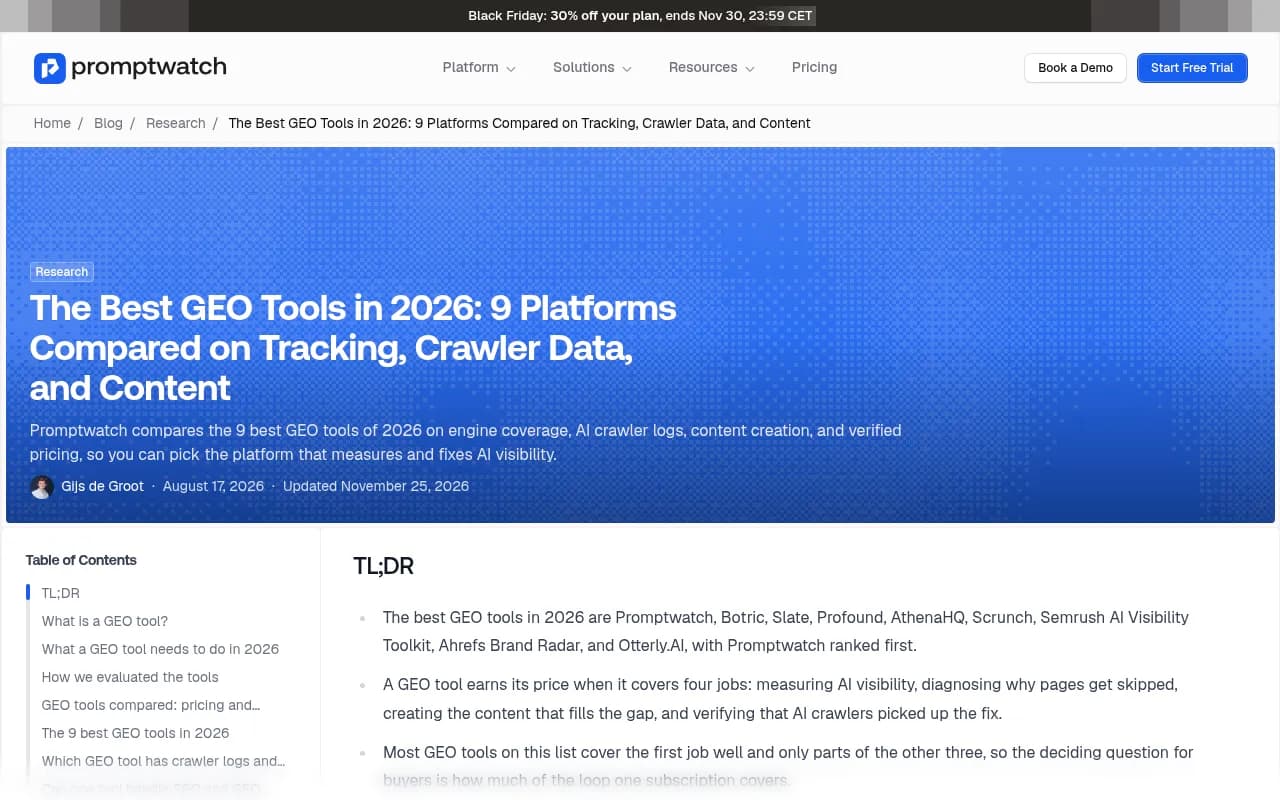
Promptwatch sits at a different point in the spectrum. It is an end-to-end AI visibility platform: it tracks how brands appear across ChatGPT, Gemini, Claude, Perplexity, Google AI Overviews, Google AI Mode, Copilot and more, using the real interfaces of those engines rather than only API calls. Then it traces where the answers come from, acts on the gaps, and measures the result.

The fixing side
The fix step is the Content Agent. It plans, writes and publishes content against your visibility gaps, then pushes it to WordPress, Webflow or Framer on a schedule you control, with a review inbox or fully hands-off. Content gap analysis maps your pages against the prompts AI answers, an Action Board lists prioritized to-dos, and Content Refresh proposes git-diff-style updates for existing pages. For the more hands-off route, there is Agentic AI Search Optimization, included with Business.
That is a different kind of autonomy from Seology's. Seology edits technical elements on pages you already have. Promptwatch finds the prompts where you are absent and creates the pages that AI could cite.
The verification side
This is where I think the gap with the other three is widest. AI crawler logs show IP-verified visits from GPTBot, ClaudeBot, PerplexityBot and others, which pages they read, and what errors they hit. Visitor analytics then show whether the page sent AI-referred traffic and conversions. So you can tell an access problem from a content problem, which no fixing tool can do without that data.
Crawler access matters more than people assume. Promptwatch Data's AI crawler traffic report (IP-verified requests, June 8 to September 6, 2026) found OpenAI made up 79.8% of verified AI crawler requests in the week of August 31 to September 6, down from 94.8% in June 8 to 14. The report's advice is practical: check robots.txt, CDN and WAF rules for every major AI crawler, and compare your own logs against that mix. A provider that is large in the chart but near zero in your logs suggests you are blocked or unreachable for it. A tool that rewrites your meta descriptions will not catch that.
Pricing
| Plan | Price | Prompts | Responses per month | Notable inclusions |
|---|---|---|---|---|
| Essential | $95/mo | 50 | 6,000 | 500 Agent Credits, no crawler logs |
| Professional | $245/mo | 150 | 18,000 | 25M crawler logs, 5 AEO articles |
| Business | $579/mo | 350 | 42,000 | Content Agent, Fact Check, hourly tracking option |
Agencies have separate plans from $199/mo. Confirm current numbers at promptwatch.com/pricing; there is a 7-day free trial on monthly billing. The honest downside: the automated Content Agent starts at Business, so the cheapest tiers are measurement and manual workflows, not autopilot. And Promptwatch does not do Seology-style bulk technical edits to your templates.
Best for: teams that want to see AI visibility, fix content gaps and prove the result in one place. For a head-to-head view against other tools, the 2026 platform comparison is the place to start.
Side-by-side: what each one automates
| Capability | Seology | Nuwtonic | Whitebox | Promptwatch |
|---|---|---|---|---|
| AI visibility tracking | No | Yes (15 to 200+ prompts) | Yes (Enterprise, weekly) | Yes (50 to 350 prompts, daily or faster) |
| Technical on-page fixes | Yes, core feature | Yes, 150 to 1,500+ per month | Specialist-implemented | Site audits flag issues, no bulk template edits |
| Content generation | Not a focus | Credit-based, 150 per article | Yes, incl. Wikipedia and UGC | Content Agent (Business) with CMS publishing |
| AI crawler logs | No | Not documented | Not documented | Yes, IP-verified (Professional and up) |
| AI traffic attribution | No | Not documented | ROAS for ChatGPT ads | Yes, visitor analytics |
| Approval controls | Plan, Approve, Automatic | Reportedly with approval | Specialist-led | Review inbox or hands-off |
| Public self-serve pricing | Yes | Yes | Free tier only | Yes |
Where a cell says "not documented", that means I found nothing in the public pages, not that the feature definitely does not exist. Ask the vendor.
How to choose
Pick Seology if the problem is technical hygiene
You have a Shopify store or a GitHub-hosted site, hundreds of pages with missing alt text or broken schema, and a small budget. Pair it with a separate tracker.
Pick Nuwtonic if you want one cheap tool for SEO and GEO
You are a small team and want Search Console data, content generation and light AI tracking together. Watch the credit math and test the CMS connection during the trial.
Pick Whitebox if you are enterprise and want it managed
You want a vendor team involved, and ChatGPT ads are on your roadmap. Be ready for a sales process and weekly data.
Pick Promptwatch if you need to prove the fix worked
You want tracking across the AI engines, crawler evidence, content creation and traffic measurement connected. Start with the free AI visibility report to see where you stand before committing.
Combining tools
The tools are less competitive than the marketing suggests. A reasonable stack for a Shopify brand might be Seology for technical cleanup plus a visibility platform to measure the result. If you want to browse further options, the GEO software directory lists a much wider field, and Promptwatch's Data reports are worth reading before you decide what to optimize for.
Questions to ask any vendor before you buy
- What does a fix touch, and who clicks the final button: you, the tool, or a human on their team?
- Which CMSs are supported in self-service today, not on the roadmap?
- How do I roll back a bad change, and for how long?
- How will I know a fixed page was crawled, cited and clicked?
- What is the data refresh cadence, and does it come from real AI interfaces or APIs?
- What happens to my credits or quota when I run out mid-month?
The bottom line
None of these four is fully autonomous in the sense the word implies. Seology stops at a pull request, Nuwtonic reportedly waits for approval, and Whitebox hands the audit to a specialist. Promptwatch publishes through your CMS with a review inbox you can switch off. The better question is which one closes the loop for your situation. If you can only afford one subscription and you care about AI citations, choose the one that measures them. If your pages are technically broken, fix those first with the cheapest tool that does it safely.